

Hooked, p.1
Hooked,
p.1
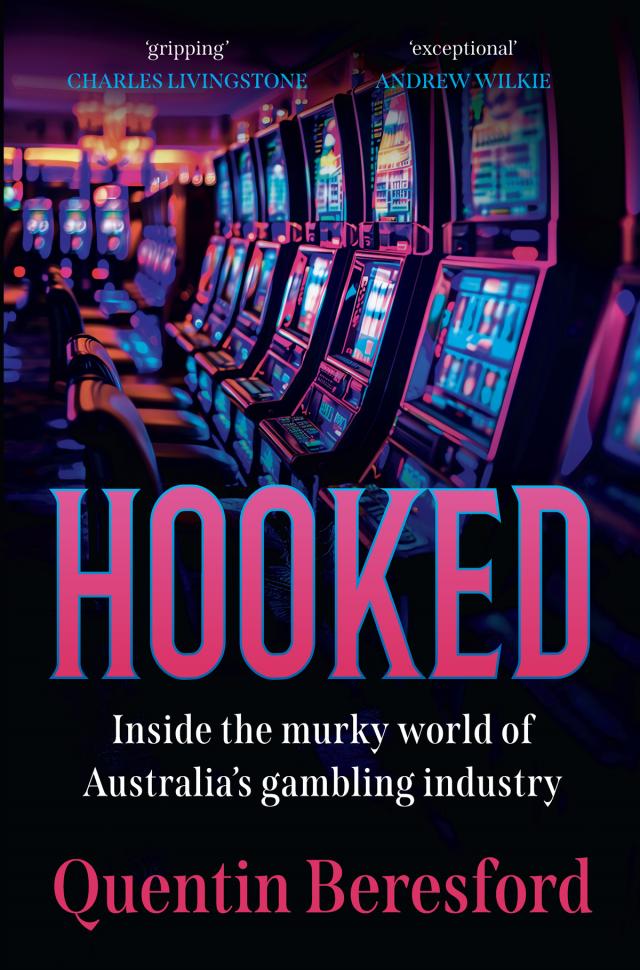


HOOKED
Quentin Beresford is the author of The Rise and Fall of Gunns Ltd, Adani and the War over Coal, Wounded Country: The Murray– Darling Basin, a Contested History and Rogue Corporations: Inside Australia’s Biggest Business Scandals, as well as Rob Riley, a renowned biography of the Aboriginal activist. He is Adjunct Professor at the University of the Sunshine Coast.
‘Gambling is one of the key drivers for preventable harm in Australia. It can cause family breakdowns, neglect of children, physical and mental health problems, financial catastrophe, increased rates of crime and family violence and, in too many cases, suicide. Yet the gambling ecosystem – bookies, pokie pubs and clubs and casinos – keep getting away with it all. The power and connections of gambling operators, and their fellow travellers, are poorly understood. This book provides a gripping account of how the gambling ecosystem grew to be Australia’s version of the NRA. It documents the history, ruthlessness and power of this avaricious business, and its continuing ability to keep governments on side. Anyone who wants to understand how the gambling business operates needs to read this.’
Charles Livingstone,
Associate Professor, Monash University
‘Quentin’s latest book is an exceptional account of the history and predatory behaviour of the gambling industry. Its detailed mapping of the cancerous effect on governance and sport is especially alarming. But at the same time, it’s a powerful acknowledgement of all those people who suffer in the clutches of the executives who run and profit from these companies.’
Andrew Wilkie,
independent federal MP
HOOKED
Inside the murky world of Australia’s gambling industry
Quentin Beresford
UNSW Press acknowledges the Bedegal people, the Traditional Owners of the unceded territory on which the Randwick and Kensington campuses of UNSW are situated, and recognises the continuing connection to Country and culture. We pay our respects to Bedegal Elders past and present.
A NewSouth book
Published by
NewSouth Publishing
University of New South Wales Press Ltd
University of New South Wales
Sydney NSW 2052 AUSTRALIA
https://unsw.press/
Our authorised representative in the EU for product safety is Mare Nostrum Group B.V., Mauritskade 21D, 1091 GC Amsterdam, The Netherlands (gpsr@mare-nostrum.co.uk).
© Quentin Beresford 2025
First published 2025
10 9 8 7 6 5 4 3 2 1
This book is copyright. Apart from any fair dealing for the purpose of private study, research, criticism or review, as permitted under the Copyright Act, no part of this book may be reproduced by any process without written permission. Inquiries should be addressed to the publisher.
ISBN 9781761170256 (paperback)
9781761179334 (ebook)
9781761178603 (ePDF)
Cover design Luke Causby, Blue Cork
Cover image Creative_Bringer/Adobe Stock
Internal design Josephine Pajor-Markus
Printer Griffin Press
All reasonable efforts were taken to obtain permission to use copyright material reproduced in this book, but in some cases copyright could not be traced. The author welcomes information in this regard.
This book is printed on paper using fibre supplied from plantation or sustainably managed forests.
CONTENTS
Introduction
1 The pokies palaces
2 The mafia comes to Australia
3 Vegas Down Under
4 Money, mateship and power
5 Crown unplugged
6 The rise of the pokies super-rich
7 The death of gambling reform
8 Capturing the state
9 The online revolution
10 Running for their lives
11 High rollers, private jets and bags of cash
12 Albo ducks for cover
Conclusion
Acknowledgements
Notes
Bibliography
Index
INTRODUCTION
Australians love to gamble. It’s in our blood, we’re endlessly told. So why write a book that questions one of the nation’s favourite pastimes?
It started with an epiphany of sorts. A while ago, I arranged for my young grandson to watch his first AFL game with me. I set up the telly and the comfy chairs in my study well in advance of the game. When I switched on the TV, I was hit by an avalanche of gambling ads. Previously I’d found them annoying but just ignored their silly depictions of male bonding over betting. But in the company of my grandchild, the ads took on a darker meaning. Was I helping groom him into betting by letting him watch one imbecilic ad after another?
Like many parents across the country, I was incensed about football getting into bed with the gambling industry. I rang the AFL the following Monday and asked to speak to an executive. Our exchange was revealing. I asked how he felt about the infiltration of gambling ads into the telecast of AFL. He gave me the corporate answer: by increasing the funding of the game, it had expanded its professionalism.
I found his answer trite and shifted the conversation to the personal: did he have children? It turned out he did: a 16-year-old son. What, I asked, did he say to his son about the gambling ads that flood the footy broadcasts? ‘I warn him about the dangers of gambling,’ he admitted. Such compartmentalisation of the personal and the commercial was a disturbing insight into the corporate mindset that was running Australia’s biggest sporting code.
That conversation took place ten years ago. Since then, the quantity of gambling ads has exploded. The public still hates them but governments haven’t found the courage to ban them. Corporate power has ruled. The conversation I had with the AFL executive smouldered at the back of my mind.
A new era of deregulated gambling commenced with the legalisation of poker machines in New South Wales in 1956 and their widespread distribution into a newly expanded clubs industry. But the era didn’t really kick into gear until the construction of Crown Casino in Melbourne in the mid-1990s. The massive complex, bigger than any Las Vegas casino, followed a protracted debate about whether a casino was in the public interest. Business interests prevailed. But the fate of Crown in Melbourne says much about the themes I explore in this book: the murky world linking powerful owners and politicians, the infiltration of national and international criminals, and the rise of gambling addiction.
So how did we get here?
Taking on the modern gambling industry means coming face-to-face with the national mythology. Gambling, of course, has formed part of Australia’s national identity; a passion for gambling arrived with the First Fleet. Most of the convicts transported to the colonies came from cities where gaming houses were common and the consumption of liquor turned many into drunkards; they were ‘hardened alcoholics and inveterate gamblers’.1 In the colonies, horse racing quickly became the biggest vehicle for gambling; by the late 19th century there was a racetrack in every major country town. But early on gambling was associated with underground activities, notably ‘starting price’ (SP) bookmakers, casinos and early forms of poker machines.
Australia’s fondness for gambling produced a strong counter-reaction during the late 19th and early 20th centuries. Protestant moralists railed against its so-called social evils, as they did against prostitution, alcohol and illicit drugs. The moralists were commonly derided as ‘wowsers’ or killjoys.
By the turn of the century, their efforts to crack down on gambling had paid off. Between the early 1900s and the late 1950s, Australia undertook one of the most ambitious attempts at social engineering anywhere in the world: a war to eradicate gambling in a nation where it was common and popular. All forms of gambling other than betting at racecourses were banned. Greyhound racing, when it emerged in the late 1920s, was a notable exception.
Predictably, forms of gambling designated ‘illegal’ persisted, often under the noses of the authorities: SP bookmaking, two-up, poker machines and baccarat all thrived. In response, police harassed, fined and sometimes jailed ordinary Australians.2 Not surprisingly, the political system was corrupted.
The embrace by later governments of mass release of poker machines and the construction of mega-casinos consigned the era of prohibition to the dustbin, but new, serious problems have emerged.
Australia’s gambling industry has developed on an industrial scale, hoovering up $32 billion a year in punters’ losses. That’s the latest estimate of total gambling losses – the net amount lost after accounting for any winnings.3 Per capita, it’s more than $1500 – a figure that rises to almost $2500 each if those who never gamble are excluded. It’s the largest per head gambling loss in the world. Our expenditure on gambling has been described as a ‘hidden black hole’ in household budgets.4
The figure of $32 billion in losses was first published in 2024 and was widely covered in the press with barely disguised shock. SBS said it represented ‘social harm on an industrial scale’.5 For money magazine Savings, the staggering losses said something about the stupidity of the country’s embrace of gambling. ‘Want to bet how bad Australians are at gambling?’ it asked.6
The data reveals the extent to which gambling has been translated into a form of mass entertainment. What’s the problem if a new generation of Australians under 35 like to hit the pub, play the pokies and place some bets on their phones with their mates while watching multiple screens showing horse racing, greyhounds, and local and overseas sports? In individu
al cases not much, perhaps, but the overall statistics tell a different story. It’s a story that includes crime, corruption, addiction, bankruptcy and mental ill health – the dark side of Australia’s mega-gambling industry. The industry pushes the line that no more than 1 per cent of Australians are affected by ‘problem gambling’. But the reality is much different.
In this new, deregulated era, gambling corporations have promoted the idea of gambling as a natural extension of Aussie mateship. And it has normalised sport as a vehicle for betting. How did the industry pull off such a cultural shift? Not surprisingly, big egos and big money lie at the heart of the answer. As this book shows, the combining of sport and gambling has had disastrous consequences for many punters and for society at large.
There are big questions that need to be asked. How does society manage gambling? When does gambling stop being a relatively harmless form of entertainment and become a societal problem? What happens when big business gets its teeth into gambling? How is the public interest served when corporations use advertising and technology to expand the culture of gambling? Is it right for governments to rely so heavily on taxes generated by gambling?
While in this book I look critically at the politics of ‘Big Gambling’ – by which I mean the alliance of the industry and governments – I avoid condemning gambling outright. So do today’s gambling reformers, who are often erroneously portrayed as prohibitionists, as if we’re still living in the 19th century. It’s a political tactic, of course.
But what of the line between gambling as entertainment and social problem? Renowned 20th-century British economist John Maynard Keynes wrote that gambling was fine if it was ‘frivolous’ – by which he meant that losses should be small relative to a person’s budget. Keynes’ objection to gambling in Britain in the 1930s was that it led to losses of large amounts of money.7 In scale, opportunities and accessibility, Australia’s gambling industry today is larger by many orders of magnitude than the British equivalent of Keynes’ time. And as we’ll see, today’s gambling corporations are utterly dismissive of Keynes’ sensible construct.
A critique of gambling involves treading a fine line. As a legitimate business, gambling operators are concerned with making profits. But the industry also exploits human weakness if allowed to operate in unethical ways. I argue that gambling has been allowed to develop a predatory business model; it seeks to maximise profits that can too often inflict individual and societal harm. Of course, not every single operator – or every gambling corporation – involved in gambling behaves in this way, but it is common enough to speak of predatory gambling as a systemic problem. As gambling researcher and expert, Emeritus Professor Mike Daube told a recent parliamentary inquiry, ‘we have known for decades that the commercial gambling industry in Australia and overseas is predatory’, because ‘the primary focus of this industry is to make as much money as possible from gamblers, knowing with certainty that the odds are stacked against the gambler, and that gamblers will suffer harm as a consequence’. Similarly, the Gambling Treatment and Research Clinic at the University of Sydney informed that same inquiry about the ‘impact of predatory gambling and gambling marketing’.8
The staggering growth of the gambling industry is no accident. It is ideologically driven. Most gamblers probably don’t give a toss about this but it doesn’t make it any less real. Gambling as big business embodies the neoliberal vision of modernity, with its emphasis on lightly regulated free markets; the right of individuals to make their own choices; the creation and promotion of new sources of consumption, especially around the commodification of leisure; the advent of ‘technologies of distraction’; the hyped emphasis on corporate profits and shareholder returns; and the synergy between governments and corporate interests.9 In ‘late capitalism’, profits often come before people.10
As partners in the gambling industry, governments have wilfully overlooked the dark side of the industry, while at the same time allowing it to grow so big that it has captured governments at state and federal levels. This ranks as one of the biggest failures of public policy in Australia in the last 20 years, as political power has been used to stymie gambling reform. Big Gambling seems to have become an industry too big to fail, and too powerful to adequately regulate.
This is the story I set out to tell – in the hope that things might change.
1 THE POKIES PALACES
on the night of 20 November 1954, several sticks of gelignite were tossed onto the roof of Aristocrat Leisure, a manufacturer of poker machines. Owned by entrepreneur Len Ainsworth, the inner-city Sydney factory would have been flattened except that some of the sticks didn’t ignite. One of Ainsworth’s employees, Joe Heywood, lived next door to the factory and, on hearing the explosion, telephoned his boss.
When he arrived at the factory, Ainsworth was confronted by a scene straight out of a crime movie: a jostling crowd, ambulance drivers, police and journalists. Luckily, no one was injured and Ainsworth’s stock of newly produced machines was undamaged. But the police issued him with a stern warning: ‘Buy a shotgun and put chicken wire on your windows. You’re in the big time now, son.’1
Ainsworth had stepped into an industry that was eagerly watched by organised crime. One rival, Raymond Smith, had hired notorious Sydney underworld crime figure Len McPherson to blow up Ainsworth’s factory.2 Smith himself had a criminal pedigree – he was the son of James ‘Shark Arm’ Smith, a Sydney crook who was murdered and whose tattooed arm was thought to have been regurgitated later by a shark, sparking a lurid but unsolved murder mystery.3
In a savage twist, Smith reneged on the deal to pay McPherson his full fee of £100 000, arguing that the man hadn’t finished the job. Not long after, Smith found his brand-new American car blown up outside his house; presumably McPherson was the culprit, and this time he’d perfected his detonation technique.
It was in encounters such as this that Sydney’s underworld met the eagerness of the post–World War II generation for new forms of leisure.
In 1954 the number of club licences in New South Wales was greatly expanded, and in 1956 poker machines were legalised. Up until that time, poker machines were illegal in NSW other than in private clubs. However, police raids occurred at regular intervals when machines found their way into cafes, guest houses and hotels. These were seized and destroyed.
With these two measures, the state embarked on a revolution in entertainment. Lavishly built community-based clubs were given the sole rights to install poker machines for their largely working-class patrons. In this partnership between government and industry, Big Gambling was born. Embryonic as the industry was in the 1950s, both sides saw merit in the partnership and worked continually to expand its scope.
‘Leagues clubs’ had arisen following the creation of rugby league in the early 1900s. At the time, as Gemma Chilton writes, ‘most social clubs in Australia were either for professionals such as engineers, Masons or for the wealthy horse racing fraternity’. Organisers of the new rugby code saw a need for social clubs for their growing numbers of followers. Clubs were no longer the province of stuffy, male elites, who guarded their privacy and gambled with impunity, including on poker machines.4 From the mid-1950s, the leagues clubs developed a new and dynamic model, offering working Australians a level of glitzy entertainment few could ever have imagined. Within five years of the legalisation of poker machines, clubs had fundamentally changed the social fabric of New South Wales.
The clubs themselves became an industry, and an unregulated one at that.5 Clubs, according to one gambling expert, ‘subordinated their social agenda to economic interests’ and grew wealthy on the back of poker machines.6 In fact, it was the not-for-profit model of the clubs that drove this shift. Not-for-profit organisations – as the name signifies – cannot distribute profits to their stakeholders; funds must be ploughed back into the operations – in this case, further amenities and services. Clubs built ever more opulent facilities, attracting an ever-greater number of potential gamblers, who were offered ever more poker machines. Management rewarded themselves accordingly.7 Pubs, by contrast, remained stuck in the past: men and women there were still socialising in separate rooms for years.


