

And one more thing, p.1
And One More Thing,
p.1
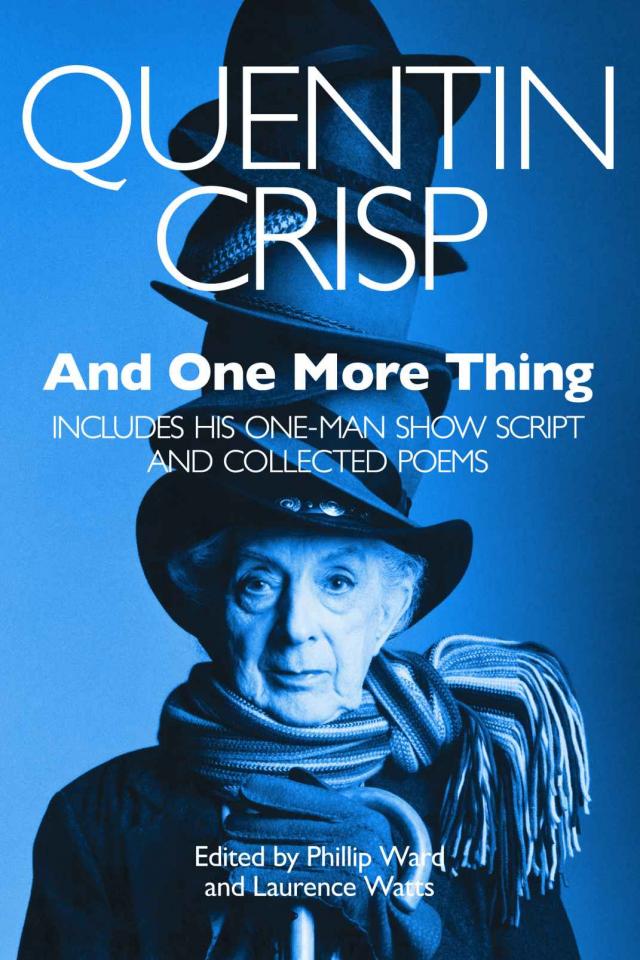


And One
More Thing
Quentin Crisp
Edited by Phillip Ward
and
Laurence Watts
© 2018 Phillip Ward
All rights reserved.
Front cover photograph by Joseph Mulligan
ISBN: 0692168095
ISBN-13: 978-0692168097
CONTENTS
Foreword
Pg 1
1
Supermodels, Fashion and Beauty
Pg 5
2
Children
Pg 14
3
Shoppers
Pg 23
4
Friends
Pg 26
5
People Who Work
Pg 39
6
Flapper Girls and Walt Disney
Pg 47
7
The Religious Right
Pg 55
8
Americans
Pg 65
9
Bill, Hillary and Monica
Pg 82
10
The British Royal Family
Pg 88
11
Australians
Pg 96
12
Philosophers and Human Beings
Pg 100
13
Married Couples
Pg 105
14
Drag Queens and Performers
Pg 111
15
Homosexuals
Pg 117
16
Television Hosts
Pg 122
17
The Alternative Christmas Message
Pg 126
18
Apology
Pg 132
19
Collected Poetry
Pg 135
20
An Evening With Quentin Crisp
Pg 165
21
A Conversation with You-Know-Who
Pg 184
Bibliography
Pg 186
About The Author
Pg 189
FOREWORD
YOU MAY BE FORGIVEN FOR thinking that 2017’s The Last Word – the third and final installment in Quentin Crisp’s autobiography – was his last book. After all, in it he states that, “This will be the last book that I shall write. My swan song, if you will. A chance for me to have the last word.” Quentin was, of course, absolutely right. The Last Word was his last book. And yet so is this.
When my co-editor, Phillip Ward, and I sat down to edit the manuscript that he and Quentin had produced after many hours of interviews and dictation, we reasoned that it was best split into two works. The Last Word was to be the first – in which Quentin summed up his life, his approaching death, and his philosophy – and the second is this, And One More Thing, in which Quentin primarily shares his views on other people, their lives and their views.
And One More Thing is not a book of continuous prose. It is not meant to be. Instead, it contains the final musings and thoughts of Quentin that we could not fit into The Last Word. We present them here as vignettes, alongside his collected poetry, his apology, the transcript of his ‘Alternative Christmas Message’, and the script of his one-man show.
The material for this book was dictated by Quentin to Phillip Ward in sessions that took place in the two years before his passing (1998-1999). In his advanced age, Quentin would frequently veer off subject. Such material didn’t fit into the narrative of The Last Word, so we include it here, fearful that leaving it unpublished would be doing a disservice to Quentin’s legacy.
In the ‘vignettes’ section you will find Quentin talking about all manner of people from flapper girls to Monica Lewinsky, and from the British Royal Family to Walt Disney. Some subject matter will be familiar to fans of Quentin while others will be new.
Next, we include the texts of his infamous apology to the gay community and his Alternative Christmas Message. The original Christmas Message, sometimes inaccurately called the Queen’s Speech, is an annual address by the British monarch to her subjects, broadcast on Christmas Day on the BBC. Quentin was the first person chosen to make an unofficial address, also broadcast on Christmas Day, on Channel 4, which began in 1993 with Quentin and continues to this day.
Then we present the collected poetry of Quentin Crisp. He wrote a good many poems. Those included here have been collected by Phillip Ward from a variety of sources. Quentin always meant to include his poetry in his final literary work, and a good deal of effort was made by him in trying to recall his poems in the last years of his life.
Lastly, we include the transcript from the scripted element of Quentin’s one-man show An Evening With Quentin Crisp. This transcript was made by Phillip Ward, based on Quentin’s performance of the show in New York City in 1999, and was edited and rewritten by Quentin. It is therefore the version he would have performed in England later that year. Of course, Quentin was never able to perform it on tour in England that year, passing as he did on November 21, 1999, not long after touching down in Great Britain. Quentin was ninety years old.
There is beauty in And One More Thing as well as a sense of completeness. If there are errors, please consider these ours and not Quentin’s. Our motivation in compiling this book has been to ensure that fans of Quentin have access to as much of his previously unpublished work as possible.
Laurence Watts & Phillip Ward
December 2018
VIGNETTES
1. Supermodels, fashion and beauty
Previously I have stated that, had I been born a woman, I would not have wanted to have been particularly beautiful or striking. That would have attracted too much of the wrong kind of attention, which would have in turn necessitated, or at least demanded, more of me physically than I have ever been willing to give another person.
I am not certain however that, had I been female, my sense of fashion would be any different from what it is now.
People have, at different times, described my look as flashy. It is no such thing. It is merely the product of what clothing has been gifted to me over the years. I never shop for clothes. I am not fashionable. The pronouncements I have made on style come not from an adherence to fashion, but from a practical disconnection from it that enables me to observe others.
That being said, I confess I have never understood women’s desire to be fashionable. It is such a waste of time, which is why I personally eschew it. But they run towards it. They want it urgently. Fiercely. If short skirts are ‘in’, they rush home and shorten their skirts or they buy them in overpriced stores.
A woman once told me of her dilemma. She said: “You think you’re impervious to fashion. When the fashion for short skirts arrives, you think, ‘I shan’t do anything about it. I shall wear long skirts.’ But within about two days, you can feel your skirt flapping about your ankles. And in some way, you are affected to want to be fashionable.”
Thus, women are ‘victims’ of fashion. But why are men not victims of fashion? I suppose certain men are. Actors for example. But they are not affected to the same extent that women are. Women are mortified when they are caught wearing something that is not fashionable.
Make no mistake however, fashion is not equal to style. It exists instead of it. When you don’t know who you are, you consult the glossy magazines. Then, all we know when we see you coming down the street is that you had enough money to buy Vanity Fair. That’s not what style is. Style is not stylishness. The latter of the two words has been corrupted nowadays to mean something else.
If you base your style on glossy magazines you can, of course, adapt the current style to yourself. You can make use of it and remain the same. But there can be all sorts of problems. Can you wear very short skirts if you have terrible legs? That’s something you really have to make up your own mind about. Women, after all, want to be attractive regardless of the current fad.
When short skirts above the knee came in, I was horrified to see them sported by women with legs like horses. They looked horrifying, but nevertheless they still wore short skirts and presumably considered themselves to be fashionable. It’s a three-way war: how to be attractive, how to be yourself, and how to be fashionable. It’s a very difficult equation.
And it’s arbitrary because the fashion industry is, of course, really governed by the manufacturers rather than designers. There is an industry surplus of wool and so wool becomes fashionable. Some new type or color of fabric is invented and so that becomes fashionable. All of a sudden shops are flooded with brown - light brown, dark brown, and so on. But why wear it if brown isn’t a color that emphasizes your best features and detracts from your faults?
These days supermodels have overtaken superstars in popularity. I think this is because they are nearer to us. Superstars live ‘over there’ in Hollywood, which is at a distance from most Americans. Otherwise they are only depicted on the silver screen, through which one cannot hope to get their attention. By contrast, supermodels are walking up and down catwalks only a few feet away from us. They appear more accessible. Superstars could only do the equivalent with hordes of security guards to assist them.
And supermodels are so thin. Impossibly thin. So thin that clothes can be put on them in just a matter of seconds. Because without anyone thinking about it, they go off stage, smiling, someone takes hold of them, rips their clothes off and puts new clothes on them. Then they go back on the catwalk again. But because they are so thin not
hing ever gets torn.
I’ve never seen anything work on the catwalk that someone could wear in real life. I once saw a model walking down the catwalk with her hands on her breasts to prevent them jumping out from her dress. Then there was another woman with a backless bead costume down to the end of her spine. If she had turned a quick turn, the whole thing would have fallen off. At another show there were women with fringes on the front of their shoes. In any real-world setting they would be forever saying, “You’re standing on my fringe! Thank you.” Of course, they all looked beautiful, but everything was always so impractical. My suspicion is that, once the fashion show is over, the designers collect up all the fabric that’s been displayed, take it back into the workroom and remake it into real clothes for everyday people.
I remember once meeting Vivienne Westwood, who was quite extraordinary. I didn’t know who she was initially, but after we were introduced it became apparent that I knew her in a time gone by. We met during New York Fashion Week. Her collection was good, but the show was not. It was a bit untidy, a bit awkward. There was a great mock stone entrance for the girls to enter by, which unfortunately meant that they had to stoop down in order to enter. And that sort of spoiled everything. You can’t really creep onto the catwalk. What kind of an entrance is that? But the clothes were good. And the clothes were more realistic than they are at most shows.
Ms. Westwood’s clothes were made of wool. Alas, the models had horrible hair, which detracted from rather than enhanced the look of the clothes. I don’t know why they did that. They all looked like they had just got out of bed. And there were various mistakes in the show as well that were obvious to onlookers. Those are the worst kind of mistakes. There was no passing them off as deliberate actions.
I am told Ms. Westwood is very, very rich. So, I suppose all the effort that goes into these shows, her collections and her public persona is worth it. But I don’t think I would wear any of her fashion. Principally, of course, that is because all of her designs are for women, but there is also an aesthetic judgement I am making. Yes, her clothes were more acceptable as street clothes than a lot of the other shows I have seen, but they nevertheless weren’t my kind of style. I’m sure she’s not worried. I don’t think I am the kind of person she is designing for anyway. I shouldn’t be as I never buy anything.
I can see why she’s successful though. If fashion shows are meant for buyers, then I could see how a buyer would look at her collection and say “I could sell that in my shops.” Too often it seems as though fashion shows are meant for something else entirely. They seem to be more of a way to get your name known to everybody, with outlandish photos in the newspapers and stunts meant purely for shock value. And if this truly is their purpose they are a poor form of live entertainment.
Ms. Westwood has a husband. He is a young man and when I met him he was wearing a black kilt. He seemed very nice. He was there at the show and he was at the party afterwards. He didn’t say anything, not to me or anyone else. But at both the fashion show and the afterparty, even though both were such great to-dos, no one ever said very much. I’m guessing he was about thirty years old. She’s about fifty. A very spritely fifty though, and with hair the color of breakfast food. And she’s very unassuming. In spite of all her fame and wealth, she wasn’t flinging herself about but behaving in a very circumspect way.
Another time I saw a Todd Oldham show, which, though very efficient and very beautiful, was totally impractical. Absolutely nothing worn on the catwalk that night could be worn by real people. I said to my companion, who sat next to me for the show, “Could any of these girls get into a taxi wearing any of these clothes?” He didn’t think so. It was all too much. Too over the top.
But Mr. Oldham’s show was very efficient. There were always two girls on the catwalk, one coming and one going, and always walking very fast. They had to walk quickly because they had to fit the show into just three-quarters of an hour. So, the models strode forward, they twitched in front of the cameras, and then they scuttled quickly backstage. It was almost Germanic in its execution.
The fashion industry proves that beauty is most definitely not in the eye of the beholder. Beauty is in the eye of the possessor. A woman who feels beautiful can convince other people that is what she is. The fashion industry revolves around this point. And I think it’s a point that applies particularly to women. Men aren’t supposed to care whether they’re beautiful or not. I think they do, but they’re supposed not to. But women are allowed by society to bask in their beauty. And if they feel they are beautiful, they have a relaxed sort of glow which spreads all around them.
Of course, people say that beauty is in the eye of the beholder because some will find beauty in others whom no one else thinks is beautiful. But such situations ignore the general consensus of what makes someone beautiful. It’s easy to create a list of these attributes, but these are essentially the commonalities you see between models and television and film stars. I don’t know how we’ve come to have a universal view of what is beautiful but, by whatever process it is, it’s also true that every age has had a different view of what beauty is.
The previous age to ours admired women with sloping shoulders and rather large arms, so that you couldn’t see the elbow or the wrist. Consequently, all the women wore dresses that best displayed these qualities, if they had them. And they had smooth necks, small hands, small feet, small waists and wide hips. These days, of course, in order to be considered beautiful you’re meant to be stick thin, straight up and down.
From time to time, I’m asked if I have any beauty tips. I do not. My only advice is rather general, which is that you should keep on applying make-up until you look the way you want to be. Then you should stop. The mistake that people make is to pile on more and more make-up as you get older. This is a great mistake. You don’t end up looking younger from this kind of heavy application, you end up looking like other old people who are trying equally as hard to look young, which is to say you look old. You actually need less as time goes by, not more.
I’ve also been asked my opinion on tattoos, which to me is a form of bodily disfigurement rather than enhancement. I have never been able to fathom why anyone would wish to have his or her body permanently spoiled and scarred by a tattoo artist, but it is a practice that is increasing in popularity here in America, and one that a great number of women have now also decided to undertake.
When I had any pride in my body, I wanted it to be totally my own. Not disfigured by strange mottos or rudimentary sketches of fish or birds. Of course, now that I am old, ‘the great tattoo artist’ has marked my skin in all sorts of unpleasant ways. I think my own reluctance to get a tattoo, when perhaps I was closer to the right age for one, was that such an action was too manly a practice to suit my idea of myself.
Tattooing was originally done by sailors who wished, for some unknown reason, to be identified should they wash up on a foreign shore. But now that nobody washes up on a foreign shore, I think tattooing has just become a sort of a peer-group test. Most tribes have tests for would-be warriors, and I think getting a tattoo has become a modern-day equivalent. It’s a test of endurance, because the application of a tattoo is painful. The less you flinch at the pain the more manly you are considered I would imagine, or something like that anyway.
You see, in primitive life when the tribe was perpetually threatened either by nature or by some other tribe, everybody had to be strong. Everyone had to be ready to take up their arms, or whatever it was that they fought with, and fight. They didn’t want anyone who was going to turn and run away. So, that’s why they had these rites of passage. Nowadays the motivation of peer pressure within groups of friends, which are our modern equivalent of tribes, is less obvious. It seems more like herd mentality to me.


