

The last word an autobio.., p.13
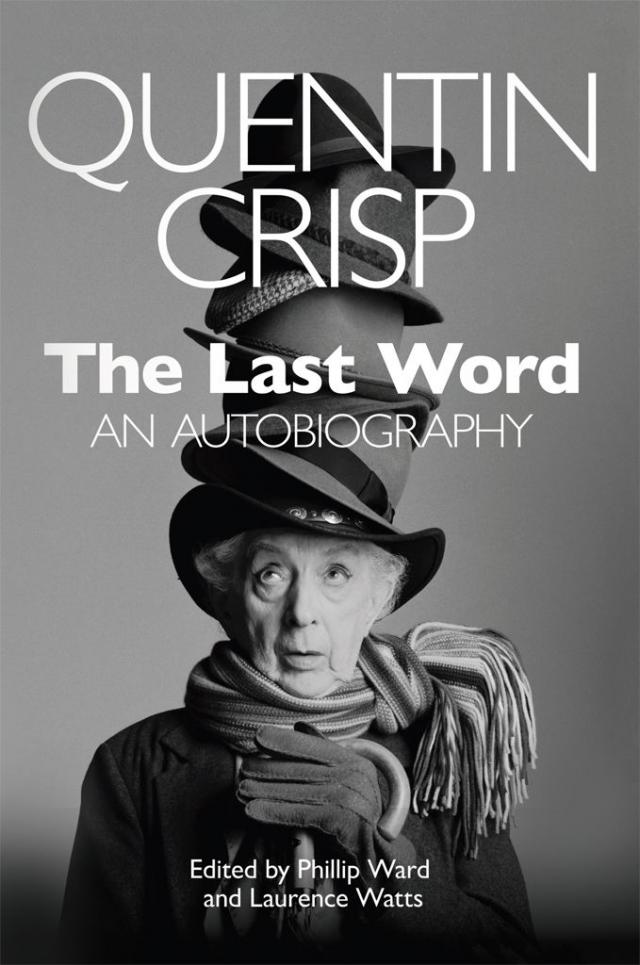
The Last Word: An Autobiography,
p.13


I don’t know if I have any stage presence. I certainly try. I try to enter very slowly, this somehow allows you take in your audience without doing anything or saying anything. There are certain people who occupy the stage when they come on. Mr. Pavarotti had it. Ms. Bankhead154 had it too. She arrived on stage and everyone of course went mad and screamed and shrieked and clapped. She looked as though she enjoyed it, that she was grateful, and that she was at your service in some way. That’s what you try to do. If you’re not careful though you do it when you enter rooms, which of course is a sin.
Other than for my one-man show, the only other time I’ve been on stage was when I played Lady Bracknell in the Importance of Being Earnest155 on a small stage where I could be heard simply by raising my voice. It was a production in a dim cellar on Mercer Street, and I was offered the part having only been in America for about eighteen months.
It wasn’t a pleasant experience because it took place during a very hot August in a theatre with no air conditioning. All you could hear was the fluttering of programs throughout the show as people wafted them about, trying to keep cool. I, of course, was dressed up like a dog’s dinner.
It was actually the first and only play I’ve acted in since I was a child. Playing Lady Bracknell is a very easy part because it’s short and showy. You can hardly do it wrong. Her lines are funny on their own so you don’t have to point them out or make them funny. They just are. These days I couldn’t be in another play because I would never be able to remember the lines.
* * *
135 Richard Gollner, who became Quentin’s agent when Donald Carroll, 1940-2010, returned to the U.S.
136 The Kings Head Theatre
137 1975’s The Naked Civil Servant, directed by Jack Gold
138 Possibly the manager of The Mayfair Theatre
139 Brian Norman Roger Rix, actor, activist and one-time producer at Cooney-Marsh Ltd. which owned the Duke of York’s Theatre, 1924-2016
140 The British trade union for actors
141 Vanessa Redgrave, English actress and political activist, b. 1937
142 Equivalent to union membership
143 A play by Agatha Christie that has been running in London since 1952.
144 Hillard Elkins, Producer, 1929-2010.
145 Michael Bennett, American musical theatre director, writer, choreographer, and dancer, 1943-1987
146 Julie Harris, five-time Tony-award winning American actress, 1925-2013
147 A 1979 play by Ernest Thompson, later a film.
148 Charles Durning, American actor, 1923-2012
149 Maureen Stapleton, American actress, 1925-2006
150 Directed by Sam O’Steen, 1975
151 In 1991
152 A play by William Luce, American writer, b. 1931
153 Joan Collins, English actress, b. 1933
154 Tallulah Bankhead, American actress, 1902-1968
155 By Oscar Wilde – see footnote #77
CHAPTER 13
The Naked Civil Servant
The Naked Civil Servant156 may have been the most successful book I’ve ever written but it wasn’t the first book I had written. There were others. Chiefly these were handbooks on lettering or window dressing. The Naked Civil Servant was the first book of mine to cause any kind of stir however.
I did write a satire called All This And Bevin Too157 when Mr. Bevin158 was the Minister of Labor in England. It was a continuous limerick about an unemployed kangaroo, but it was a thin little book with a paper cover that caused no sensation whatsoever.
The people who caused me to write The Naked Civil Servant, the story of my life, can be said to have been the greatest influences in my life. It was Mr. O’Connor’s159 radio interview with me for the BBC’s160 Third Programme161 that started it all. I was one of a series of hooligans Mr. O’Conner interviewed. He knew a lot of us because he himself was a regular visitor to Fitzrovia back in the 1930s.
Then, as luck would have it, a literary agent by the name of Mr. Carroll heard my interview with Mr. O’Connor and suggested I write a book about my life experiences and philosophy. I had originally wanted to call the book I Reign In Hell, referencing Milton’s162 line in Paradise Lost163 but Mr. Carroll was having none of it. Though he was a Milton fan, he thought the reference164 too obscure, the word ‘reign’ too pretentious and believed having the world ‘Hell’ in the title would scare people away. He thought The Naked Civil Servant was a much more intriguing title and that, I am glad to say, is what we went with.
The publication of The Naked Civil Servant by Jonathon Cape Ltd.165 did not mark a huge turning point in my life however. Nowadays, historians say the book was a bestseller at the time. It was no such thing. It sold its edition which if memory serves was about three thousand copies, but that was not enough to make it a bestseller. Had it sold thirty thousand it would still not have been a bestseller. It would have taken sales of more like three hundred thousand in order to be a bestseller. What publication did however, was slowly get the ball rolling.
Reviews for The Naked Civil Servant weren’t altogether bad and sales were further helped by a documentary about me that was made by the talented Mr. Mitchell166 for Granada Television.167 It was this broadcast that was seen by my friend Mr. Haggerty and which sparked an idea in his head for a film.
Mr. Haggerty introduced me to a man called Mr. Mackie168 whom I helped write a screenplay based on my book. Our original idea was to turn it into a movie, but we had trouble getting interest from film studios despite an early interest and commitment from Mr. Hurt to play the role of me.
Eventually Thames Television picked up The Naked Civil Servant and the rest, as they say, is history. Mr. Haggerty imagined it, Mr. Mackie wrote it, Ms. Lambert produced it, Mr. Gold169 directed it and Mr. Hurt played the lead role. I am incredibly indebted to these people because they were the way in which I came not just to America, but the way in which I came before the public. After The Naked Civil Servant was broadcast in England170 and later in America,171 Mr. Hurt became my official representative here on Earth.
But, as I stated at the beginning of this chapter, The Naked Civil Servant was not the first book I had written. It was my fourth. My first two books, one on calligraphy172 and another on window dressing,173 were written more than thirty years before when I was in my late twenties.
At the time, I worked in the art department of a printer who printed the handbooks put out by the Blanford Press which wrote books about sign writing, window display and everything else connected with pictorial advertising. Blanford Press were based on Blanford Street which was a turning off of Baker Street in London. They paid me to write both books and because of this I’ve only ever written the books I was told to write. I’ve never sat in my room thinking, “I will write a book,” because I wouldn’t have the self-assurance.
As a graphic artist, I created book covers, but I don’t remember all the book covers that I did. I can remember a book called Freemasons’ Guide and Compendium174 for which I did a cover. I think it contained a T-square and a pair of dividers that I arranged in a pattern. I did the less important books as well as the ones that sold principally on their covers like romances, thrillers and westerns.
You see, the latter of these book types sold on the book-stands in mainline railway stations. While waiting for their train, a passenger will say, “I’d better have something to read on my journey.” Then they see a book with a gun on it with fire coming out of the end of it, which of course never happens, and they think, “That looks like a good read.” Or else they see a darkened cover and a torch focused on some false teeth lying on the ground and they think, “Oh, that looks exciting. I’ll buy that.” Or they see a girl with red hair with her shoulder strap broken being lifted up in the arms of a man and they think, “Oh, how romantic. I shall buy that.”
In order to create an effective cover, you need to know what kind of a person would buy the book you’re designing for. You rapidly learn to skim through a book rather than to read it to see what kind of person the story is intended for.
If you’re flicking through and the author says, “Her eyes filled with tears and her breasts rose and fell,” you know it’s for men. This would require a cover featuring a woman with long, wavy red hair. Had the book been written for a female market it would have said, “Her eyes filled with tears and her bosom rose and fell,” this would necessitate a cover featuring a dark-haired woman. If the book hadn’t mentioned the crying woman’s breasts at all, it would be for children. In this case you draw a cover with a woman with straight, short, muted blonde hair. Those are the basic rules of how you do covers for books.
A Barbara Cartland novel would of course require a romantic proposition. As such, an embracing couple in eighteenth century costume might be appropriate with the man always taller than the woman. The woman might be leaning on his chest and looking up at him and he would be looking down at her. He would be clean-shaven, with clear, cleft features and probably be in uniform.
In Colour in Display I endeavored to suggest chiefly that if you are dressing a window it must have a prevailing color. You can’t have a window dressed in red, blue, and green because it doesn’t work. You have to have a window which, from a long way off, you can see is a blue window. That way passersby think, “I wonder what it’s like.” Then they come and look at it. I also impressed upon my readers, not that there would have been very many, that you should never make your displays more spectacular than the thing or things you are displaying.
I also said that the maximum point of interest lies in the maximum point of contrast and that the greatest contrast is not between black and white but between black and yellow. This is because black and white are contrasted in color, but not in glow. Yellow, on the other hand, is a vibrant color while black is a negative color. That’s why the contrast between the two is the greatest there is.
I explained that window displays need a contrast in size. This means that the ideal display contains a little bit of yellow and a black background. That attracts everybody. I arrived at all this purely by thinking about it. I wrote it all up and made it a book for which I was paid sixty pounds. That was a lot of money for me back then.
I felt considerably less proud of my previous book, Lettering for Brush and Pen, principally because I didn’t understand the subject at all. It was great fun to write because it was an adventure of sorts, but the end result was, as far as I was concerned, unsatisfactory. That was for Frederick Warne & Co.175 and I only earned eight pounds from it.
All in all, I worked for the printing company for four years. That’s my record and about all I can stand working for anybody. Or about as long as anyone can stand me. I survived working for Harrap’s176 for two and a half years. During that time I must have done one book cover at least once a fortnight (or every two weeks, in American). So I must have done an enormous number in all. About one hundred and twenty or so, I should imagine.
They were of things like A History of Fireworks177 or French Made Easy, or they were sort of documentary books or dark romances. The romances were given to outside artists. They would return great blotchy paintings, the type where at first glance you can’t see what anything is, but if you hold it in a particular way it looks like a man with a beard looking out across the horizon. Such effects were well beyond my meager capability. I can only paint in a very clear style, which is often my undoing because if I do it wrong, it’s easy for everyone to see that it’s wrong.
I didn’t keep any of my drawings and paintings. I did keep them for a while when I lived in London because I needed to show them to people to get more work. I sent a lot of them to Harrap’s when I applied for the job in their studio. After they saw them they said, “Yes, come and work for us.” So they knew in advance that I did book covers. Moreover they knew how long I took and how much I charged for them.
Book covers were the only kind of work I did by then. I didn’t do any advertisements. Typically I used poster paints which are more of less watercolor paints. They are solid and they have the quality of oil paints but are soluble in water. Back then I think everyone used them. They dry much lighter than they are when wet, which is their difficulty. This meant that if you painted something red, by the time the paint had dried it would end up being pink. You had to take this into consideration when using them.
At the printing company I first worked for a man called Mr. Drake. Then he left. He hated the job and he hated his boss. When he left he said, “I ought to give you some words of advice but I can only say keep on doing what you’re doing because it is obvious to me you don’t give a damn.”
I smiled and nodded.
Then I worked with another man who was a complete fraud and didn’t do any work. He went out and sold his own drawings and came back at four o’clock not having been in the office all day. After that, I worked alone before finally I was given my own assistant, which made me feel very grand. I can’t remember her name, but she was from Australia and she was very nice. When I eventually left, the foreman said, “Oh, thank God. I was wondering what we were going to do with you.”
I left to go to the National Trade Press which was a firm that published trade books. I was only there for about three months because it was so cold I couldn’t stay in the office. I don’t know why it was freezing. The others didn’t seem to mind it. There were five other people working there, but I was the only one who was frozen. I became a freelancer after that. I liked freelancing. When you are freelance, either you can’t think how to fill in your time or else you are rushed off your feet.
I don’t miss painting. I couldn’t paint in the room I’m in now. The light isn’t strong enough, my hand is no longer steady and my eyesight is very weak. I suppose I could still do line drawing if I could find my drawing board. It’s around somewhere. I’d also need drawing pens, pins and a piece of paper. It would be a bit of an upheaval, really.
I have always written books under the name of Quentin Crisp. I’ve been Quentin Crisp since I was about twenty-six. I would say the books were written just after the name Quentin Crisp was given to me. I have no regrets about changing my name. It’s been very useful. People are saddened though when they learn it isn’t my real name which, I suppose, shows that they thought it fitted me adequately.
My real name is Denis Pratt which I was quick to get rid of. It was changed for me by people I knew. I wouldn’t have done it otherwise. I haven’t got the self-confidence. I’ve accepted it now and because other people have accepted it, it seems more appealing. When I accepted it in spite of other people, it was difficult to maintain.
My surname was actually given to me by a man called Mr. Palmer who ran a café in Camden Town. He was sympathetic to my cause and the two of us were friends for a time. One night I was sitting with him on his bed eating supper when he asked me to telephone the café he owned. I asked him why and he said it was because he was sure his staff shut up and went home when he wasn’t there to watch them.
Since I always do what I am told, I proceeded to telephone the café in question, only to Mr. Palmer’s and my surprise someone answered the phone at the other end. They asked me what I wanted. Panic-stricken I turned to Mr. Palmer and said, “What do I want?”
To which he prompted, “Ask if I’m there.”
So, I said, “Is Mr. Palmer there?” Obviously he wasn’t. He was with me.
“No,” they said, “but I will tell him that you called. Who should I say was calling?”
Thinking that I shouldn’t give them my real name I turned to Mr. Palmer once more and asked, “Who am I?”
And calmly he said, “You’re Mr. Crisp.”
I forgot all about the incident, but was reminded about it later in the week. Mr. Palmer had kindly said I could have a meal at his café any time I was passing. So, later that week I ventured to take him up on his offer and made my way to his café. When I arrived and asked, “Is Mr. Palmer here?”
“No, Mr. Crisp,” came the reply, “I’m afraid he’s not.”
And I remembered what had happened and I thought, “Mr. Crisp. That’s who I am.”
So, for a short while I was Denis Crisp. Until one evening when lots of us sitting around someone said, “You can’t go on being called Denis.”
I said, “Why not?”
To which they replied, “Oh, it’s so feeble.”
So I asked, “Well, what should I be called then?”
And people started suggesting a whole host of names in quick succession. When someone suggested ‘Quentin’ I said, “Stop. That’s my name.”
It was as if I was holding a divining rod and I had just struck water. And that’s how I became Quentin Crisp at the age of twenty-five or twenty-six.
Although everyone came to know me as Quentin Crisp, my name legally remained Denis Pratt for the next fifty-five years or so. Until I came to America.
It was my bank manager, in fact, who said he thought it would be unwise for me to have a passport in one name and use another.
“I think you should legally change your name,” he suggested.
So I did. And when I came to pay the lawyer who filled in and filed all the paperwork for me, he wouldn’t accept any money. He said: “Just give me a signed copy of your book and that will be enough.”
So that’s what I did.
So, although I was born Denis Pratt, I will die Quentin Crisp. It’s as if it’s taken me a whole lifetime to truly find myself, which in a way is exactly what has happened. Even my passport now says Quentin Crisp.
I would never go back to the name Pratt again. That name was a mistake. I don’t think my parents had any idea what the word prat means in the wider world. You can make a pratfall in America, which means you fall on your rear end, but things get decidedly worse when you cross the Atlantic. In England, prat is a word describing a certain part of the female anatomy.
I don’t think that my mother ever commented on my name as Quentin Crisp. Had she done, I’m sure it would have meant talking about my homosexuality, which we never did. I’m sure she thought there was something illicit about me using a name other than the one I was given at birth. Another possibility was that she was actually quite jealous. She, after all, was a Pratt her entire life and as I have mentioned, she hated the man whose name she took.


