

The last word an autobio.., p.18
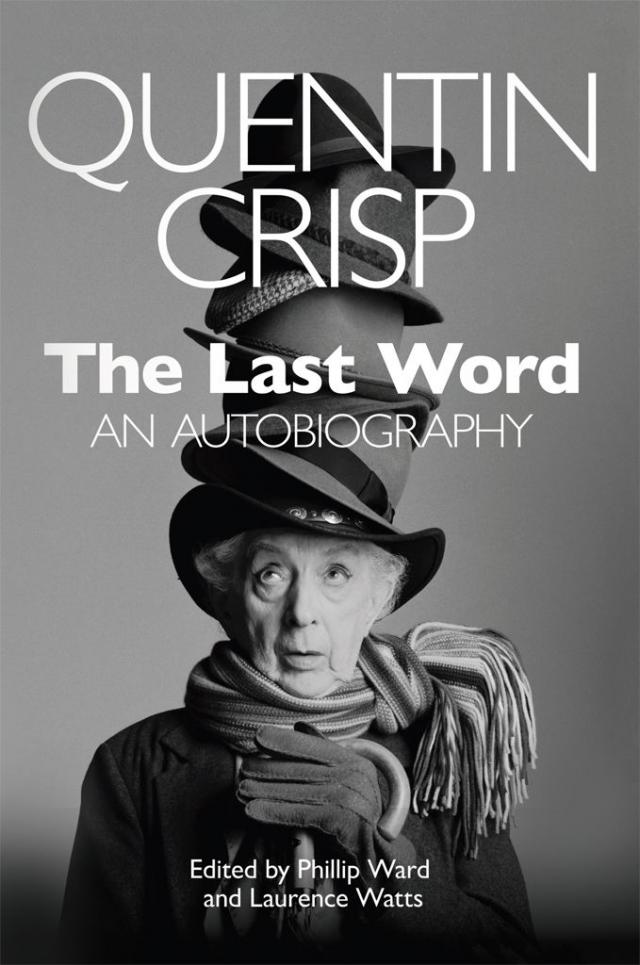
The Last Word: An Autobiography,
p.18


As is typical of men and women of a certain age, Quentin talked a lot about his own death. When you are older and live alone, you have a lot of personal time and you drift in your thoughts. You start to think about how much time you have left. If you reach sixty, you realize death is probably twenty or so years away. When you’re eighty, it is likely a lot closer. After Quentin turned eighty, he started talking more and more about death. His body was falling apart. His stage presence had always been full of energy, but the older he got, the more his exuberance declined. He frequently talked, on stage and off, about wanting to die because he could no longer live the way he wanted. When he turned ninety in December 1998, he openly wished that death would hurry up and arrive. By that time, he had cancer, a hernia, blood pressure problems, an enlarged heart, and debilitating eczema.
We had already begun to get his affairs in order. In other words, Quentin had started to physically prepare for his death. Sometime in 1997 he approached me with a request to help him write one final book. This was odd. Up until that point, Quentin had confessed to only ever writing books that were requested of him. This one would be different. This would be the first and only book he wanted to write. It would also be his last. In it, he wanted to voice all that he had left to say. His original idea was to call the book The Dusty Answers, a reference to the fact that we would record material for the proposed tome from the subject matters that arose from the Q&A portion of his one-man show. In the end though, since Quentin’s purpose was to have the last word on his life, we went with a different, more appropriate title. For the next two years, Quentin and I would record our conversations, slowly creating the content that you have just read. We finished those sessions in July 1999, about four months before Quentin died.
Not long afterward, Quentin started to clear out the contents of his apartment, room five at 46 East 3rd Street. Now anyone that knew Quentin knows that this was extraordinary. Up until then, Quentin would not let anyone move anything in his room. His tiny residence was packed from wall to wall with bags of what to an outsider might look like junk or garbage. That was how Quentin lived. Despite the chaotic appearance however, Quentin knew where everything was, or would so as long as nothing was moved. From July, he started gathering things that we might consign to the trash. During that time I also helped him clear out the floor of his closet where he kept his paperwork. Eventually Quentin created a path from his front door into and around his room, a path that hitherto had never existed.
In his final months, Quentin also asked me to help him prepare a new will. Quentin had been perturbed by someone pressuring him to hand over his life’s work and savings so they could “look after things for him.” Quentin was having none of it. As part of our cleanup, we gathered together his old wills and found that a number of people named in the most recent version of his will were now dead. This prompted the creation of a new will that split his savings principally between his three nieces and left future revenue from his books to his collaborators and partners. He also left token sums of money to people he believed might think they deserved more substantial legacies, and whose potential pain he wanted to soothe. He signed the will one week to the day before his death.
When and how Quentin died is a matter of historical fact. Following the success of a revival of his one-man show, “An Evening with Quentin Crisp” at the Intar Theater, New York, beginning in 1998 to coincide with his ninetieth birthday, Quentin was offered the chance to take the show back to England. A number of people advised him against this, I being one of them. None of us were sure his body could survive the rigors such travel would place on it. Now, of course, we know that it couldn’t. Nevertheless, Quentin was determined to go. It’s worth asking why, since there are those who claim that Quentin effectively committed suicide by doing so.
Quentin was certainly aware of the possibility of his dying on the trip to England, but he didn’t undertake the tour knowing with certainty that it would kill him. Yes, he is on record noting the merits of suicide for someone in his dilapidated condition. He also openly confessed to being physically incapable of taking his own life, not to mention mentally incapable of doing so – Quentin was a self-confessed “sissy” in that regard. So focusing on those two facts alone, one might conclude that a “suicide tour” was Quentin’s best way out of this world. This was not the case. In truth, Quentin went to England for one reason and one reason only: he was a professional people person. He didn’t want to let down the organizers of the tour, and he wouldn’t have wanted to let down those who had bought tickets to see and hear him. Being on stage, having a voice, and being the center of attention was Quentin’s lifeblood. It is what he lived for, and that’s why he flew to England on November 20, 1999.
Partial proof of this can be seen in Quentin’s reaction to the machinations of a so-called friend who had tried to cancel his upcoming tour of England “for Quentin’s own good”. I arrived at Quentin’s apartment one evening having collected his mail. I had brought food for us both and assumed we would eat and go through his letters and fan mail together, as was our normal routine. I used my key to let myself into his apartment only to find Quentin uncharacteristically furious. He instantly accused me of being in league with this third person and of trying to ruin his livelihood. I assured him I had no part in it. He eventually calmed down, but behind his hostility was a determination that no person would conspire with his failing body to prevent him from doing exactly as he wished. I told Quentin that I only wanted what he wanted. He was ninety years old and had lived his entire life on his terms. Why should he stop now? I knew that Quentin might die on the trip to England, but in truth, he might have died at any moment of any number of things. He should just do what he wanted and what he wanted to do was go to England and be Quentin Crisp. That was what he lived for.
My partner and I dined with Quentin on the night before he left for England. I had already seen him twice that week, once to talk about work and on another occasion to give him his nitroglycerin pills (for his angina) which I had picked up from his local pharmacy. Quentin didn’t want to take the pills in case they prolonged his life. I persuaded him that taking them would instead actually increase the quality of life he had left, and he seemed happy with that explanation and accepted them. I collected Quentin from his apartment on Thursday evening and we made our way to Haveli Banjara, a local Indian restaurant. While we waited for Charles to arrive, I helped Quentin study for the written test he planned to take as part of applying to become an American citizen. He got every answer right. Two of Quentin’s remaining life ambitions were to become an American citizen and to meet Elizabeth Taylor.
Over dinner, Quentin talked about the passing of his life. I suspect he had received a phone call shortly before I arrived from someone making one last plea for him not to go to England. This had agitated him but as I have said before, death was also a topic that he had discussed both publicly and privately for many years at that point. One thing he did do at the end of the evening, which was out of character, was give me a publicity poster from his film Orlando that he had signed. It was not clear to me that was him saying goodbye, but we were both aware that dinner that night might be the last time we saw each other. After dinner, Charles and I walked Quentin back to his apartment building. As he pulled himself up the staircase with his right hand gripping the railing, I wished him the best for his tour and told Quentin I loved him, and as he slowly moved up the stairs he calmly and quietly told me he loved me. Then I waited in the lobby of his building and listened to him climb the stairs to his floor. Once I heard him arrive and shuffle toward his apartment door, we said goodnight.
The next morning I called him to wish him a safe flight. He was in good spirits. His journey to Manchester would take him first to London Heathrow and then immediately onwards on a second, shorter flight. That evening he stayed in the house of Emma Ferguson, a lady he had never met and a friend of a friend, a set-up arranged at Quentin’s request by his tour’s organizers, a situation that Quentin preferred to a hotel. The morning after his arrival in England on November 21, 1999, Chip Snell, Quentin’s companion for the tour, found him dead in his room. Chip found him lying in his bed with the bottle of angina pills in his hand and several pills scattered over the bed. I found out that Quentin had died when someone called me from England to ask if I had seen the news. I hadn’t, but I quickly turned on CNN to confirm what had happened. Although news of Quentin’s passing left me heartbroken, I can’t say it surprised me because of all that I have said thus far. Quentin died of a heart attack.
As per his wishes, Quentin was cremated and his ashes delivered to me by Chip when he returned from England. Quentin had personally instructed me to throw them in the garbage can, but I confess that was one request of his that I could not carry out. The months and years that followed were hard for me not only because I had lost one of the people I loved most in the world, but because Quentin made me the executor of his estate. The man who professed no skills and claimed to be unemployable amassed a personal fortune well in excess of a million dollars during his lifetime. It just goes to show you how much you can save if you live as frugally as he did and never say no to an opportunity.
Charles and I spent the two months following Quentin’s death emptying his apartment. In theory, we could have cleared it out in a day, given its small size, but that would have been careless not to mention practically impossible. For contrary to Quentin’s assertion that, “After the first four years the dirt doesn’t get any worse,” eighteen years of dust and grime actually creates a considerable barrier and problem. Of course, Quentin was never troubled by it, but that’s because he was wise enough never to move anything in his apartment. For us, it was a different story. The first day was the worst because we were not fully prepared. We lasted about two hours before retreating. Each of us had trouble breathing. When we came back thereafter, we brought protective masks and gloves. Oddly, while the dirt likely caused or aggravated Quentin’s eczema, I’m convinced the conditions he lived in actually contributed to his longevity by boosting his immune system. By the time we were done with the room, the sink’s color had changed from black back to white and the carpet, which was irreparable, had been removed.
Quentin wasn’t a hoarder, despite the picture I’ve painted. You have to remember that his room was very small, so everything he owned was kept in that one room. What he did collect however were his manuscripts, books, photographs (principally of himself), magazines and newspaper articles as well as assorted items that had been gifted to him over the years. A beetle in a ring box. A piece of the Berlin Wall. Quentin had attempted to throw away a lot of his early photographs some months earlier, but I convinced him not to and offered to look after them instead. They seemed to make him feel bad because they showed him looking young and beautiful. Something that in his advanced age seemed alien to him.
As my co-editor mentioned in the foreword to this book, The Last Word is being published eighteen years to the day of Quentin’s passing. Why has it taken so long to get it to you? Well, there are a number of reasons. In the years that followed Quentin’s death, I busied myself with his estate as I have said. I am a meticulous person and wanted to make sure that Quentin’s wishes were carried out to the letter and that his legacy was secured. Additionally, I helped arrange a memorial for Quentin, which was held at the Cooper Union on March 3, 2000. The principal reason for this book’s delay however, is that The Last Word was created via a series of interviews that Quentin and I conducted and all of these had to be transcribed first before they could be edited. Initially, I couldn’t even listen to Quentin’s voice because of the heartache and tears that came with being transported back to each moment in time. We got there in the end, but I will admit it took a lot of time for me to heal.
What did Quentin mean to me? He was part of my life for thirteen years. In the end, I had a longer adult relationship with him than I did with my own mother and father, and for me, he fulfilled both of those roles. Had Quentin not been in my life it would have been quite different because my initial meeting with him on film gave me the affirmation I needed to be my true self. Without Quentin, I would not have set out on the journey of self-discovery that I did.
Being Quentin’s friend provided me with many life experiences that I otherwise would not have had. Having him in my life, sharing his, and being worthy of his love made every day that I knew him like a fairy tale. It validated the influence the movie had on me as a young man. It reminded me and continues to remind me every day that it is okay to be me. If you take anything from Quentin’s life and writing, it should be that the problem is never with you, it is with the outside world.
Taking on the responsibility for Quentin’s estate after his death has been a mixed experience. On the positive side, I have learned a lot about the law and have been able to ensure that Quentin’s final wishes were executed. I have also been able to preserve and prolong his influence. On the negative side, I have learned a lot about the users and hangers-on that were present in Quentin’s life and who continued to make demands on him long after his death.
Quentin became part of my family. One of the truly beautiful aspects of the gay community is our notion of the family you choose versus the family you are born with. For many of us who have struggled with families that are unaccepting of our sexuality, this is the lemonade we make from the lemons life gives us. Quentin was someone whom I loved unconditionally, and I grieved for him like a lost parent when he died. Quentin was family.
I am thrilled that The Last Word is finally published. I’m also relieved to finally let go of the guilt that I have felt all the time it remained unpublished. The Last Word compliments The Naked Civil Servant because, like the former, it too has a certain sadness, though a sadness absent of self-pity. The thing I am delighted about most however, is knowing that there are people out there who will now fall in love with Quentin all over again.
Phillip Ward
October 2017
Quentin Crisp, The Last Word: An Autobiography


