

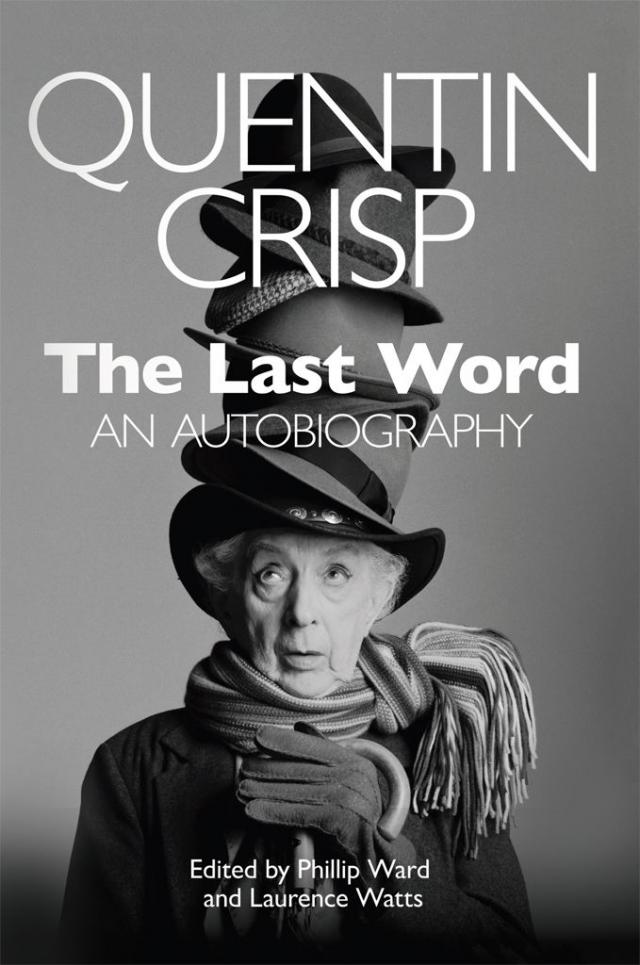
The last word an autobio.., p.17
The Last Word: An Autobiography,
p.17


I would like to die alone in my room. Somebody died in one of the other rooms of my building and they were found the very next day. I don’t know what caused anyone to look in their room and find them lying on the floor, but something did. I suppose if I didn’t answer the telephone people would eventually come knocking at my door and when I didn’t open it they might conclude that I was dead.
The other day I received a letter saying I was a fraud. That I longed for death but kept on living. I can see their point. It’s not that I’m a fraud however, it’s that I’m not capable of the suicide that would bring my life to a close. I couldn’t inflict violence upon myself or pain.
I used to know a lady who hanged herself. That must take hours to die. You tie something around neck and then you hang it on a hook and you jump off a chair. But you don’t die for hours. It can’t be a pleasant way to go and yet that’s what she did. She was about forty, I suppose. I never dreamed she would do such a thing. I knew she was unhappy, but I didn’t know she was as desperate as that. Her suicide occurred over twenty years ago when I was living in England.
I had hoped Mr. Clinton would declare a limit on the number of days we are allowed to live, but he didn’t. It seems perfectly reasonable to me that, at the age of say, seventy-five, you would receive a telegram from the White House saying, “We congratulate you on reaching your seventy-fifth birthday and hope to see you in the Forgetting Chamber at 4:30 p.m.” Then an unmarked van would arrive, you would get into it and be taken to the town hall and put to sleep the way animals are.
Such certainty would enable planning. You would make arrangements regarding your possessions and money and would not have to leave anything to chance. As it is, you cling on to everything because you feel you will go on living indefinitely. I feel I’ve lived too long. I repeat myself incessantly and I take up time and space. One of the hate letters I received said I was a waste of space, and I am.
When I came to America, I found that everybody was my friend and friendship is certainly a good substitute for love. As the end of my life approaches I can’t say that I have been loved because I don’t really know what love means. Instead I can say I am content with my relations with other people. When people say they love me, I can only say thank you. I do not say, “I love you,” back.
I found three hate letters the other day. They all end with ‘Drop dead.’ and ‘Go to Hell.’ and other expressions like that. I don’t know why people are so angry with me. In England the gay community accepted me, while heterosexuals did not. Here the heterosexuals accept me, while the gay people do not. I can’t help it. I can’t calculate what the gay community wants.
I was never more surprised than how angry Ms. Clausen200 was when I said that a pregnant woman should have the right to abort her fetus if she knew it was gay. She was very upset. She said I’ve made it easier for people to beat up homosexuals. Obviously, I didn’t want them murdered, I wanted them never to be born, which is different. Very different. What I was proposing was an act of compassion. I wouldn’t wish what I have suffered throughout my life on anyone.
Ms. Clausen kept referring to the fact that people had more social persecution in my day than they have now. She may be right. Of equal concern to me though are the horrors of homosexual life: the cavorting in men’s lavatories and darkened rooms in public houses. That too might have changed without my knowing, but it is the degradation homosexuals suffer that I am so keen they avoid. When it comes to sex, I am happy now, because I haven’t bothered with sex for more than fifty years.
I don’t believe in life after death. The idea of once more falling out of your mother’s womb with the words, “Here again.” is too much for me to bear. I never understand why Ms. MacLaine201 espouses the notion of reincarnation. This life alone has left me weary enough that I would gladly forgo all my future lives. I hope that death is just nothing.
If we do reincarnate after this life, I want to come back as a woman. I feel I am suited to the life of a woman and have not been suited to the life of a man as I have said earlier in this book. That has been my trouble. I wouldn’t mind what sort of woman I came back as, the same class and the same nationality as I have now would do. I wouldn’t want to have a grand life. I wouldn’t want to find that I was a duchess or something. I wouldn’t want to be beautiful because I wouldn’t want to be sought after or anything weird like that, but I wouldn’t want to be hideous either. Preferably I would have a job that’s not too taxing which I could do satisfactorily while waiting for life to pass.
I don’t like the countryside now, but I might like it more if I were a woman and could live there in some kind of comfort. I don’t like nature, I like people, chiefly women. In this life I would like to have been a middle-class woman surrounded by more or less the same and to have played bridge well enough for people not to dread having me as a partner.
I don’t like nature because it’s so lonely and does nothing for you. People say that it’s wonderful to look at, but I never look at anything, so I don’t really long to stare at the clouds or the sky or the trees or the grass or anything like that. I’m not interested in what things look like. I don’t see any spirituality in nature.
People are always trying to sell it to me. We have conversations which begin, “Well it’s nice to get out of city at times, isn’t it?”
And I say, “No.”
“Very well, to get fresh air into your lungs, then?”
And I say, “No.”
I would like the whole of North America to be paved over and, if possible, to have a glass roof put over the whole thing, like a huge Grand Central Station.
When I was younger, I think I probably thought of myself as poetic rather than spiritual, someone uninterested in this world or in making money. I don’t think that’s the same as being spiritual though. Being useless isn’t the same as being spiritual and I’ve been useless all of my life.
When you’re useless, you have to be able to appeal to people to help you, which I learned to do. Being useless is not the same as being hopeless, but people use the words interchangeably. “Oh you are hopeless.” They say it, snatch whatever it is away from you and make it work. But they don’t really mean you are without hope. They mean they are without hope for you. I did have hope in a time gone by, but now I don’t have any hope at all.
I don’t believe I have a soul. I would say the soul is a human invention inspired by fear. It protects people from the notion that they die when their body dies. When my body dies, I don’t visualize that my soul will take wing and fly out of the window toward the sky. I think I will stay here and I shall be dead.
Can one die stylishly? I think you can. You must die without trying to get the world’s pity. You mustn’t let any guilt fall on anybody. So, if you commit suicide, you must explain why you’ve done it so that nobody feels they should have stepped in or seen it coming. People are always saying, “I should have known, I should have seen the signs.” This is rubbish. People who commit suicide don’t want anyone to see the signs.
Anyway, you can’t win. If you fail to commit suicide people say, “Well it’s just a call for attention,” but it isn’t. Typically those who try unsuccessfully succeed in doing so at a later date. I remember there was an actress, I forget her name, who tried to kill herself and her husband found her at it and prevented it from happening. She tried again, successfully, twenty-five years later, so she was always thinking, “I can still do it.”
I would never kill myself, but I’ve thought about it. I was in touch with the Hemlock Society which sent me a book telling me everything I needed to know. It was so elaborate. I had to go to Mexico in order to buy a specific drug, then I had to get it past customs on the way back and drink it at once along with something, having taken my shoes off or something. I have never attempted suicide, so I don’t or can’t say how far I would go. When I hear of people who have however, I am filled with admiration that they managed to get away with it.
Suicide seems perfectly sensible to me, if one wants to avoid being a nuisance to those surrounding us. Otherwise our friends and family feel obliged to help us throughout terminal illnesses, saying things like, “You look better today,” and the other lies that accompany bunches of flowers and boxes of chocolates. You know you don’t look better and you want to die.
I don’t think it’s right to kill yourself to get out of a mess you yourself have created though. To my mind you can’t commit suicide so as not to pay your debts. I think you’re obliged to tidy everything up first before you pop your clogs. I’ve tidied up everything as far as I can. This has involved throwing away everything that’s useless in my apartment with the exception of me.
I think doctor-assisted suicide is perfectly acceptable. I don’t know why people are so cross with Dr. Kevorkian.202 He only kills people who long for death. Why should they be made to stay alive? Just because the idea of killing them is connected with the idea of murder? This is a nonsense spread by the same fundamentalists that equate masturbation with infanticide.
Of concern to me is whether or not I have a heart attack, something all too likely from what my doctors are telling me. I don’t know what that would be like, but my biggest fear is dying temporarily only to be brought back by some method of resuscitation. I would rather they leave me lying dead on the floor. I would not know any different, so a heart attack would do quite nicely. That would be dying in style.
Once dead, I want to be cremated because I don’t really want a funeral service. I don’t want anyone to have to stand in the pouring rain in a churchyard around an empty hole, while someone explains how wonderful I was. That would be respectively miserable, morbid and untrue. I’ve gone and that’s that. I don’t mind the idea of a memorial service though because that might be jolly. Then everyone who ever knew me can meet in some place and talk about how awful I was.
I don’t want my ashes spread over the sea or any of that rubbish. Just get rid of them. Throw them in the Hudson River if you want.
When people ask me how I want to be remembered, I think they imagine themselves leaning down from a cloud and counting the people at their funeral. A woman once said to me, “You don’t know that there’s nothing afterwards.”
To which I replied, “I don’t know that tomorrow will come, but it does.”
I see nothing around me that lives that after it dies. Why should we live? Who are we that we are so special or important? I assume that death is death and I’m very glad it is because one of the nicest things you can say about life is that it will end.
I don’t care how I am remembered. If you suppose I will look down from a cloud and find that I have been misunderstood or misquoted, you are wrong. I would be annoyed but I shall be dead, so what does it matter?
I am told Mr. Shaw203 has left instructions that his epitaph reads: “Go away.” That’s nice. On my tombstone, not that there will be one, I suppose it could say my name, but who wants to know that I’m lying there? It seems to me that epitaphs and tombstones exist only for those who weep for the dead and bring them flowers. In which case, the perfect epitaph for me would be “I am not worthy.”
Yes, that would be lovely.
* * *
197 Diana, Princess of Wales, first wife of Charles, Prince of Wales, 1961-1997
198 The Blessed Teresa of Calcutta, Albanian-Indian Roman Catholic nun and missionary,1910-1997
199 Joan Crawford, American actress, 1904-1977
200 See footnote #47
201 Shirley MacLaine, Oscar-winning American actress, b. 1934
202 Jacob Kevorkian, American pathologist and euthanasia activist, 1928-2011
203 Artie Shaw, American composer and actor, 1910-2004
AFTERWORD
Quentin once said that an autobiography is an obituary in serial form with the last chapter missing. In his case, because we finished the content for this third installment of his autobiography four months before he passed away in July 1999, there is not much missing. Even so, this afterword will fill in what little of Quentin’s story remains untold by him. This is his missing last chapter.
I first encountered Quentin when I was around 18 years old and saw the movie version of The Naked Civil Servant by accident on Kentucky Educational Television. I believe it was 1976. Only a few years earlier in 1973, the American Psychiatric Association removed homosexuality from its Diagnostic and Statistical Manual of Mental Disorders. Back then growing up gay in Eastern Kentucky, especially in the kind of fundamentalist Christian environment that I was raised in, meant living in fear. Fear of ostracism, fear for your liberty, and with the KKK a very real threat, fear for your life.
We had been watching television as a family, and my mother had been flicking through the channels to find something suitable for us all to watch. Quite how we ended up watching The Naked Civil Servant, I have no idea, but watch it we did. The rest of my family scoffed and jeered throughout the broadcast. I, on the other hand, having known I was gay since the age of seven or eight, was transfixed. Seeing Quentin in my living room, a resilient, self-assured and openly gay man, gave me more courage and strength than I can convey. It didn’t matter that he was fifty years older than me, it didn’t matter that he was describing life in another country, and it didn’t matter that I couldn’t relate to his flamboyant, some would say feminine, appearance. He spoke to me directly and gave me the thing that Harvey Milk would later insist every gay man needed: hope. He told me it was okay to be who I was, though I knew I could never be that person in Eastern Kentucky.
I moved to New York on Friday, July 13, 1979. It’s an easy date to remember. I’d finished college and wanted to begin my adult life in the same surroundings as the poet Edna St. Vincent Millay. That meant moving to Greenwich Village and in 1983 that is what happened when I moved in with my lover, Charles Barron. Charles lived on Christopher Street only four blocks away from Millay’s townhouse, and that is where I built my life for the next 26 years. Quentin moved to New York in 1981 and, though I saw him perform a number of times in those early years, it was not until February 1986 that I finally got to meet him.
I was working as an editor for a company called Business Research Publications when my secretary, Kathy Hurt, came back from lunch one day unusually excited. She told me she had just met Quentin Crisp while in the line for stamps at the East Village post office. After confirming that she had actually met Quentin (a brief description was sufficient since who else in the world looked or dressed like Quentin?), Kathy lamented that she hadn’t formally introduced herself to him. Not a problem, I told her. He’s in the phone book! She should call him up and arrange to have dinner with him and, that way, I could come along and meet him as well (I confess that until then I had always lacked the confidence to reach out directly to Quentin myself).
So that is how, aged 29, I first came to meet Quentin over dinner at Las Ventanas on the corner of Christopher Street and Bleecker Street. In hindsight, a Mexican restaurant was a terrible choice for a dinner date with Quentin since he hated spicy food. At the time though, I had no idea. Quentin famously never said ‘no’ to anything, especially a free meal. Without question, he was wined and dined by many thousands of people over the course of his lifetime. So exactly what turned our initial meeting into a relationship that lasted the next thirteen years, I couldn’t tell you. Quentin actively avoided second rendezvous dates because he typically used up all of his best one-liners and anecdotes on the first.
Why or how then did Quentin and I become friends? Well, there was certainly a spark or a bond between us as early as that first encounter. Not a romantic spark you understand, though in subsequent years rumors persisted that he and I were having some kind of affair. That amused us both. I can say however, that having observed a number of people over the years around Quentin, by comparison to them I neither asked for nor demanded anything from him. Unlike others, I did not try to use Quentin to embellish myself.
My relationship with Quentin was similar to that between a father or a mother and their son, especially so since my own father had died when I was eleven or twelve. The age gap between us certainly supported our respective roles in that scenario, but the warmth I had for Quentin came not from a blood relationship, but from a desire to help him in any way that I could. It was true love. Distilled further, I wanted to make sure that everything he had given to me and the rest of the world was repaid back to him. One positive aspect of my restrictive Christian upbringing was that at least I had been raised to give back.
Over the next few years, I saw Quentin every week. Then at least twice a week. Then even more frequently. He inhabited a different world from me, his professional or celebrity world which I never knew or tried to be a part of. Instead, I knew Quentin as a private person. The real Quentin was different from his public persona, but just as fun and entertaining. Quentin never criticized others in public, nor did he curse, but in private it was altogether a different matter. We cooked for one another (Charles and I more so than he), we would take him to dinner at his favorite restaurant – the now-defunct Sazerac House – and we shared birthdays, Christmases and other celebrations together.
As he became frailer, I began to help him not just with errands and chores but also with his work. When he lost the use of his left arm, I helped him continue writing by taking his dictation and typing up his essays and articles. My role in his life eventually merged that of friend, family member, personal assistant and caregiver. In hindsight, it sounds like a second job, but as every son or daughter with an ailing parent knows, and though it is time-consuming, most days you don’t even notice the time go by and even when you do there is nothing in the world you would rather be doing. So whether I was collecting his mail, chaperoning him to events or helping him get dressed, it was nothing more than he deserved.


