

On wholeness, p.5
On Wholeness,
p.5
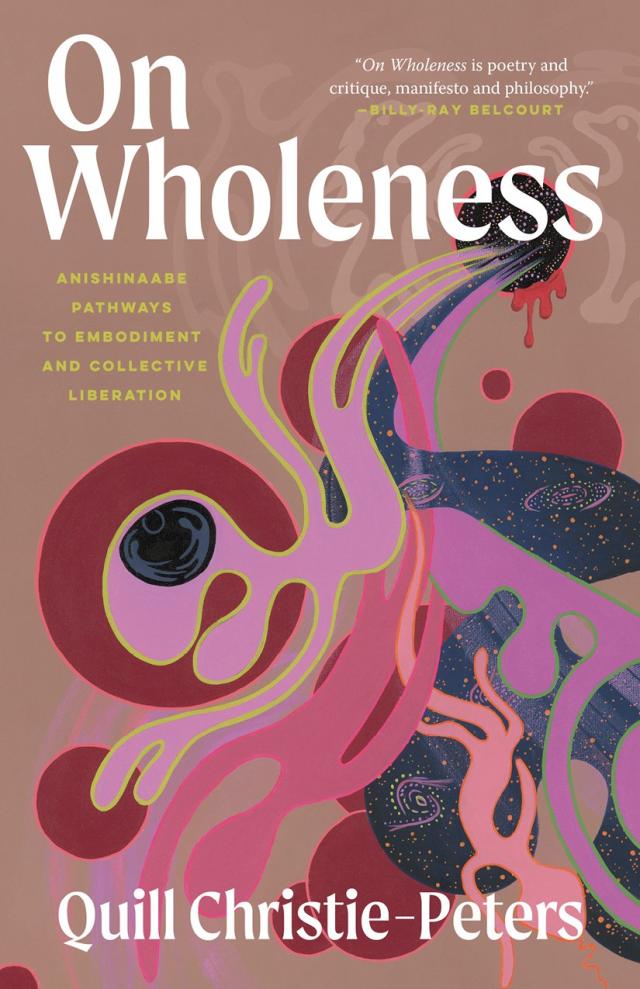


When we leave the place before birth, we climb onto the delicate spider’s thread that leads us to the earth below, spiralling toward the earth like a leaf in the wind. We descend through the birth canal to meet our new physicalities and the gentle containment of the human experience that now belongs to us. Grief, love, hope, and pain are now ours to carry, held temporarily by the confines of linear time and space, only to be dissolved one day into the sparkling mist of the universe. Born to parents whose bodies may be battered and bruised by the settler colonial world, we open our eyes to greet them. Born to homelands flooded and bombed, cut open, and destroyed, we extend our arms to cradle them. Despite the harsh and violent world that awaits, we still carry inside our bodies the swirling smoke that whispers to us visions of a sweet and just future. And so, we choose to persist.
Chapter 3
The shape of my body
I have danced upon the spider’s thread to descend from the stars. I am in my body now, and it feels like home. Instantly cradled by the new familiarity of the rise and fall of my breath, my soft belly swells with my fragile mortality. I am in my body now and it feels like unabashed joy. The feeling of euphoric impermanence as I take my first breath and howl with the tenacity of creation.
I was born on a snowy morning in January. During my mother’s quick labour, I descended from the stars, travelling along the spider’s thread to meet the narrow passageway that would squeeze me into existence. My mother was just twenty years old, but she speaks of my birth as an experience where she felt strong, connected, and unfaltering in her confidence to birth me whole. She was supported by my maternal grandmother, my father, and my two brothers. There is a picture of my young brother holding my tiny hand just after I was born with pure awe pouring from his eyes. I imagine myself in that moment—the pressure surrounding my new body as I contort and greet the blinding light of the hospital room, the feeling of spilling out yet being confined by a physical body outside of water for the first time, and then the warm embrace with my mother. I imagine what surrounded me in that moment—all my ancestors ushering me into this world with the same pure awe pouring from their eyes, the spider intently watching over us all, and the air thick with the vibration of creation.
My birth was a moment of wholeness for both me and my mother. I wish that I could write about how whole my body continued to be as I grew from a baby into a woman, but my body was also born into the settler colonial world.
When I was born, my homelands and stardust came with me. When I was born, my ancestors sang a song of celestial joy and justice. When I was born, my spirit helpers ruptured the great beyond to deliver me into breath. But my ancestors also knew they had to whisper strength into my ear, and the spirits held me in one last embrace before the storm.
Here on earth, my homelands shift, moan, and move with the pulse of the universe. Anishinaabe bodies flicker under the moonlight, and then disappear into the night sky with a flash of iridescent light. My ancestors are so tangible they are almost visible—past, present, and future contained within a moment of running my hands through the dewy grass. If all was right with the world, I would have been born into this spectrum of creation, unabated and undisturbed.
My body, whole and full, would enter the stream of creation like a drop of sacred water running through my homelands. My body, whole and full, would spill out of my mother’s to meet the river that surrounds us. My body, whole and full, would be adorned with the inherent movement of creation, hair reaching stars and galaxies swirling in my palms. But in the settler colonial world, the movement of creation is not permitted. We are born into rivers dammed, our bodies brushing up against the cold concrete borders of colonialism.
The inherent and unrestrained movement of creation has always posed an existential threat to the rigid requirements of structural oppression. By necessity, settler colonialism is a project of attempted stillness so that it may contain and control the wild pulse of exuberant creation. Boxes, boundaries, and harsh lines cut across body and land, attempting to hold us in place. In the broadest sense, they cut the land up into parcel and piece through rail and road. They removed the density of creation through logging and mining. They blocked the water until we felt like we were going to burst. With the Indian Act, they forced us onto small parcels of land called reserves. With residential schools, they removed children from their families. They outlawed our ceremonies and prevented us from gathering. They worked so hard to quell the movement of creation.
Settler colonialism can only enforce this stillness with a violence so unnatural that it echoes throughout the universe as an anomaly. A violence that, at times, feels otherworldly in its utter terror. A violence that erodes, contorts, and compresses Anishinaabe bodies and homelands. Our bodies and lands are marked by this violence—made smaller, made stiller, parts of us giving out because of the sheer force around us.
Rather than being born into a stream of swirling creation, my body left the waters of my mother to be held still by the compression of boxes and compartments surrounding the curvature of my physical form. I look to my parents and I cannot see complete wholeness. I look to my grandparents and I cannot see complete wholeness. All around me, I see a world where we must struggle to glimpse the wholeness that is our inherent right and work tirelessly to breathe life into the movement of creation.
My father wanted us to carve a black ash tree together, in the old way. First, we would find a tree struck by lightning. Then, we would dig it out of the earth with our bare hands, no matter how long it took. At night, we would sleep in the bush, lining up our beautiful bodies with specific constellations so that we could dream the carving designs. When he told me this, I saw my great-grandpa Pete. I saw my father as a little boy, standing by his side as they traversed our glorious homelands.
Before I can talk about my own body’s topography, I need to talk about the bodies of those I come from, both people and place. This exploration of who I am constitutes an extended self-location, marking both the heart of, and limits to, my knowledge in relationship to the content of this book. I start with my ancestors, but now I do so in reference to their solely earthbound forms. My paternal great-grandparents, Agnes Wayash and Pete Kabatay, were fierce Anishinaabeg who kept the fires of our resistance lit, ensuring our collective survival amid the settler colonial storm. Their spirits are kept alive in my family through the stories we share and the ways we remain connected to them through our bodies. I feel particularly connected to my great-grandpa Pete because we share the same helper of the bear. The bear medicine in my life has always been an overwhelming presence that binds me to my responsibilities that extend to me from the great beyond. I am lucky to not only glimpse my great-grandparents through my father, who was raised by them deep in the bush, but also to feel their love, care, and guidance in my own body.
When my father was an infant, his father, Lawrence, drowned at Lac des Mille Lacs. The death of my grandfather marked a disconnect from my father’s paternal side. My father was raised with the help of his maternal grandparents and spent most of his childhood living out our old ways within the expansive flow of our homelands. During this time, settler colonialism was reaching its rigid limbs into Northwestern Ontario with more force, but there were still lots of places deep in the bush to escape to. My dad speaks of our ancestral home sites spanning from just west of Thunder Bay, over to Winnipeg, and down into Minnesota before the border with the United States was solidified. He can point out places he has lived in Quetico Provincial Park and on the Seine River. He speaks of the years living with his grandparents as some of the greatest times in his life, when he got to hear our old stories told sprightly by the mouths of his brilliant and fearless grandparents.
My paternal grandmother, Agnes Kabatay, shows the same adoration for her parents by embodying their knowledge and gifts in her own life. My father, my late auntie Norma, my siblings, and I are all members of Lac des Mille Lacs First Nation. However, my grandmother’s other children are members of Couchiching First Nation, and my grandmother currently belongs to Mitaanjigamiing. My grandmother’s parents were from Seine River reserve, whereas my father’s paternal side were from Lac des Mille Lacs. All these reserves are in Treaty 3 territory, and traditionally our people moved freely across our larger land base. Although my father has thought about switching bands to be on the Seine River reserve, we remain with Lac des Mille Lacs to ensure that we preserve our presence within a land base that has been hit particularly hard by forced displacement and dispossession. The reserve designations in my family are relatively arbitrary, which is a reflection of how our people were mobile, flowing wildly with creation. The most important locator that we maintain is our relationship and belonging to Treaty 3.
Around the time Treaty 3 was signed in 1873, the people who were living in the region of Nezaadiikaang, or what is now known as Lac des Mille Lacs reserve, were known to be some of the most political and strong-willed in the region. We did not want to sign the treaty and were proving to be a continual thorn in the side of the early colonists who wanted to formally settle the region. Settler colonialism is cunning and strategic, responding most violently to its largest threats. Intentionally, the government chose to construct a series of hydroelectric dams on our reserve land that would flood not only our traditional territory but also the reserve itself, making our homelands unlivable for generations. Stated differently, the government first forced Anishinaabeg of that region onto a tiny parcel of our homelands and soon after forcefully expelled us from even that tiny parcel of land. These hydroelectricity projects would power the province of Ontario while our homelands became artificially submerged beneath the settler colonial swell.
The land must have been so lonely when we all left. The animals and spirits, frogs and spiders must have mourned us under the stillness of the moon. The muskrat, trying to build its new world, would be destroyed again and again with the rise and fall of the dam. The fish, slowly filling up with mercury, were helpless to protect their young from its impact.
When I was a baby, my mom and dad travelled to Lac des Mille Lacs with a group of our family to protest our inability to reside there. Their intention was to construct cabins from the land, demonstrating our sovereignty and tenacity to enact what is our inherent right. I was all cheeks, swaddled in green mesh, while my grandma and all the elderly women taught the younger men how to use chainsaws. They built cabins while I sucked on my toes in the sweltering summer heat, but they had to abandon the project when some men arrived with shotguns. Settler colonialism is so cunning and intricate; once it removes the Indigenous people from the land, there are so many invisibilized and overt mechanisms that cement its power.
The muskrat cries for the sun. Beside their family’s home, in ruins, they weep for the sun to dry up the earth and for their home to persist. They follow the shoreline instinctively when they are ready to build their homes. And without notice, the water rises because of the dam and submerges them completely. The shoreline takes the hit. The shoreline is eroded and changed by the ebb and flow of an unnatural tide. Many beings weep at this change. Anishinaabeg cry for the sun. Beside their ancestral homelands, they weep for the sun to dry up the earth and for their homes to persist. But without notice, the settler colonial tides submerge them completely so that they must try once again to build their homes.
This hydroelectric project in our territory prevented Anishinaabeg from accessing their reserve for generations. We went from being some of the most politically steadfast people to being unable to even exist in a community beside one another. This was wholly intentional, the result of government action undertaken with the goal of subduing our rising resistance. Although reserve designations can be relatively arbitrary within the region, they unfortunately define our limited rights afforded through the Indian Act to necessities such as housing and livelihood. Being unable to live on our reserve effectively pushed many people to seek refuge and survival in urban centres, and many community members ended up living in many different places. Today, the reserve reflects this lived reality of disconnection through displacement. And so my dad remains a member of Lac des Mille Lacs instead of switching bands—in order to assert his presence as someone who grew up on our homelands and can trace his lineage to the Treaty 3 region for generations upon generations.
After seven years of living in the bush with my great-grandparents and migrating cyclically throughout Treaty 3 territory, canoeing and walking as their main modes of transportation, immersed in our old ways, my dad and Auntie Norma were forced to attend residential school. They attended St. Margaret’s residential school in Fort Frances, Ontario, which was nothing short of a horror story, a genocidal attempt to completely destroy Anishinaabe spirit and body. At the school on the shore of Rainy Lake, Anishinaabe children were brutalized, tortured, and killed in incomprehensible ways—a violence so unnatural it echoes throughout the universe. When my father got out as a teenager, he could not live on our reserve because of the flooding from the dam. He also found it too alienating and painful to live with family members in Treaty 3 because of everything he had just endured. Residential schools were a silent explosion—children bore the brunt of the violence, but every single person in a community was affected in complex ways. My father left our homelands and began frequenting urban centres such as Toronto and New York, where he became an artist.
The impact of residential school in Treaty 3 territory is immense, but in our region it largely only directly affected one generation. Importantly, this is not a shared experience in many other regions where multiple generations of residential school survivors suffered sustained imposition. My father and auntie were the only generation to attend residential school in my family. In my grandmother’s generation, they experienced the day school system, which was similar to residential school in its genocidal intent, but ultimately less isolating because children would return to their families each day. They also experienced the sanatorium system, which removed Anishinaabe people from their homelands for little to no reason and tormented, abused, murdered, and medically experimented on them. My grandmother’s sister was taken to the local sanatorium, but my grandmother “only” had to attend day school.
My father’s displacement from our territory is multi-dimensional and reflects a shared experience with many people of this generation from Treaty 3 who attended residential school. They survived not only the attempted genocide of the residential school system but also the subsequent alienation and complex trauma coupled with layers of forced displacement as a result of resource extraction. In Treaty 3, settler colonialism stole people’s ability to have a home on their homelands, then on their reserve, and then with their families. Finally, settler colonialism stole people’s ability to find home within their own bodies.
My father always has to be moving. As a young man, he could be found on specific street corners in Toronto, laughing away with my uncle Steve, selling artwork for cash. A whole generation had to find a sense of home on the streets. The layers of colonial violence that affect my father tell me that our existence as full and whole beings is deeply threatening to the forces of settler colonialism. They knew that if they did only one of these atrocious things to us, we would persist. In their fear and weakness, they gave it everything they possibly could, all at once.
And we still persist.
I dropped my dad off at the Nipigon gas station on a frigid January winter’s day. It was time for him to start moving again. He looked at me with a huge smile and told me not to worry. He told me that people always pick him up, and that if they don’t, he has a solar blanket and knows how to stay warm in a tree well. He could see the worry on my face. He told me that being cold brings us closer to our spirit and reminds us of our fleeting humanity; that it is a beautiful thing to feel that fragility, and that is part of our way. He didn’t freeze to death when a Thunder Bay cop dropped him off far from town on a freezing winter night. He didn’t freeze to death when he ran away from residential school, navigating through the bush to find home. He will stay warm as he hitchhikes from Thunder Bay back down to Toronto, walking the endless highway he has travelled so many times before.
My dad became a wandering artist who loved the big city and found community in other Native people of his generation who were also displaced to urban centres. He sold his artwork on street corners but also did exhibitions in galleries, flickering between worlds.
At this time, my mother was engaged in activism and solidarity work, largely informed by her parents’ participation in the fight for Indigenous rights of the 1970s to ’90s. My maternal grandparents were Scottish and Irish immigrants who moved to Canada in their twenties. My grandmother Peggy worked as a bank teller and my grandfather Harry was a plumber. They aligned themselves with the struggles of Indigenous peoples at the time, though this does not negate their complicity in settler colonialism. Despite aligning themselves with Indigenous sovereignty, my grandparents and mother still participated in and benefited from settler colonialism. In order to truly sabotage their settler identities, they would have had to remain in constant examination of their privileges and sense of responsibility, a messy and incomplete process for them. I wish with all my heart that my grandmother could have lived longer so that I could sit at her kitchen table and explore these nuances with her.
My grandmother Peggy was a special person, a fiery Irish woman with piercing blue eyes who wouldn’t take crap from anyone. She was also deeply community-oriented and knew every single person on our block of St. Clair intimately. She passed away when I was fifteen, and at her funeral an endless line of people we had never seen before told us how Peggy had changed their lives.


