

On wholeness, p.8
On Wholeness,
p.8
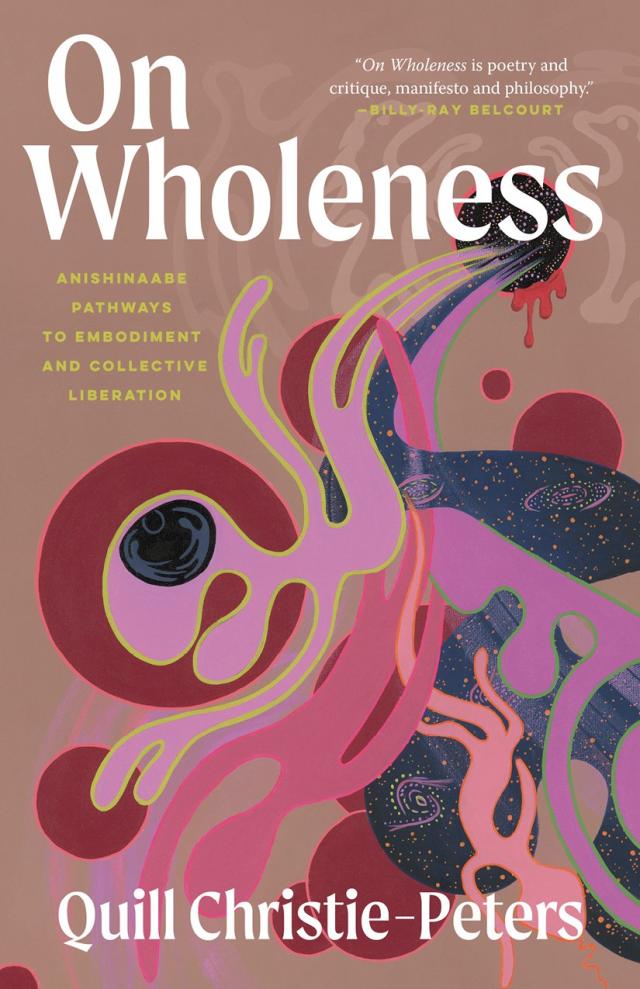


It is years later when my bones begin to ache—that moment again in the hot sun, guts leaking, as you told me how they operated on your tiny body and you still don’t know why. Our grief is never just our own; it spills over bodies and land. We are always braced for the overflow, and it is my turn to burst.
Settler colonialism has always attempted to disrupt our capacity for love in order to clear the land and ensure its future. It has always attempted to disembody us to prevent us from accessing the expansive dimensions of love that make us Anishinaabe—the way the land adores us so, the feeling of never being truly alone, the lullabies of our ancestors recited into our babies’ ears, the sound of a black hole, the ability to sacrifice our bodies in the here and now for the justice of creation. Our love was, and is, undefinable, boundless, and alive. Our love was, and is, a complex web of relations that far extends our own communities, traversing homelands, animal kin, and the spirits of the great beyond. Our love has always been the kind of love that holds our communities together, that weaves us into the fabric of our homelands, and that has always given us a purpose that extends far beyond our human experience. Our love has always been deeply threatening to the settler colonial project.
Through the residential school system they targeted the relationship between self and body not only as a mechanism of genocide and removal but also as a way to threaten our capacity to love. Each child removed from their family’s arms was like a hammer falling onto stone, irrevocable cracks cascading across the land. They further distorted our understandings of love through the sexual violence and torture of children that ripples throughout generations. The impact of such horrific and sustained sexual violence on young children is complex. Some of the children who attended residential school grew up to become parents who could not express love, parents who enacted the same harms onto their own children, parents who were scared of their own identities, parents who were so disembodied that they walked away from all responsibilities, parents who could not bear to sit still.
When they cut your hair, they could not see the silk. When they cut your stomach, they could not reach the earth. When they raped your body, they could not be whole. When we rupture, our ancestors always dance around our wounds.
To be Anishinaabe and have a parent who attended residential school is to exist in complicated motion—on the one hand, I have mourned the expressions of love that have been stifled in my family, and on the other, I have marvelled at how our capacity to love shifts and evolves to pour out of us regardless of our disembodiment. When dreaming up our strategies for collective liberation alongside Palestinian kin, I joked that maybe they could teach us how to love again. As I said this out loud, a part of me wept silently. The truth is that I had been noticing how loudly Palestinian people love each other, how viscerally they love their homelands, and how unfalteringly visible they make their love for life. In particular, I had been noticing how fervently they love the children. Faces of Palestinian people wrinkling up into deep smiles at the sight of my three-year-old daughter at community events. Watching a man notice my daughter from across the room and hurriedly stuffing his pockets with candies; a moment later, she walked by him and he offered them to her with an exuberant expression.
On a trip with Palestinian organizers, I watched my daughter surrounded with complete and utter love, expressed unfalteringly and without pause as they played with her under restaurant tables and snuck her sweets at every pit stop. This wasn’t the Anishinaabe love she was used to—at times expressed inconsistently, whispered through a shame that was never ours but that we can’t quite escape, the eerie discontent of feeling distance in the people sitting right beside you. As intergenerational inheritors of residential school impact, we wade through the complexities of learning how to show our love after such nuanced, sustained, and unimaginable horror directly attacking our capacity to love. Palestine continues to teach me how to reclaim our love and how to once again love our children with ferocity.
Although dimensions of love in my family have been disrupted by the residential school system, it does not mean that the love is not there, but rather that it is hard to articulate and receive. Our love, whether or not it is expressed in its full dimensionality, is unwavering and ferocious. Our love traverses galaxies, and it will never be quelled by the violence of our earthside experiences.
Our love is what allowed my auntie to experience unthinkable harm yet remain such a caring and grounded person. She wrote her master’s thesis on the concept of intergenerational trauma inflicted from residential school, one of the first voices to conceive of our trauma in this way. She returned to her body, against all odds, to open herself and understand her own pain as an act of profound love for her children, her family, and her community.
Our love is what allows my grandma to experience a lifetime of multi-faceted trauma yet remain a fierce carrier of our culture. After attending day school, losing multiple relatives to colonial violence, and having her children taken from her, she eventually became the glue that holds us all together, holding on to the old language, holding on to our old ceremonies, jingle-dress dancing us into a beautiful future.
Our love is what allows my dad to have his body broken, cut, abused, and tortured yet still be able to hold kindness and acceptance for all people. He persisted through his intended destruction to become a fearless man who demands a world of justice not just for our own people but for our Palestinian kin.
Can you see what they can never take from us?
Beautiful brown father, I am holding your tiny body under a blanket of stars. Playing with insects in the tall grass, you chuckle deep into your belly that has not yet been cut. In between gasps of laughter, I whisper that you are loved and beautiful and whole, spider silk dancing between past and future. Look at me, Father, I am whole and full. I am you.
Despite the horrors of residential school, my father has never faltered in making sure I know who I am as an Anishinaabe person. Despite the violence and the loss, he has painted colourful worlds that remind us of all that we are. Despite the assimilation, the cutting of his hair, the hunger experiments, the medical experiments, the torture, my father revels in the beauty of the universe and delights in the pleasure of what it means to be Anishinaabe. And although his body often dissolves, and he blows away like a leaf in the wind, he remains anchored in his own sacred ways to his children, his grandchildren, his homelands, and himself. It has always been the greatest honour to come from him. It will always be the greatest honour to be Anishinaabe and to come from such expansive love.
And so, I hold my auntie and father as small children. I give them a final hug and feel their spirits so close to their bodies. I whisper that they are so loved. And I send them both off into the still night, where they will encounter a vicious storm. And yet, loved in ways they can never touch. And yet, loved in ways they could never imagine.
I grew up knowing and understanding my parents’ experiences of violence from a young age. Alongside my intergenerational entanglement with my parents’ disembodiment, I accumulated my own experiences of bodily harm that made it hard to be present in my body. I have drawn upon disembodiment as the coping mechanism most readily available to me. The scale and scope of the violence my parents suffered warped my threshold for what is possible to endure in this world. For a large portion of my life, I discounted and minimized my own experiences of bodily harm because they were not as extreme as the horror of my father’s experiences in residential school and my mother’s experiences of multiple forms of sexual violence as a child and teenager. The world I was born into dictated the threshold for what we can and should endure, and so I buried a lot of my own experiences with this conception.
It is crucial to state again here the privilege I hold as a mixed person raised by my white mother. Her privilege covers me like an umbrella, shielding me from many forms of violence, while also extending opportunities I would not otherwise be afforded. I have never been beaten up in a public space for being Native. I have never been driven to the edge of town in the winter by the police. I have never been apprehended from my family. These are all experiences that my immediate family have had because they do not have the same proximity to whiteness that I do. Importantly, the scale of bodily harm we experience informs the impact that settler colonialism has on our relationship between self and body. My relative privilege allows me to experience a level of disembodiment that I am able to reflect upon and write about, and that I believe I am able to repair in my lifetime. Many of my family members and larger community might continue to exist in disembodied states for their own persistence.
Most of the harms my body has endured are tied to my identity as an Indigenous woman, and my proximity to whiteness has mostly restricted my experiences of direct bodily harm to the realm of sexual assault. I feel the weight of cisheteropatriarchy crushing my shoulders and spine, reverberating deep into my heart and belly. The weight is so immense because it is a central and long-standing structure of settler colonialism that has privileged cisgender, heterosexual men at the expense of others for generations. Since contact, the settler state has recognized how Indigenous women, Two-Spirit, trans, queer, and non-binary people are so deeply threatening to the colonial project, and as such, these people have always been the explicit target of the settler state.
The lived experiences of Indigenous women, Two-Spirit, trans, queer, and non-binary people cannot be homogenized, but it is worth stating that, collectively, these people bear the brunt of a specific form of settler violence intent on destroying our bodies. Since contact, our bodies have been deemed unworthy, disposable, and conquerable. Since contact, violence against our bodies has been state-sanctioned and encouraged as an effective tool to clear the land for settler occupation and expansion. They were so terrified of our power, of our ability to weave our communities together, of our connection to the great beyond, that they targeted our bodies with ferocity. They could not comprehend the ways our bodies vibrated in the moonlight, the ways our pleasure reverberated throughout galaxies, the ways we made our communities unshakeable, and so they feared—and harmed—us deeply.
When we weep, the waters of our homelands softly comfort us as they travel across our skin. When we speak, our voices channel ancestors that they don’t remember. When we dance, our bodies transform into smoke and swirl with the complexity of the universe. They have always harmed us for fear of what they will never have, what they could never even comprehend, what they can never reach. They have always wanted us to retreat far away from our bodies so that they can destroy them.
My interrogation of the power structure of cisheteropatriarchy is limited by virtue of my privilege as a cisgender person. I experience cisheteropatriarchy as someone who is both oppressed and privileged within this structure in different ways, and so there are nuances, and depths of violence, that are outside of my experience. Despite my experience being linked to my identity as a cisgender woman, it is important to emphasize that transphobia has been absolutely central to the settler colonial project, and that trans, non-binary, and gender non-conforming people have always been central to our communities and nationhood. It is also important to state outright that when I talk about the legacy of harm that Indigenous women face through settler colonialism, this implicitly includes all women. It is the settler colonial context that necessitates that I state this explicitly.
There are many examples of how the state has sanctioned violence against Indigenous women, including the pass system, the ongoing crisis of missing and murdered Indigenous women, girls, Two-Spirit, and trans people, forced sterilization, and the Indian Act, to name a few. Although I will not dive into this legacy of harm, I will discuss the overlying binary that Indigenous women are forced to exist within. On the one side of this binary is the “good” Native woman who is an assimilated, polite, and docile Indian princess archetype. On the other side is the licentious, immoral, worthless, and dirty savage archetype. Importantly, on both sides of this binary, we are hypersexualized and rendered non-human.
This binary sustains the narratives that enable violence against our bodies. This binary also weighs heavily upon us and contributes deeply to our disembodiment. This binary props up the power structure of cisheteropatriarchy that is so integral to the settler colonial project. This binary is upheld through legislation and law, the representation of Indigenous women in popular culture and media, and the portrayal of our deaths and harms in courtrooms and to the public.
This binary is omnipresent and insidious in the colonial world. It continuously normalizes the dehumanization of Indigenous women and provides a justification for inflicting harm on our bodies. This binary has sustained generations of narratives that dictate the treatment of Indigenous women’s bodies. This binary is one of the foundational mechanisms of settler colonialism that has always worked to remove the bodies of Indigenous women from the land. Indeed, I felt the effects of this binary from a very young age.
At the tender age of twelve I stopped making eye contact in public because of the stares from white men who looked like they wanted to harm and conquer me. When I was seventeen, a partner affectionately called me his “little savage.” The hands of a partner just below my neck when I refused to have sex. The times I never said yes. The times I was told I was pretty for a Native girl. The times I have been called Pocahontas. I wish to travel back in time and sit with my twelve-year-old self to tell her she is human and exquisite, to hold her so close to my body that she does not take any distance from hers.
The binary imposed on Indigenous women serves an overarching narrative that portrays our bodies as conquerable and non-human. This narrative encourages and sanctions the genocide, violence, and violation that our bodies face in the settler colonial context. The violence we experience is twofold in that it occurs within our intimate lives as well as beyond our sphere of relationships. We can truly be harmed anywhere. My body was first violated when I was a child, an experience that put me into a disembodied state early in life. When I was a teenager, my body was violated and fetishized. As an adult, I have worked really hard to protect my body from violence, but I still carry the constant fear of being harmed outside my personal relationships. On top of my own experiences, I carry the stories of the ways my mother and other relatives experienced near-fatal violence on their bodies from strangers.
All these experiences normalized my own dehumanization and the lack of control I had over my own body. Especially as a child, when I was trying to make sense of my belonging and value in the world, I could not comprehend the ways my body was being mistreated by so many. I floated softly away from my body as a way to cope. I disembodied myself from presence within my own body, but also from the ability to feel pleasure and worthiness in my physical body. The bodily harms we experience as Indigenous girls and women are so relentless and dehumanizing that we often disembody ourselves just to be able to breathe.
I once begged the moon to make me feel. I couldn’t find my body in the murky darkness. I once begged the moon to stay with me, whole, so that she could illuminate the dark night and I could find my body. At the edge of my skin, at the parts I don’t like to touch, I feel the warmth of a fire not my own. Ancestors tending to my softness, always working to keep us whole. When I cry, it is a gift that brings me back to my body. The moon makes me weep with her as we look at all that has happened to this beautiful body of mine.
The violation of my body as a young person pushed me into a state of disembodiment that didn’t allow me to be fully present in my body and that didn’t allow me to take ownership over my own pleasure, desires, and wholeness. In my intimate life, I learned to be completely absent as a way to protect myself from the harms that I expected to happen. In my emotional life, I grew further away from my capacity to feel my emotions and existed as a stone wall. I was able to experience further harms and trauma without flinching because I wasn’t fully present. I had become so skilled at my own compartmentalization and disembodiment.
Disembodiment, a muted relationship with my own body, is one of the central ways I experience settler colonialism. In the hardest of times, I have felt like I cannot find my body within a long and dark night. In the easiest of times, I have still struggled to feel and process emotions in my body, living in an invisibilized loop of disassociation. However, the body itself is an agentive entity that has the capacity to love and care for us. Our ancestors call us back to our bodies when we cannot bear to look at them. We are always spilling over.
One day my body said, “Enough.” At a time when I experienced true care and consent with a loving partner, my body ruptured and expelled all these experiences I had been hiding in my bones. Memories of my experiences of harm, and memories of my father telling me his stories of violence, came crashing out of me and lay on the floor for me to look at them. My body needed to shake me. My body was calling me back. This rupturing was incredibly painful and unsettling. I became uncomfortable with being touched at this time and was forced to reckon with my ability to black out painful experiences. This was the first time in my life that I had to acknowledge that I was living in a muted and dissociated state, and I started to think critically about the body as a site of colonial impact. This was also the first time in my life that I painted my own body. As my body ruptured, I painted myself feeling whole and good, full of pleasure, spilling over all my physical dimensions. I marvelled at this moment of wholeness that my body had given me.


