

On wholeness, p.9
On Wholeness,
p.9
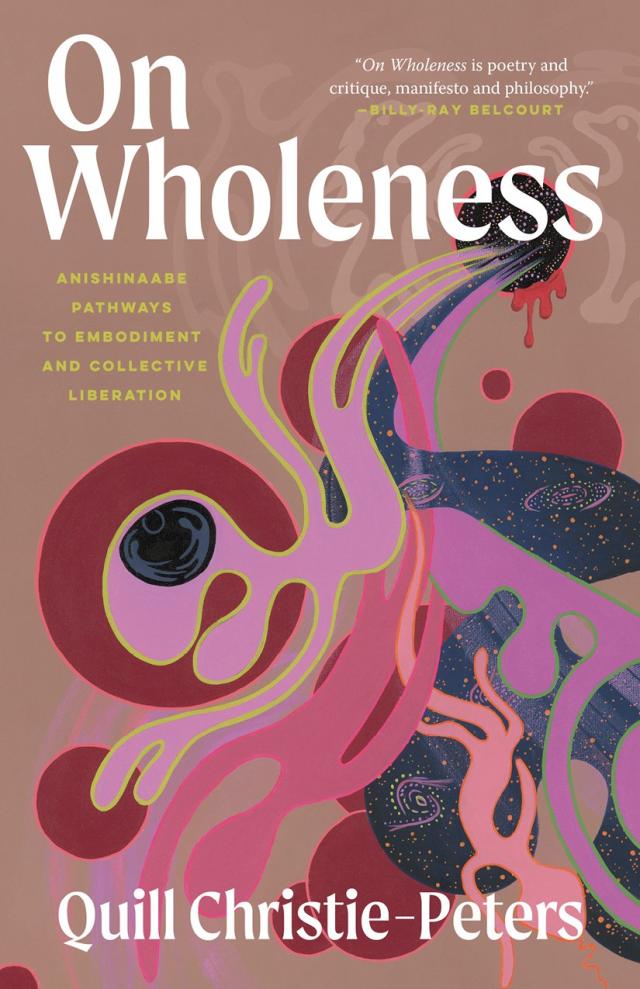


In the soft veil of the weeping moon, the guardians of my softness wet my skin with blood and tears, and they pick blueberries from my perfect flesh. They soften my edges so that I may ebb and flow. They work my skin so it becomes tender, so that I may feel. I spoke with the moon and she made me whole.
Settler colonialism makes the night so dark and endless. It is persistent in its violence and cunning in its strategies to remove Indigenous bodies from our homelands. Settler colonialism is always attempting to remove the self from the body, as a way to distance us from the expansive relationality that is the foundation of who we are. The violence of the residential school system and the realities of bodily harm that Indigenous women face through cisheteropatriarchy are but two stories of many that spill onto our communities in complex ways. As Indigenous people, we are always experiencing multiple forms of violence that exist in complex and interlocking ways to inform settler colonial disembodiment. For this reason, disrupting our disembodiment is a non-linear process. We may do so much work to come back to our bodies, only to experience harm that pushes us into disembodiment again. We may flicker between various states of embodiment as we grapple with the ongoing forms of violence we face. But there is so much power in charting colonialism and understanding its strategies, because this also illuminates what is threatening to colonialism.
When it feels hard to be vulnerable about my own experiences, I think of my auntie Norma and the work she did after residential school to open herself up as an act of nurturing future generations of Anishinaabeg. When it feels hard to be vulnerable about my own experiences, I think of my mother and the ways she insisted on life for herself and for me by refusing to keep her stories hidden. When it feels hard to be vulnerable about my own experiences, I think of my father speaking truth to my tenth-grade history class, or the curious stranger asking about his art, or the crowd of people who gathered to fight for a free Palestine. Opening ourselves up is an act of expansive love that is informed by our responsibility to future generations. We often find the strength to open ourselves up, not through the love we have for ourselves, but through the love we have for those around us and our innate desire to help them feel whole.
When I open myself up, I swim back to my body and look at the stories it holds. When I open myself up, I flicker with my own embodiment, even if it is momentary, and even if it hurts. When I open myself up, I can finally find my body in the cold night. We will find our bodies in the dark and endless night.
Interlude
A return to our swirling smoke
I am lying on the forest floor and I cannot breathe. Too many days of witnessing the genocide in Gaza, and today, I cannot hold my body up against the weight of this world. I press my forehead to the ground and let my tears speak to the land. The water that spills out of me is hot and salty, dripping onto the still-frozen ground beneath me. I have moved beyond crying—my face contorts into frozen agony as no sound escapes me except for my disgruntled breath. I don’t recognize this part of myself. I cannot take it anymore. The dead children on my phone. The grandparents wailing in horror. Understanding, in an embodied way, what it feels like to live through this type of violence and what is to follow. I cannot take it anymore.
The smoke surrounds me in the forest.
The genocides of Indigenous peoples across the globe always target our beautiful children, the spirits who have so recently travelled to their bodies, who should be given the chance to delight in the complexity of existence. I imagine my grandmother, whose children were stolen from her to be abused and tortured beyond what we ever could have predicted, now living through a time when Palestinian children are being murdered and harmed beyond the limits of human comprehension. Oh, the pain of it all. The pain of a single person who must experience, resist, and witness settler colonialism in all its ugly forms in a single lifetime. Oh, the children! Oh, the children! Oh, the children!
I am now lying flat on my back on the forest floor. All I can do is let my body succumb to the weight of it all, and I imagine myself sinking deep into the earth to live in the bones of our mother. The smoke pouring out of me forms a funnel that lifts to the sky.
Although settler colonialism is always an incomplete project by virtue not just of our resistance but also the resistance and will of creation, we still experience staggering loss, parts of ourselves falling off from the sheer weight of it all. Loss of our loved ones who are taken by intricate processes of genocide. Loss of humanity as the world watches a live-streamed genocide and doesn’t act. Loss of our homelands who are opened up, mined, deforested, and polluted. Loss of our children who are taken from us by violence and state-sanctioned removal. Loss of pleasure and our ability to feel whole and full in our bodies that are harmed relentlessly by sexual violence. Loss of presence in our bodies as we drift away from them through the disembodiment that gives us reprieve. The loss is undeniably staggering.
My father speaks at a rally for Anishinaabe and Palestinian children:
“They tried to make me lose.
“Loss of identity, loss of innocence, loss of meaning, loss of family, loss of childhood, loss of language, loss of feeling, loss of community, loss of spirit. Loss of life. Loss of morality.
“Genocide, forced removal, and relocation.
“Trying to change our names. Making it illegal to use our medicines. Making it illegal to dance. Making it illegal to sing. Making it illegal to bury our dead our own way. Making it illegal to birth our babies our way. They tried to make us lose.”
But the swirling smoke always remains. Despite the incomprehensible loss and struggle of Indigenous life, the swirling smoke in Indigenous bodies is absolute. As smoke, its medium is immaterial, indescribable, and fleeting yet omnipresent, agentive, and all-encompassing. Settler colonialism reaches out its razor-sharp edge of violence to cut the smoke like it cuts our bodies, but instead, it leaves no mark. Settler colonialism attempts to study the smoke, but it is incapable of comprehending it, and even sometimes of being able to see it.
My father continues:
“I did not lose.
“I gained knowledge of bad and good. Dictatorships. Democracies. Friendships.
“The voice of reason says, stop the atrocities!
“We have to rescue the starving and dying families. We need to get food and aid to the people in Gaza. We are outraged at the brutalities of the regimes.”
The smoke beats from my father’s chest and swirls up into the sky.
Deep within our bellies, under our rib cages that have been fashioned from generations of our ancestors’ heavy and grounded bones, the smoke flickers with the vibrant colours of the universe and the ferocious movement of the great beyond. Deep within our chests, where our homelands grow our sacred empathy, the smoke carries the whispers of our ancestors who call us back into our bodies so that we can be more present in them, so that we can feel, so that we can resist, and so that we can continue to fight for Indigenous life, love, land, and body in our own homelands and beyond.
From within this smoke, the universe breathes creation into us.
From within this smoke, the waters of the universe wash our broken bodies and our spirits tend to our wounds.
I am still lying motionless on the forest floor, but now the land embraces me and begins to sing me a lullaby of sweet and endless creation. She whispers to me, “Let me hold you.” The smoke that swirls deep within my chest begins to rise out of me, circular wisps that travel from my body up into the sky. The land whispers, “I am always holding you, I am in your bones, and I create a garden out of your grief. I am holding this moment, and I too tremble with the great moan of the universe. You are not alone in your rage and grief.” The smoke that pours out of me now begins to flicker with pink stardust and the ancient whispers of ancestors and spirits who give voice to my pain.
As the land holds me, I slow my breath enough to feel the smoke rising from my chest. I realize that the smoke did not come to comfort me in this moment of rupture. My ancestors were not summoned through my moment of grief and pain. No, it is the opposite. It is precisely because the smoke swirls inside me so wildly that I am able to rupture, that I am able to meet this moment for what it is. I rupture because I can feel in my body my ancestors’ love, rage, and grief as they witness the ripples of this genocide across the farthest corners of the universe. I rupture because I feel my homelands tremble with the weight of settler colonialism in my own bones. I rupture—in my temporary and specific body—because I am in conversation with all the elements of creation that care for me, that care for Anishinaabeg, and that care deeply for Palestinian life, love, justice, and dignity.
The smoke both surrounds me and is me.
Standing beside my father at the rally for Palestine, I speak:
“I owe you our vulnerability when the entire world has been watching yours.
“So I stand beside my father today, and I say, ‘Look at what they can never take from us.’
“My father is here, full of love not just for his people but for yours.
“You can starve children and beat them and torture them, but we will never stop loving who we are and the world around us.
“My father is here, full of care just like the tender men of Palestine who are enduring so much, digging children out of the rubble with their bare and bleeding hands.
“And I am here, the daughter of a residential school survivor, with so much love in my body that it teaches me that there is no hierarchy between my children and yours.
“Look at what they can never take from us.”
As I speak, smoke pours out of me.
The smoke is always spilling out of me. In my deepest moments of pain, it is there swirling in my chest. When I run far away from my body, it remains emanating out of warm embers that are tended to by ancestors who love me so. When I lie on the forest floor in a moment of ruin, the land holds me and the smoke rises out of my chest to the sky. When I speak to the crowd beside my father, the smoke pouring out of both of us is so tangible that it makes us all weep.
When I was a twelve-year-old girl about to travel far away from my body, the smoke inside me remained. When my father was in residential school being tortured and starved, the smoke inside him was swirling. When my great-great-grandma hid under the bodies of her dead family members in a massacre, the smoke inside her body travelled up into the stars so that the universe could mourn with her. Our ancestors always tend to the fires within our hearts so that the smoke remains. They visit with each other and laugh and joke and pray while they throw kindling on the gentle flames. No amount of violence can ever quell the swirling smoke inside our bodies. We are everything they can never truly touch.
There is no true loss when everything taken from the world continues to live on inside our bodies. Ancestors whisper to me in the night. The waters of my homelands swell and break as I move through my own grief. I touch the great beyond through my flesh, connecting to my responsibilities as an Anishinaabe person who comes from the stars. I teach young people how to feel the swirling smoke inside their bodies and watch them feel loved and held by all our relations. I mark people’s bodies with ink and in the rupture bind them to our sacred constellations. I laugh with my daughter and it echoes up to the stars. I weave together futures of Anishinaabe and Palestinian wholeness.
No matter how much violence, how much loss, how much grief, the swirling smoke inside my body will connect me to all that I am and all that I will be. Amid the settler colonial storm, I still have my ability to be whole.
We still have the ability to be whole.
PART II
Chapter 5
On Wholeness and Spilling Over
Anishinaabe creative practice
and falling in love with all that we are
Spreading paint across canvas is like splashing the world with my own blood. In the most glorious way. All the things that make me who I am dance across the canvas in triumphant harmony. All my ancestors, all my kin, all the moments of my life, translated into colours so vibrant. When a painting is finished, I sit back and revel at the visualization of our expansive love contained within brushstrokes. When I paint, I feel immaculately whole.
Anishinaabe creative practice is the act of dancing with all our relations in order to mark our world. The first part of this framing, dancing with all our relations, signifies the expansive relationality that is at the heart of our art. The second part of this framing, marking our world, signifies that our art is inherently a process of worldbuilding. The true medium of our creative practice is not physical material but rather the relationships that comprise our worldview as Anishinaabe people. Our art begs us to be whole. Our bodies listen. As colours are pulled across canvas, as we dream our art while sitting in the stillness of feeding our children from our bodies, as beads are laid down with the threads of the laughter of our aunties around us, we experience wholeness.
Wholeness, our ability and right to be fully present within our web of relationships that span from birth to death, earth to sky, stars to the great beyond. Wholeness, the ability to convene with everything that we are.
Since time immemorial, Anishinaabeg have cultivated ways to dance wildly with all our relations in order to shape our world. Through ceremony and our own bodies, we are adept at exiting the linearity of time and space to access our ancestors, the spirits, and the low rumble of our expansive universe. Our culture is attuned to our lived reality that includes feeling, seeing, and hearing our ancestors and spirit kin. Our relationships that extend beyond the earthly plane are integral to who we are as a people and allow us to govern ourselves in ways informed by past and future, lovingly cradled by the wisdom of our ancestors and in synchronicity with the totality of the universe.
In the settler colonial world, our culture may be called spiritual, but this label is only necessary in a society that ignores the ancestors and spirits that so viscerally govern the land it has forcefully planted itself upon. Here, to be spiritual is considered whimsical at best, a descriptor that is not assumed to be true or real but rather a phenomenon or spectacle that can initiate a process of othering to be weaponized to support colonial intentions. The concept of spirituality in the settler colony is rooted in hierarchy and compartmentalization. Within the realm of this constructed spirituality, there are so-called experts or leaders who climb the spiritual hierarchy and obtain spiritual authority. Within the realm of this constructed spirituality, compartmentalization rules—to be spiritual is to exist solely in the realm of the sacred.
Taking note of the colonial construction of the concept of spirituality allows me to clearly step away from the stereotypical, limiting, and inaccurate representations of Indigenous spirituality that dominate mainstream consciousness when discussing Anishinaabe body, ceremony, and creative practice. Indigenous peoples have always borne the brunt of spiritual stereotypes that confine us to the tropes of the wise medicine man or shaman, which are deep-rooted tactics of dehumanization. From an Anishinaabe perspective, to be spiritual is simply to be human. There is no spiritual hierarchy because everyone lives out their own relationships with their ancestors and spirit kin. There is no confinement of spirituality to the sacred because we are in constant conversation with the great beyond through our bodies, in every moment of every mundane or transcendent day.
When I convene with my ancestors, I do not have to be in a smoky lodge with sacred drumming all around me. When I converse with my spirit helpers, I do not have to be deep in the bush walking in stillness. These communions happen amid the everyday and in so many different ways precisely because our bodies are the technology that allows us to dance with all our relations. Because our bodies extend beyond the physical, they allow us to touch the great beyond and dance with our ancestors. And because our bodies are unique, how each of us experiences this is radically different from one another. There is no monolithic spiritual experience that makes us Anishinaabe. There is everything but the monolith, and that is what makes being Anishinaabe so beautiful.
Sometimes, a painting is seamlessly bound to the present, past, and future simultaneously. Sometimes, it makes no sense in the beginning and all the sense at the end. When I started working on my painting the place before birth, I didn’t even really know why; a cool concept, at best. As I started painting, so much boiled up in me: My mother. My father. In Anishinaabe culture we sit in the stars and choose our parents. We see our whole life ahead of us and we consent to it.
When we participate in ceremony or make art, we are using our bodies. Both ceremony and art use the body as a technology that allows us to rupture the here and now in order to touch the great beyond. Although both practices look radically different, I have felt similarities between the two along a spectrum. There are moments when I paint where I feel in direct conversation with my ancestors. At times, I have even laughed out loud. There are also moments when I paint where I am fully and utterly my human self, floating through my own earthbound experiences. And then there are explicit moments when the art becomes the ceremony itself. It is here where I feel that distinct sharpness in the air, the rupturing of time and space not just through my own body but in the space around it, opening up enough to hear the whispers of the universe beside me. When I experience this explicit feeling of ceremony when I am tattooing, painting, or beading, I know that whatever I am working on is in direct conversation with something much larger than me. For me, making art is a methodology of wholeness, a way to come back into my body and dance with all our relations. Along this entire spectrum, I glimpse wholeness.


