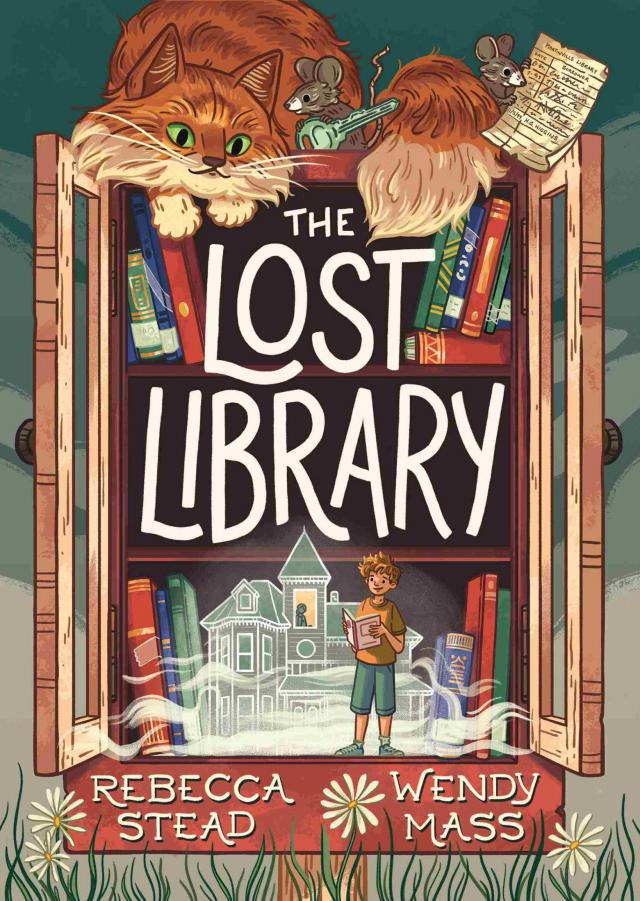
The lost library, p.5
The Lost Library,
p.5


* * *
When the bus pulled into the school parking lot, Rafe’s parents were both standing there waiting for it. He waved at them from the window, and his mom threw her arms around him as soon as his feet hit the ground. As if Rafe had been away for a week instead of an afternoon.
“Well?” Rafe’s dad said.
And Rafe said, “It was good,” and waved bye to Evan.
There was a little crowd of parents, actually. But Evan didn’t even look for his. They had trusted him to get home on his own since the end of third grade.
But then he heard Rafe call out. “Hey, Ev—there’s your dad!” And he pointed across the street.
His dad was standing at the edge of the town green, apart from all the other parents. He was under a tree, slightly bent, as if the space was a little too small for him.
“Dad!” Evan called. He watched his father find him in the crowd of kids and break into a smile. Evan jogged over. “I didn’t know you’d be here. Hi.”
His dad put one big hand on Evan’s head. “I was in town and saw everyone waiting, so I figured your bus was coming. How was GMS? Are the walls still mint green? Does the gym still smell like floor polish?”
“Yes and yes. And the bells are so loud. The cafeteria is gross. I’m glad we didn’t have to eat lunch there.”
His dad laughed. “Stop. You’re making me miss the special flavor of GMS frozen fish sticks! Believe it or not, they grow on you.”
“Edward?” Mr. O’Neal was crossing to where they stood. “Do you have a minute?”
“Of course. Everything okay?”
“Oh, for sure,” Mr. O’Neal said. “Everything is great. Just one tiny thing.”
“Two seconds, Evan!” his dad said, and followed Mr. O’Neal to the water fountain, where Mr. O’Neal took a long drink, wiped his mouth, and spoke in a low voice. His dad just listened. And then Mr. O’Neal handed him something, which his dad slid into his back pocket.
“What was that?” Evan asked when he was back.
“Nothing to worry about, kiddo.”
“Was it another mouse complaint?”
For some reason, his dad laughed at that. Evan didn’t think the mouse complaints were funny. He didn’t know his dad thought they were funny, either.
“Nope. Just some … um, paperwork.”
“Oh.”
Paperwork?
Chapter Sixteen
AL
The house feels different without the library cart in the basement. We are different. The dear cat remains outdoors with the books. And now suddenly Mr. Brock can’t keep hold of the broom. It passes right through his fingers.
Another thing: Supper has become quite somber. Last night, Mr. Brock, after so many years of cheerful suppertime book chatter with Ms. Scoggin, just gazed at his potato or looked sadly at the book on his lap.
He sniffed loudly and said, “Ms. Scoggin, the young woman in this story is being treated most unfairly. Most unfairly! I do wish I could help. But I suppose you will tell me that I am only a ghost.” He looked miserable.
“Maybe the lady’s future is brighter than you think!” I said, trying to cheer him up. In fact, Mr. Brock had told Ms. Scoggin all about the ending of this book just a day ago, and so I knew what I was talking about. But, as always, he pretended not to hear me.
“Things will get better,” Ms. Scoggin said, patting Mr. Brock’s hand. “I am sure of it.” She attempted to pick up her teacup. I watched her fingers pass through the handle several times before she managed it.
“I hope you are right,” Mr. Brock said. “A ghost can only hope, I suppose.” He gave a long sigh. “What courage!” Then he paused, and a suspicious look came over him. “But, Ms. Scoggin, I suddenly have the strangest feeling that I have read this book before.” Mr. Brock’s shoulders slumped. “I have no doubt told you all about it? Before?”
Ms. Scoggin and I exchanged a look.
“And I have listened with such joy, every time!” she said.
Mr. Brock used to remember every book he read. I had fetched hundreds of them over the years, from the library in Grantville. But recently he has begun to read the same story again and again, without even noticing.
“But how wonderful, Mr. Brock,” I said quietly, “to be able to read the books you love most, as if for the first time! I am quite jealous.”
He is very good at pretending that he neither sees nor hears me. But he sat up a little straighter, gazed at Ms. Scoggin, and managed to produce a small smile. “I am a lucky man,” he announced.
Ms. Scoggin’s forehead was tight. She looked almost distressed.
“Is he all right?” I whispered.
“My dear,” she said in a low voice, “this cannot go on forever, you know.” She gestured impatiently. At the table? At ourselves, sitting around it? I wondered if she was unhappy with my dinner. I had served baked potatoes for several nights in a row.
“What cannot go on?” I asked her. “Are you talking about Mr. Brock’s books, or the potatoes?”
“Potatoes!” She exploded. “What does this have to do with potatoes? I am talking about us. We can’t stay much longer, my dear!”
Whenever she starts talking like that, I pretend not to hear her. I learned how from Mr. Brock.
They went to bed early, while I stayed up worrying (and washing the dishes). It was painful to see Ms. Scoggin so upset. But it’s hard to solve a problem when you don’t know what it is.
* * *
Today, I woke up determined to make the day a good one. I fixed Ms. Scoggin’s tea, put two sugar cubes on her saucer, climbed the stairs, and knocked on her door.
“Come in!” she barked.
I put on an extra-large smile and entered her room.
She was sitting up in bed, fiddling with her pin.
“It won’t stay on straight!” she said. “Impossible thing!”
Gently, I took it from her and fastened it to her shirt. “There,” I said. “It’s perfectly level! And here’s your tea.”
She sighed. “Thank you, my dear. I’m just a bit tired today.”
Her librarian pin, from our library days, an impossible thing? I had never once heard her complain about it before. I touched two fingers to my own pin and hoped this was not another Changed Thing.
As I was closing Ms. Scoggin’s door behind me, I heard two quick knocks from below. My heart jumped, and I rushed down the stairs and opened the front door.
No one. Just a small paper bag. I scooped it up.
I knew what was in the bag: a tuna fish and dill pickle sandwich on rye bread, with lettuce. In my library days, it was my favorite lunch. The sandwich arrives every Wednesday, but I am never quick enough to see who has left it for me.
I carried it, smiling, to the icebox. But then I thought, what’s wrong with tuna for breakfast? (Especially after a week of potatoes?) So here I sit, eating it, and thinking about the dear boy again. It must be because of all the fuss about the library pins.
* * *
One day, long ago, when I was still getting to know him, I asked Ms. Scoggin for some advice. Could I be doing more to draw the dear boy out? To make him want to sit with us on the rug during Wednesday Book Club?
Ms. Scoggin said, “His mother died last summer. My advice is to let him sit where he wants to.”
“Oh,” I said. And she gave me an understanding look.
As Ms. Scoggin knew, I was also motherless. In fact, I had no memory of a mother or a father. At the orphanage, it had sometimes been said that those of us without parent memories were the lucky ones. But I was never sure about that.
It’s true that I did not long for my parents, the way some others did. But aren’t “parents” the source of a life’s direction? If life is a line, leading somewhere, aren’t parents the dot from which it sets forth?
Even people who disliked their parents, as one or two of my orphanage friends claimed to do, had a “from.”
But me?
I was told that I could make up my own “from.”
“Imagine whatever you like!” the orphanage manager told me. “Any of it could be true. Anything!”
But I did not know where to start. Were they farmers? Acrobats? Doctors? Spies? Sailors? Horse people?
Were they kind? Careless? Selfish? Brave? Horrible? Wonderful?
I would lie in bed, imagining. It was hard work. I preferred, once I had been taught how, to read stories that other people had imagined.
First, I read all the stories in the book room at the orphanage, and then I found all the other places books were hiding in the building. Our cook had a wonderful collection in her bedroom—she had kept every book she loved as a child. I worked my way through her shelves while “helping” in the kitchen, which meant occasionally stirring the soup with a spoon in one hand while holding a book with the other.
Then, in third grade, I discovered the public library. There were, I realized, many, many books to be read. (Until then, I had been slightly worried about running out.) At the orphanage, each of us had a flashlight, and I began to stay up very late with mine, reading until my eyes would not stay open. Which meant that I usually did not manage to turn my flashlight off. Luckily, I knew where the batteries were kept.
And then the orphanage manager found me rooting through the battery drawer, which was almost empty. She told me, gently, that I would need to start getting my own batteries.
“Let’s go to the battery library, then,” I told her. “I’m going to need a lot.”
She laughed. “The what?”
“The battery library,” I insisted, shaking my flashlight at her. “To borrow batteries.”
There were no battery libraries. Batteries had to be bought with money. Batteries, she explained, were expensive. And once you were done with them, that was it, they were used up.
For the first time, it occurred to me that books don’t get used up. Books got powered by the reader, didn’t they? They could be read again and again. (As long as no one dropped them into the soup. Which only happened once.)
But I still needed batteries.
The manager said that I had given her an idea. She would lend me battery money now, and I could pay her back later.
“How?” I asked her. “I don’t have any money to pay you back with.”
She said I would get a job, when I was older. Since I liked books so much, maybe I could get a job at a library. And that is what happened.
My first job was at our city library, an old, very large, not-too-clean building squeezed between a small bank and a smaller hardware store. To me, that library always looked like a grubby giant whose arms had been tied behind its back. My job was after school, because I was only thirteen years old. Mostly I mopped and looked with great longing at the young adults who stamped the circulation cards, wheeled around the squeaky carts full of books, and talked to the patrons. (About books!) They were, I learned, assistant librarians.
I mopped. And cleaned toilets. Nobody talked to me.
But I had library privileges. And battery money.
Chapter Seventeen
MORTIMER
The second major expansion of Martinville’s little free library took the form of an old red wagon pulled by two third graders: Jessica and Winnie D. (Not to be confused with Winnie R., Mortimer remembered, who was in the fifth grade.)
Jessica and Winnie D. had divided their wagon of books into three parts and labeled them with beautiful handmade signs: There were HORSE STORIES, DOG STORIES, and OTHER ANIMAL STORIES.
No CAT STORIES. Mortimer tried to glare at them, but they were scratching him behind the ears at the time, and he did not manage it.
As they left, Winnie called back to him. “I’m coming back later, cat! With my dad!”
* * *
When the sun began to get low in the sky, Mortimer stretched out on the grass and listened to the frogs, who had started their night singing early. Several of the animal books had already been taken (two dog, one horse), and a few books had been added to the egg crate. Even with a few other afternoon departures, there wasn’t much room behind the cheese cupboard doors. But all was well with the library.
He watched the door of his house, wondering when his dinner would emerge.
The porch door opened. Looking left and right, left and right, Al came quickly across the green with Mortimer’s supper dish. Mortimer stood up and got ready for her hug.
But Al didn’t hug him. She seemed entranced by the library.
“Look at this,” she whispered, “the library is growing!” She examined the red wagon, her fingers caressing one book at a time while she cooed over the signs the girls had made.
Mortimer began to wonder if Al was going to set down his food dish anytime soon.
“Sorry!” she said, catching his expression. “I guess I got excited.”
First looking around to make sure they were alone, Al sat with him while he ate. “Ms. Scoggin is hovering more than usual,” she told him. “Last night, she had to keep hold of her chair with one hand in order to stay at the table! And Mr. Brock keeps dropping his books. I wonder if I should be worried. Are there ghost doctors, do you suppose? How would I even call one?”
Mortimer had never thought about it. Cats could see ghosts, of course, but he had never seen a ghost doctor. Then his thoughts were interrupted by voices from the other side of the green. Not mouse voices. Human ones.
Al’s eyes got big. She hugged Mortimer quickly before picking up his empty dish. It was a tight hug on a full stomach, but Mortimer was happy to have it. Then he watched Al race back to their house, half-bent into a funny crouch.
The human voices approached from the other direction. Winnie D. was back, Mortimer realized, with her dad.
“Did you see that?” Winnie said, looking toward the History House, where Al had just scurried up the steps.
“Yes, I did,” her dad answered quietly.
“Have you ever talked to her, Dad? Jessica tried once, on a dare. But the lady ran away.”
“Don’t play games with that lady,” Winnie’s dad said. “If she wanted to talk to us, she would. I think she wants to be left to herself.”
“Ooh, the cat’s still there!” Winnie said, catching sight of Mortimer. “I told you he lives here.”
Winnie’s dad carried a big beach umbrella in one hand and a shovel in the other. He carefully dug a hole, inserted the umbrella stick, and then Winnie refilled the hole, patting the dirt down hard so the stick wouldn’t wobble. When they opened the umbrella, it covered both Mr. Gregorian’s egg crate and the red wagon. Then Winnie laid a towel, folded twice, on the ground under the umbrella.
“It’s supposed to be a bed, if you want it,” she told Mortimer.
After they left, he settled on the towel, which was nice and thick. From here, he could see all his books. He liked his bed very much. He doubted he would be able to see the stars through the umbrella, but he, along with the books, would stay dry if it rained.
Mortimer liked Winnie D. It was fine that she liked dogs and horses better than cats.
Mortimer liked his library. He was taking good care of it.
And so were the people of Martinville.
* * *
He wondered if Finn had ever found any food.
Chapter Eighteen
AL
I first saw the Martinville Library, and met Ms. Scoggin, the same week I started college in Grantville. I had just left the orphanage and was only seventeen years old. Everything felt very new and bewildering.
Ms. Scoggin had put an ad in the paper. She needed a “library helper,” and she hired me on the spot. I hoped there would not be as much toilet cleaning in Martinville as there had been at the grubby giant.
* * *
Ms. Scoggin told me, soon after I arrived, that every time she read a new book, she built a new room in her mind. “I have rooms and rooms up here now,” she said, tapping above her left ear, “but there’s always space for another one.”
After that, whenever I looked into her shining brown eyes, I imagined an enormous and beautiful house on the other side of them.
I had a pretty big house behind my eyes, I realized. But I wanted a bigger one.
For some years, I did very little besides go to my classes, clean the library, and read books. Sometimes, Ms. Scoggin helped me choose them. Hunched over my breakfast, riding the bus, and in bed with my flashlight, I built room after room in my mind.
My house grew very large indeed. And, slowly, I stopped worrying about the mystery of my “from.” I did not have to imagine a tragic story about kind (but poor) acrobats, or smart (but selfish) bankers, because, I realized, I was “from” my own now-enormous house. The house I had built myself by reading all those books, with help from Ms. Scoggin, and from those flashlight batteries, which turned out to be, as the orphanage manager had promised, quite expensive.
It was only natural, once I had finally solved the question of my “from,” to start to wonder about my “to.” In other words, where was I going?
The answer was obvious. I was going to be a librarian. When I told Ms. Scoggin, her face went bright. She walked to her desk, opened a drawer, and pulled out an application for library school.
She’d already written my name at the top.
Chapter Nineteen
EVAN
Evan’s phone rang while he was brushing his teeth that night. He spit and ran back to his room without rinsing.
“I started thinking,” Rafe said. “About what Mr. O’Neal said on the bus. And I looked up the library fire. Guess what? It burned down on the exact same day those books were returned. November 5, 1999. That’s the date on all the circulation cards, right?”
“Yeah, are you sure?”
“It burned down that night, after closing. I found an article online.”
Evan thought about the way Mr. O’Neal had been looking at him on the school bus.