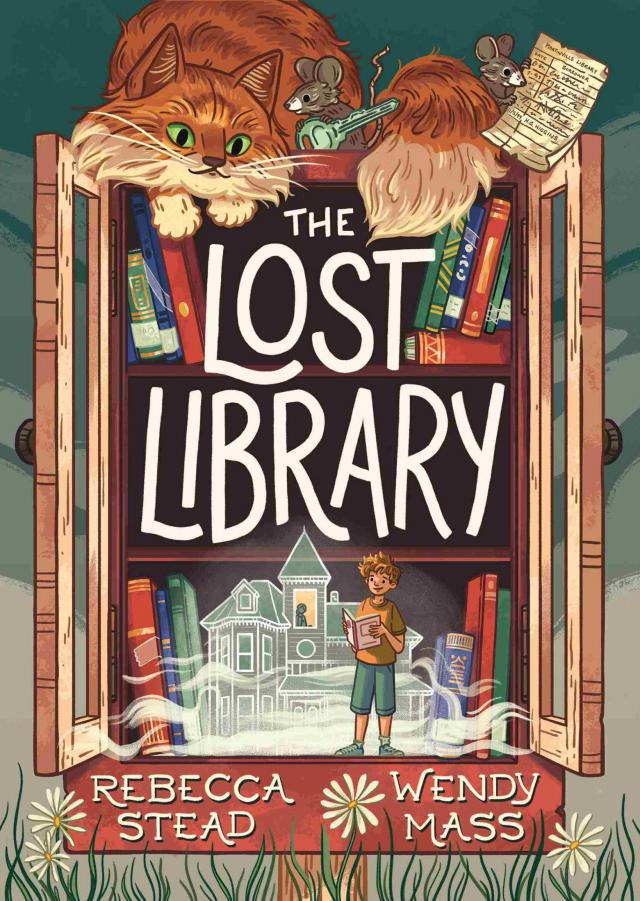
The lost library, p.8
The Lost Library,
p.8


“Paint!” the little girl said, pointing. “Paint more, Mommy!”
“Our paints are at home, honey. Let’s read now. Read book?”
“Book,” the girl confirmed. “Me-ow.”
Mrs. Baker removed one of the books from the case and opened it.
“Here’s a poem I love,” she said. “This poem is called ‘April Rain Song,’ by Mr. Langston Hughes. He was a teenager when he wrote it.” She cleared her throat, and began:
Let the rain kiss you.
Rain kiss! Mortimer thought. That reminded him of “wind tickle.”
Let the rain beat upon your head with silver liquid drops.
Silver liquid, his heart said. Yes! Exactly.
Mortimer closed his eyes so he could listen better.
When the poem was over, he opened them. Something inside him had changed.
Listening to poetry, Mortimer’s heart said, feels like looking in a mirror.
Maybe he was good with words, in his own way.
He wished he could tell Petunia.
“Whoops,” Mrs. Baker said.
Mortimer looked up and saw clouds, heavy and low. He felt a few drops of rain.
Mrs. Baker closed the book and carefully pushed the suitcase along the grass until it was tucked safely under the umbrella. They all scooched until they were underneath, too. Together, they watched the rain fall. Silver liquid drops.
But Mortimer felt unaccountably tired. He knew he was old, but he had hardly ever felt old. Now he did.
If Petunia is anywhere, he told himself, she must be old, too.
Which seemed impossible.
* * *
Mrs. Baker left the suitcase, which became the library’s fourth room.
Chapter Twenty-Six
EVAN
Friday morning, Evan’s parents made him a special graduation breakfast, French toast with bananas. His mom squeezed fresh orange juice, and his dad cooked the bananas with sugar in a pan, making them sweet and crunchy. When they were sitting at the table, his parents looked pretty happy. His mom had actually taken her headset off, and his dad was laughing. Maybe, Evan thought, he should stop trying to solve a mystery that probably didn’t exist.
He tried not to wonder about H. G. Higgins.
He tried to worry about nothing other than keeping his button-down shirt clean for graduation that afternoon.
* * *
He was stuffing books into his backpack near the back door when his mom asked, “Have you been back to the little free library, Ev? I drove by yesterday—people sure seem to love it.”
Evan hadn’t been back. He could see it across the street on his way to school, though. It was definitely growing.
His dad said, “I’d like to see it, too. Maybe after graduation?”
“It’s weird they never rebuilt the real library,” Evan said. “Why didn’t they?”
His mom cleared her throat. “Well, when the library burned down, it was a really painful time—for the town.”
“Dad? I mean, you lived here.” His mother had grown up in California. She and his dad had met in college. “Didn’t anyone want to rebuild it?”
His dad was staring at the table. He said, “If anyone did think about rebuilding, I’d be the last person in town they would talk to about it.”
The kitchen felt quieter than it had ever been. Even the refrigerator seemed to hold its breath.
Evan said, “Why?”
But his dad just smiled. “I don’t know why I said that, Evan. I guess I didn’t get much sleep.”
“The school librarian said you used to work at the library, when you were in high school. Were you working there when it burned down? Did you know those people who died?”
His dad looked at the floor. “I have so many emails to answer, Evan. I can’t have this conversation right now. I’ll see you at graduation.”
“Yes, the picnic!” his mom said, fiddling with the headphones that hung around her neck. “Dad’s making a pie.” She was nervous, Evan realized.
“You guys!” Evan said. “You can’t just—not tell me anything!”
His parents studied him. The way they were looking at him made Evan feel, for those few seconds, like he could see himself through their eyes. He stood tall and looked right back at them.
Then his dad looked up and said, “You’re right, Evan. How about after the picnic you and I talk? We can walk home together.”
Evan hesitated. “This afternoon? You won’t back out?”
“No chance. It’s a plan. So get yourself on the road, and let me do my work and start up this pie.”
Evan glanced at his mom, who was smiling across the kitchen at his dad. His dad would explain it all. Today! Why hadn’t he just asked him before?
He left the house feeling closer than ever to solving his probably-not-even-a-mystery.
* * *
The day felt long, even for a half day. Evan mostly looked around their classroom and felt weird that they were never coming back to it. He couldn’t even eat his lunch, but he wasn’t sure if it was because he was excited about graduating, nervous about talking to his dad later, or sad about leaving Martinville Elementary. Through the cafeteria windows, they started to hear cars pull up. The families were coming.
Mr. O’Neal excused himself, and everyone knew why. Every year, he bought a new bow tie for graduation, and he always put it on right before the ceremony started. The ties were usually … colorful.
“What do you think it’ll be?” Evan asked Rafe, who was eating Evan’s sandwich. “Polka dots? Rainbow stripes?”
Rafe chewed. “Baseballs, maybe?”
“Baseballs?”
Then Mr. O’Neal reappeared, wearing a bow tie with little books on it. Some of the kids clapped. “In honor of our new little free library,” he said, patting his tie. “This is it! Graduation time. Let’s line up.”
Then the other fifth-grade teacher, Ms. Brennan, called out, “Let’s move, people!” and her class jumped up and mobbed the door. Mr. O’Neal rolled his eyes.
* * *
Chairs had been set up on the lawn outside, and it was sunny out, with what Evan’s mom liked to call a “perfect breeze.” While they marched down to their seats near the front, kids waved to their parents and pointed at the rows of desserts waiting on the long table near the podium. Evan found his parents and waved. Then he caught up to Rafe in line so they could sit together.
Each year, the fifth-grade teachers picked poems to read at graduation. This year it was Mr. O’Neal’s turn to read first. “This year’s graduating class is an especially lovely and deep group of students,” he said, unfolding a piece of paper. “So I picked an especially deep and lovely poem. It’s called ‘The Summer Day,’ and it was written by the American poet Mary Oliver.”
He cleared his throat, and began:
“Who made the world?
Who made the swan, and the black bear?
Who made the grasshopper?
This grasshopper, I mean—
the one who has flung herself out of the grass,
the one who is eating sugar out of my hand,
who is moving her jaws back and forth instead of up and down—
who is gazing around with her enormous and complicated eyes.
Now she lifts her pale forearms and thoroughly washes her face.
Now she snaps her wings open, and floats away.
I don’t know exactly what a prayer is.
I do know how to pay attention, how to fall down
into the grass, how to kneel down in the grass,
how to be idle and blessed, how to stroll through the fields,
which is what I have been doing all day.
Tell me, what else should I have done?
Doesn’t everything die at last, and too soon?
Tell me, what is it you plan to do
with your one wild and precious life?”
Mr. O’Neal looked up from his paper, smiled, and blew them all a kiss.
“Wow,” Rafe said.
Evan turned around in his chair to look at his parents. His dad was wiping at his eyes. He saw his mom lean over to kiss him on the cheek.
Then Ms. Brennan was marching up to the podium. She grabbed it with both hands and leaned forward.
“Life is like riding a bicycle!” she shouted. “To keep your balance, you must keep moving! Albert Einstein said that!” She turned around and walked back to her seat.
Then the fifth graders stood up to get their diplomas, one by one. Mr. O’Neal stood off to the side and shook hands with every kid in their class. When it was Evan’s turn, he said, “Keep looking for life’s mysteries, kid.”
And that was it. Everyone turned their attention to the dessert table.
* * *
There were sixty different kinds of cakes, pies, brownies, and cookies.
Correction, fifty-nine: Rafe’s parents had brought a bag of mixed nuts, because they “worried about sugar.”
Plus, they said, Rafe had that dentist appointment right after the picnic.
* * *
“Do they remember about the expiration?” Evan asked Rafe. They were on a blanket, eating five kinds of cookies. And this was only round one.
Rafe shook his head. “I have a feeling they forgot all about it. But it’s probably better that way.”
“Yeah, they look nice and relaxed.” Squinting, Evan had picked out Rafe’s parents in the crowd standing around the long dessert table. “Your parents only moved here ten years ago, and they’re talking to everyone. Look at my dad, alone over there. And he was born here.”
Evan’s dad was, as usual, standing a little bit apart from everyone else.
Rafe said, “He’s just shy, maybe.” He shoved a whole cookie into his mouth.
* * *
Half an hour later, Evan walked around picking up stray napkins and feeling antsy to leave. He was uncomfortably full of dessert, but worse, his dad had promised (promised!) to tell him … something, on the way home.
And then, when everyone had started gathering up their blankets and packing up their half-eaten pies, his dad had totally backed out.
“I’m so sorry, Evan.”
“Dad! You promised.”
Looking upset, his father was already moving toward the parking lot. “I just—I can’t right now. But we’ll talk soon. I promise.”
Evan stared after him. What just happened? A minute ago, he’d looked like he was actually having fun, for once, laughing with Mr. O’Neal. And then, when it was finally time to walk home together, he ran away.
Evan was done with waiting. It was time to put his detective cap on again. But he didn’t draw his thumb down his forehead. Too many people around.
Evan kicked a napkin. Then, feeling bad, he bent down and picked it up. His mom came up behind him and put an arm around his shoulders. “Your dad just needs a little more time. Walk me home? I’ll buy you a piece of pie.”
“Not funny. And I can’t go home yet. I have something to do.”
“Okay. But be home for dinner.” His mom raised the basket in her hand. “We’re having pie!”
Chapter Twenty-Seven
AL
Another graduation day.
The poems were especially good this time. (I listen every year, from the corner of our porch.) And the sight of the children running like wolves to the dessert table is always cheering. But when I came back inside and closed the door behind me, all my worries returned.
Ms. Scoggin is often off the floor now, for one thing. Hovering.
Mr. Brock reads the first chapter of his book over and over.
And the dear cat does not come home.
And me. I feel different, too. That old library cart carried not just old books, but old memories. Strong ones.
Mr. Brock’s singsong voice came down the stairs. “Ms. Scoggin? Where, oh where, is my 4:00 P.M. cheese, Ms. Scoggin?”
“I’m sure I have no idea!” Ms. Scoggin called back to him from her chair in the parlor. “But I hope it arrives soon, along with my tea!” She hovered above her chair, grabbed on to the seat cushion to steady herself, and fixed me with a look.
I was very happy to make the tea and fetch the cheese because I wanted—well, what did I want?
For Ms. Scoggin’s smile to come back, mostly.
So I brewed a pot of tea and brought it to Ms. Scoggin, and then took the cheese plate from the kitchen cupboard and set off for Mr. Brock’s room with it.
I was rushing past the front door on the way to the stairs when I heard a knock.
Someone was at the door. On a Friday.
Someone, I realized, who could definitely see me.
Was it just bad luck that I had been right in front of the big porch window?
It was a boy, holding a notebook.
* * *
As you know, my invisibility has always been a struggle. I could tell that it was doing absolutely nothing for me now. Because the boy was waving to me through the thin curtain, just a little.
I had two choices. I could pretend I had not seen him, and just turn my back and walk away, or I could open the door. Neither one appealed to me at all. It’s terrible when you don’t like your choices. I looked at the cheese, and then back to the boy, who gave me a little smile. I have never in my life been able to turn my back on a smile.
Which meant that I would have to open the door. So I did.
“Hello,” he said uncertainly. “I don’t know how this works. Was I supposed to make an appointment?”
“Yes,” I said. “I believe all History House appointments are to be made in advance. And tours are on Tuesdays and Sundays.” I thought of all my best hiding places, and how far I was from them.
His smile dropped, and he said, “Oh. Sorry.” And suddenly I was looking at the schoolbag on his back. He clearly intended to walk away, and if I’d had a moment to reflect, I would have let him do just that. Instead, some long-buried instinct kicked in, and I heard myself speaking!
“Wait. How can I help you?”
Chapter Twenty-Eight
EVAN
The woman who opened the door at the History House was not the same one who gave the tours. Evan felt kind of silly when he realized he had assumed that Mrs. Baker, who also worked at the Martinville Town Hall and ran the Summer Pancake Breakfast at the firehouse, actually lived at the History House. That was silly, like when he was little and thought that his teachers lived at school.
Instead, he stood in front of a barefooted lady in a long summer dress holding a plate of cheese. She wore a small round pin below her collar that said “AL.” And she did not look happy about opening the door.
She looked … nervous. And told him he was supposed to make an appointment, which he was almost relieved to hear. He turned to go.
But then she said, “Wait. How can I help you?”
He turned back. Now she was smiling. He couldn’t help looking at the cheese, arranged in four small, perfect triangles. Maybe there was a party going on in there? Someone had probably rented the History House for their own private graduation party. That would explain the name tag.
She followed his gaze, glanced at the plate, and said, “Oh, I’m sorry. I wish I could offer, but someone’s already—this belongs to someone.” She blushed.
Evan felt himself go red, too, and said, “Oh, no, I don’t want any. But are you having a party? I can come back.”
She laughed. “A party! No. This is just—” She moved her cheese-plate-hand behind her back. “Never mind. Please come in!”
Evan had been inside the History House many times over the years—it was always open on town holidays, like the Winter Stroll, when everyone bundled up and walked around the green admiring all the lights people put up on their houses and trees. He and his mom always stopped at the History House, where the old iron chandelier was lit by a lot of small candles, and drank cups of hot cider while his dad waited outside. His dad always said it was too pretty out to come inside.
And Mr. O’Neal had brought them here for a Tuesday Tour, even though they’d already gone in fourth grade, and also in second grade. But Evan didn’t mind—he loved seeing the way people in Martinville lived a hundred and fifty years ago—the rooms lit only by candles, pitchers and basins in the bedrooms for washing, big clunky wooden beds with beautiful quilts on them, and the kitchen where people had once cooked their meals inside the massive fireplace, which had an iron hook to hang the pots on. Each dish had its own slot in the wooden rack that hung on the wall. The cups hung on their hooks. There was something peaceful about all of it.
Now, from where he stood on the porch, Evan could see into the two front rooms, one of which was a cozy living room with a fireplace, a small sofa, and two soft chairs. The other room was mostly empty, except for a wooden table with chairs around it. This was where his class had gathered to listen to Mrs. Baker talk about the history of Martinville. She’d spread out some pictures and old papers on the table, and they all took turns looking. But not touching. Mrs. Baker had been very clear about that.
Today, the table was bare and gleaming, and Al the cheese lady was pulling out a chair for him. He took off his backpack and sat carefully with it in his lap. She wasn’t looking at him, but she wasn’t not looking at him. It was a little strange.
“Now, what sort of book are you after?” she asked.
“Oh. I’m not—after—a book,” Evan said. “I thought there might be some old pictures here, that I could look at. Of the old library. Or maybe some newspaper articles, from back when it burned down?”
The cheese woman froze.
“I won’t hurt them,” he added. “I mean, I won’t mess anything up.”