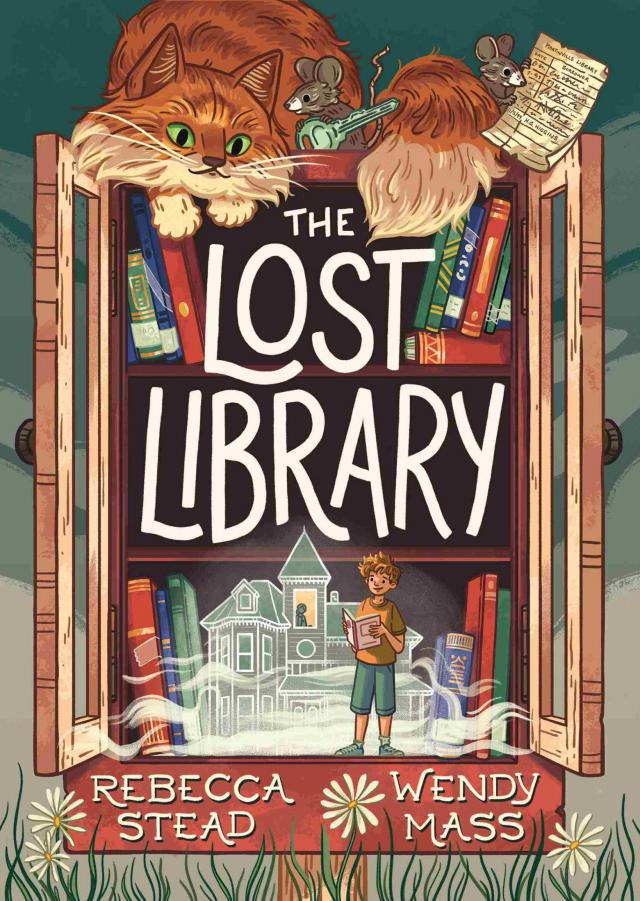
The lost library, p.9
The Lost Library,
p.9


She unfroze. “Don’t worry about that. In fact, you look like a very careful person. And yes, there is a box of things, clippings and such. Can you wait right here? Will you be all right alone for a minute?”
When she came back, she had a pair of eyeglasses hanging by a thin chain around her neck and a cardboard box in her hands.
* * *
A half hour later, Evan was partway home, holding his journal tightly to his side. He hadn’t wanted to put it in his backpack, because that would have meant letting it out of his sight. And he could not do that.
Inside his head, he could hear the words he had copied from the newspaper clipping, almost as if they were screaming at him:
The fire warden has determined that the tragic fire started in the basement. The police are questioning a young library intern, who was the last person known to have been in the basement before the fire broke out. His name is withheld here due to his age.
* * *
The road home felt much, much longer than usual.
Chapter Twenty-Nine
AL
What an extraordinary half hour. How can I explain it? To be useful again, not as a tea-and-cheese-bringer, or a potato-cooker and applesauce-maker, but, almost, as a librarian.
To be engaged with a young mind—a curious mind! It was wonderful. I felt I had to stop myself from floating up off the floor right in front of him (although I had never actually managed to float). For once, I was grateful for my unsatisfactory invisibility. That struggle, which I had always thought of as a weakness, had given me this beautiful moment.
I looked out the window and across the way, to where my little library stood. I felt proud of our town for making it grow, and proud of the dear cat for watching over it. And I remembered Ms. Scoggin’s words. You are a librarian, are you not?
Chapter Thirty
EVAN
Evan wasn’t even halfway home when he heard a squeaky bike bell from the road behind him. Evan stopped and turned. Demetri Pappas was pedaling toward him with a big smile on his face, calling out, “Evan!”
When Demetri braked in front of him, Evan saw that his bike basket was full of individually wrapped brownies.
“Want one?” Demetri said. “I got over to the town green as soon as the bus dropped me off. So many desserts are looking for a good home on graduation day.” He grinned.
“I’m full,” Evan said, one hand on his stomach. You’re tall now, he was thinking. In his running shorts, Demetri’s legs looked a mile long. And he used to be kind of short. Like Rafe.
“I saw you guys at school this week,” Demetri said. “You excited for Grantville Middle?”
“Yeah. I guess so.”
Demetri laughed. “I wasn’t thrilled about it, either. But you’ll like it. You get to pick an instrument. And I’ll be on your bus! For a year, anyway.”
Evan tried not to be too obvious about it, but he was still looking at Demetri’s legs. He had some bike grease on one shin, but his legs weren’t extra hairy. For some reason, this felt reassuring.
“It’s my other leg,” Demetri said, raising his far knee.
“What?”
“The scar.”
That was when Evan remembered Demetri’s epic scar, which ran down one leg, from hip to knee.
And then he remembered how Demetri got it.
“I just realized that I forgot something,” Evan said. “I have to go back to town.”
“Okay—have a good summer. I’m leaving for camp next week.” Demetri pedaled away, calling back, “I’ll save you a seat on the bus in September, okay?”
“Okay! Thanks!” Evan was already running in the other direction, despite the stomachache. To Rafe’s house. Because what he had to do next was dangerous, and he would feel better if Rafe were with him.
Luckily, Rafe’s dentist appointments were usually very quick. His parents made him brush after every meal.
Chapter Thirty-One
EVAN
The treehouse was a little bit famous—to the kids who knew about it, mostly the kids who lived on Evan’s road. It was just far enough into what they thought of as “their” woods that, when they first saw it, they imagined they had discovered something that not even one grown-up knew about. And the treehouse was high enough that they knew climbing up there was not only definitely against the rules, but actually pretty scary.
Then they got a little older. They talked about it, daring one another to go up. A few did go up, though none got in. There was a locked door, they reported, at the top of a very wobbly climb. The “ladder,” just rough planks of wood nailed to the trunk every few feet, had chipped in many places, and a few spun unexpectedly on their nails. Everyone who went up seemed relieved to be safely back on the ground, with the exception of Demetri Pappas, who lost his grip, got a cut down one leg, and broke an elbow. He was two years older than Evan, and was the chief reason Evan was never tempted to go up there himself. Until now.
Demetri was a friend, but being two years older, he’d started taking the bus to Grantville Middle two years ago. He was in the middle school orchestra, and came home on the “activities bus,” which got in later. He had a lot of homework and didn’t hang out in the woods much anymore.
Evan looked up at the tree.
It was Demetri who had told Evan about the padlock on the treehouse door, after he fell. He had used the exact word Rafe had: padlock.
“Are you sure you want to do this?” Rafe asked. “My dad says this thing is an attractive nuisance.”
“What instrument does Demetri play again?” Rafe’s mother taught music to a lot of kids in town.
“Violin,” Rafe answered.
Evan felt the outside of his front pants pocket to make sure the keys were still there. He tightened the straps on his backpack. “So his elbow must be fine now. If he plays violin, I mean.”
“True,” Rafe admitted. “Mom says he’s very good, actually.”
Evan nodded, put one foot on the first nailed-in plank, reached up to the second plank with both hands, tested it for stability, and hoisted himself onto the tree’s trunk.
* * *
There were a few shaky moments, but Evan climbed, plank by plank, until his arms felt weak and his head was almost level with the metal latch on the treehouse door. As promised, there was a padlock on it. A padlock that had foiled every previous climber.
Grateful for the nice thick branch beside him, Evan braced himself and fished for the keys. “Don’t drop,” he heard himself say. But he wasn’t sure whether he meant “don’t drop the keys,” or “don’t drop to the ground.” It was a long way down.
He grabbed the lock, which meant both hands were now off the tree itself, making him slightly light-headed with fear, and slid the smaller key into it.
“It FITS!” he yelled.
“YAY!” Rafe called back.
Evan smiled but didn’t look down. He turned the key and heard a click. The lock popped open.
“It’s unlocked!” he yelled, and then carefully maneuvered the padlock off the latch, shoving it into his pocket. He didn’t want to drop it on Rafe’s head.
Now all he had to do was open the treehouse door. He had to duck, to let it swing over his head. One arm wrapped around his friend (the sturdy branch), he gripped the corner of the door and yanked.
And then a few things happened very quickly.
First, Evan realized that the rusty hinges were not going to hold the door.
Also first, because these two things actually happened simultaneously, the door tilted dramatically, paused for a second, and then fell to the ground.
In that one-second pause, Evan had let go of the door so that he would not go down with it. He hugged his branch and heard the door land with a huge crash, followed by what felt like a huge silence.
Arms trembling, he hung there. “RAFE?”
More huge silence.
He looked down. But all he could see were leaves. “RAFE?”
Then he heard Rafe say, “Whoa.”
“ARE YOU OKAY?”
“Yeah!” Rafe yelled. “It missed me!”
Evan felt his heart start up again. “I’m coming down!” he yelled.
“No, keep going!” Rafe called. “I’m on my way up!”
“What? No!”
“What, yes! Expiration date, remember? Get going—I’ll be up there in a minute, and you’d better be out of my way!”
His eyes now at treehouse-floor level, Evan saw a rough plank floor covered with dirt and broken branches. He reached out, shoved his fingers into a crack between two floor planks, and pulled himself in. Flipping over, he lay there, looking up at … very little: plank walls with light shining in between the cracks, and a big open window covered by a screen of leaves hanging outside it.
He sat up. Everything felt pretty solid. He took a few deep breaths and was getting to his feet when Rafe’s head popped up at the doorway.
“That was fast,” Evan said. “I’m really glad you aren’t dead.”
Rafe smiled. “Me too. Pull me in—I need a hug.”
He wasn’t kidding. When Rafe needed a hug, he asked for a hug. It was one of the things that made Evan understand that Rafe, unlike Rafe’s parents, was mostly fearless.
Once he was in, and after the hug, Rafe brushed shards of bark from his shirt. “The ground isn’t as safe as my parents think it is.”
* * *
They scoured the treehouse for clues.
They tried to scour it, anyway. It was just the floor, four thin walls, and a bench built in along one of them, opposite the overgrown window, which filled the treehouse with a strange greenish light.
No shelves. No boxes. Nothing else to open. Nothing to find.
“Not seeing any clues,” Rafe said, running his fingers along the rough walls. Rafe had read that sometimes the hands could feel what the eyes missed. He jerked one hand back suddenly, but only to suck on a finger and say, “Ow. Splinter.”
“Keep looking,” Evan said, examining the underside of the bench. “Maybe there are initials carved somewhere. Look for HGH.”
Squinting at his splinter, Rafe said, “Tell me again why this matters so much?”
Evan hesitated. “I need a suspect,” he said. “A real one.”
Rafe nodded. Then he said, “Tell me again why you need a suspect?”
“Because.” Evan took a deep breath and decided to say the words. This was Rafe. He could trust Rafe.
“Because my dad is a suspect. I think he was working at the library that night. In the basement, where the fire started. But he didn’t do it. I know he didn’t. So I have to figure out who did.” He waited for Rafe to ask more questions.
But all Rafe said was, “Your dad would never set fire to a library. Not in ten million lifetimes. Anyone who knows him would know that.”
It felt good to hear Rafe say that. “Yeah, well. Not everyone knows him, I guess.”
“But you really think H. G. Higgins had something to do with it?”
Evan shrugged. “Maybe. We know he returned a book that day. A book with a picture in it.”
“But we don’t know that those keys were his. They could have been anyone’s.”
“The keys opened the treehouse,” Evan said, sitting down on the bench. “So if there’s something up here that points at H. G. Higgins, he’d be a real suspect. I could tell the police, maybe.”
“Yeah. But there’s nothing here.” Rafe paced around the floor in a tight circle, then stopped in front of the single, overgrown window. Leafy branches hung every which way just outside it, blocking the view.
Evan stared for a second, then jumped up and went to the window. Reaching through the opening, he tried to push aside some of the branches. “Help me.”
Even using all four of their arms, they managed to clear only a little spy hole through the green. But it was enough. All of Martinville lay below them. They could see most of the town hall, a corner of the school, and the top half of the History House.
Evan said, “This is it! This is where the Polaroid picture was taken. H. G. Higgins—or someone—was standing right here with the camera.”
Rafe smiled. “The picture was inside the book…”
Evan reached for his backpack and felt around inside it. “And the book was returned to the library on the day of the fire…”
“By H. G. Higgins!”
Evan held up the Polaroid while Rafe did his best to maintain the view through the spy hole without falling through the window.
“Right here,” Evan said. “I can even see that knot in the picture.” He pointed to a brown spot in the wood just beside the window.
Rafe squinted at the Polaroid. “Yeah. And whoever’s eye that is. Too bad there isn’t a little more face. This could be anyone.” He held the picture up to Evan’s face. “It could be you!”
“This proves that H. G. Higgins used to live in Martinville. He was at the library the day it burned down. And then he never came back. He probably lives in New York City with millions of other people and thinks no one will ever find him!”
“Suspicious,” Rafe said. “But why would he want to burn down a library? He writes books.”
“I’m going to find him,” Evan said, ignoring the question. “I’ll make him confess. And then everyone will know my dad didn’t set that fire.”
“I’ll help you,” Rafe said.
Chapter Thirty-Two
AL
The problem with my beautiful moment with our visitor was that I wanted the one after it to be beautiful, too. I wanted another person, a person with questions, to knock on the door. But the child with the notebook was only in the house for twenty minutes, and there was no one else.
After he left, I sat down at the big wooden table with the box marked “Martinville Library Fire.” He had carefully repacked the things inside, which I appreciated as I laid them out in front of me. There were a few news articles from the Grantville paper, and even a short paragraph from the City News. (Martinville is too small to have its own newspaper.)
Plus the obituaries of Ms. Scoggin and Mr. Brock. (They had both led notable lives, unlike myself.) I remembered the funerals, where the three of us ghosts had stood together in the sunlight, watching. I was particularly watching our dear boy, of course. Though we’d watched him grow quite tall by the time he was a teenager, his cheeks had never fully lost their roundness. He still blushed whenever he spoke, which is a sure sign of depth and sincerity. And, at Ms. Scoggin’s funeral, he spoke.
He talked about what the library meant to him. I know it sounds unlikely, but it seemed as if he was looking at us the whole time he spoke. I felt just as invisible as Ms. Scoggin and Mr. Brock were that day, but I may have been fooling myself.
My mind struggled with the same old knot:
It was impossible that our dear boy had started the fire. He would never do such a thing. Even if he was upset. Never.
It was impossible that anyone else had started the fire: The warden said that a match had been struck in the library basement and held to a book. No one but the dear boy had been there.
I remembered the dear boy that fateful evening, his head down and his ears bright red, hurrying down the basement stairs after Ms. Scoggin let him have it: Criticisms galore. He hadn’t changed the paper towel rolls in the bathrooms. He needed to remember to stand up straight and look people in the eyes. And, worst of all, he’d mis-shelved some biographies in the fiction section! A misfiled book was as good as lost, didn’t he know that by now?
By the time he got away from her, he was practically running.
I had not let myself think of that day for a long time.
I gathered up the clippings, put them back in their box, and walked it over to the large cabinet marked “Town History.”
Hardly anyone ever comes to look at such things.
Lost in my cloud, I crossed the parlor to gather Ms. Scoggin’s teacup.
She was in her chair, her cup within reach, but still full to the brim and, by now, surely cold. Mr. Brock had come downstairs and was in his spot on the sofa.
Or he was hovering above it, anyway. I stared: They were both hovering now? Why?
Mr. Brock gripped his book with both hands. I realized I had never given him his cheese. It wasn’t like him not to notice the absence of cheese.
“You didn’t drink your tea,” I said to Ms. Scoggin. “Should I brew another pot?”
She shook her head. “I shouldn’t have yelled at him,” she said. “He was a good boy.” She covered her librarian pin with one hand.
I didn’t say anything. I knew she wasn’t talking about the child who had just left our house. We both knew exactly who she was talking about. The dear boy. But what could either of us do about it now?
I will always remember the day Ms. Scoggin presented him with his official staff pin. His eyes blazed with a pride I remembered from my own first day at the library. From that moment, he never came to work without it. We all wore our pins.
Ms. Scoggin’s said “Librarian.”
Mine said “AL” (for “assistant librarian,” which Ms. Scoggin said was too many letters to fit.)
And Edward’s said “Intern.”
Edward. That was his name. Our dear boy.
He liked to call me Al.
Chapter Thirty-Three
EVAN
“Dad!” Evan wasn’t even in the house yet. He was shouting from the driveway. “Dad!”
His father’s worried face appeared on the other side of the cellar window, near Evan’s feet.
“Dad!” Evan talked at the window. “I know about the library. I know what everybody thinks—that you…” He couldn’t make himself say it.
His dad’s face went away. Ten seconds later, his father banged out through the screen door with hard eyes and blotchy cheeks. “Who told you that?”
“No one told me!” Evan said. “I figured it out myself.” He held up How to Write a Mystery Novel. “Everyone thinks you set that fire, don’t they? But I know what to do—I think I know who did it!”