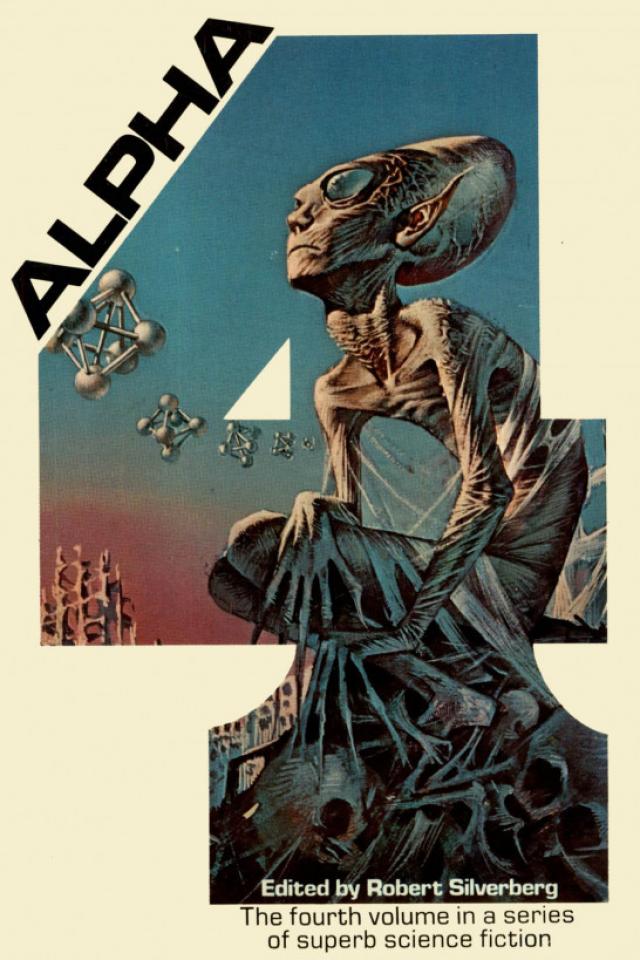
Alpha 4, p.11
Alpha 4,
p.11


The thought about the clock arrived. Divine revelation.
“The dancing will be on now,” I said, standing up like a jackknife.
“No!” Husband said.
“No!” Perdita said.
“You look as if you have aged,” I told them. That is my favorite line in all speech.
I ran out of the room, slamming the door behind me, ran step-club-step-club down the passage, and hurled myself into the elevator. With infinitesimal delay, I chose the right button and sank to ground level. There, I wedged the lattice door open with a chair; that put the elevator out of action.
People in the street took no notice of me. The fools just did not realize who I was. Nobody spoke to me as I hurried along, so of course I replied in kind.
Thus I came to the dance area.
Every community has its dance area. Think of all that drama, gladiatorial contests, reading, and sport have ever meant in the past; now they are all merged into dance, inevitable, for only by dance—our kind of dance—can history be interpreted. And interpretation of history is our being, because through the timescreens we see that history is life. It lives around us, so we dance it. Unless we have clubfeet.
Many dances were in progress among the thirty permanent sets. The sets were only casually separated from each other, so that spectators or dancers, going from one to another, might get the sense of everything happening at once, which is the sense the timescreens give you.
That is what I savagely love about history. It is not past; it is always going on. Cleopatra lies forever in the sweaty arms of Anthony. Socrates continually gulps his hemlock down. You just have to be watching the right screen or the right dance.
Most of the dancers were amateurs—although the term means little where everyone dances out his role whenever possible. I stood among a crowd, watching. The bright movements have a dizzying effect; they excite me. To one side of me, Marco Polo sweeps exultantly through Cathay to Kubla Khan. Ahead, four children, who represent the satellites of Jupiter, glide out to meet the somber figure of Galileo Galilei. To the other side, the Persian poet Firdausi leaves for exile in Baghdad. Farther still, I catch a glimpse of Heyerdahl turning toward the tide.
And if I cross my eyes, raft, telescope, pagoda, palm, all mingle. That is meaning! If I could only dance it!
I cannot stay still. Here is my restlessness again, my only companion. I move, eyes unfocused. I pass around the sets or across them, mingling stiff-legged among the dancers. Something compels me, something I cannot remember. Now I cannot even remember who I am. I’ve gone beyond mere identity.
Everywhere the dancing is faster, matching my heart. I would not harm anyone, except one person who harmed me eternally. It is he I must find. Why do they dance so fast? The movements drive me like whips.
Now I run into a mirror. It stands on a crowded set. I fight with the creature imprisoned in it, thinking it real. Then I understand that it is only a mirror. Shaking my head, I clear the blood from behind my eyes and regard myself. Yes, that is unmistakably me. And I remember who I am meant to be.
I first found who I was meant to be as a child, when I saw one of the greatest dramas of all. There it was, captured by the timescreens! The soldiers and centurions came, and a bragging multitude. The sky grew dark as they banged three crosses into the ground. And when I saw the Man they nailed upon the central cross, I knew I had His face.
Here it is now, that same sublime face, looking at me in pity and pain out of the glass. Nobody believes me; I no longer tell them who I think I am. But one thing I know I have to do. I have to do it.
So now I run again clump-trot-clump-trot, knowing just what to look for. All these great sets, pillars and panels of concrete and plastic, I run around them all, looking.
And here it is. Professionals dance out this drama, my drama, so difficult and intricate and sad. Pilate in dove-gray, Mary Magdalene moves in green. Hosts of dancers fringe them, representing the crowd who did not care. I care! My eyes burn among them, seeking. Then I have the man I want.
He is just leaving the set to rest out of sight until the cue for his last dance. I follow him, keeping behind cover like a crab in a thicket.
Yes! He looks just like me! He is my living image, and consequently bears That face. Yet it is now overlaid with make-up, pink and solid, so that when he comes out of the bright lights he looks like a corpse.
I am near enough to see the thick muck on his skin, with its runnels and wrinkles caused by sweat and movement. Underneath it all, the true face is clear enough to me, although the make-up plastered on it represents Judas.
To have That face and to play Judas! It is the most terrible of all wickedness. But this is Parowen Scryban, whom I have twice murdered for this very blasphemy. It is some consolation to know that although the government slipped back in time and saved him afterwards, he must still remember those good deaths. Now I must kill him again.
As he turns into a restroom, I have him. Ah, my fingers slip into that slippery pink stuff; but underneath, the skin is firm. He is small, slender, tired with the strain of dancing. He falls forward with me on his back.
I kill him now, although in a few hours they will come back and rescue him and it will all not have happened. Never mind the shouting: squeeze. Squeeze, dear God!
When blows fall on my head from behind, it makes no difference. Scryban should be dead by now, the traitor. I roll off him and let many hands tie me into a strait jacket.
Many lights are in my eyes. Many voices are talking. I just lie there, thinking I recognize two of the voices, one a man’s, one a woman’s.
The man says: “Yes, Inspector, I know that under law parents are responsible for their own children. We look after Alex as far as we can, but he’s mad. He’s a throwback! I—God, Inspector, I hate the creature.”
“You mustn’t say that!” the woman cries. “Whatever he does, he’s our son.”
They sound too shrill to be true. I cannot think what they make such a fuss about. So I open my eyes and look at them. She is a wonderful woman but I recognize neither her nor the man; they just do not interest me. Scryban I do recognize.
He is standing rubbing his throat. He is a mess with his two faces all mixed in together like a Picasso. Because he is breathing, I know they have come back and saved him again. No matter; he will remember.
The man they call Inspector (and who, I ask, would want a name like that?) goes over to speak to Scryban.
“Your father tells me you are actually this madman’s brother,” he says to Scryban. Judas hangs his head, though he continues to massage his neck.
“Yes,” he says. He is as quiet as the woman was shrill; strange how folks vary. “Alex and I are twin brothers. I changed my name years ago—the publicity, you know... harmful to my professional career...”
How terribly tired and bored I feel.
Who is whose brother, I ask myself, who mothers whom? I’m lucky; I own no relations. These people look like sad company. The saddest in the universe.
“I think you all look as if you have aged!” I shout suddenly.
That makes the Inspector come and stand over me, which I dislike. He has knees halfway up his legs. I manage to resemble one of the tritons on one of Benvenuto Cellini’s saltcellars, and so he turns away at last to speak to Husband.
“All right,” he says. “I can see this is just one of those things nobody can be responsible for. I’ll arrange for the reprieve to be countermanded. This time, when the devil is dead he stays dead.”
Husband embraces Scryban. Wonderful woman begins to cry. Traitors all! I start to laugh, making it so harsh and loud and horrible it frightens even me.
What none of them understands is this: on the third time I shall rise again.
ANGEL’S EGG
Edgar Pangborn
Edgar Pangborn is a quiet, retiring man of middle years who lives in rural New York State and, all too infrequently, offers the world some glowing, magical work of fiction. The rich and tender story you are about to read marked his debut as an author of science fiction in 1951. It was followed by several novels, including the lovely A Mirror for Observers and the rollicking picaresque Davy. After a prolonged absence from science fiction, Pangborn is producing some new stories: cause to rejoice.
LETTER OF RECORD, BLAINE TO MC CARRAN, DATED AUGUST 10, 1951.
Mr. Cleveland McCarran
Federal Bureau of Investigation
Washington, D.C.
Dear Sir:
In compliance with your request I enclose herewith a transcript of the pertinent sections of the journal of Dr. David Bannerman, deceased. The original document is being held at this office until proper disposition can be determined.
Our investigation has shown no connection between Dr. Bannerman and any organization, subversive or otherwise. So far as we can learn, he was exactly what he seemed, an inoffensive summer resident, retired, with a small independent income—a recluse to some extent, but well spoken of by local tradesmen and other neighbors. A connection between Dr. Bannerman and the type of activity that concerns your department would seem most unlikely.
The following information is summarized from the earlier parts of Dr. Bannerman’s journal, and tallies with the results of our own limited inquiry. He was born in 1898 at Springfield, Massachusetts, attended public school there, and was graduated from Harvard College in 1922, his studies having been interrupted by two years’ military service. He was wounded in action in Argonne, receiving a spinal injury. He earned a doctorate in biology in 1926. Delayed aftereffects of his war injury necessitated hospitalization, 1927-28. From 1929 to 1948 he taught elementary sciences in a private school in Boston. He published two textbooks in introductory biology, 1929 and 1937. In 1948 he retired from teaching: a pension and a modest income from textbook royalties evidently made this possible. Aside from the spinal deformity, which caused him to walk with a stoop, his health is said to have been fair. Autopsy findings suggested that the spinal condition must have given him considerable pain; he is not known to have mentioned this to anyone, not even to his physician, Dr. Lester Morse. There is no evidence whatever of drug addiction or alcoholism.
At one point early in his journal Dr. Bannerman describes himself as “a naturalist of the puttering type—I would rather sit on a log than write monographs: it pays off better.” Dr. Morse, and others who knew Dr. Bannerman personally, tell me that this conveys a hint of his personality.
I am not qualified to comment on the material of this journal, except to say I have no evidence to support (or to contradict) Dr. Bannerman’s statements. The journal has been studied only by my immediate superiors, by Dr. Morse, and by myself. I take it for granted you will hold the matter in strictest confidence.
With the journal I am also enclosing a statement by Dr. Morse, written at my request for our records and for your information. You will note that he says, with some qualifications, that “death was not inconsistent with an embolism.”
He has signed a death certificate on that basis. You will recall from my letter of August 5 that it was Dr. Morse who discovered Dr. Bannerman’s body. Because he was a close personal friend of the deceased, Dr. Morse did not feel able to perform the autopsy himself. It was done by a Dr. Stephen Clyde of this city, and was virtually negative as regards cause of death, neither confirming nor contradicting Dr. Morse’s original tentative diagnosis. If you wish to read the autopsy report in full I shall be glad to forward a copy.
Dr. Morse tells me that so far as he knows Dr. Bannerman had no near relatives. He never married. For the last twelve summers he occupied a small cottage on a back road about twenty-five miles from this city, and had few visitors. The neighbor, Steele, mentioned in the journal is a farmer, age 68, of good character, who tells me he “never got really acquainted with Dr. Bannerman.”
At this office we feel that unless new information comes to light, further active investigation is hardly justified.
Respectfully yours,
Garrison Blaine
Capt., State Police
Augusta, Me.
Encl: Extract from Journal of David Bannerman, dec’d.
Statement by Lester Morse, M.D.
LIBRARIAN’S NOTE: The following document, originally attached as an unofficial “rider” to the foregoing letter, was donated to this institution in 1994 through the courtesy of Mrs. Helen McCarran, widow of the martyred first President of the World Federation. Other personal and state papers of President McCarran, many of them dating from the early period when he was employed by the FBI, are accessible to public view at the Institute of World History, Copenhagen.
PERSONAL NOTE, BLAINE TO MC CARRAN, DATED AUGUST 10, 1951
Dear Cleve:
Guess I didn’t make it clear in my other letter that that bastard Clyde was responsible for my having to drag you into this. He is something to handle with tongs. Happened thusly—When he came in to heave the autopsy report at me, he was already having pups just because it was so completely negative (he does have certain types of honesty), and he caught sight of a page or two of the journal on my desk. Doc Morse was with me at the time. I fear we both got upstage with him (Clyde has that effect, and we were both in a State of Mind anyway), so right away the old drip thinks he smells something subversive. Belongs to the atomize-’em-NOW-WOW-WOW school of thought—nuf sed? He went into a grand whuff-whuff about referring to Higher Authority, and I knew that meant your hive, so I wanted to get ahead of the letter I knew he’d write. I suppose his literary effort couldn’t be just sort of quietly transferred to File 13, otherwise known as the Appropriate Receptacle?
He can say what he likes about my character, if any, but even I never supposed he’d take a sideswipe at his professional colleague. Doc Morse is the best of the best and would not dream of suppressing any evidence important to us, as you say Clyde’s letter hints. What Doc did do was to tell Clyde, pleasantly, in the privacy of my office, to go take a flying this-and-that at the moon. I only wish I’d thought of the expression myself. So Clyde rushes off to tell teacher. See what I mean about the tongs? However (knock on wood) I don’t think Clyde saw enough of the journal to get any notion of what it’s all about.
As for that journal, damn it, Cleve, I don’t know. If you have any ideas I want them, of course. I’m afraid I believe in angels, myself. But when I think of the effect on local opinion if the story ever gets out—brother! Here was this old Bannerman living alone with a female angel and they wuzn’t even common-law married. Aw, gee.... And the flood of phone calls from other crackpots anxious to explain it all to me. Experts in the care and feeding of angels. Methods of angel-proofing. Angels right outside the window a minute ago. Make Angels a Profitable Enterprise in Your Spare Time!!!
When do I see you? You said you might have a week clear in October. If we could get together maybe we could make sense where there is none. I hear the cider promises to be good this year. Try and make it. My best to Ginny and the other young fry, and Helen of course.
Respeckfully yourn,
Garry
P.S. If you do see any angels down your way, and they aren’t willing to wait for a Republican Administration, by all means have them investigated by the Senate—then we’ll know we’re all nuts.
G.
EXTRACT FROM JOURNAL OF DAVID BANNERMAN, JUNE 1-JULY 29, 1951
June 1
It must have been at least three weeks ago when we had that flying saucer flurry. Observers the other side of Katahdin saw it come down this side; observers this side saw it come down the other. Size anywhere from six inches to sixty feet in diameter (or was it cigar-shaped?) and speed whatever you please. Seem to recall that witnesses agreed on a rosy-pink light. There was the inevitable gobbledegookery of official explanation designed to leave everyone impressed, soothed, and disappointed. I paid scant attention to the excitement and less to the explanations—naturally, I thought it was just a flying saucer. But now Camilla has hatched out an angel.
It would have to be Camilla. Perhaps I haven’t mentioned my hens enough. In the last day or two it has dawned on me that this journal may be of importance to other eyes than mine, not merely a lonely man’s plaything to blunt the edge of mortality: an angel in the house makes a difference. I had better show consideration for possible readers.
I have eight hens, all yearlings except Camilla: this is her third spring. I boarded her two winters at my neighbor Steele’s farm when I closed this shack and shuffled my chilly bones off to Florida, because even as a pullet she had a manner which overbore me. I could never have eaten Camilla: if she had looked at the ax with that same expression of rancid disapproval (and she would), I should have felt I was beheading a favorite aunt. Her only concession to sentiment is the annual rush of maternity to the brain—normal, for a case-hardened White Plymouth Rock.
This year she stole a nest successfully in a tangle of blackberry. By the time I located it, I estimated I was about two weeks too late. I had to outwit her by watching from a window—she is far too acute to be openly trailed from feeding ground to nest. When I had bled and pruned my way to her hideout she was sitting on nine eggs and hating my guts. They could not be fertile, since I keep no rooster, and I was about to rob her when I saw the ninth egg was nothing of hers. It was a deep blue and transparent, with flecks of inner light that made me think of the first stars in a clear evening. It was the same size as Camilla’s own. There was an embryo, but I could make nothing of it.
I returned the egg to Camilla’s bare and fevered breastbone and went back to the house for a long, cool drink.
That was ten days ago. I know I ought to have kept a record; I examined the blue egg every day, watching how some nameless life grew within it. The angel has been out of the shell three days now. This is the first time I have felt equal to facing pen and ink.