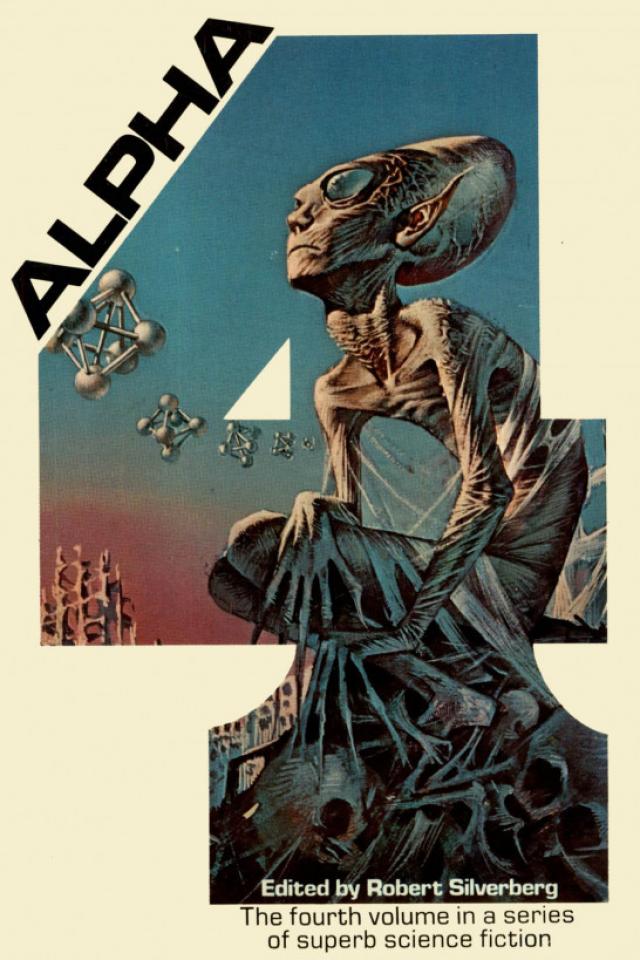
Alpha 4, p.15
Alpha 4,
p.15


I have not found-the recall painful, at least not in retrospect. There must have been sharp moments, mercifully forgotten, along with their causes, as if the process had gone on under anesthesia. Certainly there were plenty of incidents in my first twenty-eight years that I should not care to offer to the understanding of any but the angels. Quite often I must have been mean, selfish, base in any number of ways, if only to judge by the record since twenty-eight. Those old letters touch on a few of these things. To me, they now matter only as material for a record which is safely out of my hands.
However, to any persons I may have harmed, I wish to say this: you were hurt by aspects of my humanity which may not, in a few million years, be quite so common among us all. Against these darker elements I struggled, in my human fashion, as you do yourselves. The effort is not wasted.
It was a week after I told the angel my decision before she was prepared to start the recall. During that week she searched my present mind more closely than I should have imagined was possible: she had to be sure. During that week of hard questions I dare say she learned more about my kind than has ever gone on record even in a physician’s office; I hope she did. To any psychiatrist who might question that, I offer a naturalist’s suggestion: it is easy to imagine, after some laborious time, that we have noticed everything a given patch of ground can show us; but alter the viewpoint only a little—dig down a foot with a spade, say, or climb a tree branch and look downward—it’s a whole new world.
When the angel was not exploring me in this fashion, she took pains to make me glimpse the satisfactions and million rewarding experiences I might have if I chose the other way. I see how necessary that was; at the time it seemed almost cruel. She had to do it, for my own sake, and I am glad that I was somehow able to stand fast to my original choice. So was she, in the end; she has even said she loves me for it. What that troubling word means to her is not within my mind: I am satisfied to take it in the human sense.
Some evening during that week—I think it was June 12—Lester dropped around for sherry and chess. Hadn’t seen him in quite a while, and haven’t since. There is a moderate polio scare this summer, and it keeps him on the jump. The angel retired behind some books on an upper shelf—I’m afraid it was dusty—and had fun with our chess. She had a fair view of your bald spot, Lester; later she remarked that she liked your looks, and can’t you do something about that weight? She suggested an odd expedient, which I believe has occurred to your medical self from time to time—eating less.
Maybe she shouldn’t have done what she did with those chess games. Nothing more than my usual blundering happened until after my first ten moves; by that time I suppose she had absorbed the principles and she took over, slightly. I was not fully aware of it until I saw Lester looking like a boiled duck: I had imagined my astonishing moves were the result of my own damn cleverness.
Seriously, Lester, think back to that evening. You’ve played in stiff amateur tournaments; you know your own abilities and you know mine. Ask yourself whether I could have done anything like that without help. I tell you again, I didn’t study the game in the interval when you weren’t there. I’ve never had a chess book in the library, and if I had, no amount of study would take me into your class. Haven’t that sort of mentality—just your humble sparring partner, and I’ve enjoyed it on that basis, as you might enjoy watching a prima-donna surgeon pull off some miracle you wouldn’t dream of attempting yourself. Even if your game had been way below par that evening (I don’t think it was), I could never have pinned your ears back three times running, without help. That evening you were a long way out of your class, that’s all.
I couldn’t tell you anything about it at the time—she was clear on that point—so I could only bumble and preen myself and leave you mystified. But she wants me to write anything I choose in this journal, and somehow, Lester, I think you may find the next few decades pretty interesting. You’re still young—some ten years younger than I. I think you’ll see many things that I do wish I myself might see come to pass—or I would so wish if I were not convinced that my choice was the right one.
Most of those new events will not be spectacular, I’d guess. Many of the turns to a better way will hardly be recognized at the time for what they are, by you or anyone else. Obviously, our nature being what it is, we shall not jump into heaven overnight. To hope for that would be as absurd as it is to imagine that any formula, ideology, theory of social pattern, can bring us into Utopia. As I see it, Lester—and I think your consulting room would have told you the same even if your own intuition were not enough—there is only one battle of importance: Armageddon. And Armageddon field is within each self, world without end.
At the moment I believe I am the happiest man who ever lived.
July 20
All but the last ten years now given away. The physical fatigue (still pleasant) is quite overwhelming. I am not troubled by the weeds in my garden patch—merely a different sort of flowers where I had planned something else. An hour ago she brought me the seed of a blown dandelion, to show me how lovely it was—I don’t suppose I had ever noticed. I hope whoever takes over this place will bring it back to farming: they say the ten acres below the house used to be good potato land—nice early ground.
It is delightful to sit in the sun, as if I were old.
After thumbing over earlier entries in this journal, I see I have often felt quite bitter toward my own kind. I deduce that I must have been a lonely man—much of the loneliness self-imposed. A great part of my bitterness must have been no more than one ugly by-product of a life spent too much apart. Some of it doubtless came from objective causes, yet I don’t believe I ever had more cause than any moderately intelligent man who would like to see his world a pleasanter place than it ever has been. My angel tells me that the pain in my back is due to an injury received in some early stage of the world war that still goes on. That could have soured me, perhaps. It’s all right—it’s all in the record.
She is racing with a hummingbird—holding back, I think, to give the ball of green fluff a break.
Another note for you, Lester. I have already indicated that my ring is to be yours. I don’t want to tell you what I have discovered of its properties, for fear it might not give you the same pleasure and interest that it has given me. Of course, like any spot of shifting light and color, it is an aid to self-hypnosis. It is much, much more than that, but—find out for yourself, at some time when you are a little protected from everyday distractions. I know it can’t harm you, because I know its source.
By the way, I wish you would convey to my publishers my request that they either discontinue manufacture of my Introductory Biology or else bring out a new edition revised in accordance with some notes you will find in the top left drawer of my library desk. I glanced through that book after my angel assured me that I wrote it, and I was amazed. However, I’m afraid my notes are messy (I call them mine by a poetic license), and they may be too advanced for the present day—though the revision is mainly a matter of leaving out certain generalities that ain’t so. Use your best judgment: it’s a very minor textbook, and the thing isn’t too important. A last wriggle of my personal vanity.
July 27
I have seen a two-moon night.
It was given to me by that other grownup, at the end of a wonderful visit, when he and six of those nine other children came to see me. It was last night, I think—yes, must have been. First there was a murmur of wings above the house; my angel flew in, laughing; then they were here, all about me. Full of gaiety and colored fire, showing off in every way they knew would please me. Each one had something graceful and friendly to say to me. One brought me a moving image of the St. Lawrence seen at morning from half a mile up—clouds—eagles; now, how could he know that would delight me so much? And each one thanked me for what I had done.
But it’s been so easy!
And at the end the old one—his skin is quite brown, and his down is white and gray—gave the remembered image of a two-moon night. He saw it some sixty years ago.
I have not even considered making an effort to describe it—my fingers will not hold this pencil much longer tonight. Oh—soaring buildings of white and amber, untroubled countryside, silver on curling rivers, a glimpse of open sea; a moon rising in clarity, another setting in a wreath of cloud, between them a wide wandering of unfamiliar stars; and here and there the angels, worthy after fifty million years to live in such a night. No, I cannot describe anything like that. But, you human kindred of mine, I can do something better. I can tell you that this two-moon night, glorious as it was, was no more beautiful than a night under a single moon on this ancient and familiar Earth might be—if you will imagine that the rubbish of human evil has been cleared away and that our own people have started at last on the greatest of all explorations.
July 29
Nothing now remains to give away but the memory of the time that has passed since the angel came. I am to rest as long as I wish, write whatever I want to. Then I shall get myself over to the bed and lie down as if for sleep. She tells me that I can keep my eyes open: she will close them for me when I no longer see her.
I remain convinced that our human case is hopeful. I feel sure that in only a few thousand years we may be able to perform some of the simpler preparatory tasks, such as casting out evil and loving our neighbors. And if that should prove to be so, who can doubt that in another fifty million years we might well be only a little lower than the angels?
LIBRARIAN’S NOTE: As is generally known, the original of the Bannerman Journal is said to have been in the possession of Dr. Lester Morse at the time of the latter’s disappearance in 1964, and that disappearance has remained an unsolved mystery to the present day. McCarran is known to have visited Captain Garrison Blaine in October, 1951, but no record remains of that visit. Captain Blaine appears to have been a bachelor who lived alone. He was killed in line of duty, December, 1951. McCarran is believed not to have written about nor discussed the Bannerman affair with anyone else. It is almost certain that he himself removed the extract and related papers from the files (unofficially, it would seem!) when he severed his connection with the FBI in 1957; at any rate, they were found among his effects after his assassination and were released to the public, considerably later, by Mrs. McCarran.
The following memorandum was originally attached to the extract from the Bannerman Journal; it carries the McCarran initialing.
{{rightjust}}Aug. 11, 1951
The original letter of complaint written by Stephen Clyde, M.D., and mentioned in the accompanying letter of Captain Blaine, has unfortunately been lost, owing perhaps to an error in filing.
Personnel presumed responsible have been instructed not to allow such error to be repeated except if, as, and/or when necessary.
C. McC.
On the margin of this memorandum there was a penciled notation, later erased. The imprint is sufficient to show the unmistakable McCarran script. The notation read in part as follows: Far be it from a McC. to lose his job except if, as, and/or—the rest is undecipherable, except for a terminal word which is regrettably unparliamentary.
STATEMENT BY LESTER MORSE, M.D., DATED AUGUST 9, 1951
On the afternoon of July 30, 1951, acting on what I am obliged to describe as an unexpected impulse, I drove out to the country for the purpose of calling on my friend Dr. David Bannerman. I had not seen him nor had word from him since the evening of June 12 of this year.
I entered, as was my custom, without knocking. After calling to him and hearing no response, I went upstairs to his bedroom and found him dead. From superficial indications I judged that death must have taken place during the previous night. He was lying on his bed on his left side, comfortably disposed as if for sleep but fully dressed, with a fresh shirt and clean summer slacks. His eyes and mouth were closed, and there was no trace of the disorder to be expected at even the easiest natural death. Because of these signs I assumed, as soon as I had determined the absence of breath and heartbeat and noted the chill of the body, that some neighbor must have found him already, performed these simple rites out of respect for him, and probably notified a local physician or other responsible person. I therefore waited (Dr. Bannerman had no telephone), expecting that someone would soon call.
Dr. Bannerman’s journal was on a table near his bed, open to that page on which he has written a codicil to his will. I read that part. Later, while I was waiting for others to come, I read the remainder of the journal, as I believe he wished me to do. The ring he mentions was on the fifth finger of his left hand, and it is now in my possession. When writing that codicil Dr. Bannerman must have overlooked or forgotten the fact that in his formal will, written some months earlier, he had appointed me executor. If there are legal technicalities involved, I shall be pleased to cooperate fully with the proper authorities.
The ring, however, will remain in my keeping, since that was Dr. Bannerman’s expressed wish, and I am not prepared to offer it for examination or discussion under any circumstances.
The notes for a revision of one of his textbooks were in his desk, as noted in the journal. They are by no means “messy”; nor are they particularly revolutionary except insofar as he wished to rephrase, as theory or hypothesis, certain statements that I would have supposed could be regarded as axiomatic. This is not my field, and I am not competent to judge. I shall take up the matter with his publishers at the earliest opportunity.5
v~~~~~~~~~~~~~~~~~~~~~~~~~~~~~~v
5LIBRARIAN’S NOTE: But it seems he never did. No new edition of Introductory Biology was ever brought out, and the textbook has been out of print since 1952.
^~~~~~~~~~~~~~~~~~~~~~~~~~~~~~~^
So far as I can determine, and bearing in mind the results of the autopsy performed by Stephen Clyde, M.D., the death of Dr. David Bannerman was not inconsistent with the presence of an embolism of some type not distinguishable post mortem. I have so stated on the certificate of death. It would seem to be not in the public interest to leave such questions in doubt. I am compelled to add one other item of medical opinion for what it may be worth:
I am not a psychiatrist, but, owing to the demands of general practice, I have found it advisable to keep as up to date as possible with current findings and opinion in this branch of medicine. Dr. Bannerman possessed, in my opinion, emotional and intellectual stability to a better degree than anyone else of comparable intelligence in the entire field of my acquaintance, personal and professional. If it is suggested that he was suffering from a hallucinatory psychosis, I can only say that it must have been of a type quite outside my experience and not described, so far as I know, anywhere in the literature of psychopathology.
Dr. Bannerman’s house, on the afternoon of July 30, was in good order. Near the open, unscreened window of his bedroom there was a coverless shoe box with a folded silk scarf in the bottom. I found no pillow such as Dr. Bannerman describes in the journal, but observed that a small section had been cut from the scarf. In this box, and near it, there was a peculiar fragrance, faint, aromatic, and very sweet, such as I have never encountered before and therefore cannot describe.
It may or may not have any bearing on the case that, while I remained in this house that afternoon, I felt no sense of grief or personal loss, although Dr. Bannerman had been a loved and honored friend for a number of years. I merely had, and have, a conviction that after the completion of some very great undertaking, he had found peace.
IN HIS IMAGE
Terry Carr
Until 1971 Terry Carr was best known as the creative and venturesome editor who helped some of the finest science-fiction novels of recent years reach print—among them Ursula LeGuin’s The Left Hand of Darkness, Joanna Russ’s And Chaos Died, and R.A. Lafferty’s Fourth Mansions. Now a freelance based in the San Francisco area, Carr continues to edit—the Universe series of anthologies for Random House and an annual compilation of the year’s best s-f for Ballantine—but he has also resumed his own writing career after too long a hiatus. This crisp, moving little story is a good sample of his current output
I am quite beautiful, truthfully, built in the image of man though of course I am not an exact copy. But I have two arms and two legs, each articulated once at elbows and knees and each having either hands or feet.
I have a head also, which contains my sensory organs for sight, sound and radio; unlike humans, however, my logic processes are housed outside my head, mostly in my torso, thought I also have a radio link with the public computer. Good for calculations of all kinds, nearly instantaneous when I might take seconds, minutes. I never have to guess about chances; pubcomp calculates them for me.
Pubcomp says it is 98 to 3 that there is a human being alive in the city.
That is the easy calculation: “a human being.” But when we begin to speak of the human being, calculations become less sure. Pubcomp says it is .009% possible the human is in my city sector, and that is one of the highest probabilities, so I am searching diligently.
The other cities report no humans since two years four months plus past, so our human must be the last. (Correction: with all factors calculated, there is .0000000012 chance of another human on Earth. But that includes such hypotheses as human mutations to enable them to extract oxygen from oxides of sulfur or nitrogen. I ignore this hypothesis and others like it.)