

Out of earth, p.11
Out of Earth,
p.11


Penha can’t even see what her granddaughter, the girl, was looking at. Let alone the girl herself.
‘Do you remember, Deusa? Maria da Penha not screaming when she was born?’
‘That’s right, Maria, you came out your mother’s belly already not screaming.’
‘You couldn’t even use your ears, devil child, you were born weaned.’
‘It was Ma who said so, Penha was born already weaned it’s true, she said so.’
‘I heard her saying when the circus comes she’ll give them Penha to take with them.’
‘That’s what she said. I can’t stand this sin-faced devil-child any more, is what she said.’
‘Lord no, devil child, her mother don’t talk about people like that, Deusa, what are you saying?’
‘Really, Neusa, Ma cares about us, doesn’t she?’
‘Gosh, yes, Deusinha, I hope so, Deusinha, let’s hope so.’
The metamorphosis machine is the eclipse, it’s the woman, it’s the gorilla. An eclipse is when our eyes hide the sun, it’s when the woman hides inside the gorilla, one on top of the other, but don’t worry, it’s not a fight. The woman is the gorilla’s hunger and the gorilla is a monster like people imagine, big, with a hairy navel and belly. Everyone knows what the imagination is, but they’re not sure how to describe it: it’s something to do with not looking straight on, quite the opposite, it lies behind people’s eyes engorged.
All of us have some sense of how a woman stops being a woman and becomes something else, a gorilla thing. That’s what a woman is, the moon’s feet on the ground. We shouldn’t even be having ideas. God’s the one with the ideas, people just live through them. Grandma’s the one who knows things, but there’s a lot she doesn’t say, and keeps to herself. Keeping to oneself means not needing anyone else. And hunger? Everyone has hunger.
There’s none of this when the stomach is sleeping peacefully, Fátima’s wrong, dammit, Fátima knows nothing about this: hunger means stuffing your mouth with a stomach of words. Don’t you see how we talk when we’re hungry? The woman with next to nothing on gleaming all forgotten everyone knows how she turns into a gorilla, the distant roar, the broken bones, the fur showing. Only the girl watches the gleaming forgotten woman only the girl notices, my God, look how hungry she is. Goddamnit, why was it only the girl? Not long now until we tell you.
‘Look at that, Deusinha, it’s another of those hunger artists.’
‘Look, Neusa, this one’s on his last legs, see?’
‘This one’s got nails, look, Deusinha, he hasn’t eaten his own fingers.’
‘Gotta watch out for that one, what if he takes his chance and eats.’
‘Don’t need to, when he eats he’ll stop being a hunger artist.’
‘Let’s keep an eye on him, Neusinha, this time we’re in luck…’
‘Did you see, Deusinha? The creature in front of us right in front of…’
‘Did you see? Let’s keep an eye out, Heaven knows our luck might run out again.’
‘Bite that tongue of yours. Mary mother of God. This time it’ll be in Vilaboinha.’
When the girl, Penha’s granddaughter, was still a child with her dress trailing on the ground the girl staring into the distance, staring, asked her grandma who were all those people, her grandma gave her a beating to stop her being a pest, cursed child, quit seeing things where there isn’t nothing. Tonico’s daughters like their grandma called the girl retarded, and got a beating too don’t be so rude; as for Tonico he was never seen again, he went to complain to their grandma and eventually disappeared.
‘Let it be, come on, Ma…’
‘Let it be?’
‘We’re going to see all the daylight we can.’
‘See if he’s…’
‘We’ll see, let’s go and see if he hasn’t eaten his nails…’
‘Or the hair on his legs.’
‘It’s their way, Ma, but people’s eyes can have the wool pulled over.’
‘Everyone’s laughing, waiting, cos it looks like he’s gonna…’
‘We’re going to see him every day we…’
‘First he had flesh and skin…’
‘Now you can see all his insides.’
‘Like an animal laid out all quiet on the earth.’
‘Let it be, come on, Ma, we can’t miss it.’
‘Today’s the day! Ma, it’s today…’
‘Today’s the day he’s gonna die.’
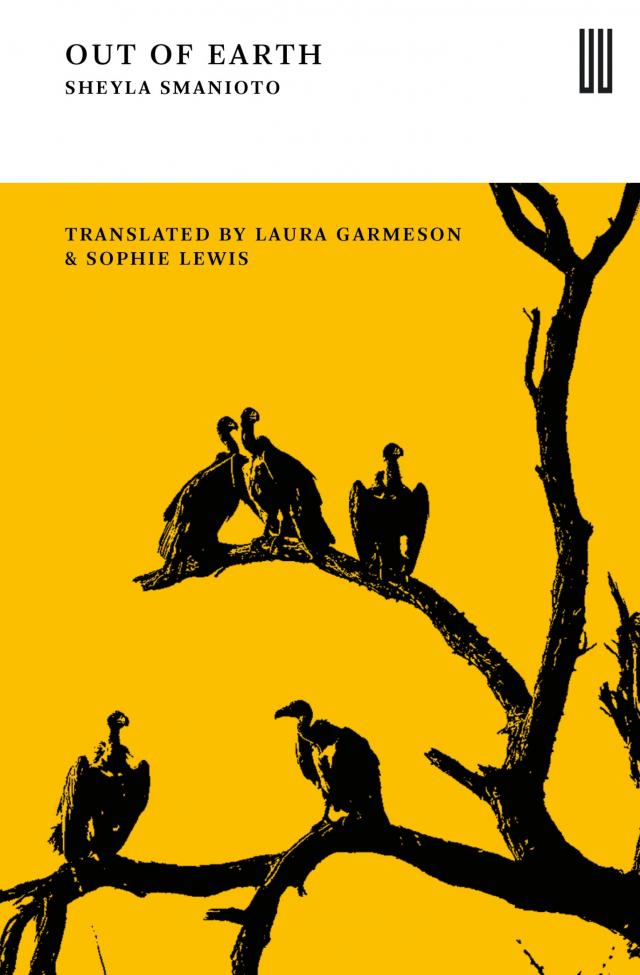
With her stomach propped against the kitchen sink, Penha scrapes her spoon around the bottom of the pot, who knows what she’ll find deep down in there, what it is that, try as she might, she can never dislodge. Penha watches the earth outside in disarray without her granddaughter’s obsession; Penha watches the wind, she watches the wind and, Lord Almighty, she sees nothing. The girl swept everything away in her eyes. All old Penha sees is Scarlett among the circling vultures, watching everything from the top of the lone tree, waiting to see what the earth is holding. It was Cida who planted the tree.
At first it took Scarlett some time to climb the tree. Little by little, digging her fingers into the musty bark, tearing her nails, grazing her skin. At first she tried jumping, pulled herself up, reached and stretched, the vultures around her laughing at the strange four-legged creature, can you believe it doesn’t have wings. Then the vultures carried Scarlett to the top, their beaks caught in the fabric, they left the child teetering falling into the arms of the branches, at first she fell, but it wasn’t long before Scarlett learned to jump up there on her own.
Penha, poor old thing, is looking at the horizon seeing nothing except her great-granddaughter, it’s not the girl, it’s not Maria de Fátima. Penha sees only Scarlett Maria learning with the vultures how to gently walk the earth. Learning with the vultures how to sprout from the tree. Learning with the vultures how to be weightless. Learning with the vultures how to watch death. Learning with the vultures how not to die. Learning with the vultures how to wait. Scarlett who only knew a single word.
‘Quiet, Penha, be a good girl and look at the artist.’
‘After you’ll go whining that we dragged you here by the hair.’
‘You think we like having you around?’
‘Ma told us to bring you, sin-faced devil child.’
‘Shut up, Maria da Penha, stop pulling that face.’
‘You think it’s easy doing what he does for us?’
‘Shhh, Maria da Penha, see he’s practically ready now.’
‘Dammit, devil-squit, stop shuffling your feet.’
‘Don’t you see you’re disturbing the hunger artist?’
‘Don’t move your head, just put up with the dirt.’
‘Pay attention, look, Maria da Penha.’
‘He’s not blinking, he’s not moving, are you watching?’
‘Are you watching, freak of nature? He’s not complaining…’
‘He’s not scratching, or crying, or cheating…’
‘Did you see? He’s not like you with ants in your pants.’
‘Go on, Penha, go ask him to teach you how to shut up.’
One time the starving girl, tired of stealing bones from Skinny, yanked off the handle of a pan, chewed it for ages, almost swallowed it, when her grandma noticed that was it, she went crazy, she used her fingers to snatch the wood out the girl’s throat, her hand in her mouth fingers nails and everything, took a tooth out with it that had come loose and the bones the girl hadn’t ground down, and then she beat her granddaughter until she repented for what she’d eaten.
‘Why aren’t you laughing, Maria da Penha?’
‘Aren’t you watching the hunger artist?’
‘Aren’t you watching, Penha? Laugh, go on then, crybaby.’
‘Come on, Penha…’
‘Aren’t you watching the man being silly?’
‘Go on, Penha, crack a smile.’
‘Aren’t you watching the man?’
‘What’s what? The hunger artist…’
‘Give him a smile, Penha, go on.’
‘They like it, artists do…’
‘That’s why they kid around…’
‘Aren’t you watching?’
‘He’s there to be laughed at, Penha, you wretch.’
Ever since she lost her granddaughters to elsewhere, Penha wasn’t saying a word. Scarlett, like the vultures, kept quiet. She came in the wake of the wind, cursed girl. She perched in the garden of corpses. At first Penha was scared, it’s true. She hid herself away in the crannies of the house, staring out the window to the street: her great-granddaughter a flock of birds, the girl who never came, the wind that never brought Fátima.
When Scarlett was little, Dona Penha hid herself away at home, imagine that, watching the child grow acquainted with death. When Scarlett was fledged, Penha would sometimes go outside. Quietly pacing the earth, saying nothing. She finds an arm that’s lost its body, bones showing, blood, tendons, she throws it for the vultures to find, she throws it so they can kiss the wounds. She watches how they fly over to it, watches how Scarlett flies. Since she was little she’s always been there first.
‘Dammit, it’ll be just like the other time…’
‘Good Lord, Deusinha, wash your mouth out…’
‘Am I lying, Neusa? Who round here isn’t starving?’
‘You’re not wrong, Deusa, it’s already losing its charm…’
‘All this time to do nothing…’
‘I’ll be an artist then, see the world and everything…’
‘If it’s to be stuck there like him, count me in…’
‘Don’t you mind being trapped like a monkey?’
‘Hell no, Neusa, you wouldn’t fit in that cage…’
‘I kinda think it’d be nice, watching the people walk past…’
‘I’d just love to see you, Neusa, sitting there just like him. Not talking.’
Once the girl, Fátima’s sister, called her grandma Old Lady, thinking that’s how names are made: the skinny dog’s called Skin-and-Bones, she’s a girl called girl, her mother who disappeared is called Aparecida, and Fátima must be very fátima, because nobody else is. Like Scarlett, that foreign word, even though deep down that isn’t even the baby’s name. She’s also Maria, we’re all Maria deep down. Maria da Penha, Maria Aparecida, Maria de Fátima, Maria the Girl and Baby Scarlett Maria.
‘They sent the artist away, Neusinha…’
‘Cross your heart sure, Deusa? Today I didn’t see…’
‘They beat him up and threw him out…’
‘Good riddance, he wasn’t going to die or nothing…’
‘He tricked us all the phoney…’
‘And he’s still calling himself an artist!’
‘Mother said artists ain’t what they used to be…’
‘That’s what she said, back in her day they used to die of hunger…’
‘They suffered for real they did it for real…’
‘This one don’t even care! In those days everything…’
‘He didn’t even try didn’t even move…’
‘He just sat there, he didn’t die…’
‘And he could still twist his whole neck inside the cage…’
‘What do you mean, Deusa? Tell me…’
‘I had to drag Penha out of there…’
‘Dammit, why’s that? Was she being stubborn?’
‘He fixed his eyes on Penha and wouldn’t look away…’
‘I told you, didn’t I? She must have laughed at him.’
The day after Fátima died, a huge storm soothed the earth of Vilaboinha. The heavenly water, a blessing, it came without warning, Maria da Penha didn’t even realise the rain was Fátima. Fátima raining down on all the earth, knocking on Penha’s door, but Penha didn’t recognise her granddaughter in this liquid form, she kept waiting for Fátima, kept waiting for the girl, neither of them came, goddamnit, nobody came no living body at least.
What she ought to do was curse her granddaughters, ah that’s what she ought to do. She remembered her two granddaughters and forgot — what was the girl’s name again? What she ought to do was curse Maria de Fátima, but she couldn’t remember the name of her other granddaughter. Goddamnit, the girl didn’t even have a name. Cida died without naming her, Penha thought she didn’t deserve one. What she ought to do was curse Maria de Fátima, and find a way to also curse the girl. But the name she never gave her youngest granddaughter took care of itself.
Tonho ran outside, leaving Fátima dead on the kitchen floor. The girl listens to the silence, waits to make sure, and only then comes out from under the sink. The rain at the door is bringing the earth from outside in the wind, goddamnit, the earth wants to take Fátima’s body away. Fátima’s face, topside, silverside, a whole landmass, multitude, memory. Fátima dead, bone, broth, blood, tendons. Fátima’s imagination in there, inside those extraordinary eye balls, Fátima’s imagination right there with the girl, its lustre gleaming among the pieces of meat. Fátima’s succulent imagination.
Everyone knows how the woman stops being a woman in order to become something else, a gorilla thing, only the girl notices my God how hungry she is. Nobody thinks that suddenly the woman before she becomes a gorilla nobody thinks that the woman dying of hunger, starving, the woman wanting to be somebody more than just herself, nobody even thinks that the girl starving to death from being just herself, that the girl tastes Fátima’s flesh, sinking in her teeth and shoving it down her throat.
Fátima’s flesh, along with the record of all our fates, with her bitten nails, the maps on her legs, the burns from picking up the pan still hot. Fátima’s body, her arms and legs, her knuckles, her knees, her kneecaps, a wild animal sleeping beneath her pubic hair, her dried-out elbows at the windows. The cracked feet that run in the family, like Penha’s, like the girl’s, the apples of her cheeks worm-eaten just like Cida’s.
No one even thinks the girl doesn’t even think she sees Fátima’s body she chews, she knows the taste, knows the gagging, chews the fates, chews the calluses, go on, girl, it’s the only way you’ll turn into a gorilla, go on, girl, chew. She the girl girl girl she chews chews chews and licks her lips and licks the floor when she’s finished. She takes Fátima’s bag, her papers, takes Fátima’s ears, hides the bones, the nails, leaves Scarlett at her grandma’s door, she leaves her grandma and Scarlett all alone. She isn’t the girl any more.
Didn’t I say something was up?
There’s a word for this crazed earth, flesh, there’s a word for unhooked memory, blood. There’s a word but we don’t say it no way do we say it nobody says that word, not here in these parts, no word goes unpunished, not one of us uncursed by it. Words are same as prayers, they don’t forgive, they devour us from the mouth, they rip apart, they condemn, this word enters our body and takes hold. That’s how it is since the madwoman died.
It went like this: they stuck the madwoman’s body in the ground. I heard someone say she died of a broken heart without her granddaughters. The children of Vilaboinha went running all over her, the town was celebrating, making an offering to the devil. The gale arrived soon after, the madwoman had only to die for it to rain, the gale came as a gift. People were running home through the packed earth streets, we ran til our eyes filled with dust, we ran so much we didn’t see Penha’s body disinterred and running alongside us.
Holy shit! Here comes the madwoman thrown out of the earth!
They chucked the body in again, put a tree on that unquiet thing, a creature to live on top of her, but the madwoman’s arm came up among the roots, then her body, and she was being reborn whole. They threw her body back in, tramped all over it, set up houses there, sent up prayers, but in that earth her body would not stay, so it stayed inside the walls, residing. Even in the earth Penha could not rest. That was when we decided to see what the great-granddaughter of the madwoman of Vilaboinha wasn’t saying, but she showed us. What’s up with the tree, wretch?
They hung Penha’s body up for the wind to swing as it pleased. They tore out one of her nails for good luck, if a girl’s a virgin the madness can be contagious. It was the wind beating and raising the flock of vultures and all of us hearing the wind beating and sprouting from the corpse words. The children crowded in close, the girls were pretending, the old people couldn’t hear anything. The wind was licking us all it wouldn’t shut up. Out-of-earth, said the wind. Out-of-earth the wind went and said, out-of-earth, the wind beat against the body, out-of-earth. Nobody repeated it.
Out-of-earth: the only word Scarlett knew.
The girl arrived in São Paulo twenty years earlier carrying Fátima’s bag, Fátima’s torso, her internal organs, skin and eyes, toes, ribs, heels and shins, veins and arteries, the girl arrived in São Paulo without knowing who she was. What’s your name, asked the man with the name badge, she was still swallowing, she looked down at her bag, the girl didn’t know, she looked at the papers, looked at the ticket, looked at the blood under her nails, felt it in her throat, felt heels, torso, arteries. The answer came from her stomach: my name is Maria de Fátima.
Time: a train powered by dead bodies.
Train: a ghost gone off the rails.


