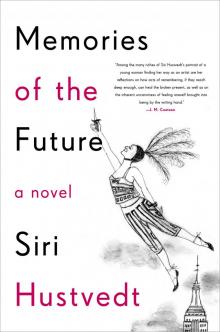
Memories of the future, p.23
Memories of the Future,
p.23


The drawing was obviously a variation on the image in the book. Yes, there were circles and vines and the face of a flying baby on a string and the square, what was that? I wanted to laugh, but there was something disturbing about the image. I watched Lucy slide the drawing back into the envelope and place it inside the volume with a look of satisfaction. She returned the book to the pile and came to retrieve the candle from me. She grabbed it a little roughly, and with the jerk hot wax dripped onto my hand. I suppressed a gasp and, as I examined the purple oval near the bottom of my thumb and began to pick off the congealed wax, I felt upset. Before I knew what was happening, tears had warmed the corners of my eyes. When I looked up, I saw Patty looking at me. Her face was sympathetic, too sympathetic. What did she want?
“I realized that our thought, Western thought, has been a flight from mingling ambiguities. Every person is made of two people, but the theoretical meanings of gestation have been completely misconstrued. Embryology remains deeply mysterious. The umbilical cord,” Patty said, “or more properly, the placental cord, the lifeline that connects mother, placenta, and fetus is the ur-reality of mammalian life, of placental mammals, a between force, a link, the connective tissues that prefigure our birth. But the placenta is hardly present in the medical books. It’s an afterthought. It’s the missing human organ, banished from the discourse. You see, it’s there in the drawing. In every other culture but ours, the afterbirth plays a crucial role. It’s a second being, a twin, a double of the infant.” She went on for quite some time, explaining how the organ was buried, or dried to be used as a healing powder, or digested for its spiritual nurturance. I felt interested and repelled at the same time. I wondered what the woman-hating Hua did with the placenta.
“Think about it,” Patty croaked. She sounded like a bullfrog. I love the sounds of bullfrogs. “There are no images of birth in Western art, not until the twentieth century, not that I can find anyway. There are thousands of meek Madonnas and babes, crucifixions, death, dying, battles, corpses everywhere, but birth—nothing.” She looked at me. “Unstable borders are intolerable. You see that, don’t you? In the beginning, it’s not one thing and the other. It’s both. It’s the mother and a wholly dependent fetus; it’s not two people. That’s ridiculous. It’s not two until very, very late in pregnancy. But just think about it. Every one of us begins inside another human being, attached to her through the magic of a temporary organ science knows little about and hasn’t bothered to study. Now, why is that?” Patty looked very pleased with herself.
“Isn’t it funny?” Lucy said. “We’re all born! Did you ever see anybody giving birth in the Metropolitan Museum?”
“Never,” Patty said and laughed.
I remembered Lucy talking about her children then. “Just because the cord was cut . . .” Two dead children. Lindy was fifteen. Her son had exploded somehow. Poor Lucy. Patty had power over her. And now she’s seeing the ghost of her daughter. I heard canine toenails approaching and Moth handed us the glasses of rosé. I had the peculiar sensation that I had already been in the apartment for a long time, that Moth’s reference to Provence and to the smell of lavender had occurred days ago. I smelled the pink liquid. Alice began to nudge my thigh with her nose, a signal that I should pet her. I did, with my left hand, and the mutt stared up at me with grateful, luminous brown eyes.
Alice wasn’t going to accost me with astral bodies, signs, knives, circles, or placentas. She just wanted to be rubbed. I sipped the wine.
More guests arrived. Moth introduced me to Martin Blume, a heavyset man who taught philosophy at NYU, a man in his late fifties, I guessed, in a suitably rumpled corduroy jacket, gray hair swept back from his temples, a large, straight nose, and eyes that glistened with irony. He shook my hand firmly and smiled slightly with one side of his mouth. I must have seen in his expression promise for the hours ahead. Here was a person who would relieve me from the descending cloud of hidden meanings—from ghosts and signs and temporary human organs. The professor bantered with Moth about her shawl, chatted about the David Hockney exhibition at MoMA with Patty, and charmed Lucy by taking an interest in a necklace I had not even noticed she was wearing by asking, “Victorian?”
Sarah Blume had none of her husband’s charm. She was a squat woman with a nervous gaze that darted from one person to another, and whenever her spouse began to speak she had a peculiar habit of ducking her head, as if she had been swatted by some invisible presence. Several times I watched her open her mouth, only to give up immediately. I wanted to yell, Speak up, woman! Just speak up! She did manage a few hesitant words about a daughter who lived in Stockholm and worked in some capacity at an institute. The mysterious Alistair remained silent, offering only an intermittent smile and friendly nods meant to illustrate he was listening attentively. The last person to join the company was Gorse, one of the women I had heard through the wall. She had a narrow wrinkled face and a thin body, a little lumpy around the middle, but it was her high sweet voice I remembered from the night of the knife and the little man. Was she the one who had said, “I’m afraid. Will he die?”
I sat on the sofa and listened. Like Alistair, I smiled and nodded. Unlike him, I made a few comments that struck me as appropriate. I was beginning to feel better. My dizziness had vanished. Professor and Mrs. Blume had ushered a comforting, pedestrian aura onto the premises. This was, after all, a dinner party. The conversation was meant to be superficial. I stroked Alice steadily, who had taken up a position near me, but each time I withdrew my hand from active petting, she nudged me for more caresses, and her insistence was beginning to irritate me as well as attract the commentary of Moth—“I hope she isn’t bothering you. Alice, lie down!”
Alice did not lie down. Martin Blume, who had seated himself opposite me, looked on with amusement. I felt exquisitely conscious of his eyes. I heard Lucy say to Patty: “I picked it up at the magical child, dirt cheap.” It sounded like a place, not a person. I wanted to inquire, but an instant later Alice’s nose moved aggressively in the direction of my crotch and, as I pushed her cold snout away, Patty rumbled in her hoarse tenor, “She adores you. I’ve never seen her quite like this.” When I lifted my head, I saw the professor smiling at me; this time he displayed his even teeth. My face felt warm again, and I noticed Lucy glance at Blume, register his expression, and revert to her sniffy, unkind self. She gave me a look that communicated the words behave yourself, as if she firmly believed I had arrived at the dinner with the sole intention of seducing the dog and/or the man.
After we were seated at the long dinner table near the windows, which were opened a crack to let in the air, the wine had relaxed my shoulders and produced a pleasant lifting sensation inside my skull. Patty sat at the end of the table to my right and seemed somewhat less fragrant. Gorse sat directly across from me, and I noted that she repeatedly straightened her glasses with both hands, as if she couldn’t situate them well enough on her long nose, and that she made a little noise in her throat after each adjustment. Alice, my devotee, who had followed me into the dining room, slid deftly under the table and arranged herself so that her head rested comfortably in my lap. I was glad she seemed to have lost interest in sniffing my genitals. Patty informed me that Alice intended to look longingly up at me throughout the meal to induce my pity and, soon after, my scraps. Patty laughed, a deep rumbling laugh. “It’s an effective strategy,” she said. “Our Alice is well versed in a silent rhetoric of persuasion.”
When I told Martin Blume, seated across from me at an angle, that I would begin my studies at Columbia in September, he looked puzzled. “But it’s all men, my dear.” I explained that I was going to graduate school in comparative literature, to which he said, “Ahhhhhh.” We talked for a while, and Tristram Shandy came up along the way, probably because I brought it up. The subject animated him, and he smiled and spoke to me about Hume’s influence on Sterne, which I already knew about, but I found it pleasant to listen to him expound. I enjoyed listening to words I understood. We laughed about how long it takes for Tristram to get born, not until volume four. And I quoted the line I loved about the novel’s temporal scheme—“digressive . . . and progressive, too, and at the same time.” He looked over at me then with benevolent brown eyes, and I felt his attention as if it were a small sun shining on me at the table. It had the quality of a memory I couldn’t place, a good memory.
Patty was deep in conversation with Gorse but also seemed to be following what Blume and I were saying to each other because she grinned at me and said, “I see we’ve returned to birth. Delivering babies, delivering manuscripts, nine volumes, nine months. The book is one long labor!” Some moments later, she quipped, “I’m listening to you. I’m not surprised that you’ve left out Mrs. Shandy altogether.” To which he said, “Never! I always remember the ladies,” and returned to his disquisition. I recalled Mrs. Shandy shouting at some point late in the book: “What’s this story all about?” I thought it would be nice to mention it, but then Lucy, after giving me a close and critical look, distracted Martin Blume with a question, and he turned away to speak to her.
Abandoned for the moment, I listened to the mix of voices as if the table were a single being with many mouths and then to the constant sound beyond the chatter of cars passing on the West Side Highway. The wine was still rising in my head, and Alistair, seated to my left, had a voice, after all. He was speaking to Sarah Blume in polite tones. I noticed that the skin at the back of his neck was rosy and that the wool of his jacket had pilled. I wondered why I had felt so bad half an hour ago. I noticed that the linen cloth under my plate was badly wrinkled, but when I surveyed the table as a whole, I detected a smooth area toward the middle, as if someone had started ironing and had given up. I remarked to myself that the china and crystal were fine, as were the two heavy silver candelabra with five dark candles burning in them that summoned the image of a frightened heroine in a great black-and-white room with blowing curtains and organ music. I smiled to myself, and thought, Yes, that’s the way I’ve been behaving—like a scaredy-cat. That’s what Kari and I used to say. I noticed that the floral arrangement was peculiar—a haphazard collection of herbs that included drooping sage and browning rosemary and comparatively fresh oregano mingled with red roses, their necks fallen. My mother would have disapproved of both wrinkles and centerpiece, but I felt sympathy for the person I strongly suspected was Moth who had begun the ironing job and stopped. I also felt a pang for the roses, as if they were weren’t flowers but people hanging their heads in sorrow or shame. It wasn’t their fault they were a little too sad or old to stand upright.
But now I must think through why it all went so badly wrong, why the whole atmosphere of the dinner changed and why I acted the way I did. There is much that can’t be articulated when several people find themselves in a room together. Bristling as well as warm breezes circulate among those people, and one may find oneself in a crosswind without knowing why. It must be connected to the density of memories in the room. Each person drags his past into a chair with him and then he sits down next to another person who has her past along with her as well—mothers and fathers and aunts and uncles and friends and enemies and hometowns and roads and mailboxes and streets and diners and skyscrapers and bus stops are all there in the events that have stayed with him or her because the thing that happened caused pain or joy or fear or shame, and as I look back on the dinner party, I understand that the memories seated in the chairs along with the guests included dead people like Irma and Lindy and Ted Jr., yes, real ghosts borne into the present by each mind at the table—and when you multiply the pasts and memories and ghosts of everyone in the room, you understand they aren’t quiet or contained because they inevitably reappear in the conversation in one form or another, and then they begin to mingle and stir up the rest of the company, one blending into the other, and it’s not only the words of the conversation that count but the tone of voice each person uses when he or she talks, and then think of all the looking back and forth that goes on at a dinner table and the gesturing and all the visible information as well—faces that flush momentarily and tiny beads of sweat that form on upper lips and wrinkles that arrive on a face only in a smile, or the various pairs of eyes that appear cool and indifferent and other pairs that are alive with interest, or the same pair of eyes that seem far away one instant and focused the next, and every person is reading and rereading and interpreting all the big and small signals that are whirling about and that can’t be kept separate from the memories at all, and I wonder how on earth we keep track of any of it.
I know that Lucy told the awful story about the hamster during dessert. The hamster story was the stillness before the storm, but seconds before the hamster story there had been the incident of Martin Blume’s hand on his wife’s shoulder. I am calling it “the incident of the heavy hand” because I think it was crucial to the turn that took place and changed everything. Before the heavy hand and the hamster, many subjects had come and gone, most of which I’ve forgotten. Patty’s talk was memorable, however odd, but much of the dinner-table chitchat has vanished. I know that Alice had fallen asleep on my feet, and I felt the steady rhythm of her breathing belly against my bare ankles. We had eaten well. I can still see Moth’s long, narrow face, wattled at the chin, and her eager eyes surveying the table, her kingdom for the evening, as she told us “to eat and drink and be merry as hell.” She had brought in the aromatic leg of lamb herself for Patty to carve, which Patty did carve expertly, and then Moth had rushed back to the kitchen for small potatoes and asparagus and had said, “Oh, fuck, damn, shit,” when several buttered potatoes dressed in bright green parsley had rolled out of the heaping bowl onto the floor upon her return to the dining room, after which Alice had raced from her position under the table and had swiftly lapped them up.
I know that by the time the dessert arrived, a lemon tart, I had discovered that Patty was writing a book called A Study in Western Amnesia, which treated “esoteric works” by women philosophers but also a few men. I had further discovered that Patty and Martin “went way back” to graduate school, had studied in the same program, but that Patty had abandoned the study of “mainstream philosophy” to pursue “the other side of things,” a side of things her friend-from-way-back strongly disapproved of as “the province of kooks,” and which Patty defended in her deep voice, but exactly what she was defending wasn’t clear to me except that it was connected to “the body, feeling, and the sacred imagination” and perhaps the peculiar drawing, the key to the key.
I took Martin Blume’s side, as moderately, discreetly, and diplomatically as I could. I was feeling hostile to “the other side of things,” whatever they were, because they seemed as diffuse and intangible as the herbal smells in the air. Gorse had informed me that she was an artist who painted “the invisible forces of nature and spirit,” a grandiose project of many colors she had piped on about in her sweet high voice between her tic-like relocations of her glasses and nearly inaudible squeaks. I had divined that Astral Alistair was a polite Englishman who sold rare books and had “clients” all over the world and expressed himself almost exclusively in negative terms, a verbal habit that may have been responsible for my first impression of him as dry, a person so parched I feared he might turn to dust if I spoke too forcefully in his direction. “No, that particular edition was not without interest,” “I wouldn’t call it dull, no, not dull precisely.” “It wasn’t a scintillating lecture, but . . .” The man eschewed the positive altogether and yet he did it with an affable demeanor, and I sensed that for him negativity was a form of modesty.
I also know that between the appetizer and the dessert, Sarah Blume had undergone a personality change. The doormat had become a flying carpet, encouraged by Moth, who had been pouring a lot of wine at their end of the table and exclaiming, “Well, fuck all that!” a phrase that caused Sarah to yelp with laughter. Lucy, too, was altered. She had taken on a glazed expression as she fluttered, cooed, and smiled at Martin Blume, who grinned back at her with what struck me as genuine pleasure in her company. I could see Lucy was flattering him, but I had also seen his eyes stray repeatedly away from Lucy and onto his wife, toward whom he had sent numerous significant glances. Alistair and I had become keenly aware that Sarah’s hilarity had been rising decibel by decibel since the beginning of the meal, although we hadn’t said a word to each other about it. Nevertheless, just after Sarah had released a cackle with a little scream in it, Alistair regarded me fixedly for a couple of seconds, as if to say, “That might not be entirely called for. Don’t you agree?” My view of the uproarious Sarah was partly blocked by Alistair himself and further by the scarf that bloomed at his collar, so I hadn’t been able to see if she had met her spouse’s eyes, but from the sound of things his corrective looks had been wholly useless.
At some moment after that, Martin left the table, no doubt headed for the toilet. On his way, he paused beside his wife’s chair. I confess I leaned forward to see what he was doing. I watched as he placed his hand on his spouse’s shoulder and squeezed it, not hard, but it was then that I, peering at Sarah in profile just beyond Alistair’s shoulder, saw her smile vanish and her chin drop. It had startled me—that heavy hand, the squeeze. As I had watched, I had felt the fingers on my own shoulder and along with the sensation a keen sense of shame. What had happened? Sarah had been wild, it’s true, and Martin had wanted to stop her before, before what? Before she laughed too hard? Before she drank more? Why had his hand seemed so terrible? Was it that his grip had been so effective?
Moth, too, fell suddenly silent as she watched the husband disappear into the hallway. Lucy, seated directly across from Sarah, had had a better view of the heavy-hand incident than I’d had, and while the professor-husband was passing urine and the tart was being delivered by Gorse, Lucy began a charged monologue on the subject of not knowing who people really are. She insisted “they” can fool you over and over again, and I instantly began to worry about what she might say. “Smiling snakes,” Lucy barked at Sarah, who said nothing. As Lucy spat out the words, “liars, cheats, deceivers,” Alistair sent me a look of high alarm, which I answered with an acquiescent glance. The table was silent. Lucy forged on.