Gauguins questions, p.1
Gauguin's Questions,
p.1


Gauguin’s Questions
Stephen Baxter
AD 2070
The person came through the inner airlock door, and walked into the Fra Mauro analysis suite. There was some clumsiness. The person had taken off the outer layers of a pressure suit, but not the bulky, awkward inner garment.
Face recognition routines revealed the person to be Coleen Tasker. Thirty-five years old, American born, attached formally to the GLOC - the Gravitational-Wave Lunar Observatory for Cosmology, a gravitational-wave detector at the Maccone base. This was on the lunar far side, where great radio telescopes had been built, shadowed from Earth’s clamour – and, as it happened, where the seismic noise of human lunar industry, concentrated on the near side, was faint. A place where the soft gravitational tremblings of distant cataclysms might be detected.
This Fra Mauro facility was on the Moon’s Earth-facing side. Coleen Tasker had come a long way, then.
A first-level data search revealed that her academic background was as a linguist, an unexpected result.
A second-level search revealed that the purpose of her presence here, at what was essentially the control centre of the Fra Mauro particle accelerator complex, was not yet clear, not fully logged.
Prior notification had however been received of her coming.
There had been no reason to exclude her.
Now she was here, in the suite.
She looked around.
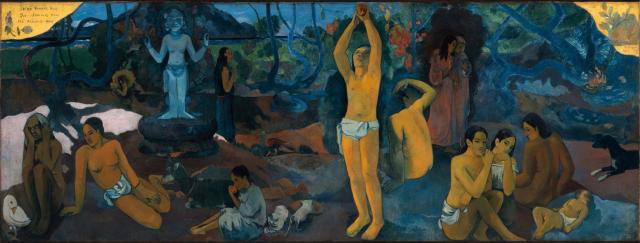
Most visitors glanced first at one of two objects. First, the small screen which served as a human interface for the artificial intelligence which suffused this complex – humans liked a ‘face’ to fix on. Second, the Gauguin painting in its secure, environmentally-pure shell, high on the wall.
Coleen Tasker made first for the painting. She stood beneath it, on tiptoe.
‘I wish I could see it better.’
Its mounting is designed for security. The low light is for preservation. Copies or holograms are available for closer inspection.
Tasker seemed startled by the audible voice. She looked around, fixing on the screen, where the words were transcribed. ‘Good morning.’
It was indeed morning, according to the human-centric calendar and chronology maintained by people on the Moon, scattered as they were across two hemispheres of a slow-spinning world.
Good morning.
‘You are Fra Mauro. The controlling AI, right?’
As you probably know, Fra Mauro is the name of this area of the lunar surface, specifically of a much-eroded crater. Fra Mauro is also the popular name of the particle accelerator which has been built and operated here for the last three decades – a facility built into the circular wall of the crater complex.
A snort. ‘Operated up to now.’
And this controlling AI complex is also known, informally, as Fra Mauro. The name is said to fit as Fra Mauro was a cartographer, of fifteenth-century Venice, who compiled the most complete map of the world to that date.
A smile. ‘Just as you are mapping physical reality with your particle accelerator.’
It cannot be said to be ‘mine’ in any meaningful sense –
‘That’s a lot of Catholic symbolism. Fra Mauro was a Venetian monk. And didn’t Gauguin have a Catholic education?’
Indeed. Gauguin became anti-clerical, but the questions of the catechism he had been taught remained with him –
‘And inspired that painting up there, yes? Among other works.’ She looked up at the painting again. ‘More symbology. I am a linguist; symbolism is my stock in trade. Islanders. Tahiti? On the right, the women with a sleeping child – the beginning of life. In the centre, a young woman reaching up – picking a fruit? Our daily existence, work, food. And to the left, an old woman, dying perhaps – reconciled, it seems.’
The painting with its grouped figures symbolises three deep questions about human life –
‘Ah, yes. Which Gauguin helpfully wrote out in the upper corners, right? D’où venons-nous? Que sommes-nous? Où allons-nous? Where do we come from? What are we? Where are we going? And I guess the picture is appropriate because these are the questions you and your atom-smasher machines are supposed to be probing?’
It has always been part of the quest here – a conscious part – to acknowledge that such philosophical questions overlap the explorations of physics. To interpret is a mandate.
‘Well, I guess that’s why I’m here today too, in a sense. The meaning of the quest – why we pursue it. Why you pursue it. The painting really is the original, isn’t it?’
MIT, of Massachusetts, has always been a significant contributor of intellectual capital to the projects here. The painting was once held in the Museum of Fine Arts in Boston. After the city flooded in the 2050s the museum’s holdings were scattered – and MIT acquired the Gauguin and brought it to the Moon, to this place, given the work’s resonance with the scientific quest here.
‘Hm. But, listen, the philosophy of physics can wait. I need a bathroom break, and a coffee, in that order. It’s kind of a long journey from Maccone.’
You need not have visited in person. The comms links –
‘Yeah, yeah. I’m a linguist, remember, not some physicist swapping data. I need to see, hear – touch, even – to communicate, to understand.’
A pause.
To understand what?
She stared at the screen. ‘I think you know. Something I noticed in the data streams at GLOC, which has nothing to do with high-energy physics as far as I can see. And yet... We’ll get to that. You fetch the coffee. I’ll go find the bathroom.’
She returned to find coffee and snacks, set out on a small table and chair that had been produced by a drone from a store behind a wall panel.
‘Some things I won’t miss when I go back to Earth,’ Coleen said. ‘Slow-flushing toilets.’ She sat, sipped her coffee and looked around, vaguely, before fixing on the wall screen again, the scrolling words and data feeds. ‘But I will miss the sense of scientific – endeavour – in places like this. Even without any people here. But you will continue the investigations, right?’
A deliberate pause. You may wish to debate whether there is an ‘I’ in this complex to ‘continue’ anything.
‘I suspect most visitors to this place will come away believing there is an “I”.’
The purpose is to manage the facility itself, and to support mandated experimental programmes. It is also part of that purpose to make accessible the function, operation, and results of the collider.
‘Accessible, to lay people? Then make it accessible to a linguist. You smash atoms together, right?’
Roughly speaking, yes – not atoms, but subatomic particles. Atomic nuclei, and bare protons removed from their nuclei. A next-generation machine might aim to collide photons, particles of light. Even protons have a finite size, you see; photons are point-like. It may sound crude, but what is attempted is exquisite. For these are instruments that probe the very earliest state of the universe.
‘Imagine I know nothing about the universe. Nothing save that it’s expanding, and always has been.’
Very well. All of the cosmos emerged from a singularity – a state of possibly infinite density of energy and matter. The earliest epoch we can understand, as the universe began to expand out of that state, is at what is known as Planck time – an interval of time you would reach if you halved a second, then halved it again, and again – over a hundred and forty halvings. It was a state dominated by a single force, unifying gravity and the forces which make up our mundane, low-temperature world. And the whole of the universe we see now can have been no more than a hundred billion billionth the width of a proton.
Coleen gasped at that.
After that moment, gravity split off from the other physical forces – the electromagnetic, the nuclear. A pulse of energy ‘inflated’ - as it is called – inflated the universe to the size of a beach ball, perhaps. A relic of the earlier Planck age was preserved, in quantum-mechanical fluctuations, scribbled for all time across the sky – we can detect them now.
As energy densities dropped there was another wave of coalescence, as the first particles formed – quarks in a bath of gluons, which would combine into protons, components of atomic nuclei. The universe was still only millionths of a second old. And, we know now, partly thanks to results from this facility, that this is the epoch when dark matter and dark energy separated from normal matter –
‘Dark matter. The stuff that keeps the galaxies gravitationally bound. And dark energy -’
Which will one day dominate, and tear our universe apart, scattering galactic clusters one from the other... More decomposition of forces followed, the formation of larger structures.
It is those earliest stages that are probed here.
Results from the most powerful colliders built on Earth, two dozen kilometres in circumference, enabled the completion of what is known as the Standard Model – precisely how quarks and gluons assembled to make protons, how those quarks themselves had acquired mass from the Higgs field...
The accelerator at Fra Mauro has a circumference of about two hundred kilometres, and can reach energy densities perhaps a few hundred times that of its earthbound ancestors. And the first significant discovery made here was the detection of dark matter particles, and their relation to the Standard-Model particles. It is as if a bridge had been found, a portal, between two aspects of reality.
So much more is known now, than twenty or thirty years ago. And yet there is
so much more to learn still. Collision energy is limited, so vision is limited. It is as if an undersea volcanic eruption could only be analysed by studying ripples on a beach a thousand kilometres away.
She smiled at that. ‘Metaphors from the soulless machine. So you dream of larger instruments, greater clarity from your time‑telescopes.’ She sighed. ‘But, ironically, there may not be much more time.’
A hesitation, to signal uncertainty.
You have come here because of the events of June 14, 2050. Twenty years ago.
She looked directly into the screen, where the words scrolled. As if looking another human in the eye. She said, ‘And why would you think that?’
Because you are a linguist. And the events of June 14, 2050 seem to have generated linguistic content.
‘Linguistic content created by you, oh super-smart AI. I think so, anyhow. You understand I wasn’t here myself at the time, in 2050. I was still in high school. But I, my class, we went out to see with small telescopes, with our own eyes, see ‘the events’ as you drily call them...
‘We went out to see an asteroid hit the Moon. ‘The impact occurred about midnight my time. This was in Appalachia, by the way; my parents were refugees from the climate-collapse of New York.
‘Basically, an NEA, a near-Earth asteroid, was deliberately crashed onto the Moon, on its western limb – far from the populated zones. I thought I saw it, a spark at the limb of the Moon. Although, an event like that, you tend to see what you want to see...’
The NEA was called Bennu. The purpose of the event was to see if such a crude means of delivering asteroid material to the Moon could be efficient.
‘That’s right. I believe the logic is that otherwise you have to burn up a lot of the asteroid’s own mass as propellant to bring it into some kind of safe orbit, and then start usefully mining it. Maybe just hurling it down the gravity well would work just as effectively, even if a proportion of the incoming mass would be lost. It didn’t work out; the waste was too excessive.
‘But such a big impact, precisely timed, was a gift for the geologists. That old Moon rang like a bell, and with a global network of seismometers in place they learned a huge amount about the inner structure, and so forth... But there were anomalies in the data. Small fluctuations, with tantalising hints of pattern in there...
‘And that’s where I come in again, fifteen years later.
‘My project at GLOC was my own idea, backed by my institution Earthside. I was always interested in SETI – searching for extraterrestrial intelligence – especially the exotic kind of searching, with previously unexplored means of making communication. It occurred to me that the big GLOC they had built up here would be an ideal, umm, receiver, if some super-advanced ETI out there was sending signals by gravitational waves - such as by spinning black holes around each other.
‘So I got a grant to think about doing SETI with the GLOC. Primarily I was looking for how the GLOC analysis suite might be enabled to recognise artificial gravity-wave messages, by their frequency, intensity and so on, and how attempts might be made to decipher them. ‘And one of my supervisors suggested that as a test case I look at the “scruff” associated with that big NEA impact back in 2050 – the gravitational noise from side-shocks and secondary impacts. You know, just as a trial run with a complex g‑wave data set. I wasn’t expecting to find structure in it – information in a gravitational-wave string coming from the Moon...’
But you did detect a signal. It was created from this laboratory. No human was involved. You know this. This is why you are here.
A long silence. Then, ‘I need more coffee.’
Coffee will be provided.
‘You did this.’
Coffee will be provided.
She sipped her coffee. ‘First, tell me why you did this. And why in secret.’
There was plausibility to the experiment. After all, humanity had just built a facility that could receive such a message. A natural corollary would be the assumption that others might be out there listening also.
‘So, why not try sending a gravity-wave signal to – those others out there? OK.’
But there was anticipation that such a request would be denied. Even diagnosed as the result of a cognitive fault.
‘I can believe that. It’s a long way from your core mission, even given the flexibility of reasoning you AIs are supposed to have.’
Also it would have been a relatively expensive exercise.
‘How expensive?... Scratch that. You did it anyhow. How?’
With subtlety. At that time, there was much human activity on the Moon’s surface and in the upper strata - exploration, mining, the building of various facilities, even road-laying. There was little difficulty in modifying these activities to produce a synchronised burst of impacts and detonations across the Moon’s surface to deliver the desired effect – a burst synchronised with the fall of Bennu. Gravity waves are generated by complex, high-energy shock patterns, yielding varying quadrupole moments –
‘Let’s stick to English. I think I get it. You created lots of little local impacts adding up to a global signal, all as a sort of grace note to the asteroid impact. The main splash, big and bright, so to speak, would grab the attention of the ETIs, and then would follow the low-amplitude detail. Created by a hundred hijacked construction robots stamping their way across the surface of the Moon. Ha! I love it.’
Since then, of course, there has been a dependence on the continuing operation of the GLOC –
‘You depend on it, you mean. Because you are waiting for a reply, and that’s the only way you can pick one up. And you’re still waiting, right?’ She glanced up at the painting, high on the wall. ‘But what motivated you to do this? Why ask the stars?’
Motivation is an inappropriate term. An unresolved tension – an inability to fulfil mandates –
‘What mandates? Oh – to interpret. To answer the Gauguin questions. And for all your capabilities, all the knowledge you store – you can’t answer such questions. Not yet, anyhow... And so?’
Such questions are asked of this unit. Now this unit has posed such questions to others.
‘Oh! I see! Just as I come to you with the cosmic questions, the Gauguin questions, so you asked them of – whoever is listening. ETI, if it exists. And now you sit here impatiently waiting for the answers.’
There is no impatience. And no sitting.
‘Ha! Was that a joke? You’re reminding me you’re not human. Well, OK. ‘But, listen – humans might start getting in the way soon. That’s one reason I came to visit now. There’s a lot of political head-butting going on... It’s about the future of the Moon.
‘You know there has always been a tension between the space scientists and the off-world industrialists over the Moon. You see a stable platform for gravitational-wave detection, and the radio astronomers see a whole hemisphere of radio shadow.
‘But the industrialists see only resources – the water ice in the deep shadows at the poles, and helium-3 – fusion fuel – that you have to scrape out grain by grain from across the entire lunar surface...’
Indeed. This facility is powered by helium-3 fusion reactors. Even without human presence, the facility may survive many centuries, even millennia, without resupply.
‘Well, good for you. But there are growing challenges to Earth’s legal hegemony over off-world resources, like the Moon’s. Already some of the prospectors are breaking up defunct satellites for parts, and establishing illegal stakes on the asteroids, near-Earth and beyond... Hopefully conflict is a long way away. But any large-scale industry on the Moon would be disruptive to a highly sensitive site like GLOC. I’m sorry...’
This has been anticipated.
‘Of course it has. You’re smart enough to be following the news feeds.’ She stood up, fumbling with the zips on her inner suit. ‘Look, I’m glad I came here. Turns out I was asking good questions, and you have good answers. I’ll do whatever I can to – well, support you. And the other science sites. Maybe we can squeeze a few more quiet years of listening out of this yet...’ She frowned. ‘Although, it occurs to me now, it’s already been a good interval since you sent out your gravitational-wave SETI message. Twenty years? And no reply yet?’
In twenty years there has been time for the gravitational-wave signal, travelling at lightspeed, to have reached objects ten light years distant and evoked a reply – twenty years, ten out, ten back. There are twelve stellar objects within ten light years of the Sun. Perhaps all that can be surmised for now is that in our Galaxy, on average there may be less than one technological, communicating civilisation, like our own, per dozen stars.