

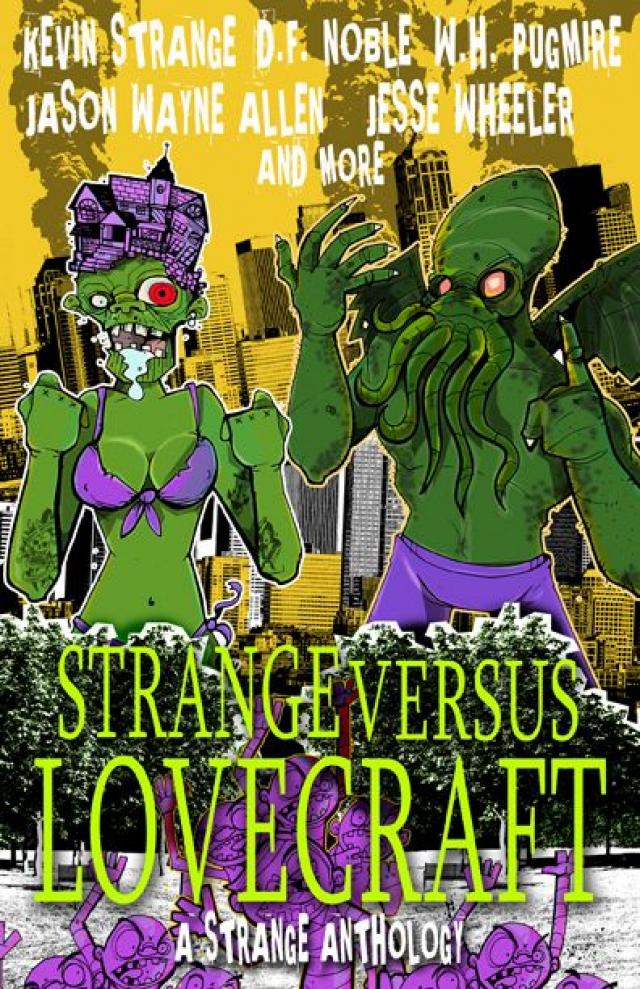
Strange versus lovecraft, p.1
Strange Versus Lovecraft,
p.1


StrangeHouse Books
P.O. Box 592
Wood River, IL
62095
www.strangehousebooks.com
Copyright © 2013 by StrangeHouse Books, LLC
Cover art Copyright © 2013 by Chris Hamer
www.urbnpop.com/
“The Quicken of Ursula Sphinx” © 2013 by W.H Pugmire
“The Curse of the Black Goat” © 2013 by Kyle Noble
“Never Name He Who Is Not To Be Named” © 2013 by Tim J. Finn
“McHumans” © 2013 by Kevin Strange
“Olaus Wormius” © 2013 by Rich Bottles Jr.
“Eat Shit and Die” © 2013 by Frank J. Edler
“The Horror at the Garrsmouth Orgy” © 2013 by Jason Wayne Allen
“Ghost Load” © 2013 by D.F. Noble
“Nyogtha of the Northern Line” © 2013 by Adam Millard
“Vicious Jelly” © 2013 by Craig Mullins
“Chumlord of Westmouth Harbor” © 2013 Jesse Wheeler
All rights reserved. No part of this book may be reproduced or transmitted in any form or by any means, electronic or mechanical, including photocopying, recording, or by any information storage and retrieval system, without the written consent of the publisher, except where permitted by law.
Printed in the USA.
Table of Contents
Introduction
Kevin Strange
The Quickening of Ursula Sphinx
W.H. Pugmire
The Curse of the Black Goat
Kyle Noble
Never Name He Who Is Not To Be Named
Tim J. Finn
McHumans
Kevin Strange
Olaus Wormius
Rich Bottles Jr.
Eat Shit and Die
Frank J. Edler
The Horror at the Garrsmouth Orgy
Jason Wayne Allen
Ghost Load
D.F. Noble
Nyogtha of the Northern Line
Adam Millard
Vicious Jelly
Craig Mullins
Chumlord of Westmouth Harbor
Jesse Wheeler
Introduction
Kevin Strange
My first encounter with H.P. Lovecraft was a game changer. I'd grown up with horror movies and books, having a particular affinity for the 90s splatterpunks in my teen years. But it was at the relatively late age of 18 that I was formally introduced to the Cthulhu mythos. The indifference of cosmic alien gods toward the human race was something I had never encountered in my years of reading and watching horror movies.
The cold, calculated way in which Lovecraft wrote the dingy, backwoods occult figures, and the cunning scientific minds of his academic protagonists as they did battle on either side of forces so cosmic that their very implication could drive men mad left me in awe.
It was with delight that some years later I discovered that Lovecraft allowed, and even encouraged others to write about his alien gods, his mythical locations, and his brave, occult fighting heroes.
Brian Lumley's Titus Crow series became a favorite of mine, and the term Lovecraftian Fiction entered my lexicon. Over the years, I've consumed a ton of it. From Lovecraft's own contemporaries like Arkham House founder August Derleth, and Robert Bloch to more modern names like Jeffrey Thomas and Wilum Pugmire, the latter of which was kind enough to lend us a beautifully poetic and haunting tale for this anthology.
One thing has remained consistent over nearly 100 years of Lovecraftian “weird” fiction: An air of pomposity. A literary snobbery. It's as though one is not allowed inside the Lovecraftian sandbox without the proper password.
Lovecraftian fiction takes itself extremely seriously, even back in the age when only pulp magazines saw it worthy enough to be published.
And let's not get it twisted. I love the pomposity, the snobbery, the feeling of exclusion. No other horror fiction feels like a private clubhouse as much as Lovecraftian fiction. It's part of the genre's charm and mystery.
But I'm here to crash the party.
I come from another club, another gang. I come from the Bizarros. Another, albeit much, much younger gang of horror sub-genre writers. A group that is almost the polar opposite of exclusive, pompous and snobby. We're the kids who take in the malcontents, the freaks and weirdos, the authors other writers just don't understand.
And you know what? We love Lovecraft, too! And we want to play in the sandbox. We have stories about the Elder Gods, of backwoods weirdos living on the outskirts of Arkham, who haunt the halls of Miskatonic University by day and scream wicked chants to unnameable forces in the dead of night.
This is a collection of Lovecraftian Bizarro stories. Without a doubt the weirdest Cthulhu Mythos stories you're ever likely to read. Throw out cannon, don't expect complete and total adherence to the rules set forth by nearly 100 years worth of brilliant Lovecraftian Fiction.
Anything goes in this book. Don't be surprised if the purist in you gets a little upset by the direction our authors have taken your beloved Genre. But give us a little slack, we're still young. We're the new kids on the block, and we want to tell you our version of Uncle Lovecraft's beautiful nightmares.
-Kevin Strange 6:46pm 6/24/2013
Editor's Note
S.T. Joshi, the leading Lovecraft historian, has called Willum Pugmire the greatest living Lovecraftian writer, and I couldn't agree more. It is nothing short of a tremendous honor to have him in my collection of mythos fiction.
Please consider the following story to be a sort of primer for what comes after. An example of all of the wonder and beauty that is modern mythos fiction.
Everything after this is all downhill. We bizarros take everything honorable and pure about Lovecraftian fiction and drag it down into the unfathomable depths, violently snogging it while it slowly suffocates. Its dying thought:
How? How could such vile, unwashed beasts do this to the most sacred form of genre fiction?
We'll show you how. Just keep reading....
The Quickening of Ursula Sphinx
W.H. Pugmire
“They of the Air, Miss Pelt? Do you mean angels?”
I smiled at the old fool and pretended not to be annoyed at his stupidity. “Have you not read Ephraim’s second novel, In the Valley of Shoggoth? He mentions these Outer Ones there, in the third chapter, wherein his narrator discusses the queer influence of mortal blood upon cosmic daemons of an alternative dimension.”
“No, no,” came a voice behind me. “They lurk between dimensions, my dear; quite another thing.” I felt the shadow of his tall frame clothe me, and conjoined elements of ecstasy and fear caused me to shudder; and when Ephraim placed his hand onto my shoulder, I lowered my face, so as to kiss his pallid flesh. “Thank you, Annette, your lips are ever-soft. No, I don’t think our friend here has ever read any of my books. Literature really isn’t your thing, is it, Alfred? Our friendship blossomed from other interests.”
The older fellow chortled and winked one of his liquid eyes at me. “I was one of three that Ephraim helped to escape from the Arkham sanatorium. Oh, that was an adventure, scuttling hunched over through those tunnels underneath the asylum, in thick darkness! Oh, you should write a novel about that!”
Staying silent, I smiled at our host, who had indeed written such a novel about a similar incident.
“Alfred here never got caught, unlike Schultz and Sunand. Those poor fellows linger there still, banging their heads on walls and howling at imagined shadows—unless they got lucky and are now extinct.”
“And you turned yourself in, Ephraim, you silly fool,” the older gentleman informed us as he licked with a pale tongue at drool that began to pool at the corner of one mouth.
“I did indeed. There are rare whispers to be garnered in a madhouse—secret things furtively expressed. I had yet to be fully educated. It was there, you see, that I learned of ‘They of the Air’ and found the inspiration for my second book.” He looked at me and smiled. “But you know the charms of the madhouse, sweet Annette, as can be testified by a perusal of your fantastic verse.”
Apparently bored by the direction of our conversation, the older fellow left us. “It’s a weird idea, Ephraim, beings that cannot take material form without the aid of human blood. It makes little sense; for if these beings are beyond our known dimension, beyond cosmic law, surely they pre-date human existence. The component of our mortal liquid couldn’t possibly have any significance.”
“Ha ha! You try to make sense of Outside matters with human logic. There are puzzles that your intellect cannot comprehend. Tell me, dear Annette, when did Time begin? You see, you cannot. Your paltry human intellect cannot conceive the beginning or end of existence.”
I looked at the guests that he had invited to his midnight soirée and thought about what I knew of some of them. “Have we all been locked away?”
“I beg your pardon?”
I waved my hand to the others who milled about the room. “Have we all done time for lunacy? Are any of your evening guests slaves to sanity?”
“My dear, what a wicked imagination you have. Ah – but here is our Living Legend.”
I turned to watch Ursula Sphinx enter the room and tried not to gasp. Have you ever encount
ered someone who was so unusual, whose presence was so commanding, that to have them near you aroused sensations that you had never experienced? Your little brain, your safe existence, simply hasn’t prepared you for such an astounding occurrence. She entered, the tall and lean creature of myth, and I marveled that one so ancient could move with such grace, unfaltering; for surely she was over a century in age, as her rare early European films had dated from the Silent Era. Her one “talkie” had been, for decades, a lost film—until Ephraim’s announcement that he had located a print, for which he had paid a small fortune. It was because of that print that we had gathered this evening.
Miss Sphinx strolled to where we stood and offered her hand to Ephraim. “Have you noticed the stars, Mr. Kant? They are exactly right.” One aspect of the woman’s legend was the debate as to whether she was mute. When she began to film talkies, there was a controversy about whether the voice heard on the soundtrack was her own; and among the many rumors concerning her was that her voice had been damaged when her London flat had been bombed during World War II. Hearing that voice now was an uncanny experience. It was low-toned and whispery, as if her vocal cords had indeed been ruptured; but it also had an extremely outré buzzing quality, an undertone that resembled the sibilant sound of an articulate swarm of flies or bees.
Her fantastic feature remained the quality of her eyes, and I couldn’t keep from staring at them as they peered about the room and seemed to latch on to items that especially caught her interest. “Your abode is like the past touching at my sleeve,” she hummed to our host. And then Miss Sphinx turned her eyes to mine, and I felt afraid; for there was a hunger in her look of naked appetite that went beyond unwholesome and seemed inhuman. I quivered as she stepped nearer to me, as she lifted one ghostly hand so as to smooth it against my burning cheek. “Ah,” she sighed, a sound that had more than one level of noise, as if she shared her mouth with other entities.
“The time is right,” Ephraim informed us, raising his hand to the ancient woman’s so as to remove it from my face. I watched as he guided her to a double doorway, but I did not move as all the others followed the couple into another room. A kind of delirium overwhelmed me for a moment, a sense of panic that I had not experienced since my first few months at the sanatorium. I felt the dread that comes from absolutely losing control. It had been my mental comfort to think of myself as a young woman who had picked up the shattered pieces of her life and held them together with potent inner force. It was shocking to feel that force ebb from me, as I stood alone in the room and touched my hand to my face, to the place where I could still feel the cold press of the other woman’s flesh.
I entered the strange room that Ephraim Kant had transformed into an intimate theater and shuffled to the middle seat in the third row. The novelist had yet to enter the room, but some few others had also found seats. In the row just before me sat Humphrey Ward, whom I knew slightly from encounters at the Suicide Club I attended irregularly. I did not speak to him, but when I noticed Sally Winker some rows behind me, I smiled and waved and hoped she would not come to join me. Sally’s gossip was usually amusing, but she had trouble shutting up; it often grew tedious to listen to her continual babble about the people we had both encountered when spending time in a state hospital, recovering from attacks of lunacy. I was happy when another woman, unknown to me, entered the room and sat next to Sally. Before me, Mr. Ward jerked a little and tried not to make a noise, and I tried to remember if he suffered from myoclonus. Ursula Sphinx sat in the front row, and Ephraim stood beside her and watched the others take their places in the room. Nodding sagely, he sat, and the lights dimmed.
I watched the flickering image that was thrown onto the smooth, unblemished surface of a white wall. The film’s set resembled an overgrown forest and what might have been the remnants of Mayan ruins. Evidently the film had sound, although its black and white photography looked extremely primitive. I wondered at the source of muffled pounding that emanated from the soundtrack, and then I noticed the very unusual figures that looked like tribal men buried in the earth, with just their heads and hands showing, hands that beat upon the ground in ritualistic fashion. Then, from a large crevice in the ruins, a beautiful young woman emerged, and I knew that it was Miss Sphinx when she was little more than a child. I watched as the projected young woman held her hands to Heaven and began to chant; I was astounded that her voice was exactly the same as I had heard it that evening—a low buzzing tone. I watched as the mouths of the buried tribesmen parted, as their communicative humming joined hers, as if in summoning.
And then a spot appeared on the screen, and I thought perhaps the film had stopped and was melting. All motion on the screen had ceased except for the grotesque blotch that blurred and altered with expansion. I watched as Ursula Sphinx rose from her chair and began to speak to the image that bubbled on the screen, as she raised her arms to it and seemed to name it. I could hear her buzzing noise in my brain, and I felt an overwhelming ache to join it. Around me, I could hear others begin to move their mouths with humming. A woman in my row, three seats from me, raised one arm toward the screen, twitching her fingers as if she would clutch the unwholesome error that bubbled and blurred before us; and then her other hand sank its nails into her arm, raking the flesh until it seeped blood. I trembled as her blood did not drip onto the floor, but rather floated as a spiraling stream toward the film’s abused image. The blurred image blossomed with ruddy color. I was aware of the other streams of blood that sailed over me, toward the screen and drenching the unfathomable image, which soaked the gore into it. Humphrey Ward, in front of me, had taken a pocket knife from his trousers and plunged it into his neck. I liked the way his knife glistened in the flickering cinematic light, and I took hold of its handle and plucked it from his slumped figure. But before I could jab the implement into my eye, Ephraim’s hand caressed mine and her mouth pressed against my ear.
“No no, sweet child. You are far too perfect a poet to become so quickly extinct. They of the Air will not taste your mortal wine.”
I watched as the wet red blotch unwound a stem of its essence and touched it to the legendary woman, and I shouted as her figure blackened and became a part of the unholy horror. Ephraim took hold of my arm and guided me out of my chair, out of the row in which I had sat, toward the flickering image on the pale wall. I watched the image of the youthful Ursula Sphinx, that semi-human priestess, open her mouth, and I thought that she would buzz again; but instead, she sucked at aether, and the blurred bloody blotch fell, so as to encase her. I saw that cosmic essence sink into the texture of the young woman’s flesh, into her ears and nose and mouth. She stepped out of the screen, toward us. She stopped just before me, her fantastic eyes shimmering, and with the sweetest buzzing tone, she spoke my name with a mouth that wore one little stain of gore. Tilting to her, I kissed the blood from off her mouth.
The Curse of the Black Goat
Kyle Noble
Chicago Cubs fans are ninety percent scar tissue.
- George F. Will
Fredrick N. Dwight was a god. He stands at the center of the universe, admiring the best view Earth can provide, and stares out at the Chicago skyline. A steady October wind sails towards Lake Michigan, ruffling the thriving green blanket of Japanese Bittersweet and Boston Ivy clinging to the outfield wall. Fred kicks at the dirt of the pitcher’s mound, dusting off childhood dreams in a rush of nostalgia.
He was young again, and the urge to run barefooted across the field of Merion Bluegrass and clover swept over Fred. He would run the bases of Wrigley Field until his feet bled, stomp his bloody heel onto home plate, and leave his everlasting mark. He would play every position and smash every record, set his own, and surpass those as well. The roar of the crowd would follow him wherever he went, even through the gates of Heaven as the angels welcomed him into God’s personal Hall of Fame. Jesus was there too, wearing a Cubs jersey and waiting for Fred to sign his glove.
How could Jesus not be a Cubs fan? That motherfucker never gave up hope.


