Under the whispering doo.., p.4
Under the Whispering Door,
p.4


“Are you done?” Mei asked him.
He realized he was still screaming. He snapped his mouth closed, pain bright as he bit into his tongue. Which, of course, set him off again, because how the hell could he feel pain?
“No,” he muttered, backing away from Mei, thoughts jumbled in an infinite knot. “You can’t just—”
And then he was hit by a car.
Wait.
He should have been hit by a car. The car approached, the headlights bright. He managed to bring up his hands in time to block his face, only to have the car go through him. Out of the corner of his eye, he saw the driver’s face pass inches from his own. He didn’t feel any of it.
The car continued down the road, the taillights flashing once before it rounded a corner and disappeared entirely.
He was frozen, hands extended in front of him, one leg raised, thigh pressed against his stomach.
Mei laughed loudly. “Oh, man. You should see the look on your face. Oh my god, it’s awesome.”
He gradually lowered his leg, half-convinced he’d fall right through the ground. He didn’t. It was solid beneath his feet. He couldn’t stop shaking. “How. What. Why. What. What?”
She wiped her eyes, still chuckling. “My bad. I should’ve warned you that could happen.” She shook her head. “It’s all good, though, right? I mean, how great is it that you can’t be hit by cars anymore?”
“That’s what you took away from this?” he asked incredulously.
“It’s a pretty big thing if you think about it.”
“I don’t want to think about it,” he snapped. “I don’t want to think about any of this!”
Inexplicably, she said, “If wishes were fishes, we’d all swim in riches.”
He stared after her as she started down the road. “That doesn’t explain anything!”
“Only because you’re being obstinate. Lighten up, man.”
He chased after her, not wanting to be left alone in the middle of nowhere. In the distance, he could see the lights of what looked like a small village. He didn’t recognize any of their surroundings, but she was talking a mile a minute, and he couldn’t get a word in edgewise.
“He doesn’t stand on ceremony or anything, so don’t worry about that. Don’t call him Mr. Freeman because he hates that. He’s Hugo to everyone, okay? And maybe stop scowling so much. Or not, it’s up to you. I won’t tell you how to be. He knows that you…” She coughed awkwardly. “Well, he knows how tricky these things can be, so don’t worry about it. Ask all the questions you need to. That’s what we’re here for.” And then, “Do you see it yet?”
He started to ask what the hell she was talking about, but then she nodded toward his chest. He looked down, a scowl forming.
The pithy retort on the tip of his tongue was replaced by a cry of horror.
There, protruding from his chest, was a curved piece of metal, almost like a fishhook the size of his hand. Silver in color, it glinted in the low light. It didn’t hurt, but it looked like it should have, given that the sharp tip appeared to be embedded into his sternum. Attached to the other end of the hook was a … cable? A thin band of what almost looked like plastic that flashed with a dull light. The cable stretched out on the road in front of them, leading away. He slapped against his chest, trying to knock the hook loose, but his hands passed right through it. The light from the cable intensified, and the hook vibrated warmly, filling him with an odd sense of relief that he hadn’t expected given that he’d been skewered. This feeling was, of course, tempered by the fact that he had been skewered.
“What is it?” he yelled, still slapping at his chest. “Get it off, get it off!”
“Nah,” Mei said, reaching over and grabbing his hands. “We really don’t want to do that. Trust me when I say it’s helping you. You need it. It’s not gonna hurt you. I can’t see it, but judging by your reaction, it’s the same as all the others. Don’t fuss with it. Hugo will explain, I promise.”
“What is it?” he demanded again, skin prickling. He stared at the cable that stretched along the road in front of them.
“A connection.” She bumped his shoulder. “Keeps you grounded. It leads to Hugo. He knows we’re close. Come on. I can’t wait for you to meet him.”
* * *
The village was quiet. There seemed to be only a single main thoroughfare that went through the center. No traffic signals, no hustle and bustle of people on the sidewalks. A couple of cars passed by (Wallace jumping out of the way, not wanting to relive that experience again), but other than that, it was mostly silent. The shops on either side of the road had already closed for the day, their windows darkened, signs hanging from the doors promising to be back first thing in the morning. Their awnings stretched out over the sidewalk, all in bright colors of red and green and blue and orange.
Streetlamps lined either side of the road, their lights warm and soft. The road was cobblestone, and Wallace stepped out of the way as a group of kids on their bikes rode by him. They didn’t acknowledge either him or Mei. They were laughing and shouting, cards attached to the spokes of their wheels with clothespins, their breath streaming behind them like little trains. Wallace ached a little at the thought. They were free, free in ways he hadn’t been in a long time. He struggled with this, unable to shape it into anything recognizable. And then the feeling was gone, leaving him hollowed out and trembling.
“Is this place real?” he asked, feeling the hook in his chest grow warmer. The cable didn’t go slack as he expected it to as they continued on. He’d thought he would be tripping over it by now. Instead, it remained as taut as it’d been since he’d first noticed it.
Mei glanced at him. “What do you mean?”
He didn’t quite know. “Are they … is everyone here dead?”
“Oh. Yeah, no. I get it. Yes, this place is real. No, everyone isn’t dead. This is just like everywhere else, I suppose. We did have to travel pretty far, but it’s nowhere you couldn’t have gone on your own had you ever decided to leave the city. Doesn’t sound like you got out very much.”
“I was too busy,” he muttered.
“You have all the time in the world now,” Mei said, and it startled him how pointed that was. His chest hitched, and he blinked against the sudden burn in his eyes. Mei walked lazily down the sidewalk, glancing over her shoulder to make sure he followed.
He did, but only because he didn’t want to be left behind in an unfamiliar place. The buildings that had seemed almost quaint now loomed around him ominously, the dark windows like dead eyes. He looked down at his feet, focusing on putting one foot in front of the other. His vision began to tunnel, his skin thrumming. That hook in his chest was growing more insistent.
He’d never been more scared in his life.
“Hey, hey,” he heard Mei say, and when he opened his eyes, he found himself crouched low to the ground, his arms wrapped around his stomach, fingers digging into his skin hard enough to leave bruises. If he could even get bruises. “It’s okay, Wallace. I’m here.”
“Because that’s supposed to make me feel better,” he choked out.
“It’s a lot for anyone. We can sit here for a moment, if that’s what you need. I’m not going to rush you, Wallace.”
He didn’t know what he needed. He couldn’t think clearly. He tried to get a handle on it, tried to find something to grasp onto. And when he found it, it came from within him, a forgotten memory rising like a ghost.
He was nine, and his father asked him to come into the living room. He’d just gotten home from school and was in the kitchen making a peanut-butter-and-banana sandwich. He froze at his father’s request, trying to think of what he could have done to get in trouble. He’d smoked a cigarette behind the bleachers, but that had been weeks ago, and there was no way his parents could have known unless someone had told them.
He left the sandwich on the counter, already making excuses in his head, forming promises of I’ll never do it again, I swear, it was just one time.
They were sitting on the couch, and he stopped cold when he saw his mother was crying, though she looked like she was trying to stifle it. Her cheeks were streaked, the Kleenex tightened into a little ball in her hand. Her nose was running, and though she tried to smile when she saw him, it trembled and twisted down as her shoulders shook. The only time he’d seen her cry before had been over a random movie where a dog had overcome adversity (porcupine quills) in order to be reunited with its owner.
“What’s wrong?” he asked, unsure of what he should do. He understood the idea of consoling someone but had never actually put it into practice. They weren’t a family free with affection. At best, his father shook his hand, and his mother squeezed his shoulder whenever they were pleased with him. He didn’t mind. It was how things were.
His father said, “Your grandfather passed away.”
“Oh,” Wallace breathed, suddenly itchy all over.
“Do you understand death?”
No, no, he didn’t. He knew what it was, knew what the word meant, but it was a nebulous thing, an event that occurred for other people far, far away. It’d never crossed Wallace’s mind that someone he knew could die. Grandpa lived four hours away, and his house always smelled like sour milk. He’d been fond of making crafts out of his discarded beer cans: planes with propellers that actually moved, little cats that hung on strings from the ceiling of his porch.
And since he was a child grappling with a concept far bigger than he, the next words out of his mouth were: “Did someone murder him?” Grandpa was fond of saying how he’d fought in the war (which war, exactly, Wallace didn’t know; he’d never been able to ask a follow-up question), which was usually followed by words that caused Wallace’s mother to yell at her father while she covered Wallace’s ears, and later, she’d tell her only son to never repeat what he’d heard because it was grossly racist. He could understand if someone had murdered his grandpa. It actually made a lot of sense.
“No, Wallace,” his mother choked out. “It wasn’t like that. It was cancer. He got sick, and he couldn’t go on any longer. It’s … it’s over.”
This was the moment Wallace Price decided—in the way children often do, absolute and fearless—never to let that happen to him. Grandfather was alive, and then he wasn’t. His parents were upset at the loss. Wallace didn’t like to be upset. So he tamped it down, shoving it into a box and locking it tight.
* * *
He blinked slowly, becoming aware of his surroundings. Still in the village. Still with the woman.
Mei hunkered down before him, her tie dangling between her legs. “All right?”
He didn’t trust himself to speak, so he nodded, though he was the furthest thing from all right.
“This is normal,” she said, tapping her fingers against her knee. “It happens to everyone after they pass. And don’t be surprised if it happens a few more times. It’s a lot to take in.”
“How would you know?” he mumbled. “You said I was your first one.”
“First one solo,” she corrected. “I put in over a hundred hours of training before I could go out on my own, so I’ve seen it before. Think you can stand?”
No, he didn’t. He did anyway. He was a little unsteady on his feet, but he managed to stay upright through sheer force of will. That hook was still there in his chest, the cable still flashing dimly. For a moment, he thought he felt a gentle tug, but he couldn’t be sure.
“There we go,” Mei said. She patted his chest. “You’re doing well, Wallace.”
He glared at her. “I’m not a child.”
“Oh, I know. It’s easier with kids, if you can believe that. The adults are the ones that’re usually the problem.”
He didn’t know what to say to that, so he said nothing at all.
“Come on,” she said. “Hugo’s waiting for us.”
* * *
They reached the end of the village a short time later. The buildings stopped, and the road that stretched before them wound its way through the coniferous forest, the scent of pine reminding Wallace of Christmas, a time when all the world seemed to take a breath and forget—even just for a little while—how harsh life could be.
He was about to ask how far they had to walk when they reached a dirt road outside of the village. A wooden sign sat next to the road. He couldn’t make out the words in the dark, not until he’d gotten closer.
The letters had been carved into the wood with the utmost care.
CHARON’S CROSSING
TEA AND TREATS
“Char-ron?” he said. He’d never heard such a word before.
“Kay-ron,” Mei said, enunciating slowly. “It’s a bit of a joke. Hugo’s funny like that.”
“I don’t get it.”
Mei sighed. “Of course you don’t. Don’t worry about it. As soon as we get to the tea shop, it’ll—”
“Tea shop,” Wallace repeated, eyeing the sign with disdain.
Mei paused. “Wow. You’ve got something against tea, man? That’s not gonna go over well.”
“I don’t have anything against—I thought we were going to meet God. Why would he—”
Mei burst out laughing. “What?”
“Hugo,” he said, flustered. “Or whoever.”
“Oh man, I cannot wait to tell him you said that. Holy crap. That’s gonna go right to his head.” She frowned. “Maybe I won’t tell him.”
“I don’t see what’s so funny.”
“I know,” she said. “That’s what’s so funny about it. Hugo’s not God, Wallace. He’s a ferryman. I told you that. God is … the idea of God is a human one. It’s a little more complicated than that.”
“What?” Wallace said faintly. He wondered if it was possible to have a second heart attack, even though he was already dead. And then he remembered he couldn’t actually feel his heart beating anymore, and the desire to curl up into a little ball once again started to take over. Agnostic or not, he hadn’t expected to hear something so enormous said so easily.
“Oh, no,” Mei said, grabbing onto his hand to make sure he stayed on his feet. “We’re not going to lie down here. It’s only a little bit farther. It’ll be more comfortable inside.”
He let himself be pulled down the road. The trees were thicker, old pines that reached toward the starry sky like fingers from the earth. He couldn’t remember the last time he’d been in a forest, much less at night. He preferred steel and honking horns, the sounds of a city that never went to sleep. Noise meant he wasn’t alone, no matter where he was. Here, the silence was all-consuming, suffocating.
They rounded a corner, and he could see warm lights through the trees like a beacon calling, calling, calling him. He barely felt his feet on the ground. He thought he might be floating but couldn’t bring himself to look down to see.
The closer they got, the more the hook tugged at his chest. It wasn’t quite irritating, but he couldn’t ignore it. The cable continued on down the road.
He was about to ask Mei about it when something moved on the road ahead of them. He flinched, mind constructing a terrible creature crawling from the shadowy woods with sharp fangs and glowing eyes. Instead, a woman appeared, hurrying down the road. The closer she got, the more details filled in. She looked middle-aged, her mouth set in a thin line as she pulled her coat tighter around her. She had bags under her eyes, dark circles that looked as if they’d been tattooed on her face. Wallace didn’t know why he was expecting some kind of acknowledgment, but she passed by them without so much as a glance in their direction, blond hair trailing behind her as she moved quickly down the road.
Mei had a pinched look on her face, but she shook her head and it was gone. “Come on. Don’t want to keep him waiting any more than we already have.”
* * *
He didn’t know what he was expecting after reading the sign. He’d never really been inside something that could be called a tea shop before. He’d gotten his morning coffee from the cart in front of the office building. He wasn’t a hipster. He didn’t have a man bun or an ironic sense of fashion, his current outfit be damned. The glasses he usually wore while reading were, while expensive, utilitarian. He didn’t belong in something that could be described as a tea shop. What a preposterous idea.
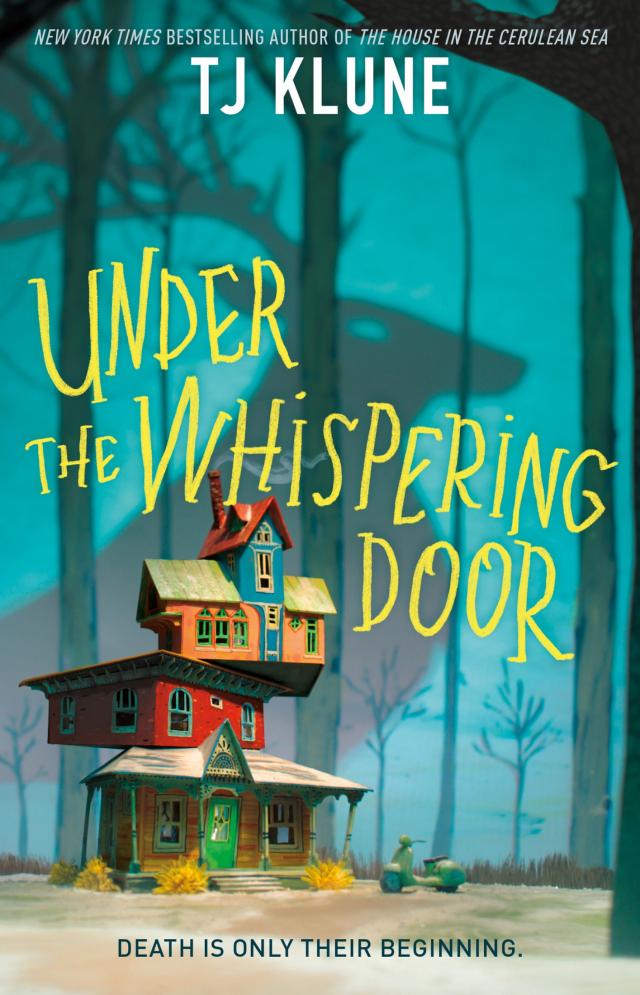
Which was why he was surprised when they came to the shop itself to see that it looked like a house. Granted, it was unlike any house he’d ever seen before, but a house all the same. A wooden porch wrapped around the front, large windows on either side of a bright green door, light flickering from within like candles had been lit. A brick chimney sat on the roof with a little curl of smoke coming out the top.
But that was where the similarity to any house Wallace had ever seen ended. Part of it had to do with the cable extending from the hook in his chest and up the stairs, disappearing into the closed door. Through the closed door.
The house itself looked as if it had started out one way, and then halfway through the builders had decided to go in another direction entirely. The best way Wallace could think of to describe it was that it looked like a child stacking block after block on top of one another, making a precarious tower. The house looked as if even the smallest breeze could send it tumbling down. The chimney wasn’t crooked, per se, but more twisted, the brickwork jutting out at impossible angles. The bottom floor of the house appeared sturdy, but the second floor hung off to one side, the third floor to the opposite side, the fourth floor right in the middle, forming a turret with drapes drawn across multiple windows. Wallace thought he saw one of the drapes move as if someone were peering out, but it could have been a trick of the light.
The outside of the house was constructed with panel siding.
But also brick.
And … adobe?
One side appeared to be built out of logs, as if it’d been a cabin at one point. It looked like something out of a fairy tale, an unusual house hidden away in the woods. Perhaps there’d be a kindly woodsman inside, or a witch who wanted to cook Wallace in her oven, his skin cracking as it blackened. Wallace didn’t know which was worse. He’d heard too many stories about terrible things happening in such houses, all in the name of teaching a Very Valuable Lesson. This did nothing to make him feel better.