Under the whispering doo.., p.5
Under the Whispering Door,
p.5
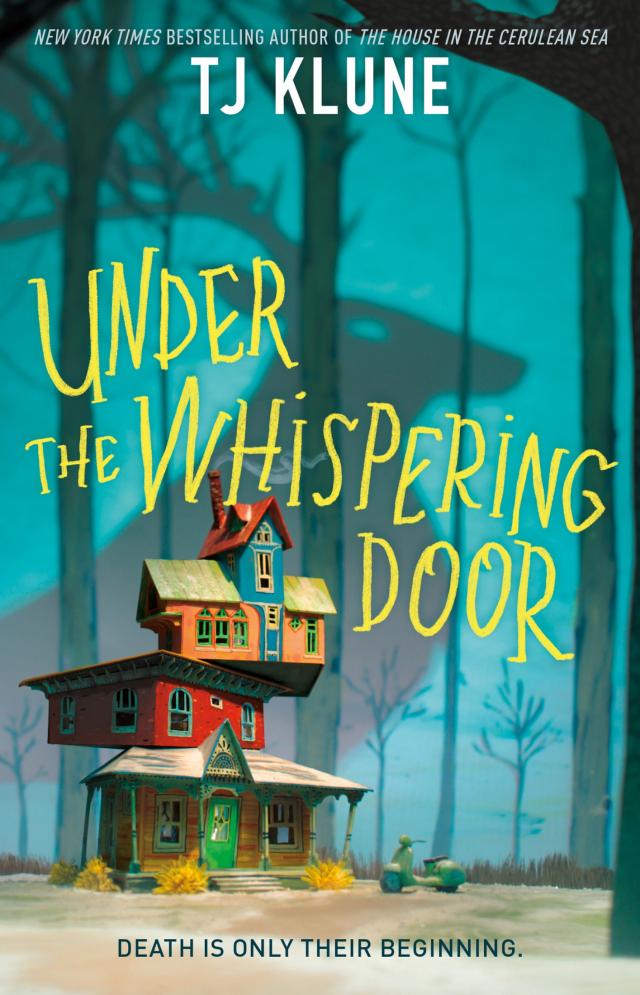


“What is this place?” Wallace asked as they stopped near the porch. A small green scooter sat next to a flower bed, the blooms wild in yellows and greens and reds and whites, but muted in the dark.
“Awesome, right?” Mei said. “It’s even crazier on the inside. People come from all over to see it. It’s pretty famous, for obvious reasons.”
He pulled his arm from her as she tried to walk toward the porch. “I’m not going inside.”
She glanced over her shoulder. “Why not?”
He waved at the house. “It doesn’t look safe. It’s obviously not up to code. It’s going to fall down at any moment.”
“How do you know that?”
He stared at her. “We’re seeing the same thing, right? I’m not going to be trapped inside when it collapses. It’s a lawsuit waiting to happen. And I know about lawsuits.”
“Huh,” Mei said, looking back up at the house. She tilted her head back as far as she could. “But…”
“But?”
“You’re dead,” she said. “Even if it did fall down, it wouldn’t matter.”
“That’s…” He didn’t know what that was.
“And besides, it’s been like this for as long as I’ve lived here. It hasn’t fallen down yet. I don’t think today will be that day either.”
He gaped at her. “You live here?”
“I do,” she said. “It’s our home, so maybe show some respect? And don’t worry about the house. If we worry about the little things all the time, we run the risk of missing the bigger things.”
“Has anyone ever told you that you sound like a fortune cookie?” Wallace muttered.
“No,” Mei said. “Because that’s kind of racist, seeing as how I’m Asian and all.”
Wallace blanched. “I … that’s not—I didn’t mean—”
She stared at him a long moment, letting him sputter before saying, “Okay. So you didn’t mean it that way. Glad to hear it. I know this is all new for you, but maybe think before you talk, yeah? Especially since I’m one of the few people who can even see you.”
She took the steps on the porch two at a time, stopping in front of the door. Potted plants hung from the ceiling, long vines draping down. A sign sat in the window that read CLOSED FOR PRIVATE EVENT. The door itself had an old metal knocker in the shape of a leaf. Mei lifted the knocker, tapping it against the green door three times.
“Why are you knocking on the door?” he asked. “Don’t you live here?”
Mei looked back at him. “Oh, I do, but tonight’s different. This is how things go. Ready?”
“Maybe we should come back later.”
She smiled like she was amused, and for the life of him, Wallace couldn’t see what was so funny. “Now’s as good as time as any. It’s all about the first step, Wallace. You can do it. I know faith is hard, especially in the face of the unknown. But I have faith in you. Maybe have a little in me?”
“I don’t even know you.”
She hummed a little under her breath. “Sure you don’t. But there’s only one way to fix that, right?”
He glared at her. “Really working for that ten, aren’t you?”
She laughed. “Always.” She put her hand on the doorknob. “Coming?”
Wallace looked back down the road. It was full-on dark. The sky was a field of stars, more than he’d ever seen in his life. He felt small, insignificant. And lost. Oh, was he lost.
“First step,” he whispered to himself.
He turned back toward the house. He took a deep breath and puffed out his chest. He ignored the ridiculous slap his flip-flops made as he climbed the porch steps. He could do this. He was Wallace Phineas Price. People cowered at the sound of his name. They stood before him in awe. He was cool and calculating. He was a shark in the water, always circling. He was—
—tripping when the top step sagged, causing him to stumble forward.
“Yeah,” Mei said. “Watch the last one. Sorry about that. Been meaning to tell Hugo to get that fixed. Didn’t want to interrupt your moment or whatever was happening. It seemed important.”
“I hate everything,” Wallace said through gritted teeth.
Mei pushed open the door to Charon’s Crossing Tea and Treats. It creaked on its hinges, and warm light spilled out, followed by the thick scent of spices and herbs: ginger and cinnamon, mint and cardamom. He didn’t know how he was able to distinguish them, but there it was all the same. It wasn’t like the office, a place more familiar than even his own home, stinking of cleaning fluids and artificial air, all steel and without whimsy, and though he hated that stench, he was used to it. It was safety. It was reality. It was what he knew. It was all he knew, he realized with dismay. What did that say about him?
The cable attached to the hook vibrated once more, seeming to beckon him forward.
He wanted to run as far as his feet could carry him.
Instead, with nothing left to lose, Wallace followed Mei through the door.
CHAPTER
4
He expected the inside of the house to look like the outside, a mishmash of architectural atrocities better suited for demolition than habitation.
He wasn’t disappointed.
The light was low, coming from mismatched sconces bolted to the walls and an obscenely large candle sitting on a small table near the door. Plants hung from the vaulted ceiling in wicker baskets, and though none of them were flowering, the scent of them was almost overwhelming, mixing with the powerful smell of spices that seemed embedded into the walls. The vines trailed toward the floor, swaying gently in the breeze through the open window on the far wall. He started to reach for one, suddenly desperate to feel the leaves against his skin, but he curled his hand at the last moment. He could smell them, so he knew they were there even if his eyes were playing tricks on him. And Mei could touch him—in fact, he could still feel the ghost of her fingers on his skin—but what if that was it? Wallace had never been a man of leisure, stopping to smell the roses, or so the saying went. Doubt, then, doubt creeping up on him, sliding over his shoulders and weighing him down, fingers like claws digging in.
A dozen tables sat in the middle of the large room, their surfaces gleaming as if freshly wiped down. The chairs tucked underneath were old and worn, though not shabby. They too were mismatched, some with wooden seats and backs, others with thick and faded cushions. He even saw a moon chair in one corner. He hadn’t seen one of those since he was a kid.
He barely heard Mei close the door behind them. He was distracted by the walls of the room, his feet moving him toward them of their own volition. They were covered in pictures and posters, some framed, some held up by pushpins. They told a story, he thought, but one he couldn’t follow. Here was a picture of a waterfall, the spray catching the sunlight in rainbow fractals. Here was a shot of an island in a cerulean sea, the trees so thick, he couldn’t see the ground. Here was a gigantic mural of the pyramids, drawn with a deft but unpracticed hand. Here was a photograph of a castle on a cliff, the stone crumbling and being overtaken by moss. Here was a framed poster of a volcano rising above the clouds, lava bursting in hot arcs. Here was a painting of a town in the throes of winter, the lights bright and almost twinkling, reflecting off an unmarked layer of snow. Strangely, they all caused a lump in Wallace’s throat. He had never had time for such places, and now, he never would.
Shaking his head, he moved on, glancing at a fireplace that made up half of the wall to his right, the wood shifting as the embers sparked. It was made of white stone, the mantle, oak. Atop the mantle were little knickknacks: a wolf carved from stone, a pinecone, a dried rose, a basket of white rocks. Above the fireplace, a clock, but it appeared to be broken. The second hand was twitching, but it never advanced. A high-backed chair sat in front of the fireplace, a heavy blanket hanging off the armrest. It looked … welcoming.
Wallace glanced to the left to see a counter with a cash register and an empty, darkened display case with little handwritten signs taped against the glass advertising a dozen different types of pastries. Jars lined the walls behind the counter. Some were filled with thin leaves, others with powder in various shades. Little handwritten labels sat in front of each one, describing even more varieties of tea.
A large chalkboard hung on the wall above the jars, next to a pair of swinging doors with porthole windows. Someone had drawn little deer and squirrels and birds on the chalkboard in green and blue chalk, surrounding a menu that seemed to go on forever. Green tea and herbal tea, black tea and oolong. White tea, yellow tea, fermented tea. Sencha, rose, yerba, senna, rooibos, chaga tea, chamomile. Hibiscus, essiac, matcha, moringa, pu-erh, nettle, dandelion tea … and he remembered the graveyard where Mei had plucked the dandelion puffball from the ground and blown on it, the little white wisps floating away.
They were all printed around a message in the center of the board. The words, written in spiky and slanted letters, read:
The first time you share tea, you are a stranger.
The second time you share tea, you are an honored guest.
The third time you share tea, you become family.
The entire place felt like a fever dream. It couldn’t be real. It was too … something, something that Wallace couldn’t quite put his finger on. He stopped in front of the display case, staring at the message on the chalkboard, unable to look away.
Unable, that was, until a dog ran out of a wall.
He shrieked as he stumbled backward, not believing his eyes. The dog, a large black mutt with a white pattern on its chest that almost looked like a star, rushed toward him, barking its fool head off. Its tail swishing furiously, it circled Mei, back end wiggling as it rubbed up against her.
“Who’s a good boy?” Mei cooed in a tone of voice that Wallace despised. “Who’s the best boy in the entire world? Is it you? I think it’s you.”
The dog, apparently in agreement that it was the best boy in the entire world, barked cheerfully. Its ears were large and pointed, though the left one flopped over. It collapsed in front of Mei, rolling over onto its back, legs kicking as Mei sank to her knees—seeming to disregard the fact that she was wearing a suit, much to Wallace’s consternation—rubbing her hands along its stomach. Its tongue lolled out of its mouth as it looked at Wallace. It rolled back over and climbed to its feet, shaking itself from side to side.
And then it jumped on Wallace.
He barely got his hands up in time before it crashed into him, knocking him off his feet. He landed on his back, trying to shield his face from the frantic, wet tongue licking all the exposed skin it could find.
“Help me!” he shouted. “It’s trying to kill me!”
“Yeah,” Mei said. “That’s not quite what he’s doing. Apollo doesn’t kill. He loves.” She frowned. “Quite a bit, apparently. Apollo, no! We don’t hump people.”
And then Wallace heard a dry, rusty chuckle followed by a deep, crackly voice. “Don’t usually see him so excited. Wonder why that is?”
Before Wallace could focus on that, the dog jumped off him and took off toward the closed double doors behind the counter. But rather than pushing the doors open, it went through them, the doors unmoving. Wallace sat up in time to see the tip of its tail disappear. The cable from his chest wrapped around the counter, and he couldn’t see where it led to.
“What the hell was that?” he demanded, hearing the dog bark somewhere in the house.
“That’s Apollo,” Mei said.
“But—it—he walked through walls.”
Mei shrugged. “Well, sure. He’s dead like you.”
“What?”
“Quick one you’ve got there,” that crackly voice said, and Wallace turned his head toward the fireplace. He yelped at the sight of an old man peering around the side of the high-backed chair. He looked ancient, his dark brown skin heavily wrinkled. He grinned, his strong teeth catching the firelight. His eyebrows were large and bushy, his white Afro sitting on his head like a wispy cloud. He smacked his lips as he chuckled again. “Good on you, Mei. Knew you could do it.”
Mei blushed, shuffling her feet. “Thanks. Had a little trouble there at the beginning, but I got it all sorted out.” Wallace barely heard her as he continued to mention sexually aggressive ghost dogs and old men appearing out of nowhere. “I think.”
The man pushed himself up from the chair. He was short and slightly hunched. If he cleared five feet, Wallace would be surprised. He wore flannel pajamas and an old pair of slippers. A cane leaned against the side of the chair. The old man grabbed it and shuffled forward. He stopped next to Mei, squinting down at Wallace on the floor. He tapped the end of the cane against Wallace’s ankle. “Ah,” he said. “I see.”
Wallace didn’t want to know what he saw. He should have never followed Mei into the tea shop.
The man said, “Kinda squirrely, ain’t ya?” He tapped his cane against Wallace again.
Wallace batted it away. “Would you stop that?!”
The man didn’t stop that. In fact, he did it once more. “Trying to make a point.”
“What are you—” And then Wallace knew. This had to be Hugo, the man Mei brought him to see. The man who wasn’t God, but something she’d called a ferryman. Wallace didn’t know what he was expecting; perhaps a man in white robes and a long flowing beard, surrounded by blazing light, a wooden staff instead of a cane. This man looked at least a thousand years old. He had a presence about him, something Wallace couldn’t quite place. It was … calming? Or so close to it that it didn’t matter. Maybe this was part of the process, what Mei had called the transition. Wallace wasn’t sure why he needed to be beaten with a cane, but if Hugo deemed it necessary, then who was Wallace to say otherwise?.
The man pulled the cane back. “Do you understand now?”
No, he really didn’t. “I think so.”
Hugo nodded. “Good. Up, up. Shouldn’t stay on the floor. Gets drafty. Don’t want to catch your death.” He cackled as if it were the funniest thing in the world.
Wallace laughed too, though it was incredibly forced. “Ha-ha, yeah. That’s … hysterical. I get it. Jokes. You tell jokes.”
Hugo’s eyes twinkled with undisguised mirth. “It helps to laugh, even when you don’t feel like laughing. You can’t be sad when you’re laughing. Mostly.”
Wallace slowly rose to his feet, eyeing the two in front of him warily. He brushed himself off, aware of how ridiculous he looked. He pulled himself to his full height, squaring his shoulders. In life, he’d been an intimidating man. Just because he was dead didn’t mean he was going to get jerked around.
He said, “My name is Wallace—”
The man said, “Tall fella, ain’t ya?”
Wallace blinked. “Uh, I … guess?”
The man nodded. “In case you didn’t know. How’s the weather up there?”
Wallace stared down at him. “What?”
Mei covered her mouth with her hand, but not before Wallace could see the smile growing.
The man (Hugo? God?) shuffled forward, knocking his cane against Wallace’s leg again as he circled around him. “Uh-huh. Okay. I see. So. Right. We can work with this, I think.” He reached up and pinched Wallace’s side. Wallace yelped, knocking his hand away. Hugo shook his head as he completed his circle, once again standing next to Mei, resting on his cane. “Hell of a first case to get assigned, Mei.”
“Right? But I think I’m getting through to him.” She glanced at Wallace with a frown. “Maybe.”
“You didn’t do anything,” Wallace snapped.
Hugo nodded. “This one’s gonna give us trouble. Wait and see.” He grinned, the lines around his eyes cavernous. “I like the ones who cause trouble.”
Wallace bristled. “My name is Wallace Price. I’m an attorney from—”
Hugo ignored him, looking at Mei and smiling. “How was your trip, dear? Got a little lost, did you?”
“Yeah,” Mei said. “The world is bigger than I remember, especially going on my own.”
“It usually is,” Hugo said. “That’s the beauty of it. But you’re home now, so don’t you worry. Hopefully, you won’t get sent out again right away.”
Mei nodded as she stretched her arms above her head, back popping loudly. “No place like home.”
Wallace tried again. “I’m told I died from a heart attack. I’d like to lodge a formal complaint, seeing as how—”
“He’s taking to being dead pretty well,” Hugo said, eyeing Wallace up and down. “Usually there’s screaming and yelling and threats. I like it when they threaten.”
“Oh, he had his moments,” Mei said. “But on the whole, not too bad. Guess where I found him?”
Hugo eyed Wallace up and down. Then, “Where he died. No, wait. At his home, trying to figure out why he couldn’t make anything work.”
“His funeral,” Mei said, and Wallace was offended by how gleeful she sounded.
“No,” Hugo breathed. “Really?”
“Sitting in a pew and everything.”
“Wow,” Hugo said. “That’s embarrassing.”
“I’m standing right here,” Wallace snapped.
“Of course you are,” Hugo said, not unkindly. “But thank you for making that known.”
“Look, Hugo, Mei said you could help me. She said she had to bring me to you because you’re the ferryman, and you’re supposed to do … something. I admit I wasn’t really paying attention to that part, but that is beside the point. I don’t know what kind of racket you’re running here, and I don’t know who put you up to this, but I would really rather not be dead if at all possible. I have far too much work to do, and this has been an awful inconvenience. I have clients. I have a brief due by the end of the week that can’t be delayed!” He groaned, mind racing. “And I’m supposed to be in court on Friday for a hearing that I can’t miss. Do you know who I am? Because if you do, then you know I don’t have time for this. I have responsibilities, yes, extremely important responsibilities that can’t be ignored.”