Gravity wars nova strike, p.1
Gravity Wars: Nova Strike,
p.1


SF Books by Vaughn Heppner
THE TRAVELER SERIES:
Galactic Marine
Sleeper Ship
The Zero Stone
The Institute
Neanderthal Planet
The Science of Mu
THE SOLDIER SERIES:
The X-Ship
Escape Vector
Final Odyssey
INVADERS SERIES:
Invaders
The Chronowarp
The Antaran
Dreadnought Ocelot
Earth Gate
Visit VaughnHeppner.com for more information
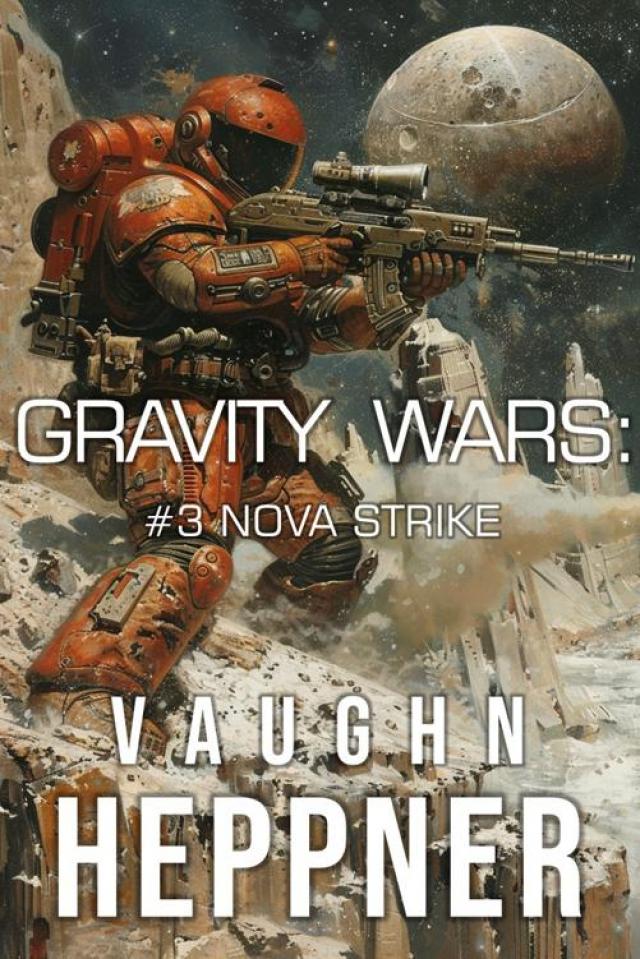
GRAVITY WARS #3:
Nova Strike
by Vaughn Heppner
GRAVITY WARS SERIES:
#1 Interstellar Assault
#2 Saturn Protocol
#3 Nova Strike
#4 Extinction Orbit
Copyright © 2024 by the author.
This book is a work of fiction. Names, characters, places and incidents are either products of the author’s imagination or used fictitiously. Any resemblance to actual events, locales or persons, living or dead, is entirely coincidental. All rights reserved. No part of this publication can be reproduced or transmitted in any form or by any means, without permission in writing from the author.
Author’s Note
I’ve written many a space opera with warp drives, hyperspace, and jump points—faster than light travel, in other words. I’ve often wondered how a space war might occur without such fanciful technology. As far as we know, traveling faster than light is impossible. Would such a war make any kind of sense under that restriction?
The novels in the Gravity Wars series imagine such a situation, using hard science as the basis. That means there are no light sabers, warp drives, or telepathy. I limited myself to using only technologies that we know are possible. Here is the ongoing scenario, one that could theoretically occur given our current scientific understanding.
-- VAUGHN HEPPNER
Minden, Nevada
Introduction
How does a small expeditionary force defeat a planet of billions?
Does human history supply any answers to such a question? In a way, that seems like the wrong thing to ask. How could human history do that? We haven’t left our solar system yet—at least, as far as we know.
Even so, there is a historical example of a small group of adventurers reaching a nation of millions and defeating them in a devastating military attack, from which the natives never recovered.
In 1519, Hernán Cortés landed at Vera Cruz with around 600 soldiers. That included 16 cavalrymen, 13 arquebusiers, 32 crossbowmen, and about 10 cannons. The bulk of his men were equipped with swords, lances, and other melee weapons. They also wore a mix of metal armor and padded cotton armor.
They set out to conquer the 10 to 15 million people of the Aztec Empire. Many historians suggest the Aztecs could mobilize up to 100,000 to 200,000 warriors for major campaigns. Many of those warriors were hardy veterans of successful battles. Even though the Aztecs used obsidian-tipped clubs, and bows and arrows, they were a formidable, well-drilled host.
At the beginning of this extraordinary war, and in order to fortify his soldiers mentally, Cortés scuttled 10 of the 11 ships that had brought the army to Vera Cruz. He left one ship for communication purposes. That meant his small army could not retreat overseas even if it had wanted to. Cortés had irrevocably committed them to the conquest of the Aztec Empire.
One wonders if Chief Marshal Assur of the Valiants might resort to a similar move, forcing his soldiers to fight with their backs to the wall, ensuring they give their all. In that way, the Valiants might achieve a victory similar to Cortés against humanity.
As the old saying goes, history doesn’t repeat, but it does rhymes. How might we see it rhyme in a desperate war where a handful of Valiants face a planet of billions?
Part I
The Proto-Sumerian Deception
-1-
EARTH
MARCH 2072
Director Livia Drusus was the most powerful person on Earth, and she had a terrifying addiction. It had driven her to lust, lies, and murder—any indignity or deed that helped her acquire what she craved most: power.
Some might have called it political power. In reality, it was to do whatever the hell she wanted.
What Livia wanted lately was to crush those who might keep her from more power. There was one person in particular she loathed. He did not live on Earth but in the orbital stations above Earth. At times, he thwarted her addiction, an unforgivable act. His name was CEO James Petty.
Incredibly, he was a man. This man was a musclebound brute, a pig and a sexist. He was old-fashioned in many ways, holding to old values, even though he indulged himself with the prettiest and most provocative women he could find. That wasn’t his great crime, obviously, although Livia also held it against him. What Petty did that Livia hated so much that she spat curses at him in her sleep was to whittle away her power.
Because of Livia’s addiction, she experienced agony of heart and soul. That he might keep from her even the smallest dollop, or take some of the power she already possessed, enraged Livia to no end.
She was tall and willowy even though she was in her 60s. She had maintained much of her former beauty even though she had done truly despicable and disgusting things to gain power. One of her worst crimes was engineering a nuclear detonation in one of the most important pusher-plate production plants on Earth, in northern Vietnam. That had been several years ago already.
The 100,000-ton Orion ships used pusher plates, allowing the space vessels to detonate nuclear devices as their motive power. The Orion ships were critical in the ongoing war against the invading aliens lodged in the Saturn system, on the moons Titan, Iapetus, and others.
Earth had badly needed that production plant. Livia had destroyed it so she could kill former Director Anwar Gray in it. The reason was simple. The stroke-addled fool had stood in her way to gaining the directorship—in other words, her increased power. Therefore, the cripple had needed to die.
Livia smiled thinking about it.
She had phoned Gray during the Vietnam production-plant tour seconds before the nuclear detonation occurred. She had mocked him, letting him know he was going to die, even though she had altered her voice, just in case the bomb plot failed.
It had succeeded with a nuclear boom, incinerating thousands of innocents, destroying the plant and nearby ecosystems and delaying the Orion-ship assault against Saturn. That delay had likely cost humanity the Second Battle at Saturn, although nobody on Earth knew that.
From that, Livia had collected Gray’s stocks and options, most of them anyway, and increased her power base because of it. Through the added power, she had become Earth’s new Director.
Her only true fly in the ointment was the damnable James Petty, a man who considered himself as the Lord of Space, as he hid up on the orbital stations. She could live with that, the hiding, but not with Petty’s hindering her from acquiring all the power she craved.
“James Petty,” Livia whispered, “you are through, do you hear?”
Livia sat outside on a lawn chair before a large swimming pool. She wore a wide straw sunhat, a long terrycloth robe and flip-flops.
Several of her protection detail cavorted in the water. They were all huge, muscular women, steroid and testosterone users, truly dangerous killers.
Livia had watched them on occasion break the back of a man who thought he could take them. She had listened to the man plead for his life afterward, giving him the thumbs down like an old Roman empress. Then, the burly guards dispatched the man in whatever way seemed most undignified, stealing his manliness at the end. It showed him, as he perished, that he was nothing, and that Livia held all the power.
The pool and mansion were located in Melbourne, Australia.
Livia had chosen Melbourne for a reason, as its geographical location offered a scientifically sound shield against the Valiant projectiles launched from the former railgun on Iapetus. The 20,000 kg iron balls had been launched at incredible speeds, targeting Earth’s most critical infrastructure. However, the trajectories followed specific orbital mechanics, favoring strikes on more central and equatorial targets. There were multiple reasons for this, the most important being: rotational dynamics, orbital mechanics, atmospheric reentry challenges, and environmental variability. They made targeting the Polar Regions and others near them with high-velocity projectiles significantly more difficult than targeting other parts of Earth.
The breakdown of those reasons was as follows:
First, the rotational velocity of Earth decreased as one moved from the equator to the poles. Projectiles needed to account for this varying rotational speed, making targeting the poles more complex compared to regions closer to the equator, where the rotational speed was higher and more consistent.
Second, launching a projectile from Iapetus involved precise calculations of orbital mechanics. To reach the poles, for instance, projectiles would need to adjust their trajectory to account for Earth’s tilt (23.5 degrees) and its elliptical orbit around the Sun. This involved more complex trajectory corrections compared to aiming at targets on the equator.
Third, the Coriolis Effect, which is the deflection of moving objects due to Earth’s rotation. That effect was more pronounced at the poles. This required additional adjustments in the projectile’s path to ensure it stayed on target, adding complexity to the launch calcul
ations.
Fourth, the angle of reentry into Earth’s atmosphere was critical. For polar targets, the reentry angle might need to be steeper to reach the higher latitudes, increasing the risk of burning up or breaking apart due to atmospheric friction. This required more sophisticated thermal protection and precise control over the descent trajectory.
Fifth and last, the Polar Regions had more variable weather conditions and terrain, such as ice and snow, which could affect the projectile’s final approach and impact accuracy. These factors made it harder to predict and control the exact landing site compared to more temperate and stable regions closer to the equator.
While Melbourne was not near the South Pole, it was much nearer than other large cities, giving it many protective benefits. The aliens’ weapons systems, while advanced, were optimized for more straightforward, equatorial trajectories, maximizing strike efficiency. This left Melbourne and similar off-center locations less vulnerable. Additionally, the Southern Hemisphere’s vast oceanic expanses provided fewer high-value targets, making precise strikes in this region less frequent and less likely.
Thus, Melbourne provided Livia not just a physical refuge, but a scientifically strategic one, reducing the probability of an alien projectile strike while allowing her to maintain command from a secure and stable location.
Right now, as previously stated, Livia was trying to figure out the best way to deal with James Petty. His latest crime was in allowing more of the alien projectiles to strike when aimed at factories controlled by her or her allies. That meant projectiles aimed at his and his allies’ factories were struck less often.
As the supposed Lord of Space, Petty controlled most of the sensor and missile launch sites—his orbital stations—that deflected the incoming projectiles from Iapetus.
That meant the 20,000 kg iron balls had wiped out more of her and her allies’ factories, stocks and bonds than James Petty’s and his allies. That had weakened her grip on power. Correspondingly, Petty had gained power at her expense.
Corporations ran Earth in 2072, the reason factories, stocks and bond were so vitally critical to those in power.
All this galled because Livia needed to be the ultimate dictator of Earth in the same way Nebuchadnezzar had ruled in ancient Babylon.
There had been a Biblical prophecy in ancient times, a dream of Nebuchadnezzar regarding an infamous statue. In the dream, the golden head and shoulders of the statue had signified the absolute power wielded by Nebuchadnezzar. He could do whatever he wanted within his realm. Later rulers were hindered, among other things, by their country’s laws.
Livia wanted to rule as Nebuchadnezzar had, by whim. If she thought it, it happened, period.
If all that wasn’t bad enough, Petty had surely infiltrated a spy deep into her organization. That spy had filched her idea of sending Earth’s two Orion ships in the direction of Iapetus.
While Colonel Mike Steele had destroyed the railgun on Iapetus many months ago, projectiles launched from there would continue to pound Earth for another 50 days.
The reason was this: It took a magnetically catapulted iron ball 400 days to travel from Iapetus to Earth. This meant Steele had destroyed the railgun 350 days ago, or almost a year ago.
When the next 50 days passed, no more projectiles would reach Earth from the 200-kilometer, destroyed railgun.
The point of the stolen idea—Livia’s brainchild—was that moving the Orion ships and sensor drones toward Iapetus would give Earth Defense earlier warning. That also meant it should be easier to deflect the projectiles, in that it took less force to deflect from farther out than closer in to target Earth.
The distance the Orion ships had traveled was small in Solar System terms: three times the distance beyond the Moon as the Moon was from Earth. The average distance of the Moon from Earth was 384,400 kilometers. The Orion ships were thus approximately 1,150,000 kilometers beyond the Moon, making them roughly 1,500,000 kilometers from Earth.
Interestingly, for the last 41 days, no projectile had broken through Earth’s Defense shield. Petty was taking full credit for that, and the populace loved him for it.
While sitting in the lawn chair, Livia barely restrained from grinding her teeth in rage. Somehow, she had to bring James Petty to his knees. First, she had to weaken him. Even before that, she needed to know how to weaken him.
That was what today’s session was about.
Livia stood up.
The hulking brutes in the pool noticed and stopped playing their silly games as they turned and looked at her.
“Never mind,” Livia said. “I am going inside. I have a meeting.”
“Do you want us to come out?” the chief guard said, a woman seven and a half feet tall and at least 300 pounds. She was a mass of muscle—a truly vicious, dangerous brute.
“Yes, you come with me,” Livia said. “The rest can stay in the pool.”
The giant guard climbed out of the pool. She wore a bikini, but she did not look anything like any supermodel Petty enjoyed to bed.
Livia turned away and headed for the mansion. Her most dangerous guard trailed behind, dripping water as she hurried.
-2-
Livia sat on an orange couch in the main living room. It was a large room with several huge paintings on the walls. A trained leopard with a spiked collar panted beside a rug.
The massive guard had hurried to a bathroom, toweled off, and was now wearing a nondescript gray uniform with a heavy gun holstered at her side. She stood near a portrait of Cleopatra standing before a pyramid.
A door opened. A small butler stepped through and indicated someone enter the room.
A slender, youngish woman entered. She had bright green eyes, a blonde bob-cut, and wore a jumpsuit and a steel-mesh vest. She moved with the grace of a gymnast. There was something unsurprisingly predatory and cunning about her.
The huge brute of a guard glared at the newcomer, almost in the way a Doberman pinscher would have done. The guard all but snarled.
Livia smiled. “Stand down, heel,” she said.
The brute’s massive shoulders slumped as she took a step back. The guard didn’t seem to mind such derogatory commands. She and the others served Livia obediently and joyously, receiving commensurate rewards for doing so.
“Jondelle Dawnstar,” Livia said to the waiting newcomer.
“Yes, Director,” Dawnstar said, coming to attention in the middle of the living room.
Livia had studied Dawnstar’s bio last night. The woman had been born and raised in the slums of Greater London. Apparently, she had traditional English genes. She was a bloodthirsty little witch, known for getting the job done.
Livia pointed at a couch across from hers.
Smoothly, Dawnstar stepped to the couch and sat down, crossing her legs, waiting with poise.
Livia had a secret to maintaining power. She ruled the Earth and some of orbital space, despite Petty’s pretensions. Her great secret was that Livia gave the same assignments to at least two different groups. The two groups often fought each other as they had similar authority in particular areas. That meant the two groups vied and intrigued against each other. Often, they would come to Livia to settle a dispute or give clarification on a project.
In this way, Livia ensured that all her operatives had counterpoints who worked day and night to keep each other from getting too powerful. That meant Livia did not have to watch her satraps as closely as she otherwise would. The system meant less efficiency in running Earth. But it helped Livia keep what she loved most: power.
Jondelle Dawnstar was a new agent in a third, competing security group. She had a team supporting her. Today was Dawnstar’s opportunity to show what she was made of. If she succeeded, the other two intelligence organizations would be on notice that they had better step it up or Dawnstar would take over from one of them.
“Have you studied the problem?” Livia asked.
Dawnstar nodded.
“Explain it to me then.”
“I have studied the methods of James Petty for the last twenty years,” Dawnstar replied. “I made an interesting discovery. He became much more effective with the addition of one person, a man foisted on him by Anwar Gray. The man’s name is Manfred A.S. Huber or otherwise known as Rumpelstiltskin.”