Warrior king, p.1
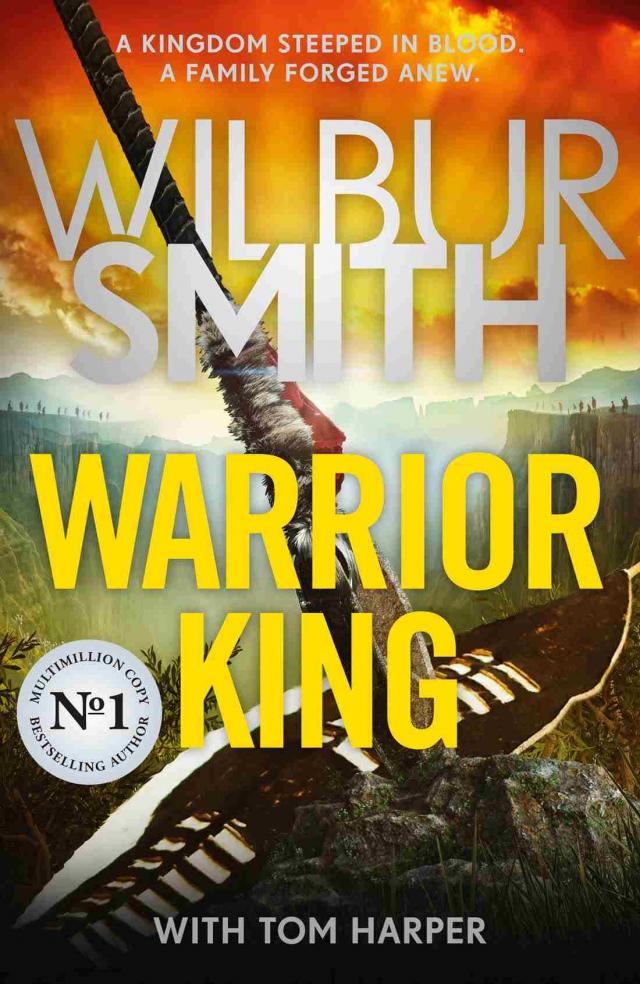
Warrior King,
p.1


Praise for
‘A thundering good read is virtually the only way of describing Wilbur Smith’s books’
IRISH TIMES
‘Wilbur Smith . . . writes as forcefully as his tough characters act’
EVENING STANDARD
‘Wilbur Smith has arguably the best sense of place of any adventure writer since John Buchan’
THE GUARDIAN
‘Wilbur Smith is one of those benchmarks against whom others are compared’
THE TIMES
‘Best Historical Novelist – I say Wilbur Smith, with his swashbuckling novels of Africa. The bodices rip and the blood flows. You can get lost in Wilbur Smith and misplace all of August’
STEPHEN KING
‘Action is the name of Wilbur Smith’s game and he is the master’
WASHINGTON POST
‘A master storyteller’
SUNDAY TIMES
‘Smith will take you on an exciting, taut and thrilling journey you will never forget’
THE SUN
‘No one does adventure quite like Smith’
DAILY MIRROR
‘With Wilbur Smith the action is never further than the turn of a page’
THE INDEPENDENT
‘When it comes to writing the adventure novel, Wilbur Smith is the master; a 21st century H. Rider Haggard’
VANITY FAIR
This book is for my love, Mokhiniso, spirit of Genghis Khan and Omar Khayyam, reincarnated in a moon as lucent as a perfect pearl.
CONTENTS
The Courtney Family in Warrior King
Algoa Bay, South Africa. April, 1820
Three Years Later . . .
Eastern Cape
Robben Island
Algoa Bay
Indian Ocean
Nativity Bay
Zululand
Nativity Bay
Kwabulawayo
Nativity Bay
Kwabulawayo
Ezindololwane
Nativity Bay
Ezindololwane
Nativity Bay
Four Years Later . . .
Talala Kraal
Mpondoland
Talala Kraal
Reader’s Club
About the Authors
Also by Wilbur Smith
Copyright
This novel, like all of those published after his passing, originated from an unfinished work by Wilbur Smith. It was completed by Tom Harper, who was hand-chosen by Wilbur to co-create a story bridge from BLUE HORIZON to WHEN THE LION FEEDS in the famous Courtney family series. Wilbur and Tom worked on outlines that met Wilbur’s rigorous standards. Wilbur’s wife, Mokhiniso Smith, his long-standing literary agent Kevin Conroy Scott and the Wilbur Smith Estate’s in-house editor, James Woodhouse, worked tirelessly with Tom to ensure Wilbur’s vision was realised in his absence.
Find out more about the Courtneys and see the Courtney family tree in full at www.wilbursmithbooks.com/courtney-family-tree
ALGOA BAY, SOUTH AFRICA. APRIL, 1820
T
he continent was hidden. A thick sea mist rolled in off the bay, obscuring the ships at anchor and the canvas city that had risen on the shore two days earlier. It deadened every sound. Only the sea remained – the hush of waves breaking in the humid air. To Ann Waite, standing on the sandy beach, it was as if she had fallen off the edge of the world.
Ann needed to be alone. She hugged her arms against her chest, feeling the breasts that were swollen with milk to feed the baby that did not exist. She remembered the nightmare of the birth at sea: spread-eagled on a table; seamen going about their work just inches away; the old naval surgeon with his knives and rusty saws jangling on the wall behind him. She recalled the claustrophobia of the tiny compartment, deep in the ship, below the waterline. It had taken eighteen hours of labour for the baby to arrive, a girl whom Ann had named Susannah.
A day later, Susannah was dead. They buried her in the ocean in a canvas shroud, with a ballast stone to weigh her down.
The grief was so painful that Ann wanted to scream. Her daughter should have heralded the new life that Ann and her husband Frank had come from England to make in Africa. Instead, the voyage that began in hope had ended in death and despair.
Out in the fog, she heard the wailing of a baby. She must be imagining it. It was the sound that haunted her nightmares: a soul adrift, abandoned to danger, that she could not comfort or embrace.
Ann had never expected to find herself in Africa. Growing up in a small village in the Pennine hills of England, the continent had been no more real to her than the lands in fairy tales. Then the war that had begun before she was born had ended. Napoleon was beaten, but it did not feel like victory to the men who returned from the battlefields of Europe. Tens of thousands of men who had known no profession except soldiering suddenly found themselves surplus to the requirements of the crown they had served so loyally. Ann’s husband, Frank, had been one of them. He had found work as a hand-loom weaver, but wages had halved since the peace and he could not earn enough to provide for the baby growing inside Ann’s belly.
Then, one morning, Frank had seen a notice posted in the bow window of the general dealer. Free land – good, fertile land, the notice promised – being given away by the government, with tools, seeds and equipment for farming to be provided at cost. It was in Cape Colony, at the southern tip of Africa.
Pulling his cap down, Frank had hurried home, a look of determination on his face.
Ann was hesitant, but Frank had fought at the capture of Cape Town in 1806 and seen a little of the country. The land was ripe, he promised her, a Garden of Eden where if you spat out a grape pip, a vine would grow in front of your eyes. ‘This is a godsend,’ he told Ann, falling to his knees. ‘The answer to our prayers. A place to make a home and raise our future family.’
Ann had yet to see the paradise she had been promised. Four thousand settlers had answered the notice and taken passage on the ships the government provided. They had been set ashore in this bay of desolate sandhills and salt marshes, billeted in tents among scrub and rocks while they waited for wagons to take them to the grants the government had assigned them. Her husband still clung to the hope that the country inland would live up to its promise. Ann had lost faith. She had seen nothing for six weeks but the dank inside of the ship and now this cursed beach where the sun blistered their skin and the wind screamed at them as if wanting to drive them back into the endless, devouring sea.
She heard the cry again – the baby. The sound cut straight to her heart; dark horrors invaded her thoughts. Was she going mad? Many of the settlers had brought their children along with them, and not all the babies born on the voyage had suffered Susannah’s fate. Though the sound seemed to be coming from a different direction – out in the bay. The fog was so thick that Ann had lost her bearings, only the sand beneath her feet seemed real.
The wailing grew louder – the infant crying at the top of its lungs, calling for help. As if its life depended on it.
Surely no parent could ignore that cry for long. Someone would find it soon and soothe the poor, scared soul.
The crying became more anguished. It was almost unbearable, but Ann was sure now that it was coming from out in the bay.
She ran to the water’s edge. The fog was thicker here, but she could see a dark shape emerging and then disappearing in the spectral grey. She heard the mournful creak and grind of wood scraping rock.
‘The baby must be on a boat,’ she murmured to herself. But the ships had unloaded all their passengers and anchored far out in the bay. And if it was a boat, there should be other sounds: the screech of rowlocks and the grunt of sailors working the oars; the shouts of the coxswain, and perhaps the soothing voice of the child’s mother. She heard none of those.
She had never encountered the sea before she left Lancashire. Its fathomless depths terrified her; she had spent the whole voyage in a state of muted panic. But now she was determined. Whether the baby was real or not, she was compelled towards the source of the crying.
Hoisting her skirts, Ann waded into the freezing water. The folds of her dress welling up; the incoming sea lifting her off her feet. The current was so strong that she lost her balance and found herself half-sitting in the water. A wave washed over her head as she tried to pull herself upwards, filling her throat as she called out in alarm.
‘Help! God, please help!’ Ann shouted, choking as another wave drowned her voice and the current took hold of her skirts, sucking her out to sea.
In the dunes above the beach, not even two hundred yards away, four thousand souls were starting the day – getting dressed, queuing for their breakfasts at the field kitchens, discussing the peculiarities of this new land. Yet they would not be able to hear her.
Desolate, terrified, half-drowning, Ann flung out her hands as the sea took her, desperate for any kind of purchase in the icy water. Sand and broken pieces of kelp billowed around her as the ocean’s relentless power pulled her further from the shore.
Then she saw it – the prow of a boat.
It was trapped in a cleft between two rocks, the waves battering it, thrusting it to and fro. Ann could see that it would sink soon – already the water around it was full of splinters and broken timber.
The next wave drove her against the rocks. She thought she would be crushed, but then the baby cried again – it was in the boat! That cry filled Ann with fire. She would not let another child slip beneath the waves. A scream rose from her chest, just as it had during her hellish labour. Sh
e pushed against the rock on which she was pinned with all her strength, striking out into the deep water.
The waves drew the boat back, then threw it forward again, thrusting it towards Ann. As it came closer, she grabbed for the bow but she was still too far away – the gunwale agonisingly out of reach.
The next wave hammered Ann against the hull with such force that she feared her ribs would break. Grabbing the prow, she clung on as the sea tore at her skirts, leaning on the boat, hoping that somehow she would be able to lever it off the rocks.
The sea heaved around her, the waves ripping at the boat. Ann looked inside.
Three people lay there: a woman, a man and a baby.
The man lay across the main thwart, slumped in the bilge. The woman lay facing him. Long honey-coloured hair hung loose around her shoulders; her skin had been burned deep red by exposure to the sun and drawn tight on her bones from hunger, though Ann could still see that she had once been beautiful. She looked so peaceful – with her eyes closed and her hands folded in her lap – that one might have thought her asleep. But her chest did not move, and the grey pallor of death had already begun to creep in around her eyes.
The man was hideously disfigured. The right half of his face was a mess of raw scars where he had been badly burned, livid dead skin twisted like a clump of maggots. On the other side of his face, hair sprouted where his beard had tried to grow. He was dressed in a long tunic, heavily embroidered with golden dragons. A pistol was still tucked in his belt.
Neither the man nor the woman gave any sign of life. They are dead, Ann thought with horror.
Between them, the baby lay on its back, eyes closed, its small face puffed scarlet with the mammoth effort of screaming. It was a boy. He had been wrapped in a piece of sackcloth, but his frantic kicking had thrown off the covering and water leaching through the crack in the hull had soaked it. His skin was starting to turn blue.
Ann leaned all her weight on the boat, turning the bow a few degrees. It was enough. Suddenly, miraculously, the boat was free, sliding out from between the rocks and into the sea. Ann almost lost her grip, fighting to keep her head above the waterline as the current took hold.
The boy cried out again, but weaker this time. Ann wasn’t sure how much time he had left.
Her feet touched the bottom. She could stand.
Ann let the morning tide carry the boat ashore, the waves nudging it up the beach until it came to rest. She knelt on the sand, exhausted, spitting out seawater, while white surf foamed around her and groped at her skirts.
The boy whimpered in the boat.
Adrenaline made Ann forget her exhaustion. Standing, she scooped the baby in her arms, unbuttoned the front of her dress and tugged the fabric apart to expose her swollen breasts. The baby’s mouth puckered as Ann lifted his face to her breast. He found the nipple and clamped down so greedily that it made Ann gasp.
It felt as if a dam had broken inside her. The hot milk emerged with such force that it seemed to sear her flesh. As the milk flowed, she felt a long-awaited release and a series of deep shudders went through her.
Holding him close to her chest, Ann peered into the boat again.
It must have been at sea for weeks. It could not have come from the ships anchored in the bay, and as far as Ann knew there weren’t any harbours nearby. It must have come from another ship, far out to sea, but why?
Ann stroked the baby’s head, covered in a thin golden down. ‘I suppose you are an orphan now,’ she murmured.
‘Who are you?’
The words rang out harsh on the empty beach. At the same time, a hand fastened around Ann’s wrist like a talon and pulled her forward. She almost dropped the child in her fright.
The man in the boat was not dead. Amid the filth and gore that caked his face, his blue eyes were cold and sharp as they stared at her.
‘Where is this?’ His voice was a rasp. He stared around wildly, trying to penetrate the fog, then fixed his gaze back on Ann. ‘Is this the Cape?’
‘Al— Algoa Bay,’ Ann stammered with dread.
His eyes narrowed threateningly. ‘Tell me your name.’
‘Ann Waite.’
‘What are you doing here?’ he demanded.
‘I came with the settlers. On the ships, from England.’ She pointed into the bay, but the fog still hid the anchored fleet. ‘We arrived yesterday.’
The man let go of Ann and pulled himself unsteadily to his feet. His grip had left a deep red mark on her wrist.
‘What is your name?’ Ann asked. It was an innocuous question, but it took courage to ask it. Even in his weakened state the man blazed danger: she could feel it emanating from him like hot coals.
The man stepped out of the boat, and almost collapsed onto the sand, as if his legs were made of rope. He grasped the boat’s gunwale to steady himself. The scars on his face twitched. ‘Ralph Courtney.’
‘Where did you come from?’
He ignored the question. A length of driftwood lay on the beach, bleached white by the sun. He picked it up and leaned on it as a crutch, scanning his surroundings.
‘Is the navy here?’ he asked.
Ann nodded.
‘How many ships?’
She didn’t know the precise number of ships. ‘Twenty, perhaps?’ she guessed.
He was still looking at her, but she seemed to have slipped out of focus, as if his mind was caught on a memory.
The baby suckled at Ann’s breast. She knew she must return him to his father, though she could hardly bear the thought of giving up the child so soon.
‘I am sorry for your wife,’ she said.
‘She was not my wife.’
‘And the baby?’
‘An orphan.’ The words were expelled with a violence that made her cover the baby in her arms. Fury, hatred – but also something deeper, she thought. A kind of despair that had no other outlet but anger.
‘You need help.’ She spoke gently, trying to calm him, afraid of the lash of his tongue. ‘Food and water.’
‘No.’ His throat was so parched he could barely grunt his words. ‘I cannot stay.’
He leaned on his stick and began to hobble away down the beach.
‘What about the child?’ Ann called.
He looked back. With his head turned, she could not see the burned half of his face and it suddenly became clear to her that he was not much past twenty years old. He would have been a handsome young man, before his ordeal.
‘His name is Harry,’ he rasped. ‘Keep him alive, if you can.’
Before Ann could ask what that meant, Ralph stumbled off into the fog.
Ann felt dizzy. She sat down on the boat’s gunwale, cradling the child. He had drunk sufficient, and his colour had returned. He lay in her arms with his eyes closed, asleep. An occasional twitch of his face spoke of the dreams inside his little head.
If not for the child, and the hard wood of the boat under her, Ann would have thought she had dreamed the encounter. Where had Ralph Courtney come from? What should she do now?
‘What are you doing?’
The voice startled her. She looked up guiltily, though she had nothing to hide. Her husband, Frank, had appeared and was staring down at her through his round, silver-rimmed spectacles.
‘You should not wander away by yourself,’ he scolded her gently. ‘Who knows what savage animals may be roaming out here.’
Then he took in the boat, the dead woman, Ann in her soaking clothes – and the child. His face went white.
‘What on earth . . .?’
‘The boat washed ashore. I heard the baby crying.’
Frank’s mouth opened as if to say something and his face seemed to twitch. He took off his glasses and rubbed them on his shirt, as if that would help him see more clearly.
‘She came from a ship called the Tiger,’ he said, pointing to the name painted along the bow. ‘But there is no ship by that name in our fleet.’
He dug his finger into a crack in the gunwale where the wood had splintered. A round lump of lead came out of it.
‘A musket ball. She has been in a battle.’
Ann stayed motionless and quiet. She held the baby tighter, her heart racing. What would Frank say? Would he insist she gave him up?
Frank looked at the dead woman, and then at the baby. He glanced at Ann and saw the fire in her eyes.