Nemesis, p.14
Nemesis,
p.14


The heat on his face returned him to his surroundings. The sun had risen blisteringly high while he was sketching, and his cheeks had started to burn. Behind him, the column would have settled down to sleep. Surely even Bastiat would not be watching. If Paul wanted to live, now was the time to brave the desert.
He mounted the camel and climbed the rise behind the statues, moving slowly in the heat. He took a deep draught from his water skin, then regretted it. How could he make it last the journey home if he drank it all now? He hooked the water skin back onto the pommel of his camel’s saddle – and as he did, he made an unpleasant discovery.
The holster that hung over his camel’s flank was empty. He had forgotten his carbine. In his haste to be away, terrified of being challenged or stopped, he had left the gun in camp.
Idiot, he berated himself.
He thought of going back, but he had already delayed too long. If he returned to camp now, he might never have the chance to escape again.
Could he survive the desert, and the long journey back, with no way of hunting or defending himself? He was still wondering about it, half tempted to abandon the whole scheme, when he reached the top of the rise. He had come to the mouth of a shallow valley, though for a moment he didn’t look at it properly. Then he did, and forgot everything except what was in front of him.
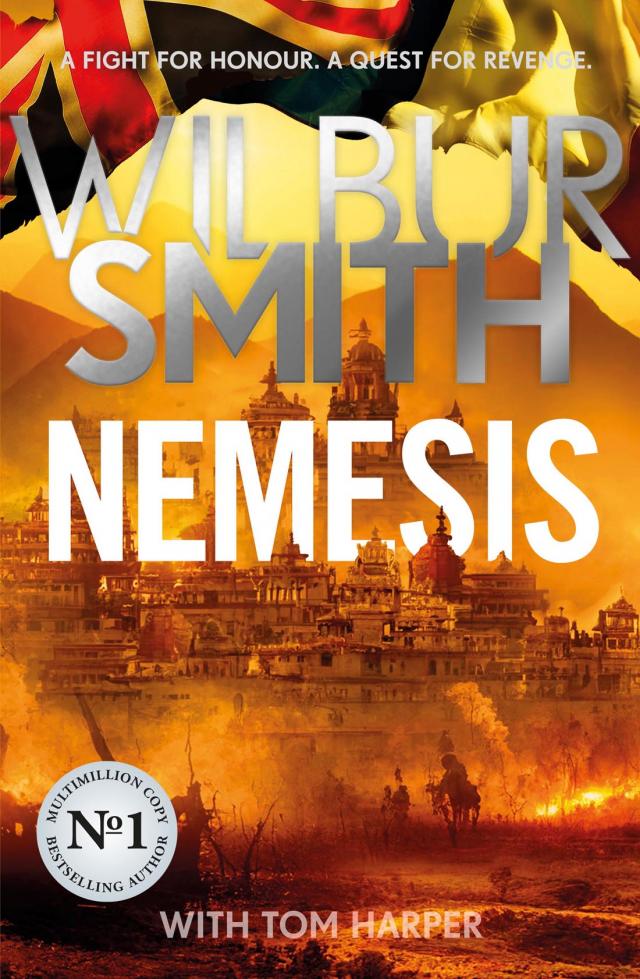
A huge complex of ancient buildings stood at its head, as proud as the day they were built. It was almost as big as a city. Rose-granite obelisks thrust up to the sky. Fat columns held up blocks of stone so huge they must have been lifted by giants. Slanted walls buttressed vast buildings. Stone lions crouched low, like swimmers in the sand.
‘What is this place?’ he wondered aloud, though the only living creatures to hear him were his camel, and the birds circling above.
The ruined city throbbed in his vision, shimmering in the heat haze. It felt like a mirage, except it was too fantastical to be a trick of the eye. The massive stones were so physical he could almost feel their gravity pulling him in.
Paul started towards it. The ground was rough and uneven; he had to dismount and lead his camel, kicking up whirlwinds of dust and dislodging loose rocks. Like the statues, the buildings were so gigantic they distorted his sense of scale. They looked to be a few hundred feet away, but Paul must have walked nearly a mile before he reached them.
Two obelisks flanked a monumental gate. Paul stepped under it, gazing nervously at the massive lintel. If one of those blocks fell . . . And they were not even at their full height. Desert sand had blown in over the centuries, accumulating in great drifts between the sheltered walls.
Leading the camel, he walked through the gate and into the abandoned city, half-striding, half-swimming through the deep sand. It was like a dream, but more unreal than any dream he’d ever had. He moved between rows of columns taller than the masts of ships, through doorways that could have accommodated whole houses. He felt himself shrinking in their presence, no bigger than one of the grains of sand blowing around his feet. It dawned on him that this could not have been a city: no human being could have lived in these buildings. They must be temples, for only a god could inhabit such a space. He had never felt so utterly alone.
But maybe he was not alone. In the wind-smoothed sand, he sometimes saw small impressions. Some were round – probably jackals or wild dogs – but others looked like human footprints. Paul glanced about him, his gaze jumping from shadow to shadow, wondering what might lie within the ruins. There were a million places to hide. If the Bishareen were here, they could take their time with Paul: hours, maybe days. The French soldiers would never come, even if they heard his screams.
He wanted to flee, but his feet kept moving forward, as though an invisible power was pulling him deeper into the city. Though the ground was buried, Paul sensed he was following a road that ran through the heart of the complex. The geography of the place seemed pregnant with indecipherable meaning. He understood – he didn’t know how – that the buildings were not individual structures but part of a greater whole, like many trees growing from a single, deep-buried root.
The road culminated in a temple that dwarfed everything that had gone before. Sphinxes and lions adorned the roof, while a statue of a bird-headed man with a long, sharp beak guarded a door waist-deep in sand.
This was the heart of the complex. Paul could feel the power throbbing from it, dormant but not dead. All routes led to this place. Even the winds could go no further. They had filled the temple with sand, a mountain of it that climbed to the lofty roof.
The shadows at the top were ink-black. The wind blew between the columns, a mournful sound like dead spirits. He felt certain there must be something terrible up there.
He had never been a brave man, but curiosity compelled him to discover what it was. He tethered the camel to a fallen column and started to climb.
It was just past noon. The sun flayed his back like a whip. Its rays reflected off the sand, stinging his eyes. He had to keep them almost shut, but grit found its way between his eyelids and chafed his eyes raw. With every step, sand cascaded away underfoot, sucking him backwards. The effort to keep going was immense. He collapsed on to his hands and knees, crawling like a dog: he could hardly push himself on. The sand shifted beneath him; at any moment it might collapse completely and carry him back to the bottom.
He came under the shadow of the portico. At least now he had the sun off his back. He worked his way across to the wall, finding handholds in the stone to steady himself and drag himself up. His arms ached with the effort. His fingernails started to bleed. He did not know why he continued onwards. It had become a battle of wills, and he would not give up.
Suddenly he put his hand out and felt cool stone. The sand levelled into a narrow shelf. He had reached the top.
Paul wiped the tears from his weeping eyes, waiting to adjust to the dim light. When he could look without flinching, he examined his surroundings.
It was awe-inspiring, as befitted the house of a god. Every inch of the walls was decorated. The grooves on the walls that he had used as handholds were in fact images, chiselled into the sandstone blocks, then coloured with paint. In the shade, enough light penetrated that Paul could see the ancient paint, thousands of years old, still vivid and bright. The dry climate had preserved it almost perfectly. The predominant colour was blue – the blue of the Nile, the blue of the sky, of fish scales and desert orchids and the evening sky – complemented by reds and yellows that spoke of the warmth of the sun.
It was a far cry from the desolate landscape outside. Had the men who did it painted it from memory – or had the Nile flowed near here in ancient times, making the desert a green and lush place? In the pictures, it was beautiful – but it was a terrible beauty, the beauty of a naked blade or a flower about to wither. The more Paul observed, the more he saw one particular character – the sharp-beaked, bird-headed god whose statue he had seen outside – stalking through the scenes like an angel of death. In one panel, the god stood holding a pair of scales. A disembodied heart lay on one side, a single feather on the other. There was nothing to explain it, but Paul understood through the alchemy of the art that if the impurities of the heart weighed more than the feather, then judgement would be swift. A terrible monster, with the front quarters of a leopard and the head of a crocodile, waited to devour the unworthy man.
Paul pulled out his sketch pad. He was swooning on the richness of the imagery around him, yet seized with the fear he could not possibly remember it all. He knew he ought to be making good his escape, but these pictures held some awful mystery, and he felt if he could only decipher it then he would possess some great and terrible power.
He was exhausted. He had not eaten since sunrise, and he had left his water with the camel. Parched and famished, he descended into a sort of trance. He filled page after page of his portfolio with dense, intricate drawings. He wore his pencils down to the nub. When those ran out, he used his tinderbox to make a small fire and blackened some sticks to make charcoal. Drawing became an act of worship, of transubstantiation. He consumed the pictures, allowing their magic to enter him.
His trance became a dream. In the great hall, he did not know if he was awake or asleep; if the images he could see were in front of his eyes or behind them. The bird-headed god came alive and walked within him. The heart on the scales was his own.
Pain beat inside his head, but as he listened, he realised it was the bird-headed god speaking to him.
I will raise you up, the god said.
Paul felt a presence growing inside his soul, like a butterfly taking flight from its chrysalis. The ancient gods of Egypt gazed down at him from the walls.
Justice comes to every man. For everything you suffer, you will have your reward.
Paul stood. The mountain of sand was so high he could touch the stars that decorated the temple ceiling. He was walking among planets, taking his place with the gods. Bestriding the universe, floating in space, untethered to the ground.
To master life, you must hold it as light as a feather.
Paul realised he was falling. His eyes opened. It wasn’t a dream. In his trance, he had wandered to the edge of the slope. The precarious sand had given way, cascading down in a torrent. Paul flung out his arms, but there was nothing to hold on to, nothing to stand on except the ever-receding sand.
Sand filled his eyes, his ears, his nose and mouth and clothes. It carried him down the high mountain, flinging him about like a rag doll. The best he could do was curl into a ball and hope he didn’t break his neck.
He fell for longer than he had thought possible and came to a halt with a bone-crunching jolt. Sand rushed over him, mounding on top of him, and he realised with horror that if he lay still he would be buried alive. He pushed himself up, flailing to scoop the sand away. As fast as he removed it, more flooded down. Somehow, he managed to claw himself upright. Kicking his legs like a swimmer, he lifted himself out.
As the last flow of sand trickled around him, Paul stood sunk up to his waist. The bird-headed god statue stared at him from a distance, likewise half-buried. Paul spat out a mouthful of sand and tried to clear his eyes. He rubbed his limbs, wondering if anything had broken.
Suddenly, he remembered his portfolio. He had been holding it when he fell, but he must have let it go. If it had been swallowed by the sand, he would never see it again. He looked around desperately.
Thankfully, it was only a few feet away from him, battered and filthy but intact. But suddenly, that didn’t matter. He wasn’t alone. A small Arab girl in a filthy dress squatted on the ground, staring at him from under a fringe of matted hair. She had picked up the sketchbook and was clutching it to her chest.
Paul, waist-deep in sand, stretched out his arm towards her.
‘Pull me out?’ he asked in Arabic.
His throat was dry, his mouth caked with sand. His voice sounded more like clashing stones than words.
The girl’s eyes widened. She stood.
‘Please,’ gasped Paul.
The girl turned and ran. Paul swore. He needed the pictures in the portfolio to remind him of what the god had said. Frantically, he squirmed and dug with his hands, until he managed to wrench himself free. Her track wasn’t hard to follow – clear footprints in the sand – but his bruised legs stumbled and splayed as he ran after her. He chased her up a slope, around a building and between two vast columns of a colonnade.
Then she vanished. Her tracks ended suddenly at the foot of a stone wall, each massive block taller than Paul. He blinked. Had she been a ghost?
A ghost could not have picked up his sketchbook and run off with it.
The slither of loose sand drew his eye to the foot of the wall. There was a gap between the stones: not much bigger than a foxhole, but wide enough for a malnourished girl to squeeze into. Big enough for a man? Paul decided to take the risk. He flung himself down, worming head first into the hole. It narrowed around his shoulders, eased a little, then tightened more. How thick was the wall? What if he ended up trapped here, unable to move?
Panic gave him strength. He sucked in his breath, tensed his muscles, then heaved himself forward, shredding the ragged shirt and the skin on his arms beneath. The rock pressed him back. Then, grazed and bleeding, he was through.
He was in a small square room. Shafts of sunlight filtered through the cracks between the bare stone blocks, illuminating the dust and flies in the air. It stank. Even with sand in his nostrils, Paul could smell the rancid air. The girl cowered in one corner, holding the portfolio like a shield. A gaunt woman sat slumped against the wall beside her, unmoving. She was the source of the stench – and the flies.
‘I will not hurt you,’ said Paul in Arabic.
The girl shrank back. It was hard to guess her age. Her body was still a child’s, but her face had a maturity that was ageless. It might have been a pretty face, if it wasn’t screwed up in a feral snarl.
‘I only want my book,’ Paul said.
The smell and the close air made him want to vomit. He had to restrain himself not to snatch the book, or beat her until she gave it up. He was bigger than her, and he still had some of the god’s strength coursing through him.
But she was helpless. Her arms and legs were so thin he could have snapped them like twigs. Whatever family she might have had, clearly she had no one now except the corpse festering beside her.
He pointed to the body.
‘Your mother?’
The girl nodded.
‘What about your father? Any family?’
She shook her head.
An orphan, Paul thought, like me.
He needed to get out of the room, away from the flies and the stink of death. He needed water. But he could not leave the girl here.
He pointed to himself.
‘Paul.’
She nodded.
‘Your name?’
She thought carefully before answering.
‘Sana.’
He smiled. His lips were chapped and bleeding; he looked ghastly. But under the long fringe, he thought he saw a twitch of response.
‘Come with me.’
He wriggled back out, grateful for the fresh air. He thought she might not come, but a few seconds later she emerged, pushing the sketchbook in front of her. She gave it to him.
‘Thank you,’ said Paul.
He took her hand. She flinched, but did not let go. They walked together like lost children, down the monumental avenue of ruined temples, colonnades and statues. Paul clutched the portfolio under his arm, thinking of the pictures within. He felt like a thief who had stolen treasure from a giant’s palace. He could sense the eyes of forty centuries upon him, but he didn’t dare look back. He thought that if he did, they might turn him to stone.
The enormous gate rose in front of them. With a shock, as if waking from a dream, Paul remembered why he had come in the first place. His escape. Everything that had happened in the ruins had driven it from his mind. But what about Sana? Where could he leave her? He could not afford another mouth to feed on his trek through the desert. But he had seen no villages or settlements nearby, no clue where she might have come from.
Sana stumbled. Instinctively, her small hand tightened around Paul’s. She steadied herself and glanced up at him. The sort of look a child would give a parent.
In that moment, Paul knew he could not leave her. She had nothing. He would have to make the food last as best he could, and pray she knew of wells where they could replenish their water.
No one has ever helped you, said a voice in his head. A voice he had never heard before: the bird-god’s voice. Why should you help her?
Because I know what it is to be helpless.
You do not even know who she is. A wild beast. She will slow your escape – you will be caught. Or you will die of hunger. Or she will cut your throat in your sleep and steal everything you have.
I will not leave her here to die.
He would not be like the Jacobins who had murdered his mother for politics; not like Lefebvre who had killed Abasi. He was better than them.
‘Get up.’
He cupped his hands to help her mount the camel. She was so light, the beast could carry both of them. They left the city, and climbed out of the valley. From the ridge, the desert stretched as far as he could see.
‘Is your home near here?’
She pointed south-eastwards. At first Paul saw nothing, but if he shaded his eyes and squinted, he could make out a dark line in the smooth desert that was too even to be natural. A house, perhaps? Surely nobody could live out there.
Where else could he go? He could not bear to spend the night in the ruined city, and nor did he want to strike out in a direction where he might intersect with Quenot’s forces again.
‘That is where we will go, then.’
*
The line Paul had seen turned out to be a squat mud-brick wall. Not a village, not even a house: only a square pen around what had once been a waterhole. But the water had dried up, and a patch of mud was all that remained.
A gunshot echoed across the desert behind them. Paul whipped around. A man was riding out of the desert on a camel. Paul thought of ducking behind the wall, but it was too late. The rider had seen him. He raised his arm and trotted towards Paul. Two more camels fanned out behind him. Were they Bishareen?
Paul had no time to run – and nowhere in the open desert he could flee to. The day had gone darker: clouds had boiled up, though they did nothing to cool the temperature. If anything, it felt more oppressive.
‘Who are they?’ said Sana.
Paul shook his head. If he was lucky, they would be merchants or traders. If not . . . Wind-blown sand made the air hazy, so he could not make out the riders until they had almost reached him. Even then, all three wore the desert dress of the locals, long white jellabiyas that covered their faces. Paul could only wait and watch them approach. He cursed himself for forgetting his carbine.