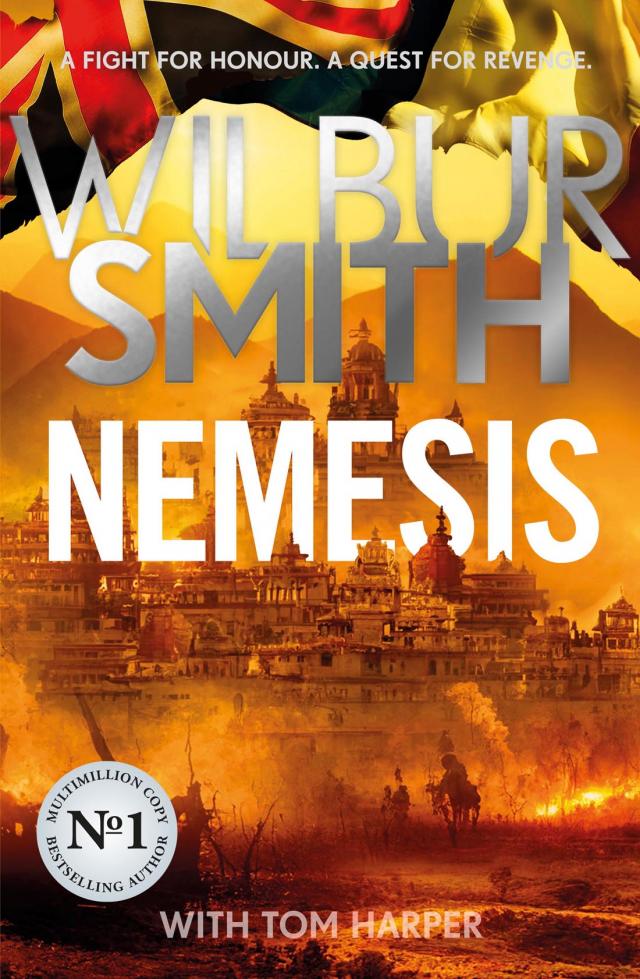
Nemesis, p.48
Nemesis,
p.48


Adam, crouching behind the battlement, was spared. The scrapshot flew by on either side, but did not touch him. As soon as it had passed, he leaped up, rifle ready to attack the gunners while they reloaded.
But the gunners on the second elephant had been waiting for the Holkaris to show themselves again. As they did, the second gun fired. Again, a blizzard of metal fanned over the ramparts, a mincing machine for any man caught in it. Adam threw himself to the floor just in time. A scrap of iron buzzed past his ear and left a long shallow gash in the side of his head. Many were not so lucky.
Those who survived were in no hurry to get up. The first gun might already have reloaded, and they had lost too many men. But in the instant that he had had his head above the parapet, Adam had seen that the sepoys were advancing again. They flooded forward, dodging around the elephants and running up the slope towards the gate under cover of the cannon fire. They carried ropes and scaling ladders.
Adam risked another glance. The Company troops were at the foot of the walls. Some had clambered on the back of the dead bull elephant and were using it as a platform. Others took cover behind it, where fire from the walls could not reach them.
‘They are coming,’ Adam warned.
It hardly needed to be said. Bamboo rattled against the outer walls as the first ladders were hoisted into place. The rungs quivered as the sepoys began to climb.
‘Up!’ Adam shouted. ‘Do not let them reach the walls!’
Reluctantly, the Holkari rose from their hiding places. Some fired down on the massed troops, while others reached through the embrasures and pushed the ladders away. One or two of the ladders toppled back into the crowd, scattering the troops behind. But others were already so heavy with the weight of men on them that they could not be budged.
Adam cracked off a couple of shots, aiming for the officers where he could find them. The men on the ground were so numerous, it made little difference. Everything had become automatic: cleaning out the rifle; ramming home the new bullet and wadding; priming the pan; darting out from cover to take the shot, and then ducking back again before anyone could take aim at him. Smoke filled the air and brought on an early twilight.
In the darkness and the press of men, Adam almost missed the light glimmering in the distance where the elephants still stood. Hugo had climbed on the elephant’s back and was shouting orders at the gunners. He wanted them to fire again. It was madness: at that range, their scattershot blast would kill as many of their own men as the Holkaris. But Hugo had more lives to play with, and he was willing to spend them profligately.
The gunners were less willing. Adam could see them remonstrating with Hugo – a brave effort, but also wasted. Hugo snatched the match from the gunner’s hand and touched it to the cannon himself. Another killing spray of iron and lead raked the ramparts. Many of the sepoys – the boldest, the ones who had been first up the ladders – were cut to pieces. But there were more below to take their places, and precious few defenders left. The final blast had taken everyone by surprise. The battlements were swept almost clear.
The sepoys reached the top of the ladders and poured over the wall. No one remained to oppose them – except for one man, who would not yield. Panjit faced the invaders with his leg splinted, one hand gripping a crutch and the other holding a sword. One of the sepoys came at him, musket raised like a spear to skewer him on the bayonet. Panjit swayed out of the way of the lunge and ran the man through with his sword, grimacing with the agony of the effort. The blade stuck in the corpse; hobbling on one leg, Panjit could not get it free. Another sepoy charged at him, and Panjit had no defence.
Adam saw a weary look cross Panjit’s face, the resignation of a man who has given everything, and failed at the last. A man ready for death.
Adam still had the loaded rifle in his hand. He fired it at the sepoy, knocking him into the soldiers behind. Before they could regroup, Adam hooked an arm around Panjit’s shoulders and dragged him back.
‘Let me go!’ Panjit shouted. ‘Let me die with honour!’
‘I would rather you lived.’
The sepoys were coming again. Adam reached down, picked up a dead man’s musket, and hurled it at the men coming after them. They tripped over it, which bought him a few more precious seconds – enough time to reach the safety of the guard tower. He slammed the door shut and bolted it, just as a bayonet struck, quivering, into the wood.
‘You should have let me die.’ Panjit did not sound angry, only sad. ‘We have lost.’
‘What about the Maharani?’ Adam demanded. ‘Where is she?’
‘In the palace.’
‘Will she surrender?’
Panjit shook his head. ‘She knew the risks when she chose to fight, rather than sign Hugo’s treaty. She will see this through.’
‘Then Hugo will go to find her.’
Panjit gave Adam a look that was half admiration, half despair.
‘You still think you can kill Hugo?’
‘Perhaps not.’ Adam plucked one of the pistols from Panjit’s belt and reloaded it. ‘But I will die before I stop trying.’
He glanced at the door. The invaders had given up trying to break it down. There were easier pickings to be had in the fortress, and they could always come back later. But if he opened it, there would certainly be someone ready to stick him with a bayonet.
Panjit read his thoughts.
‘There is another door at the foot of the tower. From there, a passage leads to the kitchens, and then to the throne room.’
‘Let’s go.’
‘You go. I will only delay you.’
‘I need you to show me the way.’
Panjit could not navigate the twisting stairs with his broken leg. Adam heaved him over his shoulders and carried him down. Outside the tower and across the courtyard, they could hear the Company soldiers flooding the citadel – but they had not found their way into the palace yet. The passage was deserted; so, too, were the kitchens. The fires were cold, with only the scent of fat and spices lingering in the air. With Adam half-carrying, half-dragging Panjit, the two men hurried through them, down a connecting corridor and into the main banqueting hall of the palace.
The moment they entered the hall, the sounds of battle grew louder. All was lost, but a few pockets of resistance held out. Most of it seemed to be coming from the throne room next door. Adam and Panjit went through.
The great mahogany doors had been thrown open. A makeshift barricade blocked the outer doorway: rubble that had been blasted from the walls; wooden screens; chests and tables. The golden throne had been chopped into pieces and added to the pile. The tiger-jacketed bodyguards kneeled behind it, firing into the courtyard beyond. Several already lay dead. The Maharani paced behind them, a tiny figure shouting encouragement. She was still dressed in her finery, with the diamond diadem on her forehead and her hair braided back.
She gave a little cry when she saw Panjit.
‘I thought you were dead.’
‘The day is not yet finished, Highness.’
A deep roar rumbled through the palace, shivering the furniture and shaking dust from the tapestries on the walls. At first Adam thought the siege guns had opened up again; then, as it rolled on, he thought someone must have fired the fortress’s powder magazine.
Panjit recognised it first.
‘Thunder,’ he said. ‘The monsoon is breaking.’ A tear of frustration slipped from his eye. ‘If it had only come an hour sooner.’
Through the doors, Adam saw the first drops of rain begin to fall on the courtyard. Dark wet spots appeared on the paving stones, singly at first, but quickly blotting into each other. All the force of the clouds was unleashed at once, nine months’ worth of pent-up moisture dropping like a landslide. It battered the ground and pummelled the hard earth. It hammered against men’s skins and stung their eyes blind.
The Maharani’s guards, in the shelter of the throne room, were spared. They could reload and fire at will, while their enemies – caught in the open – had no protection. The sepoys retreated to the edges of the courtyard, taking shelter under the arcades and in palace buildings.
The rain was falling so hard the drops ricocheted off the ground, making a fine mist. No one could fire a musket, except the men inside. They could pick their enemies off at will.
‘We are not safe,’ Adam warned Panjit. ‘They will find another way in soon enough. We do not have enough men to guard all the doors.’
Panjit nodded. ‘The west tower. We can defend ourselves—’
He broke off. The pace of firing had risen. Beyond the broken door the day was almost dark as night, but in the gloom they could see sepoys regrouping again. Their officers shouted and kicked and beat them with the flats of their swords, driving them out of their hiding places into the centre of the courtyard. In their rear, Adam saw Hugo striding about, bellowing orders and beating any man who shirked or straggled. Adam snatched a musket, but in the milling crowd he could not get a clean shot.
The sepoys formed up in a line. They made an unmissable target, and the defenders shot many down. But even with ten times as many men, the Holkaris would not have been able to kill them all. And they were running low on ammunition.
The Company troops were drenched and battle-weary. They wanted to be dry and warm, and to be allowed to plunder the palace. Without waiting for a command, they lowered their muskets and charged for the throne room doors.
A final volley of Holkari gunfire cut down the front rank of the sepoys. The men behind them surged on, stepping on the bodies of the fallen to climb the barricade. The Holkaris jabbed their bayonets and swung their weapons like clubs, but they were too few to stem the tide. The sepoys swarmed over the wall. One by one, the defenders were butchered.
Only Panjit, Adam and the Maharani were spared. The sepoys spread out around the room, making a semicircle around them. Violence smouldered in their eyes, a hair’s breadth from massacring the survivors. But they had their orders, and even in the lust of battle they knew the price of disobedience.
A dark figure loomed through the curtain of rain. Hugo Courtney strode in, through the broken doors and the splintered remains of the barricade. He was soaked, his black hair plastered to his forehead and his shirt stuck to his skin. A cut bled from his cheek. None of that mattered now. He had won.
The Maharani stepped forward. She did not reach Hugo’s chest, but she faced him unbowed. Her strength would have been astonishing in a woman twenty years older; in this child, dressed up in her full finery like a doll, it was breathtaking.
‘I will surrender my palace and my treasure. All I ask in return is that you treat my people with mercy.’
There was no one to translate. But Hugo had studied her language in secret, hiding his talent to deceive his adversaries and listen in when they thought they could not be understood. Now, he did not have to pretend.
‘You had your chance to treat with me,’ he said in flawless Hindustani. ‘Now, I will take everything.’ He ran his eye over her little girl’s body, and the face with the rosebud lips painted like a woman’s. ‘I will treat you exactly as I am going to treat your kingdom. Indeed, you will feel it most intimately. And you . . .’ His gaze swung to Panjit. ‘I will make you watch everything I do to her. You will learn the price of betraying me.’
Adam hoped the Maharani could not understand the true meaning of what Hugo threatened. But even at her young age, she recognised the intent: the age-old evil of a predator.
‘No.’
She took a jewelled dagger from her belt. Raising it high, she charged at Hugo, a battle cry on her lips.
It was an extraordinary sight – the princess, little more than a girl, charging towards the giant like David against Goliath. Her skirts flew around her legs; the diamond diadem flashed like lightning. The watching sepoys were so stunned, none of them moved to stop her.
Hugo was not so slow. He drew his sword and extended the long blade. The Maharani was almost on him. Even if she had seen it, she did not have time to change course. Perhaps she did not want to.
The point of the sword pierced her dress and sank deep into her heart. Her body seemed to fold in two. With a small gasp, the Maharani collapsed in a heap of silk and blood. Her dagger fell to the floor. Hugo reached down, yanked the diadem off her head and slipped it in his pocket.
‘A pity,’ he remarked to Panjit. ‘I would have enjoyed breaking her in, teaching her a little obedience.’
‘The same way you teach your wife obedience?’ said Adam.
‘Do not mention her. I am a jealous husband, and you . . .’ Hugo jabbed the sword at Adam. ‘You cannot afford to provoke my temper.’
‘You may have defeated me,’ said Adam, ‘but your victory is empty. Clare has left you.’
‘She will not escape. There is nowhere in India she could go that I could not find her.’
‘You are a powerful man,’ Adam agreed. ‘You will probably find her, eventually. But you will never see your son.’
Hugo went very still.
‘My son?’
‘She brought him here,’ Adam said. ‘She thought the Holkaris would protect him.’
Hugo stared at Adam, eyes burning with suspicion and doubt.
‘What did you do?’
‘What did you do when you found your enemy’s children?’ Adam held Hugo’s gaze, letting his fear stoke itself to a white heat. ‘Did you have mercy?’
‘What did you do?’ Hugo’s voice had risen to a roar. ‘Where is my son?’
‘A place where you will not find him.’
Hugo could not contain himself. With a roar, he charged at Adam, sword outstretched to run him through. Adam backed away, but he could not go far. He was almost against the rear wall. The only way out was the high window from where the Maharani had once surveyed her kingdom. The wooden screen had been torn away to make the barricade; on the other side, there was nothing but thin air and the sheer face of the mountain.
If Hugo had been in control of himself, he could have pushed Adam back at the point of the sword until Adam’s only choices were the blade or the drop. He could have had his men do it, closing the noose around Adam until it throttled him.
But Adam had goaded Hugo to a fury. This was the kill he had waited half his life for. Like a lover craving the touch of his beloved’s body, he had dreamed of the sensation of his sword sliding through Adam’s flesh, accomplishing his father’s quest. Now, that was the only thought in his head as he lunged at Adam.
Adam had one thought, too. He reached inside his coat and felt for the knife that Panjit had hidden there, still snug in its lining. He pulled it out, brandishing it at Hugo.
A triumphant smile curled Hugo’s lips. Against his own weapon, the dagger was nothing more than a needle. Hugo’s sword would be buried in Adam’s heart up to the hilt before Adam could even scratch Hugo with it.
Hugo drove the point forward. Adam stood at the window’s edge, framed by clouds and falling rain. He did not try to move forward or take his guard. He was resigned to his fate.
At the last minute, he jerked his wrist. The knife rang against Hugo’s sword. It could not withstand the force of his blow; it snapped off at the hilt. Hugo roared with triumph.
But the little blade had served its purpose. It had diverted the stroke, pushing the sword away so that it whistled past Adam’s side. Adam was inside Hugo’s guard – unarmed, but that did not matter. He did not have to live to defeat Hugo. He only had to kill him.
Hugo’s body collided with Adam. Hugo drew back to strike again, but Adam was faster. He wrapped his arms around Hugo, hugging him so close he could smell the sweat on the nape of his neck.
Then he stepped back off the window ledge.
NATIVITY BAY
T
he battle had become a nightmare. By the time Paul reached the gate, the Bengal fires had burned out, leaving the compound in darkness that was broken only by the flash of musket fire. Everything was chaos. No one wore uniforms, so a figure glimpsed could not be identified as friend or foe. People ran helter-skelter like a herd of gazelles panicked by a lion.
The main gate stood open. Not smashed off its hinges by cannon fire or battered down with hatchets – the party who had entered by the side gate must have opened it from the inside.
One by one, the remnants of Fort Auspice’s defenders returned to the house. There were not many of them. Hugo’s men followed, pressing home their advantage. It reminded Paul of that terrible night in the mountains of Gondar: left for dead, the hyenas circling around him for the kill.
Mary must be in the house.
He ran across the compound to the kitchen, praying no one would pick him out as a target. The kitchen door hung open, spewing smoke, though the fire in the hearth had been put out hours ago. Two men lay across the threshold: one white, one black, both dead. Paul stepped over them. Ten paces later, it occurred to him that he should have searched them for weapons. He ought to turn back, but his legs kept carrying him inexorably forward. He had to find Mary.
Where can she be?
He ran down the corridor, throwing open doors to the various storerooms. No one was there. Ahead of him, he heard the savage sounds of close combat: the ring of steel; the roar of guns discharged at point-blank range; the grunts of men locked in tests of strength. Through broken windows, he could see into the other wings of the house, like pictures hanging in a gallery. Furniture was overturned and smashed. Smoke billowed. Spent wadding fell to the ground and set the carpets alight. Soon the fire spread to the curtains and upholstery, licking up into the wooden roof beams and the thatch. Half the house was ablaze, though that did not stop the battle. The fire became another source of weapon. Men snatched burning pieces of wood and used them as clubs, or pushed their enemies into the flames to set their clothes alight.