Nemesis, p.32
Nemesis,
p.32
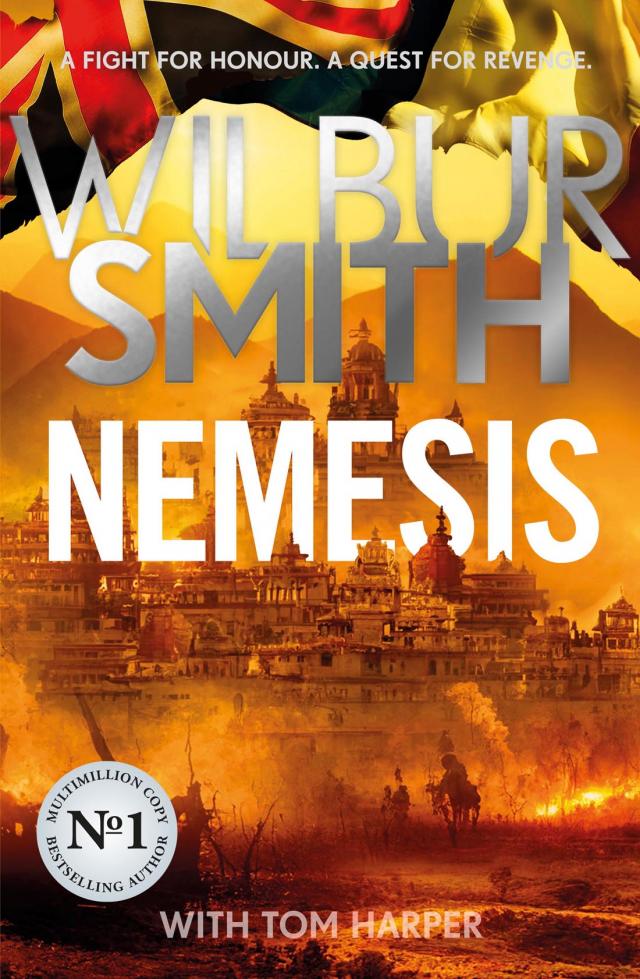


The monsoon rains had ended, and the river was running high. The men on the oars had to bend their backs against the current, while another crew on the bank hauled the boat upriver using a track-rope. Even with such slow progress, the surroundings afforded endless changing vistas: drooping bamboo and thickets of trees gave way to tilled fields, which in turn opened to broad expanses of yellow-reeded marshland many miles wide. There were crimson fields of poppies, and cotton plants whose pods were bursting with snow-white wool. At night, they moored near villages, where women brought brass bowls to fill with water, and children splashed in the shallows. Monkeys chattered in the tamarind trees and pelted the decks with fruit. One night Adam saw a herd of elephants come down to drink. It reminded him again of that moonlit night with Mary Jansen in the fields of Africa. If the slow journey had dulled his thoughts of revenge, that was all the reminder he needed.
They passed the battlefield of Plassey, though the river had spread in the last fifty years and it was now slipping into swamp. This was where Lord Clive and Gerard Courtney had defeated the Nawab of Bengal, in the campaign of revenge following the Black Hole of Calcutta. On that field, they had won British mastery over Bengal for generations. As they passed by, the Englishmen on the boat emerged from their cabin and drank a toast to Clive, and Courtney.
‘A glorious victory for British arms,’ they crowed.
They had forgotten, or did not care, that the battle had mostly been won with an enormous bribe. Despite its historical significance, it was more of a skirmish than a full-scale battle, and Lord Clive’s victory had been achieved through the black arts of subterfuge, and a torrential downpour of rain.
Adam hid his face and gave a grim smile. It amused him to think of what they would say if they knew there was another Courtney aboard the boat, and what he intended.
Day by day, he grasped more deeply the ancient power of the country. On a bend in the river, a crop of rocks jutted into the stream. They had been carved into the likenesses of Hindu gods and strung with wreaths of flowers, gently wilting and shedding their petals into the water. The towns they passed sported the high pagodas and temples of the Hindus, but also the onion domes and minarets of Islamic architecture. One afternoon, they passed a city in ruins. The river had burst its banks and flooded it, but the stumps and arching skeletons of magnificent palaces remained, thrusting out of the water like tombstones.
No one could conquer this country, Adam thought.
They might rule it for a time, through fear and power, but in the end they would fail and their works would become more ruins.
*
At Mirzapore, Adam disembarked to join the great trunk road heading south-west. With the dry season begun, the roads were busy with travellers. The Indians did not travel alone, but in large groups, sometimes two or three hundred strong. With much bowing and gesturing and pretending he could barely speak because of his deafness, Adam attached himself to one of these parties.
There was safety in numbers, but he worried his fellow travellers might begin to suspect him. He was terrified that some accident – a fall, a roll of thunder, a snake in the road – would make him blurt out in English, or somehow reveal that he was not deaf. He kept to himself, but it was impossible to travel for weeks in the same company and remain completely anonymous.
Some of his companions seemed to be growing suspicious. One, a high-caste Brahmin in a silver-embroidered coat, kept staring at Adam. He appeared to be a wealthy merchant, with a retinue of porters, guards, secretaries and servants. His attentions alarmed Adam: he could not afford to be discovered here, hundreds of miles from any prospect of help. He was relieved when the man took himself to a different part of the column.
Sometimes they encountered Company officials going about their business. The Englishmen travelled in great curtained palanquins, carried by teams of bearers who jogged along, wearing deep ruts in the dusty roads. New teams waited every three or four miles, so their lords could travel indefinitely, hundreds of miles without ever setting foot on the country’s soil. Once, when a gust of wind blew the palanquin curtains open, Adam saw one of the passengers: a fat man wearing baggy pantaloons and a silk dressing gown, reclining on cushions and drinking from a cup of sherbet. He might as well have been lying in bed in Grosvenor Square, for all that India intruded on him. Not for the first time, Adam wondered how the Company could govern India, yet remain so aloof from it.
Adam thought enviously how quickly he would reach Holkar if he had the Company’s litter-carriers at his disposal. But his slow journey had some consolations. He had started to understand his companions. Weeks on end of keeping silent had left him plenty of time to listen. His ear learned to distinguish individual words from the stream of sounds, then tentatively to apply some of the lessons he remembered from Lizzie’s grammar book. He knew he was improving when, one day, he heard a lady asking for her parasol. Adam almost gave it to her, before hastily remembering he was supposed to be deaf.
In the second month, he fell in with three companions. Their names were Ravi, Shrisanth and Sanjit; they seemed to be brothers, though more unalike brothers it was hard to imagine. Ravi had a thin face with a pointed beard; Shrisanth was stout and at least twenty years older, with a head of fleecy white hair; Sanjit had pale, feminine features offset by a prodigious moustache that curled up at the ends. They were travelling from Agra in the north all the way to Hyderabad: they had an aunt, or possibly a niece, who had died and left them an inheritance. They were jolly men who sang all day. In the evenings, they invited Adam to their campfire and shared their food with him.
He was glad of their company. They lifted his spirits and relieved a little of his lonely existence.
The country changed as they went south. Every day was like walking through a battlefield. The ryots whom they saw going out to their fields each morning carried not just mattocks and hoes, but clubs and small shields. Much of the land had been burned; the fields were scorched. The people they met had little food to barter. There were few young men in the villages, but many women and young children. From conversations he overheard, Adam gathered that this had been another front in the East India Company’s wars.
One evening, they made camp by a copse of trees, where the ground sloped down from the roadside to a small stream bed. Ravi and Shrisanth spent the afternoon digging a large hole by the stream, near the roots of a neem tree. By the time they were finished, it was so deep that it went up to their necks.
By gesturing, and with a few words of broken Hindi, Adam asked what they were doing. The answering gestures were incomprehensible, and the wide-toothed grins they gave him left him none the wiser. Later, eavesdropping around camp, he gathered that a local ruler was rumoured to have buried his treasure in this place when the Marathas invaded. The brothers had heard that it was marked by a neem tree, and decided to try their luck.
That evening, the brothers were unusually skittish. There was much giggling – not the easy laughter of other nights, but something twitchy and slightly nervous. Even though they believed Adam was deaf and usually spoke freely in front of him, that night they kept whispering to one another, exchanging sly glances when they thought Adam was not looking. He began to wonder if they had actually found the fabled treasure, and wanted to keep it secret. They looked over their shoulders towards where the Brahmin merchant had pitched his tent, as if they were afraid he would discover them.
But after Adam had gone to bed, lying on a blanket on the ground, he heard Shrisanth say quite distinctly, ‘We go at midnight. I will lead him there. You two be ready.’
It was a tone of voice Adam had not heard from him before, cold and cruel, hard to match with the smiling and shambling man Adam had walked so many miles of road with. Adam waited, awake, puzzling it over and listening.
The moon rose, the merest sliver like a crack in a door. Insects buzzed, and fireflies flashed in the darkness.
Even forewarned, Adam almost missed them. He had begun to doze off when suddenly he felt a presence, a man kneeling beside him. He was so close Adam could smell the cardamom on his breath. It must be Shrisanth.
A hand reached under the sack Adam used as a pillow. Was Shrisanth stealing from him? But there was nothing in the sack except some old clothes and the sketch of Mary. Adam had left the Neptune sword in Calcutta with Cornish – and the tiger dagger in Talbot’s guts. He had nothing else worth stealing.
Adam kept still, his eyes closed, pretending to be asleep.
Shrisanth finished his rummaging and walked away. Adam counted to twenty, then rolled over and put his hand under the sack. He felt cool metal – a cup. When he pulled it out, it gleamed silver. He had never seen Shrisanth or his brothers with such a cup; it looked far too rich for them.
Was that part of the treasure? Had they hidden it there for safekeeping?
Shrisanth had not gone back to his bed. Adam could see his shadow, picking his way through the campsite. Ravi and Sanjit’s bedrolls were empty, too.
Adam rose and crept after Shrisanth. Most travellers slept in the open air, but the wealthy Brahmin had a tent which his retainers pitched every night. Shrisanth went there. One of the servants appeared to be sleeping in front of the door, but when Shrisanth spoke a few words in his ear, he jumped up and disappeared.
Shrisanth went in. Adam stole up to the canvas and put his ear to a seam.
‘This afternoon we have found something most valuable,’ Shrisanth was saying. ‘But if we take it now, brigands and robbers will fall upon us. Your master is a great lord. He can send soldiers to protect it and we share the treasure, him and us. And you.’
‘What did you find?’ The Brahmin’s voice, suspicion tempered by sleepiness.
‘Treasure, sahib. Most valuable. Come and see it.’
Adam heard a rustling as the Brahmin pulled on his robe. The flap opened and the two men emerged. Adam followed them down the hill towards the stream bed and the hole by the neem tree. Ravi was waiting there, though there was no sign of Sanjit. Adam hid behind a bush.
‘I left my brother to guard the treasure here,’ Shrisanth explained. ‘Most valuable.’
He said it again, like a magic formula. He put his hand on the Brahmin’s back as if to usher him towards the hole.
Adam stiffened. In his weeks of travelling with the Indians, he had learned more than a few words of their language. He had begun to understand their customs, most of all the intricate rules of their Byzantine caste system.
A man of lower caste, like Shrisanth, would never touch a high-caste Brahmin. It was as unthinkable as a manservant slapping his master.
The Brahmin felt the touch and began to turn. He opened his mouth, but before he could make a sound Shrisanth swept his legs from under him. The Brahmin fell forward on his face. Before he could move, Ravi sprang forward and grabbed his wrists. Shrisanth held his ankles while Sanjit – who had appeared from nowhere – kneeled over him. Sanjit put his knee against the small of the Brahmin’s back, so that he was pinned like a butterfly. He undid the sash he used to belt his tunic, wrapped one end around each hand, and deftly put it about the Brahmin’s neck. He crossed his wrists and pulled the sash tight.
Everything had happened so quickly, the Brahmin had no chance to resist. He could neither move nor make a sound as the life was squeezed out of him.
Adam saw it all from behind the bush. He was outnumbered three to one, and unarmed. The Brahmin meant nothing to him.
All those thoughts flashed through his mind in an instant. But he could not sit in the dark and watch an innocent man be murdered. He sprang towards Sanjit.
The murderer did not notice him coming. The other two were more alert. They had been keeping lookout for anyone who might witness their crime, and saw Adam the moment he broke cover. Shrisanth let go of the Brahmin’s ankles and rose, drawing a long slim dagger from his robe.
Adam was unarmed. His only hope was to attract attention. The murderers had taken care to lure their victim to this secluded place; they would not want to fight off a large number of travellers.
There was only one problem. Adam did not know the word for help.
‘Baagh!’ he called.
It meant ‘tiger’; it was the best he could come up with. He bellowed it out in his best quarterdeck voice, a voice that could reach the masthead in an Atlantic gale. He had to hope it would carry to the camp and wake some of the sleeping travellers.
Shrisanth paused, shocked to hear his silent companion in such fine voice. He stepped away from the Brahmin, raising the knife. If Adam lost the initiative now, he would be beaten. He did the only thing he could: he charged at Shrisanth, as if he meant to impale himself on the blade.
Adam came so fast, Shrisanth took a step back. At the last moment, Adam threw himself to the ground. Shrisanth tried to bring the knife down, but Adam was close enough that he slid underneath the blade and cannoned into Shrisanth’s legs before he could strike. Shrisanth was knocked over.
Adam could have tried to wrestle the knife away. But that would have taken precious moments. Sanjit was pulling on the noose so hard it was a miracle the Brahmin was still alive. Adam lunged, trying to dislodge him from the Brahmin’s back. Sanjit had no choice but to let go of the sash.
They rolled over, a tangle of limbs and bodies in the darkness. Adam punched and kicked and bit and clawed at his opponents. He could not afford to let them pin him down.
But there were three of them, and they knew their business. They didn’t flail like drunkards in a tavern brawl. They put him in an expert lock, finding the pressure points when he resisted, and forcing him down.
Soft fabric slithered around Adam’s neck. He jerked to try and get it free, but the murderers were too strong. The noose tightened around him, closing his throat. His vision swam; he went limp. A voice whispered in his ear, chanting something low and rhythmic like a prayer. It must be Shrisanth. Adam smelled the sweet cardamom on his breath again.
With his remaining strength, Adam thrashed backwards, smashing his head into Shrisanth’s face. It broke Shrisanth’s nose. He howled in pain and let go of the noose. Before he could recover, Adam lifted himself off the ground and threw Shrisanth off.
The cloth sash lay on the ground where Shrisanth had dropped it. Adam snatched it up. It was knotted at both ends for grip, with a coin or a pebble tied in one of the knots to give it weight.
Shrisanth stumbled to his feet. Blood gushed from his nose, but there was still strength in him. Adam flicked the end of the sash around his opponent’s neck, as easily as casting a line. He grabbed the knotted ends and twisted them together, tightening until he felt something snap.
A blade lunged for him. Ravi had picked up the knife. Adam let go of the cord and twisted away so that the knife hissed past him. Adam grabbed the arm that held it with both hands and jerked it down against his knee. Ravi dropped the knife and wheeled away in agony as Adam snatched up the knife.
The odds had improved. Now it was Adam against Sanjit and Ravi. Ravi had a broken arm, and Adam had the knife. Adam checked the Brahmin, but he was lying on the ground, clutching his throat.
Adam, Sanjit and Ravi eyed one another, taking a moment to draw breath.
‘Who are you?’ Adam asked.
Ravi bared his teeth. ‘We are the deceivers.’
‘Go now, and I will not follow you.’
Sanjit shook his head. ‘You have seen our true faces – you cannot live.’
He and Ravi edged apart, forcing Adam to turn to keep them both in sight. He raised the knife, brandishing it at them. Still they edged away. Did they both mean to rush him at once?
He heard a noise behind him. Only the rustle of a leaf, but his blood was up and his senses were fully alert. He glanced back.
There were more of them – half a dozen at least, dappled figures in the shadows under the neem tree. How long had they been there? Some carried knives; others had scarves ready in their hands.
‘Now you die,’ said Sanjit.
Adam couldn’t fight so many. They closed on him like a pack of wolves. He circled, jabbing the knife at anyone who approached – but each time one stepped back, two more moved forward.
The futility of it overwhelmed him. He would die an unmarked death. The murderers would bury him in the hole they had dug; the other travellers would assume he had slipped away. No one would miss him because nobody knew he had been there. And all because he had intervened in a fight he could have avoided.
It was fate. He could never have let an innocent man be murdered – it was not in his nature. Whatever happened, it must be part of God’s purpose for him, for better or worse.
The thought brought him calm. He feinted back, then suddenly drove forward so fast that the man opposite was taken off balance. The man took two steps back – and vanished with a scream and a thud. He had fallen into the hole that had been dug that afternoon. Adam leaped over it, through the gap that had opened in the ring of men. They followed quickly, but Adam was fast. He ran towards the camp, shouting defiance.
Voices answered him. Fire lit the night sky. At the top of the slope, men had appeared carrying torches. At last someone in the camp had heard Adam’s shouts and acted on it. They were armed with the weapons of the poor – wooden axes, cudgels, even saucepans. In a pitched battle, Shrisanth’s gang might have been able to fight them off.
But the deceivers did not like pitched battles. They preferred to lure their victims to deserted places, to fight in shadows. Light and crowds were poison to them. They fell back. They crossed the dry stream bed and disappeared into the night.
Emboldened, the men from the campsite gave chase. But the countryside was a barren place, and no one wanted to risk his life in the darkness. After a little distance, Adam saw the line of torches turn back
‘Who are you?’ hissed a voice in Adam’s ear.
It was the Brahmin. He had a dark mark around his neck; his voice was hoarse.
‘A man with secrets.’ Adam jerked his head in the direction that Sanjit and his gang had gone. ‘But not like them.’