Springfield 1880, p.28
Springfield 1880,
p.28


At some point—he had no idea when—he had removed his other boot and thrown it over the edge, along with both socks.
He picked up a rifle, dropped it. He moved as though he were in a trance. Another rifle crashed below. He grabbed another and another, using both hands, and holding the new-model rifles over the edge. He stopped. He listened. He used the rifles he was about to throw into the ruination as crutches to push himself to his feet and hobbled toward the sound. It came from below.
Grat Holden slowly eased onto his knees and inched his way to the rim. Carefully, he peered down into what amounted to a partial chimney. He blinked. He tried to focus. He wondered if he were dreaming.
The figure below him, maybe forty feet from the top, stopped climbing. The head looked up. The face brightened and smiled.
“Hello, Grattan,” Captain Jed Foster said. “I don’t suppose you’d like to help me up these last few feet?”
CHAPTER 88
The dust had diminished, and the rockslides seemed to come less frequently. Soledad Tadeo bathed the forehead of her father, Sam Florence, with a rag. She looked up at the ladder, the chimney, the hellish way north that required fingers, feet, and determination.
She no longer saw Grat Holden.
Her father slept.
Another boulder toppled from somewhere inside The Canyon of The Sorrows.
No one would ever enter the canyon again, at least they would never be able to go into the opening, the horrible place that had caused so much pain for so many people. It was, she told herself, over. She felt glad that she had returned, even though she had not caused the place to collapse. That had been the will of God.
She closed her eyes and prayed for the soul of her mother. She opened her eyes and prayed for the life of her father.
Then she heard the hoofbeats.
The horse coming from down the twisting, turning, cavernous trail to hell had been loping. The rider eased the mount to a walk. The clop-clop-clop was not as loud as she had heard earlier, and fear grasped her heart. She understood.
The horse coming toward them was not the horse of a gringo or a Mexican. It was unshod. It was, most likely, the horse of an Apache.
She found her father’s pistol and eared back the hammer. She bit her lip and waited.
The horse slowed to a stop and she saw the rider as he swung out of the Indian saddle and moved through the dust and the scattered debris. He looked confused. He might have even been worried. He held a Henry rifle in his hands. He wore a red headband over his head. And when he turned and stared ahead and up at the mountain of boulders that blocked the entrance into that horrible place, she saw the mangled ear.
Soledad rose with the pistol of her father in her right hand.
“Hey!” she yelled.
The Apache whirled and fired. She felt the bullet singe her hair. She smiled as the Apache worked the lever. And then she shot the son of a bitch in his chest.
Maybe she would not get to kill the Yanqui named Jed Foster, the man who had caused so much trouble. But she would kill the Apache, the warrior with the bad ear that was made bad six years ago when she was fifteen.
She shot him again. That was for her mother.
She shot him again. That was for all the mothers and daughters he had brought to this place.
She shot him again. That was for her.
CHAPTER 89
Second Lieutenant Grat Holden blinked, but the apparition still remained on the slick, rocky ledge. It moved a bit forward, using handholds and footholds. Foster stopped, tried to shake the blood back into his fingertips, and looked again up.
“What happened to Masterson?” Holden heard himself ask.
The captain laughed. “He started the ball.”
Holden sighed. He looked at the rubble below him, trying to guess as to where the remains of Sergeant Ben Masterson might be.
“Grat,” Jed Foster called up to him. “Help me out of this, pal. We can work this out, my friend. Make ourselves a fortune. What do you say, buddy? Let’s see how Jed Foster’s luck can play with Grat Holden’s persistence.”
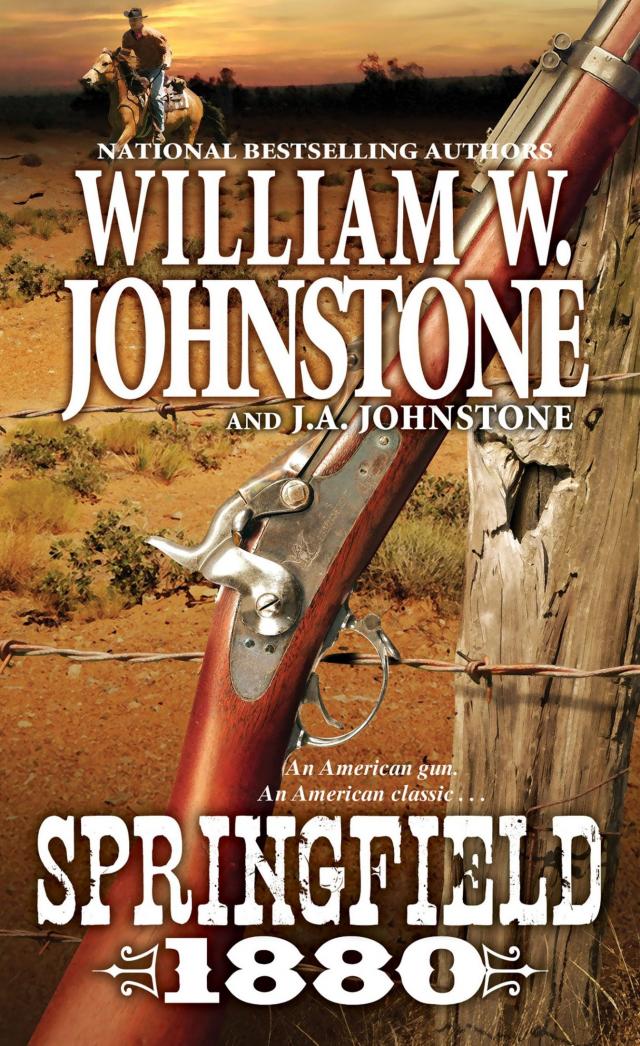
Holden looked down at the pathetic little figure climbing up the escape route Indians had used a thousand years ago. Then he looked at the Springfield 1880 rifles that he held in his hands.
He looked down again at Captain Jed Foster and showed him the rifles.
“Captain Foster, I think these are yours.”
Holden let the heavy rifles fall. He heard Jed Foster scream as the rifles slammed into his shoulder and his leg, knocking him away from the canyon’s dark, slick wall. He dropped instantly as the Springfield rifles fell with him, all the way down. The scream continued as the captain and the rifles fell to the rocks and carnage below.
It was a long fall. Eventually, the screaming stopped, and Grat Holden sat on the edge of the canyon.
He sat there, exhausted, staring at the smoke-filled floor. He searched for survivors, but he saw none, just rocks and debris. He looked again for Ben Masterson and sighed when he knew that hardcase of a soldier was really dead.
Eventually, Holden pulled himself away from the edge and stood. He needed to get back to Soledad Tadeo and her father, Sam Florence. They were in Mexico, but he saw several horses milling around, mounts belonging to some of Foster’s men. He even saw Foster’s steel dust. Those horses would have to carry them back to Arizona, back to Fort Bowie.
Holden would not be able to send a heliograph signal to the soldiers experimenting with the sun-signals. He wondered how hard Colonel Carlton Smythe would throw the damned book at him once he learned those new-model Springfield rifles were destroyed and that he, Second Lieutenant Grat Holden, was responsible. He looked over the canyon, what was left of The Canyon of The Sorrows, and the view amazed him. It didn’t make him feel any better or any less tired. But it was . . . breathtaking.
Dust and smoke rose. It would, he thought, make for a beautiful sunset.
CHAPTER 90
Sam Florence opened his eyes to see the ceiling of what he recognized as the post hospital at Fort Bowie in the southern part of Arizona Territory.
“Hell,” he whispered, “I ain’t dead.”
He looked at the sheet covering the lower part of his body and he ripped the covers off.
“Hell,” he said, with more emotion, “I’m still whole.”
A soft giggle reached him, and he turned his head to see Soledad Tadeo, his daughter, sitting in a chair next to his bunk.
Florence smiled. “Hello, daughter.”
“Buenas tardes, Padre.” Tears welled in her eyes.
The door opened, and Lieutenant Grat Holden walked inside, pulled up a chair, and found a seat next to Florence’s bed.
“I reckon,” the scout said, “that you can tell me how the hell I . . . and you and her . . . got out of that canyon.”
“Later,” Holden told him. “Over about a keg of beer at that gin mill in Dos Cabezas.”
“Foster?” Florence asked.
Holden shook his head.
“Muncie?”
The head shook again.
“Amonte Negro?”
The head shook once more. “Rurales took care of Negro. We got their report when we made it back to Fort Bowie. You don’t remember anything about that, do you?”
“No. Must’ve been out of my head.”
“We all were. A little.”
“Well, hell, we done all right,” Florence said.
“Well . . .” Holden’s voice softened. “There’s Ben Masterson.”
“Yeah. War’s hell.”
The girl brought a ladle of water toward Florence, who drank its contents down greedily. He looked back at Holden and said, “And what’s Colonel Smythe saying about all this?”
“Nothing. He’s dead.”
“What?” Florence tried sitting up, but pain knocked him back onto his pillows.
“He led a command down south to join those sun-signalers,” Holden explained. “No one knows exactly what happened, but he led his command into an ambush. Apaches jumped across the border. They say it was Crooked Nose himself. Anyway, the colonel caught about six arrows in his back. Two of his men were killed.”
“The hell you say!” Florence asked for a beer.
Soledad Tadeo told him to be quiet.
The old scout laughed. “Crooked Nose ain’t a bad sort. Tough as nails, but he ranks up there with Cochise in my book. Some of his boys, well, they’re as rotten as Jed Foster. But that’s the way with all people, I guess. You get good. You get bad.”
“The Apaches are less one bad man,” Soledad Tadeo said then said nothing else.
Florence’s head shook. “The colonel dead. Killed in the field. Reckon they’ll give him a damned medal.”
“Worse. The Tucson papers have demanded they name a fort after Smythe. But don’t worry. I hear there was another fort named Smith—but spelled the normal way—and it got burned down after Red Cloud’s War up in Montana Territory, so the Army isn’t likely to do that. Anyway, we’re here, you’re getting stronger, and . . . they are talking about giving a medal to Ben Masterson. They’re just trying to figure out how to word it.”
Florence nodded. He drank another ladle of water.
At that point, the sergeant major entered the hospital and saluted Second Lieutenant Grat Holden.
“Beggin the lieutenant’s pardon, sir, but I have a telegram from the Springfield Armory. They’re asking about all those rifles they sent here.”
Grat Holden knotted his brow. “Why ask me, Sergeant?”
“Well, sir, the major and all the captains—every last officer, to be exact—are out in the field, sir, trying to catch that red devil Crooked Nose, make him pay for killing the colonel. I know you don’t like it, sir, but, well, you’re in command . . . till the troops get back or the general sends us a new colonel. And there is no way the armory is going to listen to anything a sergeant major has to say. Especially since I don’t have a clue and—Well . . . sir, you’re the commander of this post.”
“I see.” Grat Holden pulled a flask out of his pocket and handed it to Sam Florence.
“This might offer a quicker cure than water.”
The old scout took the bottle. Soledad Tadeo pulled out the cork.
“Sir,” the sergeant major said, “what do I tell that fellow at the Springfield Armory?”
Lieutenant Grat Holden smiled as he took the flask Sam Florence held out to him.
“Sergeant,” he said as he paused the flask just below his lips. “Tell them . . . nothing.”
EPILOGUE
Toward the end of 1880, the US Army Ordnance Department reported to representatives of the Springfield Armory in Springfield, Massachusetts, that testing of the new Model 1880 .45-70 rifles in the field had garnered unanimously negative reports. The retaining device for the cleaning rod had proved knotty, soldiers had reported from posts out West, and worse, the sighting was terribly off. Therefore, the one thousand models issued to troops on the frontier were being returned to be put in storage. The Army, however, recommended that further improvements be made, reminding Springfield representatives of the Army’s long relationship with the Massachusetts gun makers.
Springfield produced new models in 1882, 1884, 1886, and 1888 before the US Army finally adopted the Springfield Model 1892–99, a bolt-action rifle chambered in .30-40 Krag caliber, as the new standard for the US Army.
Years after the 1880 field-testing run, a bookkeeper in the armory’s headquarters wrote the US Ordnance Department that of the one thousand Model 1880 rifles sent for testing, only seven hundred and fifty had been returned. The bookkeeper asked for an explanation or payment for the missing weapons.
The US Ordnance Department never responded to the armory clerk’s query.
Keep reading for a special early excerpt of the first book in an all new western series!
RIDING SHOTGUN
A RED RYAN WESTERN
by William W. and J. A. Johnstone
JOHNSTONE COUNTRY. WHERE DEATH RIDES FASTER THAN THE WIND.
A blazing new series takes you back to the lawless frontier where every stagecoach is a moving target. Where every passenger needs protection. And where every hired gun who rides along better be fast on the draw—or be dead on arrival . . .
RIDING SHOTGUN
If anyone knows the road to purgatory, it’s Red Ryan. As a stagecoach guard, he’s faced holdups, ambushes, and all-out attacks from every kill-crazy outlaw, Indian, and prairie rat. But even he’s a bit reluctant to take on his next job: riding shotgun with his driver Buttons Muldoon on a stage bound from Fort Concho, Texas, to Fort Bliss. Word has it, the Apaches are on the warpath. They’re being led by a vicious war chief who means business—as in slaughtering every Texan from here to El Paso. Thus begins a nightmare journey into 400 miles of harsh, unforgiving terrain and blood-drunk killers who plan to paint the town of El Paso red. Starting with Red’s blood . . .
Look for RIDING SHOTGUN on sale in June 2019,
everywhere books are sold.
CHAPTER ONE
“Ryan! Red Ryan, I’m calling you out! Damn your eyes, fill your hand, and get down here!
“Red, do you hear that?”
“Yeah, I hear that. Ignore him, Dolly, and he’ll go away,” Ryan said. “Now, where were we?”
The naked woman in the bed smiled. “I was asking if you love me, Red.”
“Love you? I sure do, and that’s a natural fact.”
“Do you tell the other girls that you love them?”
“Nah, Dolly, I just tell it to you.”
“Patsy Prentice says that every time you’re in town you talk all kinds of pretties to her. You never talk pretties to me.”
“Yeah, I do, all the time. Hell, Dolly, you’re as pretty as a speckled pup under a wagon. When I first rode into Cassidy Crossing and saw you standing on the balcony with the other ladies that time, I thought, ‘Well, Red, she’s the only gal for you an’ no mistake.’”
“That time? Red, it was only yesterday.”
“Times flies when you’re having fun, don’t it? Now, come closer and give me some more of that good ol’ Texas lovin’ . . .”
“Ryan! Are you coming down or do I have to come up there after you?” The man’s voice from the street, strident and angry. “I aim to shoot you down like a dog, Ryan, and be damned to ye.”
“Go away!” Red called. “At the moment, I’m real busy!”
“Come down here, Ryan!”
“Later!”
“Now!”
“Give me ten minutes, you damned nuisance, whoever you are. You should be hung for disturbing a man.”
“Get down here now, damn you!” The bullet that crashed through the bedroom window added the exclamation point to the end of that sentence.
“That’s it, I’m out of here!” Dolly said. “Everybody told me you were a crazy man, Red Ryan, and you are.”
The girl rolled off the bed, gathered up her frillies, and then stood at the door, staring expectantly at Red. Even when she frowned as she was doing now, he had to admit that she was a real purty little gal. “In my wallet,” he said.
Dolly grabbed the wallet from the dresser and took out some bills. “There’s only three dollars here.”
“And you’re most welcome to it, l’il darlin’,” Ryan said.
“That’s all?” Dolly said. “That’s all the money you have?”
“It’s all I got, and when three dollars is all a man has, he’s giving you his entire fortune.”
“You damned cheapskate, Red Ryan,” Dolly said. “Who’s going to pay for the window?”
“I’ll talk to Dark Alley Jim, tell him I’ll pay him for the window next time I’m in town.” Ryan ducked as a bullet shattered another pane. “Uh-oh, make that two windows.”
Now there was a deal of shouting and screaming in the upstairs rooms of the Golden Garter Saloon & Sporting House and the proprietor, Dark Alley Jim Mortimer, loudly demanded to know who was trying to murder his whores.
Dolly Barnes opened the bedroom door and yelled, “Jim, it’s Red Ryan. He’s been called out.”
“Ryan, you damned troublemaker, git away from here and deal with this afore my place is all shot to pieces,” Mortimer hollered. Then the man himself burst through the door, saw Ryan struggling into his long johns and said, motioning with a Greener 10-gauge for emphasis, “Git out there on the street and don’t come back here ever again.”
“I thought you were my good friend, Jim,” Ryan said.
“I’ve shot good friends afore,” Mortimer said. “And you’re not my friend, good or any other kind.”
Ryan pulled on his boots, slammed a derby hat on his unruly mane of red hair, and slid his Colt from the holster, leaving his own Greener shotgun in a corner. Scatterguns always meant a killing and he was hopeful that this situation could be resolved by prudent words rather than buckshot.
Red stepped to the window, flung it open, and yelled, “I’m coming down!” He caught a brief glance of an angry but respectable-looking gent in the street who held a revolver in each hand.
Dressed only in hat, boots, and fire-engine red underwear, Ryan brushed past Mortimer, thumped down the stairs and onto the porch that ran the length of the building.
The respectable-looking gent was obviously not in the mood for words, prudent or otherwise, and he didn’t waste any time in palaver. He cut loose with both six-guns, and Ryan ducked as bullets crashed into the door, the woodwork around the door, and one round, better aimed than the others, drilled a neat hole through the crown of his derby.
“Well, the hell with this,” Red said.
He thumbed off a shot, and the respectable-looking man clutched his right shoulder, dropped his guns and howled, “Damn! He’s shot me!”
Ryan stepped off the porch into the street, his Colt hanging by his side, and said, “What the hell did you expect me to do? Mister, with all that shooting you did, you could’ve plugged Dolly Barnes, the best value-for-money whore this side of the Concho River.”