Springfield 1880, p.6
Springfield 1880,
p.6
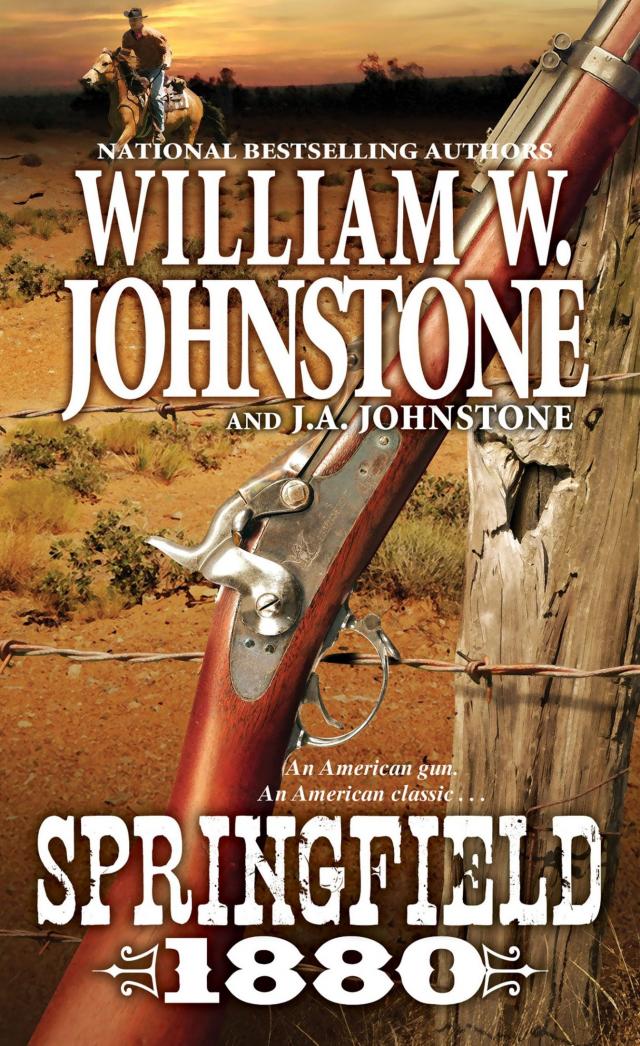


“So,” Knight asked again, “why did the Yanks replace the old model?”
Winters nodded and brought the rifle up for inspection. “The way the Yank explained it up north, suh, was this. It’s not so much the rifle they was replacin’, but this.” He withdrew the bayonet. “They, bein’ the gunsmiths and engineers at that damn Yankee armory in Massachusetts, figured they needed a better design for the cleanin’ rod and the bayonet. So they come up with this here beauty.”
He withdrew the bayonet and passed it to Captain Knight. “More of a triangle style, you see, than the old bayonets we all used fifteen, twenty years back. The thing that makes this boy dif’rent is the bayonet. The lockin’ spring here keeps this hog sticker in place. Got serrated ears on both sides, you see. So if you lift this spring, you can slide this long knife up till it locks here. Plus you can remove the whole contraption and turn this sticker into a cleanin’ rod, usin’ the threads here at the end to attach the cleanin’ devices. A rifle ain’t good for nothin’, you officers know, iffen it ain’t a clean gun.”
Will Muncie’s good eye brightened again. “Now, that’s what I wanted to hear, Winters. There’s nothing more glorious in battle than a charge. A charge with bayonets. Smelling the blood, seeing the whites of the enemies’ eyes, the fear on their faces. Hearing our hallowed Rebel war cry. Glory. Glory. Glory. How God must love war.”
He walked forward and took the bayonet, feeling its edge and grinning, then handing the “hog sticker” back to Sergeant Winters.
“Thank you, Sergeant, for your keen and clear report. How many rifles did the Yank say he had?”
“Two hundred and fifty. The Army sent ’em out here from Springfield to get some testin’ done. Plus bayonets for all the rifles, with a few extries and boxes upon boxes of ammunition.”
“Can the Yank be trusted?”
“No Yank can be trusted,” Winters replied. “You know that better than anyone.”
“How much did he charge you for this rifle?”
“Thirty Yankee dollars, but he throwed in the ammunition, such as it was. Just enough to get this baby warmed up a mite. That was what he called a deal. He wants fifty per rifle, and twenty dollars for each thousand rounds.”
Muncie stared at Fountain, the mathematician of the ex-Rebels. “Twelve thousand, five hundred dollars, sir. For the rifles. I don’t know how much ammunition he has, but I would guess five hundred to a thousand dollars’ worth. The Yankee government doesn’t like shooting much power and shot. Otherwise, the soldiers would have Winchesters or Spencer rifles.”
“We wouldn’t need two hundred and fifty rifles,” Truett said. “We’d only need say thirty . . . thirty-five to include a few extras as replacements.”
“Nonsense, Lieutenant,” Muncie said. “When we begin our march, the oppressed Confederates of Texas will rise up and join us to push the Yankee horde north till they are out of our country. Or dead.”
“Yes, suh,” Sergeant Winters agreed.
“We don’t have that much money, sir,” Knight pointed out.
“We didn’t have money in the war, either, especially during the last few years. But we learned how to take what we needed. And we need these rifles.” Muncie spun back to face Winters. “And where did the Yank say this meeting—this trade, this auction or whatever he wants to call it—will take place?”
CHAPTER 16
Holden had heard enough about Will Muncie, some insane former Confederate with an ax to grind. He asked Sam Florence, “And what do you know about this Dolores?”
The old scout hesitated. “It could mean anything, Lieutenant. A woman’s name. A place.”
“A place,” Holden said. A guess, but it seemed pretty logical knowing what he had learned so far.
“If I were guessing, it would be El Cañon de Los Dolores,” Florence said. “The Canyon of The Sorrows. Something like that. Apaches, Mexicans, and Yaqui Indians used to do some trading there. It’s in Sonora. Can’t say I’ve ever been there.”
“Could you find it?” Colonel Smythe joined the conversation.
“Not sure I want to. Nobody—no white man—knows where it is. At least, no honest white man. It’s a place where Apaches used to sell Mexican captives, sometimes white captives, too. We know it’s near Rancho Los Cielos, but that’s about all there is. There’s a bandit who has been holed up outside Rancho Los Cielos for a year or so. Maybe not quite that long. Amonte Negro—he’s as mean as Crooked Nose and as crazy as Will Muncie. Foster might try to sell the guns to that crazy Mexican, too.”
“I will go,” Holden said.
Smythe made a beeline for the cabinet and the brandy. After fortifying himself with another snifter, he shook his head. “You seem to forget, Lieutenant, that Jed Foster is now in Mexico, beyond the reach of the United States Army.”
“Well,” Sam Florence said, “you can always alert the authorities south of the border.”
Smythe refilled his snifter. He gulped this one down. “That I do not wish to do, at this time. No need in worrying the residents of Sonora or all of Mexico.”
Holden clenched his fists but said nothing. No need in worrying the residents. The residents who would be butchered by the Apaches if they got their hands on that many new weapons. Or the Rurales who might be killed by those Mexican bandits, properly armed, before the bandits rode to Mexico City to kill and plunder. And if Will Muncie got those Springfields? As crazy as Smythe and Florence had described him, Muncie wouldn’t rest until the entire Southwest ran red with the blood of the innocents.
“We don’t have much time,” Florence said. “The other word on that paper the young lieutenant grabbed says July.”
“Which is a few days from now, Sam,” Smythe said, “and July has thirty days in it.”
Actually, thirty-one, but Grat Holden was not going to contradict the colonel on that picayune detail. But he did say, “It won’t be at the end of the month.”
“And I suppose you know the exact date of this . . . auction?” Smythe asked.
Grat Holden remembered riding beside Jed Foster, before the ambush. He heard their voices clearly.
“There’s nothing like celebrating Independence Day on the Fourth of July in Mexico.”
“I don’t believe Mexico celebrates our independence, Captain.”
“Then I’ll celebrate her. By myself if I have to.”
“Independence Day,” Holden said to Florence and Smythe. “The Fourth.”
“Why then?” Florence asked.
“Foster mentioned that day on the trail.”
“That means nothing,” Smythe said.
“No,” Sam Florence said. “The shavetail here might have a point. It would be a good joke. That’s the way Jed Foster would see it.”
They all realized the truth of that statement.
“I’ll still volunteer to go, Colonel,” Holden tried again.
“Mr. Holden,” Smythe bellowed, “I cannot send a lieutenant, especially one with only five years of experience on the frontier, across the international border. It would lead to scandal, an incident that would embarrass our Army, our generals, the Secretary of War, and our president. That will not happen.”
“Then,” Sam Florence said, “you’d better let your commander know what has happened here, and you had better let Mexico know what’s about to happen down there.”
Smythe stared at the brandy, but refrained from getting too intoxicated.
“What,” Holden tried again, “if I went into Mexico out of uniform?”
The colonel tilted his head, intrigued.
“Are you serious?” he asked after a long thought.
“De—Yes, sir. Very serious.” He had almost said dead serious.
“One man?” Smythe shook his head. “How many renegades still ride with Will Muncie?”
Florence shrugged. “Twenty. Thirty. No telling.”
“And with Crooked Nose?”
“No more than with Muncie. Maybe a good deal less. Apaches are notional, temperamental. Muncie and his boys? They’re just crazy.”
“And what about that bandit you mentioned?” Smythe snapped his fingers trying to think of the name.
“Negro. Amonte Negro.” Florence shook his head. “I don’t know. He calls himself a revolutionary. A fighter for the peons, the peasants, the people. He could have five. He could have five hundred. It would just depend on the mood of the people down in Sonora.”
“I’d still like to go, sir,” Holden said.
And if the colonel declined the offer, Holden would resign his commission and go down himself. He had a score to settle with Jed Foster.
“Would you go with him, Sam?” Smythe asked the old scout.
Sam Florence did not answer. Instead, he said, “The boy’s got a point, though, Colonel. So do you. You can’t send a whole troop of cavalry across the border. Mexico might declare war. Probably not, but that’s a crazy country. And that many people would draw the attention of Negro, the Apaches, Muncie and, especially, Jed Foster. He has to think the Army and the US government won’t let that many brand-spanking new rifles get into the wrong hands without a fight.”
“Two men,” Smythe suggested.
Holden tried not to roll his eyes. Two men. What chance would two men have over an army?
“Two men wouldn’t get much attention, if they knew what they were doing,” Holden said.
Seeing that the colonel was nodding his head, Holden decided to rethink his original position. “I’m going, sir,” he told Smythe. “I’d like to pick the man who goes with me.” Holden was looking at Sam Florence, who did not meet the lieutenant’s eyes.
“No,” Smythe said. “No. But you will have a man with you.” His head bobbed again. “Understand, if you are caught or captured or killed, we will disavow any knowledge of your activities south of the border.”
“That’s fine with me, sir.”
“Then I’ll send Private Masterson with you.” Smythe liked the idea. “He’ll go. Or he’ll go to Leavenworth for ten years.”
Masterson. Holden, his mouth open, shook his head.
Ben “Hard Rock” Masterson, once a sergeant, now a private about to do hard time in the federal pen in Kansas. Ben Masterson, who hated Grat Holden’s guts. Holden would be lucky to get to Mexico alive with “Hard Rock” riding with him.
CHAPTER 17
For yet another time—Jed Foster had lost count of how often he had looked at the paper—he studied the damaged paper. That reminded him of something else Custer had told him. Keep the written orders to a minimum. Written orders can get an officer in trouble. Even lose a war. Remember what happened at Antietam to Robert E. Lee’s Army of Northern Virginia.
Foster looked at the ripped left-hand corner.
What had he written there?
One thing was obvious—July. He saw the 4th and beyond that noon. And beyond that and underlined payday. He had been doodling nonsense.
July wouldn’t tell that greenhorn Grat Holden anything. Yet the other words might give the boy some hope. A long shot, Foster thought, but wars can be lost or won on long-shot gambles. He needed to prepare. He had to guess that he had written Confederate officer Will Muncie’s name on the paper. Amonte Negro’s and the Apache chieftain Crooked Nose’s names were written in all capital letters just beyond the tear. After that was mostly ciphering, guessing at how much money the Reb, the Apaches, and the Mexican bandits might be able to bring. Foster had also written the name of the nearest Rurale leader and the alcalde of the largest and closest village. He had considered letting them bid on the weapons, too, but had dismissed those. The Apaches and Negro’s mercenaries wouldn’t come if they understood the Rurales or the local magistrate might be coming. Apaches didn’t trust Mexicans. Mexicans didn’t trust Apaches. Inviting Crooked Nose and Amonte Negro was risky enough. Rurales? No. Porfirio Díaz was on his way out as president of Mexico, and Foster had never trusted any Mexican government official.
Another thing Custer had told him. Don’t get too big for your britches. The man who goes after the golden goose instead of just one golden egg usually gets his goose cooked.
Most likely, Foster was just being overly cautious. He remembered the fight with Grat Holden near Dos Cabezas. That reckless fool. Should’ve played possum. Yet he had too much spunk for his own good. Foster remembered feeling Holden’s hand reaching inside his jacket. He recalled bringing his upper arm and forearm down against the hand. He didn’t recall seeing anything come spilling out of the pocket, landing on the dirt or cactus, but he had been a little preoccupied with the treason he was committing. When he closed his eyes and thought back, he could see Holden’s clenched fist. The ripped corner of one stupid little page could have been in that fist. On the other hand, it could have blown down the canyon or toward the “Two Heads” or gotten stuck on a cactus needle two miles from the middle of nowhere.
He told himself to forget it.
Yet he still walked to La Cantina Que No Tiene Nombre, The Cantina That Has No Name. The raven-haired beauty sat at a table studying tarot cards.
After a nod at the bartender and holding up two fingers, Jed Foster dragged up a chair and sat opposite the woman known as Soledad Tadeo.
“Reading your future?”
Without looking up, the young woman said, “I play a game, much as you Yanquis play your poker or your faro. I do not practice divination.” She turned over a card and shook her head. “But you come in and I turn over The Fool.”
The bartender came over and put a glass of tequila in front of Foster and a glass of goat’s milk in front of the woman.
“I consider myself the king,” Foster said. “And you are the queen. Perhaps the king and queen should get together.”
“I would rather sleep with a pig.”
He laughed, although inwardly he wanted to drive the wench’s head into the rough floor. “You misunderstand my intention, Señorita Tadeo.”
Actually she had not misinterpreted anything. For a girl with tarot cards who didn’t practice divination, she had read his mind perfectly.
“I come with a business proposition.” Jed Foster waited.
The woman finished her game, or at least a hand, and looked up. Her eyes were pitch black, her face unreadable. She stared, waiting, and did not touch the glass of goat’s milk while he drained the tequila.
“I do not work for gringos. I do not work for deserters.”
He gave her his best smile, a look that had left many married women and once even a preacher’s daughter falling into his arms and allowing him to carry them away before he left them in tears, ruin, and shame.
“But you work for Amonte Negro,” he said when he realized his look had no effect.
She nodded at the bartender. “I work for mi amigo. Mostly, I work for myself.”
“Then I will pay you for your services,” Foster said, “and all I ask for you to do is to lead me to Amonte Negro.”
“Again?”
He smiled. She had arranged the meeting when he had made his proposition.
His head nodded. “Again. But”—he rose—“muy pronto.”
“Do you think Amonte desires to see you again after what you did to his men the other night?”
“Those men either betrayed Señor Negro or Señor Negro tried to betray me. But I am willing to let bygones be bygones if the latter was the case. And I will pay your pal Negro for his time and trouble. And”—he winked—“I will pay you much more than I pay him.”
“Get your horse,” she said. “I will saddle mine. We shall ride out of Rancho Los Cielos in fifteen minutes.”
CHAPTER 18
The mule couldn’t pull a wagon, but Foster figured it might have enough strength to carry a few things, so he had a couple of the boys fit a packsaddle on it, and loaded the weary old Army animal with a couple boxes. Then he swung into the saddle of his bay and gave the men a wide grin.
“If I’m not back in a day or two, I’ll see y’all in hell.” He touched the spurs to the gelding and pulled the mule behind him.
On a zebra dun, Soledad Tadeo waited for him across the street.
“What do you think, Madame Tarot?” Foster asked. “Will your amigo like his gift?”
Without looking him in the eye, she eased her horse ahead of his and led the way out of town. “If they are hungry, they will appreciate the mule.”
* * *
For the life of him, Jed Foster couldn’t understand why the Mexicans and the Apaches fought over this patch to hell. Scorpions and rattlesnakes, Gila monsters and cactus. The wind blew hot. The sun baked you. On the rare times you found water, it proved hard to drink. And if you did drink it, the water might kill you quicker than a rattlesnake.
Arizona wasn’t any better, but the Army and the white settlers kept fighting the Apaches over the raw desert, too.
Soledad Tadeo slid back in the saddle as her dun picked a careful path down a sandy arroyo. She rode better than a bunch of recruits the Army kept sending to Bowie. And he really liked riding behind her when she kicked her gelding into a trot. Too bad she didn’t do that very often. Then again, it was a really hot day, and the mule, considering its load, did not want to trot at all.
The dry wash twisted like a rattlesnake’s trail, but it was deep enough and the scrub brush that grew alongside it provided some shelter from the wind. He realized that they were heading into the hills, and before long the sun had disappeared behind the high rocks.
Despite the coolness, he still had to loosen his bandanna to wipe sweat.
As they kept riding, Foster heard the woman’s soft curse and a few words she said in Spanish. Understanding the Spanish word for fools, Jed Foster smiled. He had to agree. He had heard the men up the arroyo long before the raven-haired beauty in front of him had.
They rounded another twist in the dry wash and there stood Amonte Negro.
Soledad Tadeo turned her gelding to a pool at the western side of the bend and let her horse drink. Jed Foster merely reined in his mount, kicked one leg free of the stirrup, and rested it over the stock of his Winchester.