The shoebox bible, p.2
The Shoebox Bible,
p.2


After a long time, the doctor, ashen-faced, came out into the kitchen, where my mother had been fortifying herself with endless cups of orange pekoe. “It’s all right now,” he told her. “We’ve managed to get him breathing again.” And he asked if she would please make two more cups of tea: one for the anaesthetist and one for himself.
I recovered from my first encounter with death just in time to come down with scarlet fever.
After a while, the scarlet fever metamorphosed into another variety of measles and pneumonia, and my tired chest was encumbered with stinging mustard poultices and packed like a Ming vase in an orange fleece called Thermo-gene. For a while I pretended I was a mummy being embalmed with precious spices for a long journey into an unknown future, and in a way, I suppose, I was.
Then one day my mother found me outside in a deep snowdrift, clad only in pyjamas, and neighing loudly as I galloped on a phantom horse round and round the row of bare poplar trees: round and round on an icy and cooling oval steeplechase course that existed only in my fevered fancy. She told me later she had to lure me back into the house with a bale of hay.
Outside and unseen – at least by me – snow followed snow; rain followed rain; sun followed sun. By the time I was permitted outdoors again, as thin and pale as a sardine, it was summer once more, and the world was so intensely green that it pained my watery eyes.
The happy outcome of these afflictions was that my sisters, tired of having to help entertain a bored and often cranky child, began teaching me to read when I was three. With scraps of bristol board, they manufactured flash cards, from which I was made to work out, syllable by syllable, the entire sentences they wrote, such as CHIL-DREN SHOULD BE SEEN AND NOT HEARD and SI-LENCE IS GOL-DEN. My first book was to have been The Bobbsey Twins at School, but Danny Rugg, the book’s obnoxious little villain, made it impossible for me to read the tale. From his initial appearance until the moment I finally tossed the book aside unfinished, I loathed Danny Rugg intensely; loathed him not because he was a Bad Boy but because the two g’s in his surname seemed pretentious to me. But in spite of a shaky start, by the time I was old enough to be bundled off to school and enrolled in kindergarten, I had finished The Adventures of Tom Sawyer, Adventures of Huckleberry Finn, Slim Evans and His Horse Lightning, and was doing my best to get into Michael Arlen’s The Green Hat.
Fiction was a pale fire, though, beside the fierce flame of the Century Dictionary or, to give its splendid title in full, The Century Dictionary: An Encyclopedic Lexicon of the English Language. This massive twelve-volume set, bound in black and gold and as long and grave as any Victorian casket with its plated and polished fittings, had been given to my mother by one of the doctors’ wives as payment for a party frock.
“No home – especially one with children – should be without an unabridged dictionary,” this lady said as she lugged the two heavy boxes from her car up onto our front porch. I sprang upon them like a cat on a grasshopper.
Between these covers existed another world – a parallel universe – and I would sprawl for hours on the floor, drinking in great gulps the endless invigorating wonders of its open pages.
By the time I was five I had become a youthful Gradgrind and, like that superannuated merchant of Dickens’s Hard Times, liked to think of myself as “a man of facts and calculations: so practical that I was hardly human.”
“Now, what I want is, Facts. Teach these boys and girls nothing but Facts. Facts alone are wanted in life. Plant nothing else, and root out everything else. You can only form the minds of reasoning animals upon Facts: nothing else will ever be of service to them. This is the principle on which I bring up my own children, and this is the principle on which I bring up these children. Stick to the Facts, sir!”
I must have been insufferable.
And yet were there not, in those more than seven thousand pages of the Century Dictionary, engravings of the “cherubins who flackered with their wings”; of the spurious Basilidians, who thought there were 365 generations of angels occupying 365 heavens; of Polyphemus, the Cyclops in The Odyssey, one of that race of gigantic, lawless cannibal shepherds in Sicily who likely (according to my older sister) suffered from a hereditary form of cyclopia or synopthalmia: a malformation in which the orbits of the eyes form a single continuous cavity; of the three gorgon sisters, Stheno, Euryale, and Medusa, whose heads were covered with writhing serpents instead of hair, the sight of whose terrific aspect turned the beholder to stone; of the great and venomous dragons that, in the Old Testament, were either large land animals or great marine fish, but in the Revised Version were inexplicably reduced to jackals; of the Molly Maguires, those stout, active young Irishmen dressed up in women’s clothes with faces blackened who used to suddenly surprise the unfortunate grippers, keepers, or process servers and either duck them in bog-holes or beat them in the most unmerciful manner; of the nine-killer: the shrike or butcherbird that kills more insects, small birds, and small quadrupeds than it can devour at once and impales its leftover victims in a makeshift larder of a thorn or a sharp twig; of the dead wizards and werewolves, heretics, and other outcasts that become vampires, as do also the illegitimate offspring of parents themselves illegitimate – and on the discovery of their graves, the bodies, which it is supposed, will be found all fresh and ruddy, must be disinterred, thrust through with a whitethorn stake, and burned in order to render them harmless; of the correct word to be used in describing someone who looks like a gooseberry: grossulaceous; and of griffins, which were supposed to watch over mines of gold and hidden treasures?
It was while looking up the griffins that I stumbled upon the term grass widow, or straw widow: a woman who has been abandoned by her husband.
In my distress I cried unto the LORD, and he heard me.
Deliver my soul, O LORD, from lying lips, and from a deceitful tongue.
What shall be given unto thee? or what shall be done unto thee, thou false tongue?
Sharp arrows of the mighty, with coals of juniper.
Woe is me, that I sojourn in Mesech, that I dwell in the tents of Kedar!
My soul hath long dwelt with him that hateth peace.
I am for peace: but when I speak, they are for war.
Psalm 120:1–7
Often, as we grow older, we forget how keen our senses used to be. We forget the bottlebrush intensity of a caterpillar tickling its way across our upturned palm; the thousand shades of green a leaf can be; the wonder of watching a devil’s darning needle touch down weightlessly on a sunflower; the sound of raindrops plopping like little wet meteorites into the dust; the way in which, after the rain, the sky drips with liquid gold, and how it felt to breathe in the rich black odour of the earth itself.
We knew the territory of our childhood the way a fox knows the hillside and the way a hawk knows the heavens. As children, we have mapped in our minds the lay of every twig, the proper place of every pebble, and no stone remains for long unturned. That huge red maple leaf – the one that landed yesterday, then perched miraculously atop the fence post – has flown off in the night, and the empty robin’s nest, tucked away beneath the eaves since last spring, has blown down into the shrubbery.
The first cold day of winter brings with it that greatest of wonders: frost on the windowpane. Like interstellar travellers, we sit in a warm and comfortable compartment, our faces pressed to the porthole, with winter right there at the other end of our noses. We peel, with an inquisitive fingernail, a curly shaving of frost and pop it onto the tip of our tongue. It is the icy cold of the underworld and tastes of Hades and wallpaper paste.
Then, as the sun comes up, the ice-crystal paradise mapped out upon our window glass – a vast expanse of strange seas and unknown continents, of tall sparkling towers and ruined palaces – is washed over with the dawn: the auroral pink of a baby angel’s wings.
And when at last we are bundled outside in boots and britches, caps and coats, mitts and mufflers, and even though our nostrils are pierced instantly by icy needles of cold air, we can smell the snow. We can actually smell the snow!
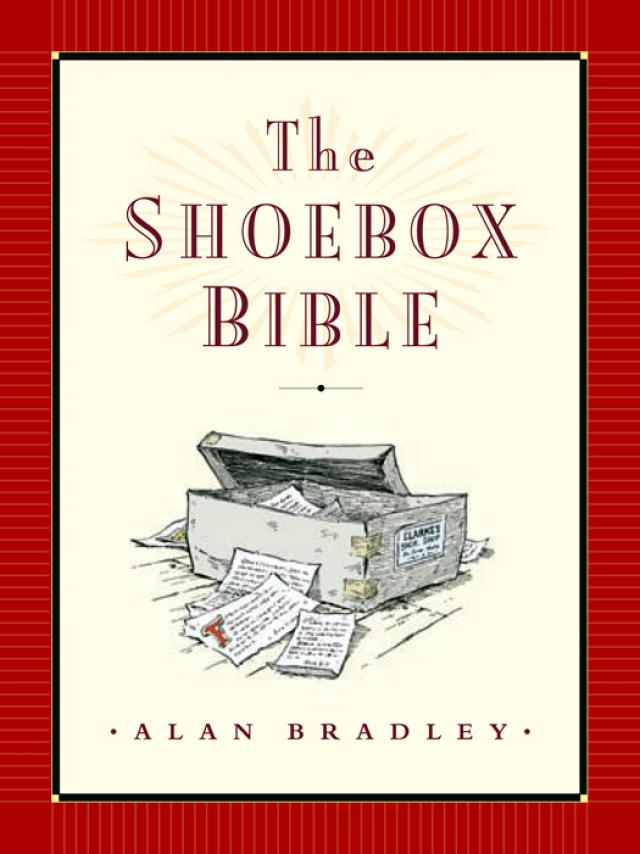
In the Shoebox Bible, there is a snapshot of me standing, close-buttoned in my snowsuit, knee-deep in a drift. I am crying, and you can clearly see the tears running down my cheeks. My mother has taken the picture from inside the house, from behind the curtains. In the snow at my feet lies a long wooden mop handle with a bear-trap wire spring of a thing at one end. I have pettishly tossed it aside because it is not the kitchen broom I like to pretend is a hobby horse.
I am crying, not because I am horseless but because my mother has got up from her sickbed to bring me the mop, which I, in anger at myself, have flung petulantly aside. For the first time, I have been stricken by her pain, and I am more frightened than I have ever been before in my small life.
Other mothers, perhaps, might have been reminded of King Lear’s apt remark about how sharper than a serpent’s tooth is a thankless child, but on the back of this picture of me, my mother has written in soft pencil:
Be not forgetful to entertain strangers: for thereby some have entertained angels unawares.
Hebrews 13:2
A LETTER ARRIVES IN A pulpy grey envelope marked O.H.M.S. – On His Majesty’s Service: he is coming home on leave. It is May.
She has written on a crinkled piece of brown paper that was once a grocery bag: not cut sharply with scissors, but carefully torn along folded creases, its deckle edges as soft and feathered as the wings of an angel. The paper has been rumpled and flattened – and then perhaps ironed – lending it the look and the feel of a manuscript from a desert monastery somewhere in the Holy Land.
She has scissored and pasted the gold capital T’s from Tetley tea boxes and the bright red and yellow F’s and M’s from a tin of French’s powdered mustard so that the whole page glows with the hushed but brilliant colours of a medieval Book of Hours:
The voice of my beloved! behold, he cometh leaping upon the mountains, skipping upon the hills.
My beloved is like a roe or a young hart: behold, he standeth behind our wall, he looketh forth at the windows, shewing himself through the lattice.
My beloved spake, and said unto me, Rise up, my love, my fair one, and come away.
For, lo, the winter is past, the rain is over and gone;
The flowers appear on the earth; the time of the singing of birds is come, and the voice of the turtle is heard in our land;
The fig tree putteth forth her green figs, and the vines with the tender grape give a good smell. Arise, my love, my fair one, and come away.
Song of Solomon 2:8–13
She tells me to stay outside and watch for him. He will be walking down from the railway station. I wait until my bones are growing cold, and then I see a stranger coming along the street with a kit bag on his shoulder. I don’t remember him, since he has been gone for most of the time I’ve been on the earth. He puts down the bag and picks me up – then puts me down – and hands me his Kodak camera to hold while he goes into the house.
“Don’t push the button,” he tells me. And those are the only words I remember my father ever speaking to me.
Inside the house – although I won’t learn this until I am nearly as old as he was on that day in May – he is already telling my mother that this will be his final trip; that he is never coming back; that he has a landlady out west who treats him well: a landlady who is accommodating. Just like that.
In the Shoebox Bible, my mother has preserved a black-and-white snapshot of the canted house across the street, its laundry hung out on a line and flapping out of focus in the breeze. On the back of it, she has written: Alan’s first photograph. I had pushed the button.
After my father’s brief return, my mother’s readings were no longer from the Song of Solomon. On the inside of an empty matchbook from a Vancouver diner, she wrote:
Woe unto him that giveth his neighbour drink, that puttest thy bottle to him, and makest him drunken also, that thou mayest look on their nakedness!
Habakkuk 2:13
The next passage, the most lengthy in the collection, is copied out in black ink in an uncharacteristically minuscule script on the reverse of a five-by-seven-inch cardboard front panel cut from a box of Post Grape-Nuts, a cold breakfast cereal:
My son, keep my words, and lay up my commandments with thee.
Keep my commandments, and live; and my law as the apple of thine eye.
Bind them upon thy fingers, write them upon the table of thine heart.
Say unto wisdom, Thou art my sister; and call understanding thy kinswoman:
That they may keep thee from the strange woman, from the stranger which flattereth with her words.
For at the window of my house I looked through my casement,
And beheld among the simple ones, I discerned among the youths, a young man void of understanding,
Passing through the street near her corner; and he went the way to her house,
In the twilight, in the evening, in the black and dark night:
And, behold, there met him a woman with the attire of an harlot, and subtil of heart.
(She is loud and stubborn; her feet abide not in her house:
Now is she without, now in the streets, and lieth in wait at every corner.)
So she caught him, and kissed him, and with an impudent face said unto him,
I have peace offerings with me; this day have I payed my vows.
Therefore came I forth to meet thee, diligently to seek thy face, and I have found thee.
I have decked my bed with coverings of tapestry, with carved works, with fine linen of Egypt.
I have perfumed my bed with myrrh, aloes, and cinnamon.
Come, let us take our fill of love until the morning: let us solace ourselves with loves.
For the goodman is not at home, he is gone a long journey:
He hath taken a bag of money with him, and will come home at the day appointed.
With her much fair speech she caused him to yield, with the flattering of her lips she forced him.
He goeth after her straightway, as an ox goeth to the slaughter, or as a fool to the correction of the stocks;
Till a dart strike through his liver; as a bird hasteth to the snare, and knoweth not that it is for his life.
Hearken unto me now therefore, O ye children, and attend to the words of my mouth.
Let not thine heart decline to her ways, go not astray in her paths.
For she hath cast down many wounded: yea, many strong men have been slain by her.
Her house is the way to hell, going down to the chambers of death.
Proverbs 7:1–27
On a long shiny strip of butcher’s paper the colour of raw meat, my mother wrote:
My son, if thou wilt receive my words, and hide my commandments with thee;
So that thou incline thine ear unto wisdom, and apply thine heart to understanding;
Yea, if thou criest after knowledge, and liftest up thy voice for understanding;
If thou seekest her as silver, and searchest for her as for hid treasures;
Then shalt thou understand the fear of the LORD, and find the knowledge of God.
For the LORD giveth wisdom: out of his mouth cometh knowledge and understanding.
He layeth up sound wisdom for the righteous: he is a buckler to them that walk uprightly.
He keepeth the paths of judgment, and preserveth the way of his saints.
Then shalt thou understand righteousness, and judgment, and equity; yea, every good path.
Proverbs 2:1–9
And this, on the back of a buff and blue envelope from the drugstore photo lab, the envelope that held my father’s finished prints:
When wisdom entereth into thine heart, and knowledge is pleasant unto thy soul;
Discretion shall preserve thee, understanding shall keep thee:
To deliver thee from the way of the evil man, from the man that speaketh froward things;
Who leave the paths of uprightness, to walk in the ways of darkness;
Who rejoice to do evil, and delight in the frowardness of the wicked;
Whose ways are crooked, and they froward in their paths:
To deliver thee from the strange woman, even from the stranger which flattereth with her words;
Which forsaketh the guide of her youth, and forgetteth the covenant of her God.
For her house inclineth unto death, and her paths unto the dead.
None that go unto her return again, neither take they hold of the paths of life.
Proverbs 2:10–19
Inside the envelope are a flattened cigarette package and three black-and-white snapshots: my photo of the neighbour’s hanging shirts waving goodbye in the wind and then a close-up of me. I am staring straight up, as if a passing dirigible has suddenly appeared in the air above our house. My father’s hand is visible on my shoulder, the cigarette between his first and second fingers burnt down to a long, drooping ash.
On the front of the cigarette pack – one that he discarded and she retrieved from the wastebasket, then opened out and flattened – are the words Sweet Caporal Cigarettes; these, like a Victorian death notice, are framed by a thin, black double line. The flap is factory-stamped in black ink, like an afterthought, with the words: Don’t Forget the Boys Overseas – Send Them “Sweet Caps” – Use Back For Order Form. Upon the reverse – on the printed lines of the form – she has squeezed in tiny letters a universe of grief: