The shoebox bible, p.8
The Shoebox Bible,
p.8
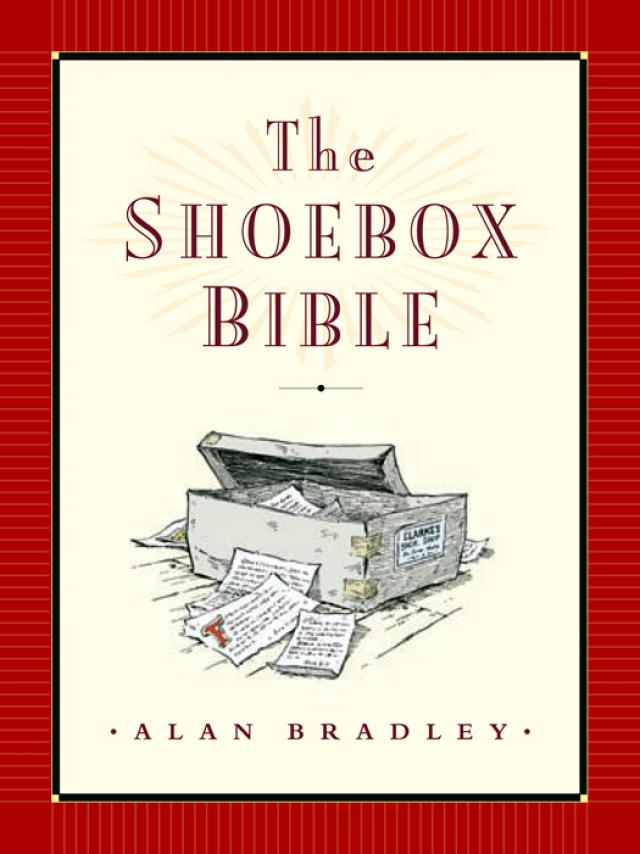


I have put off until the end the clearing out and sorting of her closets, in part because I know they will be the most work, and also because I am afraid of what they contain. Their shelves are piled to the ceiling with boxes of old black-and-white photographs, Christmas ornaments, button boxes, bits of fabric, jigsaw puzzles, balls of wool, and scrapbooks. These are not family belongings: they are my mother’s personal memories – private things that, whenever she wanted to show us something, had to be fetched down with her own hand.
It is here at the back of the top shelf that I find the Shoebox Bible. Although I have not seen it since I was a child, I recognize it at once. I lift the box down gently, blow off a film of dust, and place it in the middle of the coffee table. When I reach forward to remove the lid, I find to my surprise that my hands are shaking like the leaves of the poplar in the winds of autumn; I cannot bring myself to open it – to touch it, even. Maybe in the morning.
Next morning, the Shoebox Bible is still there on the table where I left it, but it is now dramatically illuminated by a single cold and watery beam of the low winter sun. Now, I am not only incapable of opening the box, I find I cannot even look at it – at least not directly at it. I catch myself cupping my tea mug in my hands, staring intently up at a spot on the ceiling, watching the Shoebox Bible from the corner of my eye, the way one watches an adder. Pretending not to see it, pretending not to notice it. Peripheral vision, it occurs to me, has perhaps been given to us for the regarding of those things upon which we dare not look directly. Or not, at least, without the proper preparation. This must have been the way our ancestors looked upon their gods, the way in which Moses must have peeked sideways at Jehovah on Mount Sinai.
And instantly I realize I have been hiding from myself the fact that I want desperately to go back to the street where we used to live, that I have an urge, almost frightening in its intensity, to stand again in the shadow of that house where the Shoebox Bible had once lain hidden beneath the floorboards of my mother’s bedroom closet.
I can get through today, this week, this month – but only slowly, carefully, one small step at a time. It is like suddenly finding oneself in a real-life game of Red Light: a series of short frantic dashes punctuated by abrupt freezes. This is the only way these days – this game – can be survived.
I telephone for a taxi, and the dispatcher tells me it’s going to be a while: three of their four cars won’t start. It’s the cold, she explains unnecessarily, and I know instantly that I sound to her like someone from somewhere else.
The street has hardly changed at all. The butter-yellow clapboard of the four-square house has been painted white and one of the poplar trees is gone, but otherwise it looks uncannily as it did the day we moved away a lifetime ago. My mother and my sisters and I might well have stepped offstage just minutes earlier.
No one seems to be at home, and I plough several feet up the unshovelled sidewalk to see if the chokecherry bushes are still at the back of the garden.
“You lookin’ for someone?” A woman’s voice. Aggressive. She has come out onto the porch with a broom in her hand and a cigarette in her mouth. I want to say “Yes, I am. I’m looking for myself.” But I don’t.
“I used to live here,” I tell her instead. She squints at me like Popeye.
“Frank!” she shouts into the open door. “Frank! Someone in our front yard says he used to live here.”
Frank, pulling on a parka over his blue plaid shirt, picks his way – as clumsily as if someone had just clapped figure skates on his feet – down the three icy steps to where I am standing. He shoves his face into mine, and I realize that, even though it is barely ten o’clock in the morning, he is already oiled.
“Whadda ya’ doin?” he demands, his breath like an alcohol blow lamp.
“I used to live here.”
He mulls this over, his lips moving as though he’s getting ready to eat me.
“I live here,” he says at last.
“A long time ago,” I say. “I lived here a long, long time ago.” The reduplicated adjective makes it sound like a lie.
But Frank is oblivious. A beatific look floats like a puffy cloud across the craggy landscape of his face.
“Here?” he says. “You lived here? In this house?”
“During the war,” I nod.
“He lived here during the war,” he turns and says to his wife, who has already gone inside and shut the door, leaving matters in her husband’s hands. Frank shakes his head in disbelief at the way in which she has abandoned him.
“Who lives next door?” he demands suddenly and with great craft. Apparently, this is some kind of test.
“I don’t know who lives there now,” I answer, “but when we lived here it was Clumsy MacDonald.”
“Clumsy MacDonald?”
I begin to have visions of being punched in the head, knocked out cold, beaten senseless, and left to freeze to death in the deep snowdrift that now lies precisely where I once galloped in an equine fever round and round the row of poplars.
“You know Clumsy MacDonald?”
“Yes,” I say. “I used to. A long time ago. When I lived here.”
“Son of a snake!” he says. “Clumsy still lives there. Right next door. He went to the pub. A while ago. I seen him. Out the window.”
I realize I am miming: precipitously bending back at the waist like Marcel Marceau, swivelling at the hips, making a dumb show of staring intently up and down the street as if I’m looking for Clumsy MacDonald. I am doing everything but shielding my eyes with a flattened hand.
“Tell you what … wait here!” Frank says. “I’ll go get my coat, and we’ll go have a beer on Clumsy. Clumsy’ll buy you a beer. Hell, I’ll buy you a beer – ’cause you used to live here.”
I haven’t the guts to tell him that he’s already wearing his coat, so I nod agreeably as he somehow manages to scale the front steps and vanishes unsteadily inside the house, where a loud argument quickly breaks out, full of rising reproof and shrill recriminations. As the door slams shut, I turn and make for the street.
I stroll – far too casually, and despising myself for doing it – along the narrow sidewalk where I led Mrs. Pearson to my puppet show, past the row of bushes where my father took his last-ever snapshot of his wife and children.
“Hey, Mac!” Frank is back out on the porch. I turn a little toward him, wide-eyed.
“Don’t go taking off on me now,” he says, waving an admonishing finger in my direction. “I won’t be a second.”
The door slams again … and I take to my heels, running. Down the street where I used to live I fly, my breath blowing great white comic-strip speech balloons with nothing in them. In the bitter air, every breath I take is like inhaling a pincushion, but I don’t stop running until I’m two blocks away, panting, gasping, dripping wet inside my stranger’s clothing.
Back in my mother’s apartment, I notice for the first time, although they have been there all along, the Christmas decorations she put up just before she was taken to the hospital. A golden garland frames the doorway, and on it is perched a lifelike row of tiny cotton birds. The only one I recognize is the English redbreast. A miniature Christmas tree stands on an end table, hung with bright bits of tinsel and Lilliputian coloured lights. With a shock I recognize the pipe-cleaner Santa that hangs from a bottom branch: it was chewed into its present bedraggled state by Bootsie, a cat we had when I was ten. I switch on the lights of the tree, but their sad gaiety is too much to bear, and I quickly shut them off again. The place is filled with the ghosts of Christmas Past.
An earlier Christmas Eve: perhaps the one after my father ran away from home, for I am still quite small, and I am being carried by my sisters to the midnight Christmas Eve service at our church. Because of its late hour, I have been made to take an afternoon nap so that I can be allowed to stay up, just this once, past my bedtime. My older sister is the president of our church’s youth group and has been working for days helping prepare the manger. She is anxious for me to see it, and my mother has reluctantly agreed.
This is my earliest memory of our church’s interior: a vast darkened cavern with stacked and scattered bales of hay; bearded shepherds leaning on their hooked staffs; three dark-faced Wise Men sweating in heavy velvet robes, with crowns on top of turbans, kneeling; a ewe suckling two live lambs; and at the centre of the tableau, a mother with a skyblue cowl smiling down at her swaddled baby who lies in a rough wooden crib.
The parishioners, many of them our friends and neighbours, come forward, one family at a time, to kneel at the rail and look upon the humble scene.
Like kiss-curls snipped from cherubs, golden tendrils of incense float upon the candlelight, as the Magi proffer their treasure casks, and a choir, unseen in the darkness, sings:
“We three Kings of Orient are
Bearing gifts we traverse afar,
Field and fountain
Moor and mountain
Following yonder star.”
The low, sonorous vibrations of the organ are like the shaking of Mount Sinai. In spite of my heavy winter clothing, the oak pew transmits to my small bottom the earthquake rumble of the organ, causing me to shake like a rocket ship straining to escape the bonds of Earth, and I now know for certain that this place is truly the House of God.
Our turn has come at last, and my sisters lead me forward to the tableau. I look in awe at the lambs and their mother, for I have never seen a live sheep before. I glance shyly at the Three Kings and the shepherds, all of them looking down with reverence upon the baby in the crib. My gaze follow theirs.
My second sister lifts me up so that I can see over the communion rail. I am so close I can smell the starch in the Virgin Mary’s wimple. My sister whispers in my ear, “That’s the Baby Jesus.”
I look – then look again. I can’t believe my eyes.
“No it’s not,” I say. “It’s Brazen Betty!”
“Shhh!” my sister whispers. “It’s the Baby Jesus.”
“It isn’t,” I insist, louder this time, “it’s Brazen Betty!”
I cannot be fooled: that midnight hair, that red slash of a mouth, those vigilant black eyes. They may be wrapped in swaddling clothes lying in a manger, but they are all too familiar. It is Brazen Betty, my oldest sister’s doll.
I reach out to flip her over and reveal the Amelia Sedley who surely is hidden upside down beneath her skirts, but it is too late. I am collared.
My sisters grin sheepishly as they hustle me up the aisle toward the heavy Gothic door.
As we step out into the first dark hours of Christmas morning, the choir is singing:
“Oh come, let us adore Him,
Christ, the Lord.”
Outside in the snow and the night, we walk in silence for a while, bound for home, and then my older sister says, “I’m never going to speak to you again for as long as I live.”
I consider this for a moment, and then, with tears welling up in my eyes, I say, “If you don’t luff me, I get sick on de back porch and die by de yard.”
My sister looks neither to the left nor to the right but walks on, head up, into the falling flakes. After a very long time, she says, “I do luff you – but I’m never going to speak to you again for as long as I live.”
There are times when our house is filled with music, but never when my mother is at home. We have a piano, an upright Heinzman with a lovely tone, which is, along with her Singer sewing machine, one of the last vestiges of the belongings that my mother brought into her marriage. Everything else has long since been repossessed or sold to pay off my father’s debts.
But the piano is kept in the living room, its keyboard covered. Only when she is alone and thinks I am asleep does my mother sit at the piano and play, for hour after hour, a series of melancholy minor chord progressions that, like the aurora borealis, shimmer and shift in restless sequence without really going anywhere. The only recognizable melody she ever plays, and of which she picks out with one finger only its first two bars, is her favourite song, “Lily of Laguna.” It brings back memories, she once remarks in passing, but she does not elaborate.
In the afternoons, I would fall asleep to the sound of those tentative keyboard essays, but when I awoke, the piano lid would be closed, and my mother back in the kitchen among the pots.
On the Christmas Eve following my fourth birthday, my mother has been invited over by a new next-door neighbour to play bridge – a game she despises. “We mustn’t be thought standoffish,” she says, and goes out the door for cards like a lamb to the slaughter.
My oldest sister, now in high school, is allowed to invite a few close friends over for cookies and lemon Coke. It is a deep, dark secret that one of these friends, Dave, is my sister’s boyfriend.
Because I am a pest and can be relied upon to report on their doings, my sisters have put me to bed early. At the age of four, I still sleep in the same steel-barred crib I have slept in since I was a baby, although I now sleep with the side down – yet I sometimes pull it up and pretend I live in a cage of lions.
As an added precaution against my intruding into their social life, my sisters have tied my hands and my feet together behind my back – and then to the railing of the crib – with knotted rayon stockings. This is nothing new: they do it often when my mother is out looking for work, and over time I have learned, like the Great Houdini, to leave enough space between my wrists and ankles during the initial hogtying. This precaution allows me, when my sisters have left the room, to slip free before you can say Jack Robinson.
But for a while, I just lie there in the darkness listening to the sound of piano music that drifts from the front part of the house into my bedroom. Dave is a classically trained pianist and, although he is still a senior in high school, is far advanced in his conservatory studies.
The piece he plays is one of haunting simplicity and unforgettable beauty. It is one of those melodies that is so “right” – so perfect – that it seems as though it must have existed since the Creation: from a time, perhaps, when God said, “Let there be music,” but nobody wrote it down. I do not know the name of the piece Dave plays, but it is obviously popular with my sisters and their friends too, and I hear them asking him to play it again and again and again.
By the third repetition, I have slipped out of my restraints and am peering through the crack at the door hinge. But by now, Dave has moved on to the bounce and tinkle of Fats Waller’s “Honeysuckle Rose.”
Before I can stop myself, and to my own astonishment, I find myself standing boldly in the living room, asking Dave to “play that nice one again.” My sisters’ friends put down their drinks and cigarettes and make a great fuss over me, ruffling my hair and snapping the elastic of my pyjamas. My sisters are furious.
But Dave – God bless you, Dave – is immediately charmed and pleads with them to let me stay. He lifts me up to sit in state beside him on the piano bench as he plays, once again, the opening notes of that sublime melody.
“This is just for you,” he whispers, and his fingers flow over the keys as easily as clouds drifting across the moon.
Years would pass – a lifetime, in fact – before I would hear the piece again and learn its name: this time on a car radio during a long and sad drive in the darkness and the rain. When it ended, the late-night announcer identified it as the minuet from the ballroom scene of Mozart’s Don Giovanni. I was three hundred miles from anywhere that night, so there was no way of requesting that it be played again, but when I hear it nowadays – which is often – I am no longer in a downpour on a dark highway. No, whenever I hear that little miracle of a minuet nowadays, it is instantly Christmas, and I am four years old. And I am in my crib – listening, rapt, in the darkness – and Dave is at the piano.
Imperceptibly, the sky outside the window has turned the colour of cold ashes. For a moment, I do not know where I am, until I realize I have been sitting all night, lost in a dream. No time for sleep now: when I have showered and eaten breakfast, it will be time to set out for the hospital again. There is already enough light in the room to see the Shoebox Bible, still unopened on the coffee table. Then, quickly, before the guard in my mind is able to stop me – before he can come fully awake – I reach for the lid.
Pandora crosses my mind. I think of the scene in which she opens her box (or jar, as the poet Hesiod tells us), and out of it come pouring all the demons – the plagues and wars – of Creation, mewling and hissing and screaming, then flapping off with the sound of tin wings in a vortex, to have their way with unsuspecting man. Pandora tries in vain to replace the lid, but it is too late.
Or nearly so. What is left in the box is … well, let Hesiod tell the ending:
Only Hope remained there in an unbreakable home within, under the rim of the great jar, and did not fly out at the door.
Only Hope! An unbreakable home within!
In that single instant of taking off the lid and looking inside, I know for certain that my mother never gave up hope. I know that although she has never spoken of my father, she has never – ever – stopped waiting for the day of his return.
I am so overcome by the thought of this that for a time I can think of nothing at all.
But when I do think, I recall something once written by a lovely old Victorian churchman:
Wonderful stories are told both by Jerome and the rabbis, how travellers, having cooked their food by fires made of the juniper wood … and returning a year after to the same spot, still found the embers alive.
So, like the juniper, burned my mother’s hope – and so burned her love. For her too, only hope remained – and an unbreakable home within.
This cardboard box – this Shoebox Bible – has been my mother’s test and her testament: her anchor and her sail.