The shoebox bible, p.9
The Shoebox Bible,
p.9
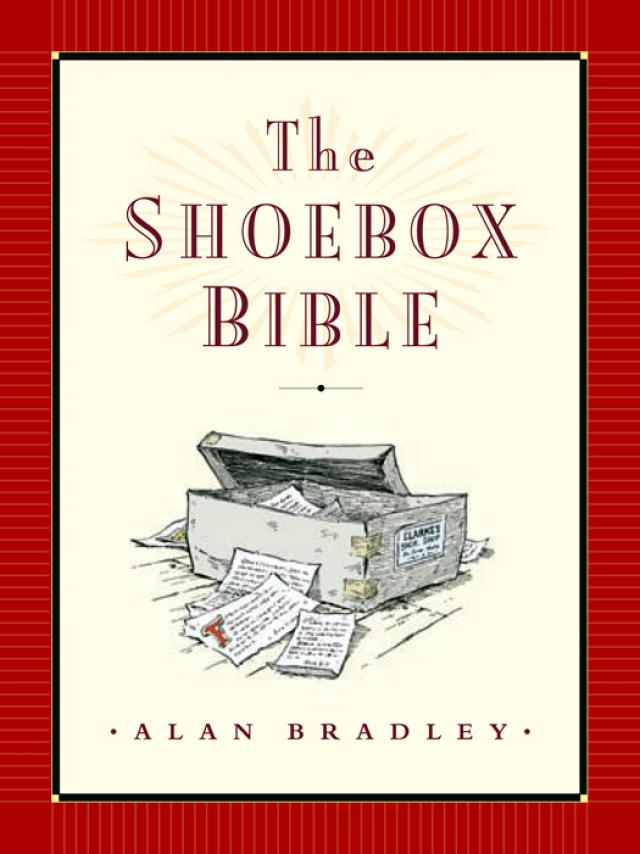


The urge to make a Bible must surely be as old as humankind. I think about this as I brace myself to sort through the scraps and pages of the Shoebox Bible.
The cozy comfort of the world inhabited by the translators of the King James (or Authorized) Version was a far different environment from the harsh desert climate endured by the nomadic Hebrews of three thousand years ago. The Pentateuch – the name given to the first five books of the Old Testament and believed to have been written by Moses himself – paints all too painfully vivid a picture of the harsh, practical realities of everyday life in those times: heat, starvation, slavery, plague, war, the never-ending search for water; the list of privities goes on and on.
Still, Isaiah was able to complain, almost a thousand years after their captivity in Egypt, of the swanky (and oddly automotive-sounding) habits picked up there by his people:
Moreover the LORD saith, Because the daughters of Zion are haughty, and walk with stretched forth necks and wanton eyes, walking and mincing as they go, and making a tinkling with their feet:
Therefore the LORD will smite with a scab the crown of the head of the daughters of Zion, and the LORD will discover their secret parts.
In that day the Lord will take away the bravery of their tinkling ornaments about their feet, and their cauls, and their round tires like the moon,
The chains, and the bracelets, and the mufflers,
The bonnets, and the ornaments of the legs, and the headbands, and the tablets, and the earrings,
The rings, and nose jewels,
The changeable suits of apparel, and the mantles, and the wimples, and the crisping pins,
The glasses, and the fine linen, and the hoods, and the vails.
And it shall come to pass, that instead of sweet smell there shall be stink; and instead of a girdle a rent; and instead of well set hair baldness; and instead of a stomacher a girding of sackcloth; and burning instead of beauty.
Isaiah 3:16–24
He prophesied that they would be exiled yet again, and about one hundred and fifty years later, his prophecy was fulfilled. This time the place would be Babylon, and the exile there would last for fifty years.
The Old Testament is about hardship: it is written in a language in which there are a hundred words for suffering, a thousand words relating to ritual slaughter in a hard and concrete world. In early Hebrew, there are few adverbs and adjectives and even fewer abstract nouns: these would not become common until after the experience of the Babylonian exile.
Their heads filled once again with modern big-city ideas, the Jews finally returned to their homeland from Babylon (whose citizens, according to Herodotus, strolled about the streets with personalized walking sticks with heads that were carved into the semblance of an apple, a rose, a lily, an eagle, or something similar), their language – and no doubt their fashions – blossoming anew.
In translating any work that originated in a society where everyday life was harder than one’s own, the words must necessarily be diluted. In the England of 1610, for example, there was no great store of words, as there was in the Hebrew tongue, to describe the thousand niceties of ritual sacrifice or the countless degradations of slavery. The glorious phrases of the Authorized Version were word-pictures of their own time: of trade and of exploration, of technology and science, of ideas rather than things; of ease and refinement rather than words describing lives worn away by sun, sand, and brutality. This was the world of Shakespeare, not of Moses, and the everyday world of the tribes of Israel must have seemed far away indeed to those translators who had lived through the long golden glow of fireworks – only recently sputtered out – that had been the reign of Queen Elizabeth I.
Even earlier – by 1530 – there had been other European translations of the Bible in English. William Tyndale and John Rogers shared the pseudonym “Thomas Matthew” to escape persecution by “those malicious and wily hypocrites … those stubborn Nimrods,” as Tyndale called the existing Church and State in a remarkably sassy “Note to the Reader.” Nonetheless, he was tracked down and betrayed by a fellow Englishman pretending to be his friend, and executed outside Vilvoord Castle in Brussels. His last words before being strangled and burnt by the public hangman were “Lord! Open the King of England’s eyes.”
But it was not to be: back home in England, John Wyclif (or Wycliffe) was burned at the stake for daring to render the word of God into the profane English language.
Every Bible, then, is intensely of its own time. Although it contains old and comfortable words from the past that have been cherished and retained, fresh words that seem to vitalize the present, and expansive words to give hope for the future, its very atoms vibrate at the frequency of the precise day upon which it was written. It is at once a history, a testament, a wish-book: a living, breathing user’s manual.
And the Shoebox Bible is no exception. I remove the lid.
The first thing I see inside the box, on top of the other papers, is a photograph of my father: his black-and-white self striding confidently along a city sidewalk, his shoulders thrown back, a smile on his face, and in his meticulously pressed air force uniform, he looks … well, he looks handsome. He looks content. He looks confident. He is totally unaware of the street photographer who is freezing this instant in time.
I have never before seen this photograph, which is professionally mounted in a five-by-seven-inch frame of sterling silver. On the brown paper that hermetically seals the back, my mother has written Joe, as if against a day when she might no longer be able to remember his name.
Piled beneath this photo are the multitude of bits and oddments of paper that make up book, chapter, and verse of the Shoebox Bible. All in my mother’s handwriting, these harlequin-coloured scraps are an account of her lost Eden: yet an Eden that has always been (I am only now beginning to see) to me a sort of Paradise.
They’re all there, the papers: much the way I remember seeing them on that day when the little boy that I once was fished them out of their hiding place deep beneath the floorboards of my mother’s bedroom closet.
And there is something else here I have not seen before. It is written on a piece of white cardboard, from one end of which a circle has been punched so that it may easily be hung on a doorknob. On this is printed a list of dairy products, each with a little square box to be ticked off by the householder: milk (pasteurized or homogenized) in quarts and pints; table cream and whipping cream in pints and halfpints; then buttermilk, chocolate milk, and butter. The name of the dairy is printed across the top in stylish script, and beneath that, a drawing of an impossibly rosy-cheeked boy and girl, and the message: Milk Is Good 4-U Drink It 2-Day!
On the back of this, in ballpoint pen, my mother has copied out these lines:
And, rising, from her bosom drew
Old letters, breathing of her worth,
For “Love,” they said, “must needs be true,
To what is loveliest upon earth.”
An image seem’d to pass the door,
To look at her with slight, and say,
“But now thy beauty flows away,
So be alone for evermore.”
“O cruel,” she changed her tone,
“And cruel love, whose end is scorn,
Is this the end to be left alone,
To live forgotten, and die forlorn?”
The words chill my heart. The lines are unfamiliar, but the iambic tetrameter and the mood are reminiscent of Tennyson. I reach up and take down from my mother’s bookcase a small, green leather-bound edition of his poems, and my breath is taken away as it falls open, at the faded red ribbon that still bookmarks those very words.
They are from Tennyson’s 1842 poem, “Mariana in the South,” and I know by the ink and her handwriting that my mother has only recently appended this final indictment of herself.
So the Shoebox Bible had not come to an end as I supposed; it was not suspended in time. It has been in her closet, living, breathing, dreaming – and even growing.
I return it to its shelf and, as an antidote to my shaking hands, turn on the television set. For the first time in my life, I find myself caught up in the foreboding immanence of Another World, and when that shadowy drama ends, I flip to another channel where Alex Trebek is telling a tearfully clapping young woman that he is sorry: that Victoria, not Vancouver, is the capital of British Columbia. Still clapping, she slinks from the studio as if he has pointed a bony finger and told her to take her bundled brat and never to darken his doorstep again, and we fade to black and come up on a commercial for lemon-flavoured laxative.
There has been no let-up in the weather – in fact it has worsened – and it has grown far too cold to walk the bitter streets. I decide to rent a car for whatever remains of my stay.
When I arrive, stamping and blowing, from the hospital parking lot, the nurse shakes her head and tells me that my mother is not having a good day, that I can sit beside her quietly if I wish – but that is all.
As the sun goes up and over the sky and long shadows sneak unstoppable across the room, I sit looking sometimes at my mother, who seems to be sleeping peacefully, and sometimes at the fairy-tale world outside. We are, I think, shut up in a chamber of horrors with a view: a window looking out onto the frozen world of the Snow Queen.
But then, quite suddenly, I recall those awe-inspiring words from the Book of Job: “By the breath of God frost is given,” and I remember how, as a child, I believed that the frost patterns I found on our windowpanes on winter mornings had been mapped out long before by God: that what we were seeing was the final form – the completion, if you will – of a great work, with blueprints that had been drawn up previously and laid out on the great trestle tables of Heaven.
And I look at my mother and see that this is true: all of it.
She sighs and says quietly, “… And another thing …”
She is looking at me, but I’m not sure if she’s awake, not sure if she really sees me.
I let her know that I am there, and she says, “Remember that old shoebox in the closet?”
I nod my head. She smiles. She has known all along.
“Take it,” she says.
It’s as simple as that. It will be the first and last time it has ever been spoken of.
Next morning, after breakfast, I drive to the church. I pull into the tiny parking lot, and suddenly I fall apart. There is no other way to describe it. My heart pounds as if it is trying to shake my face loose. My throat tightens in a knot and my ears are sending my brain the signal that I am immersed in unfathomable depths.
Simply the thought of being on the doorstep of that Sunday school – that room of shifting lights – sets my lower lip atremble. And beyond is the church, where my sisters rushed me out of that long-ago Christmas Eve service.
My breath is coming in great gulps now, my chest is heaving, and I am sobbing as though the gates of Paradise had just slammed shut in my face. Something inside of me has boiled over. It is as unexpected and as shocking as if a volcano had suddenly erupted from the green duck pond of a quiet English village.
I catch a glimpse of myself in the rear-view mirror, and I am shocked at my sudden dissolution. My heart still feels as if it is trying to claw its way out of my chest. I press both hands over my face to keep it from falling off into my lap.
Blubbering, I become aware of someone standing beside the car, someone tapping on the window, someone wearing a dark suit and a clerical collar. I turn away, pretending I don’t see him, that I’m adjusting my tie in the mirror. But he persists, tapping and tapping at the glass like the raven.
“Nevermore,” I think. But at last, courtesy forces me to roll the window down.
“Is there something I can do?” he asks. His boyish face is full of concern.
“This place …” is all I can manage, waving my hand vaguely toward the church.
“I know,” he says (to his eternal credit) and asks me if I’d like to come in for a coffee. I am too damp and too limp to refuse.
In a moment we are inside, standing in the middle of the Sunday-school room, which still has its steam radiators, but the coloured gems of its windows are mercifully muted and dull on this dark winter day, not at all the glass of my memories: yet here in the corner is the same wooden bench where my mother sat while Jesus made up his jewels.
And here is the library, where I used to borrow and devour not only such standard fare as The Natural History of the Holy Land and Travels in Palestine but also those fat gilded blood-and-thunder boys’ books that were the staples of Anglican kid life: The Boy Hunters of the Mississippi, Blue Dick: or The Yellow Chief’s Vengeance (both by the appositely named Captain Mayne Reid), Captain Frank H. Shaw’s Outlaws of the Air, and Hylton Cleaver’s The Ghost of Greyminster.
By now I have recovered sufficient equilibrium to manage the flight of stairs up to the auditorium. Here is the stage where the Reverend Mr. So-and-So and his wife sat in their tropical garb. And up there, overhanging the hall, is the balcony where the magic lantern squatted: that captivating contrivance that could summon out of darkest Africa the image of N’dumbe, their pygmy bearer, and recreate him on a sheet.
The rector asks if I’d like to see the church, and though I’m still quaking inside, I know I must. Through a doorway from the small chapel in the apse we enter the church: the church where I grew up. For a moment, we hold our breaths, the church and I.
I look at the clover-shaped gold cross on the altar and recall how, as a child, I believed firmly that if ever the crucifer, who carried an identical cross during the processional and recessional hymns, allowed the two to line up precisely, face to face, he and we – all of us – would be metamorphosed: warped into another dimension.
The moment passes, and I know that nothing here has changed but me.
I look slowly round at the space that has lived for so long in my imagination.
There is the altar rail where Brazen Betty lay in the manger. I touch it. And this is where the Three Wise Men stood. There on the walls are the familiar white marble tablets, like shields of bone, engraved with the names of those men of the parish who died in wars that were lost or won two hundred years ago. Here is the font in which I was baptized and here, beside it, the spot where my father must surely have stood not long before he ran away from home.
Haltingly, I try to put into words for the rector how much this church means to me and how I have only just discovered the depth at which it is embedded in my being. I tell him that, not far from here, my mother is dying, that I needed to come back here, but that it might be a long time before I know why. It is not a time for words, he tells me, and I know he understands, that he too is part of this place. For a while we stand together in silence, there in the transept at the crossroads of the worlds.
That evening at the hospital, and every other evening, when my mother and I talk, we speak of other things. There are other days, some good, some bad, and others too excruciating to recall: days about which nothing must ever be written. And then, on a day in March, my mother awakens early one morning and remarks to her nurse in a matter-of-fact way, “Today’s the day.”
And she’s right: it is.
SOMETIMES OVER THE NEXT several years, I try, but am unable, to read through the Shoebox Bible sheet by sheet. Each time I take it down from the shelf in my library, it squats uneasily on my desk, seeming to occupy much more space than is warranted by its size alone, and each time I put it away again unopened. I begin to form the belief that some great and unseen forbidding is at work, and I cannot make out if I am being spared or punished.
Eight years have passed since my mother’s death, and I don’t yet know what to make of the Shoebox Bible. Not until late one sleepless summer night, as I sit reading the final verses of Ecclesiastes, is the answer given to me as clearly as if it had been whispered into my ear:
Remember now thy Creator in the days of thy youth, while the evil days come not, nor the years draw nigh, when thou shalt say, I have no pleasure in them;
While the sun, or the light, or the moon, or the stars, be not darkened, nor the clouds return after the rain:
In the day when the keepers of the house shall tremble, and the strong men shall bow themselves, and the grinders cease because they are few, and those that look out of the windows be darkened,
And the doors shall be shut in the streets, when the sound of the grinding is low, and he shall rise up at the voice of the bird, and all the daughters of musick shall be brought low;
Also when they shall be afraid of that which is high, and fears shall be in the way, and the almond tree shall flourish, and the grasshopper shall be a burden, and desire shall fail: because man goeth to his long home, and the mourners go about the streets:
Or ever the silver cord be loosed, or the golden bowl be broken, or the pitcher be broken at the fountain, or the wheel broken at the cistern.
Then shall the dust return to the earth as it was: and the spirit shall return unto God who gave it.
Ecclesiastes, 12
I have been told what to do.
A day or two earlier, I had been searching for something in an old trunk: one of those trunks to which things gravitate that you don’t really need but are constitutionally unable to throw away. Here are the old keychains and paperweights, the dried-up pens, the wrong-sized staples, the trigonometry sets, the slide rules, the marbles, and the two-hole punch: useless objects, the clutter you drag around with you for a lifetime.
Without really thinking about it, I suddenly found myself holding, as if it had leaped into my hand of its own volition, a box of pencils my mother had given me for my birthday when I was seven. Rather than the common yellow, these pencils are of a sleek, dark gunmetal blue: hexagonal rather than round. Besides the legend HB for Hard Black, each has embossed in silver the maker’s name on one face, and on the opposite bevel, my name: ALAN BRADLEY.
At the top of each slender pencil is a round silver-plated capsule that tapers to a graceful oblong, and into this is fitted an ingenious silver clip in which nestles the eraser, a small pink rubber brick.