The shoebox bible, p.3
The Shoebox Bible,
p.3


Oh that I were as in months past, as in the days when God preserved me;
When his candle shined upon my head, and when by his light I walked through darkness;
As I was in the days of my youth, when the secret of God was upon my tabernacle.
Job 29:2–4
Who is left among you that saw this house in her first glory? and how do ye see it now? Is it not in your eyes in comparison of it as nothing?
Haggai 2:3
Therefore I was left alone, and saw this great vision, and there remained no strength in me: for my comeliness was turned in me into corruption, and I retained no strength.
Daniel 10:8
The third photograph in the drugstore envelope is a shot of my mother, my sisters, and I, posing, all of us, in front of a shaded flower bed. My sisters, eleven and thirteen, are smiling their usual private, close-lipped smiles, as if they share a cherished secret. The part of the snapshot where my mother’s face used to be has been snipped out with nail scissors, leaving a ragged oval hole. Behind us in the shade, between the sweet locust bushes with their fish-hook thorns and the rough-cast foundation of the house, grow lilies of the valley.
My son, attend unto my wisdom, and bow thine ear to my understanding:
That thou mayest regard discretion, and that thy lips may keep knowledge.
For the lips of a strange woman drop as an honeycomb, and her mouth is smoother than oil:
But her end is bitter as wormwood, sharp as a two-edged sword.
Her feet go down to death; her steps take hold on hell.
Lest thou shouldest ponder the path of life, her ways are moveable, that thou canst not know them.
Hear me now therefore, O ye children, and depart not from the words of my mouth.
Remove thy way far from her, and come not nigh the door of her house:
Lest thou give thine honour unto others, and thy years unto the cruel:
Lest strangers be filled with thy wealth; and thy labours be in the house of a stranger;
And thou mourn at the last, when thy flesh and thy body are consumed,
And say, How have I hated instruction, and my heart despised reproof;
And have not obeyed the voice of my teachers, nor inclined mine ear to them that instructed me!
… Drink waters out of thine own cistern, and running waters out of thine own well.
Let thy fountains be dispersed abroad, and rivers of waters in the streets.
Let them be only thine own, and not strangers’ with thee.
Let thy fountain be blessed: and rejoice with the wife of thy youth.
Let her be as the loving hind and pleasant roe; let her breasts satisfy thee at all times; and be thou ravished with her love.
And why wilt thou, my son, be ravished with a strange woman, and embrace the bosom of a stranger?
Proverbs 5:3–20
For a time, I believe, my mother pretended that my father was an exile, driven from his home and family by the war. But there came a time when this shield of fancy no longer provided comfort, however fleeting; a time when she knew at last that the way ahead would be long, and dark, and deep.
Now, she seldom spoke of him, and it would be many years before I would learn at last what had become of my father.
WHEN WE REACHED THE OUTSKIRTS, we stopped and looked back, my mother and I. A mile behind us, the lights of town, set a-twinkle by the falling snow, seemed as distant as the stars.
Out here on the windswept highway, the cold silence of the winter evening was broken only now and then by a truck blowing past in a whirling dervish of snow, its driver pushing the horsepower to get home early for Christmas Eve.
The war was dragging on, and the wives of doctors and lawyers, now volunteering at the Red Cross thrift shop, had traded the latest fashions in favour of khaki coveralls like Winston Churchill. The Singer now sat silent in the corner; there would be no more cocktail dresses.
My mother had been told of a possible job. The small workshop was outside of town on the highway, and we had set out from home the moment she had learned of it – she in her long winter coat and fur-topped overshoes, me bundled to the eyelashes in snowsuit and woollen scarf.
Before long, I had fallen into the tired hypnotic state that overcomes all plodders and trudgers in the snow. With the wilful connivance known instinctively to the very young, I stopped and stood perfectly still, my mouth wide open, pretending to be a snowman, pretending to catch some of the fat falling snowflakes on my tongue.
My mother said nothing but gave me a sad look that meant it was no time for snowmen.
“What if it’s closed?” I said. “What if it’s too late?”
She clutched my mittened hand and pulled me on with even greater resolve into the darkness.
It wasn’t too late. The lights were still on, and I could read the hanging signboard, Stan’s Ships, as it grated on its iron hinges in the cold wind. The shop’s owner, an eggshaped man with extruded teeth and a moist red face, was preparing to close for the night as we stomped in our galoshes into its overheated interior.
His cramped showroom was a veritable museum of ship models: schooners, brigs, and full-rigged ships of all sizes filled shelves on every wall, their hulls of exotic polished woods, their fittings of gleaming brass, and their rigging of black thread.
A seamstress was wanted to cut and sew the miniature linen sails. She was highly qualified, my mother told the man: she had made clothing for her children and fashionwear for the wives of doctors and lawyers. And she could provide references.
While I was gaping up in wonder at the models, the owner droned on and on and my mother listened, nodding politely from time to time. She would be required to do this and that, so on and so forth, one thing and another, blah blah blah. He appeared to be enjoying his recital of this lengthy catalogue of duties, bleating away without seeming to take a breath, rubbing his hands together, then wringing them out like wet rags.
Suddenly he wanted to show her his workshop where, back in the gloom, hung an array of chisels on the wall; where stood in the shadows his silent lathes and saws, and a pot-bellied stove that shimmered with its own heat in the corner. Through the two round isinglass portholes in its face, I could see the licking flames.
“Don’t touch anything, little boy,” he said, glaring at me over his thick glasses.
After the stifling heat of the place, I was too tired to walk home and too heavy to carry. Now it was snowing even harder.
“Come on. Let’s pretend we’re Good King Wenceslas,” my mother said.
But as we trod slowly on, homeward along the verge of the drifted, blowing highway, I could see the sparkle of ice beneath her eyes and on her cheeks.
“Mark my footsteps, good my page.
Tread though in them boldly.
Thou shalt find the winter’s rage
Freeze thy blood less co-o-old-ly.”
The rest of our carol was captured by the wind and carried off into the falling snow.
Sometimes, when I awoke after midnight, I would look out and see, through the door left ajar, my mother sitting at the card table. She had set this up near the window so that she could look out at the falling snow, keeping watch on the deserted street.
Snug in bed, I would close my eyes and visualize the classic oil painting reproduced on the table’s cardboard top: it was one of those images that seems for a time to be everywhere, from framed prints and placemats to jigsaw puzzles. The view is of an old town – somewhere in Belgium, perhaps. A man in a blue smock drives two draft horses (one white, the other black) up the muddy slope of the riverbank, dragging logs from the water’s edge toward a row of ancient, looming houses, their quaint log balconies and half-timbered faces overhanging the muck. A little girl’s mongrel dog (also black and white – his name is Majestic) yaps at the hooves of the approaching horses; on a plank pier a woman brings lunch in a wicker basket to a boy in a moored scow; another woman, surrounded by her children, barters with a peddler for food. Down the wooden stairs behind them comes yet a third woman wearing a fancy red hat. She is on her way to market. In the background, behind the houses, and reaching high into the sky, are the twin stone spires of a great cathedral, its square stone towers joined at a dizzying altitude by an arching walkway through which, I imagine, you can roller skate on a polished checkerboard floor of black-and-white marble. The house on the right has, like a skyrocket held at arm’s length, an odd little tower jutting out of one side, which, in earlier times, might have been a chapel or perhaps a privy. This architectural appendage has a pointed dunce’s cap for a roof, under which there lives in dark seclusion a hunchbacked dwarf named Rollo, who ventures out only under cover of darkness to listen to the moon.
Hanging out to dry on the log-built balcony of the house on the left – and opposite Rollo’s tower – are two pairs of woollen bathing trunks, one red, the other blue. They belong to twins named Hansje and Gretje, who are not in the picture because their papa has taken them to the opera in his black varnished carriage with a golden crow hand-painted on the door. When I tell her this, my older sister confides in me that Hansje and Gretje have drowned in the river and that their grieving mother has hung out their coloured bathing suits as a warning to disobedient boys and girls.
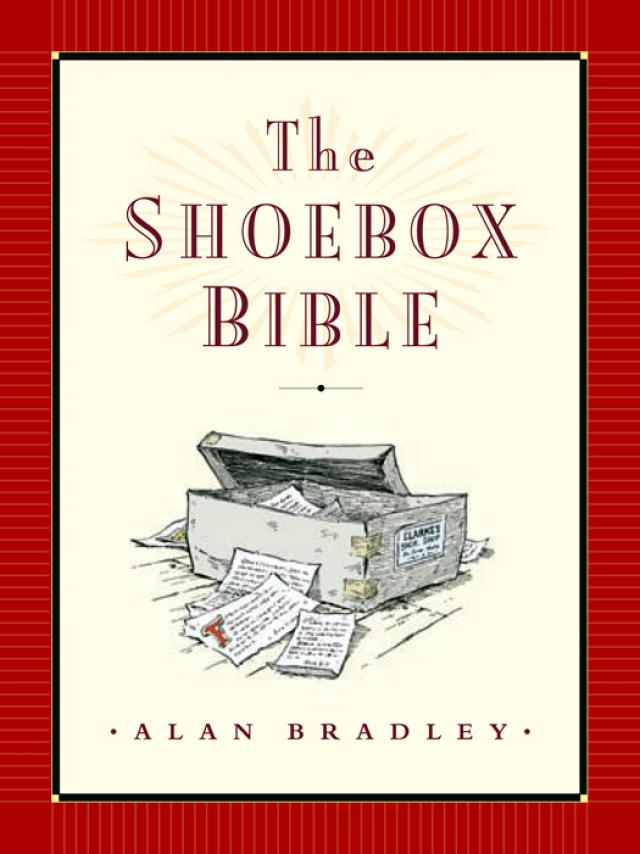
Here at this card table of towers, of drowned children and basket lunches, my mother would sit late into the night. The lid would be off the Shoebox Bible, its contents spread out before her like playing cards, and I would fall asleep at last to the dry rustle of her paper and the endless scratching of my mother’s pen.
Thou art filled with shame for glory: drink thou also, and let thy foreskin be uncovered: the cup of the LORD’s right hand shall be turned unto thee, and shameful spewing shall be on thy glory.
Habakkuk 2:13–16
These words are inked on the back of a seven-and-a-quarter by four-inch cardboard divider – one of a series – from inside a box of Nabisco Shredded Wheat. On its face, printed in blue ink, is a small flattened house that, if you colour it with wax crayons, then cut out, fold, and paste its tabs correctly, will result in number five of twenty-eight in Nabisco’s Toytown series: the Vine-Covered Cottage.
It wasn’t that my father was a bad man, my mother later told me, but that he was weak and quick to fall under the influence of the wrong sorts of people. Whenever he was led to drink, it was as though he had been seized by and shaken in the jaws of some great beast. His real tragedy, she said, was the fatal facility with which he made new friends. He was too nice: that was his problem. The magnetic pull of the beverage room with its rowdy, hectic, hilarious company became stronger than the pull of a quiet wife and family. He was like a sparrow in a whirlwind, my mother said, blown this way and that, and we should pray for him. While my sisters and I were at Sunday school singing Hymn Number 727: “God sees the little sparrow fall, It meets his tender view …,” she sat at home appending these words to the Shoebox Bible:
And the light of a candle shall shine no more at all in thee; and the voice of the bridegroom and of the bride shall be heard no more at all in thee …
Revelation 18:23
This surely was her low point. It is written on an oblong grey slab of cardboard, scissored from the lid of a discarded jigsaw puzzle: one from which too many pieces had been lost for it to have been put together again. On the backside of it, mallard ducks, male and female, land and take flight from an impossibly frosty blue winter pond, its trees all encased in icy crystal, their branches sagging cruelly beneath the burden of the snow.
Christmas morning, we awaken to a freezing house. The coal furnace has gone out again in the night, and the wind has swung round to the east, piling deep snowdrifts against our front door and halfway up the windows. Our breath dances, then vanishes before our eyes like little ghosts.
When I scratch away an arc of frost from the windowpane with my thumbnail and press my eye to the glass, I can see that, like the trees in the jigsaw puzzle, the bushes outside are crouch-backed with snow, as if the wicked Richard III were hunched in his cape of ermine, listening beneath our window.
But my sisters and I each have, in the toe of our stockings, an orange from Santa. These rare and golden treats are brighter, warmer than the winter sun, and we sniff them, roll them between our hands, peel them at last, and gobble them down before breakfast.
Oranges come from Spain, my older sister says, and I wonder aloud how Santa managed to get them round the globe.
“There is no Santa,” she whispers, so that my mother, in the kitchen, will not hear her. “Santa is for morons.”
“God wouldn’t allow there to be no Santa,” I tell her.
“There is no God either,” my other sister says, smiling.
“Yes there is,” I tell her, dead sure of myself. “God makes the sun rise and set. God makes rainbows. God makes it snow.”
“The more fool you,” my older sister says. This is one of her favourite phrases. “The rising and setting of the sun is controlled by a man in Finland who lives in an immense glass jar so as to have a decent view of the weather. He has a row of levers like the signalman at the railway station. Each one is labelled: Sunrise, Sunset, Snow, Rain, Rainbow, Fog, and so forth. His name is Mr. Rutherford.”
Unfazed, Father Christmas marches on.
This, in soft lead pencil, is written on a festive paper napkin, upon which, hanging from a single branch, are printed three green leaves of mistletoe and three blood-red berries.
A small red stain – tomato juice – on the corner of this napkin fills me with ineffable sadness when I take it out of the shoebox, hold it in my hands, and realize that this frail tissue is all that now remains of a Christmas dinner prepared by my mother, a Christmas dinner that we sat down to and ate together so many, many years ago:
I will open my mouth in a parable: I will utter dark sayings of old:
Which we have heard and known, and our fathers have told us.
Psalms 78:2–3
And the merchants of the earth shall weep and mourn over her; for no man buyeth their merchandise any more:
The merchandise of gold, and silver, and precious stones, and of pearls, and fine linen, and purple, and silk, and scarlet, and all thyine wood, and all manner vessels of ivory, and all manner vessels of most precious wood, and of brass, and iron, and marble,
And cinnamon, and odours, and ointments, and frankincense, and wine, and oil, and fine flour, and wheat, and beasts, and sheep, and horses, and chariots, and slaves, and souls of men.
And the fruits that thy soul lusted after are departed from thee, and all things which were dainty and goodly are departed from thee, and thou shalt find them no more at all.
No more at all.
How hopeless and full of desolation are those words of St. John, and how my heart sinks when I read them. They stir up a sadness in me even now, after all these years, when I think of my mother, bundled in a sweater against the cold, looking for comfort but finding instead those words that seem to have been written just for her:
The merchants of these things, which were made rich by her, shall stand afar off for the fear of her torment, weeping and wailing,
And saying, Alas, alas that great city, that was clothed in fine linen, and purple, and scarlet, and decked with gold, and precious stones, and pearls!
For in one hour so great riches is come to nought. And every shipmaster, and all the company in ships, and sailors, and as many as trade by sea, stood afar off,
And cried when they saw the smoke of her burning, saying, What city is like unto this great city!
And they cast dust on their heads, and cried, weeping and wailing, saying, Alas, alas that great city, wherein were made rich all that had ships in the sea by reason of her costliness! for in one hour is she made desolate.
Revelation 18:11–19
From that time onward, until the end of her life, I never again heard my mother’s laugh. Not that she was gloomy, because she wasn’t; not that she never smiled, because she did. But something had gone out of her: something living, some thing that had flown away. She had become like a castle with an empty room: a room that no one ever mentioned; a room that no one ever inquired about, not even politely.
When my sisters were small, my mother taught Sunday school, and I like to imagine it was there – in that lovely old high-ceilinged room in the parish hall, a room that, when the morning sun flooded in through the latticed stained-glass diamonds of its leaded casement windows, glowed like an Easter basket, spilling soft tinctured yellows and blues and pinks and mauves across the creamy walls and the black-and-white checkerboard of the floor; a room of clanking steam radiators and the acrid no-nonsense smell of overheated Christian varnish – that she was able to find the time and the place and the silence in which to read the Bible.
On Sunday mornings, we sang:
“When he cometh, when he cometh,
To make up his jewels,
All his jewels, precious jewels,
His loved and his own,
Like the stars of the morning,
His bright crown adorning,
They shall shine in their beauty,
Bright gems for his crown.”
There, in that sun-washed chamber where every inch of paint and panelling was infused with the sounds of a tinkly upright piano and the voices of departed children singing, “All things bright and beautiful, All creatures great and small …,” my mother must have copied out verses from the Song of Solomon, to carry home and transfer into the Shoebox Bible, and I sometimes pictured Jesus picking up the topazes, peridots, and amethysts of coloured light for His collection, tiptoeing so as not to disturb my mother, who, unaware of His presence, sits in the corner writing.