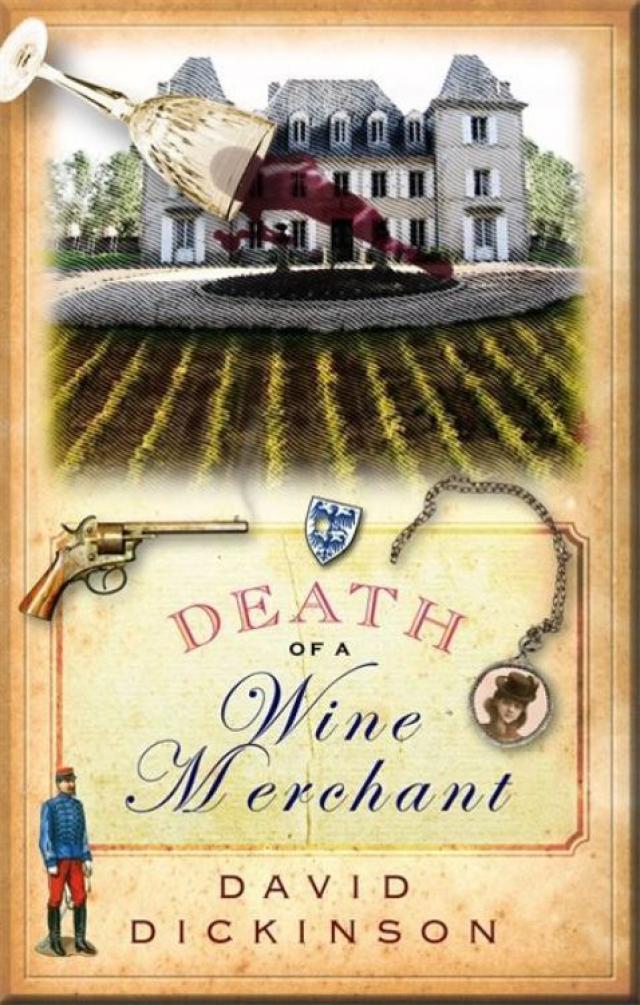
Death of a wine merchant, p.28
Death of a Wine Merchant,
p.28


‘Very good, sir.’ Charlie Healey looked at Pugh as if he were a detachment of hostile cavalry dimly seen in the distance but approaching fast.
‘Can you tell us exactly where you were when you heard the shot, Mr Healey?’
‘I was at the far end of the Long Gallery, trying to get people seated in their proper places, sir.’
‘And with your military experience, you knew immediately that it was gunshot?’
‘I did, sir,’ said Charlie Healey, wondering where this elegantly dressed lawyer was trying to take him.
‘But let us be clear on this point, Mr Healey. You didn’t see the gun, you didn’t see anybody pull the trigger.’
‘I did not, sir.’
‘And at this point, you told my learned friend, you hurried as fast as you could towards the direction of the gunfire.’
‘I did, sir,’ said Charlie, ‘I wanted to make sure there weren’t any more shots.’
‘Quite right, Mr Healey, quite right. Perhaps you could tell the court precisely what you saw when you went into the state bedroom on the far side of the house from the Long Gallery.’
‘Yes, sir,’ said Charlie. ‘It was like a tableau, so it was, everything sort of frozen. Mr Randolph Colville lying on the floor, looking very dead with blood trickling out on to the carpet, and Mr Cosmo locked into the chair opposite with the gun in his hand. I managed to get the gun off him and sent word to the master about what had happened.’
‘I’m sure you behaved very properly, Mr Healey,’ said Pugh, who suspected that a witness like Charlie would make a very good impression on the jury. ‘But could we just be clear on a couple of points? You saw the defendant with the gun in his hand. But you didn’t see him fire it, did you?’
‘No, sir, I did not.’
‘And, to the best of your knowledge, the gun could have been fired by some other person or persons unknown who made good their escape down the stairs in the state bedroom, so convenient as that was the room where the murder was committed. Is that not the case, Mr Healey?’
‘If you put it like that,’ said Charlie defensively, ‘then I suppose it could have happened in that way.’
‘Let me try to sum up your position for the benefit of the gentlemen of the jury, Mr Healey. You didn’t see anybody fire the gun. You didn’t see the defendant fire the gun. A completely different person could have fired the gun and fled down the stairs leaving the defendant to follow the noise of the gunshot and find his brother dead. Is that not so?’
Charlie Healey did not choose to reply.
‘No more questions,’ said Pugh and sat down.
Powerscourt and Lady Lucy were eating lunch in the buffet of the Gare du Nord in Paris. Lady Lucy was looking anxiously at the weather. ‘I do hope we’re not going to have a crossing like the one we had on the way over, Francis.’
‘That’s not possible, my love.’ Powerscourt was making his way through an enormous lamb chop. ‘I’m sure those kinds of storm only happen about once every five years or so.’
‘Johnny Fitzgerald should be back in London by now.’ Lady Lucy was having moules, a growing mountain of empty shells threatening to spill out of the bowl. ‘That should cheer Mr Pugh up at any rate.’
‘I’m not sure that what we’re bringing is a great deal of use,’ said her husband, relapsing into miserable mode. ‘I’m sure he was going to make a lot of the mysterious foreigner going to the wedding anyway. We’ve just managed to put some flesh on the bones for him. We’ve got a name and address.’
‘I’m sure he’ll be able to get Mr Colville acquitted now,’ said Lady Lucy loyally. ‘I’m certain of it.’
Sir Jasper took a long time on his examination of Detective Chief Inspector Weir. This was because of the length of time Weir took thinking about his answers before he spoke. Pugh could feel his irritation rising. His junior kept sending him messages as the afternoon went on. The young man had a remarkable talent for drawing life-like sketches of the people about him. He had already produced a choleric Judge Black with both hands wrapped round an enormous pencil, and the foreman of the jury, one hand to his forehead, lines of worry etched across his face.
When Sir Jasper had finally finished with the policeman, Pugh rose to his feet with a broad smile on his face. He had just had an idea and there wasn’t time to bounce it past his junior, unusually mature in his judgements for one of his age.
‘Tell me, Detective Chief Inspector, how long is it now before your retirement?’
Weir also smiled a mighty smile. ‘Why, sir, it’s six weeks and two days now.’
‘And you plan to stay in Norfolk with Mrs Weir?’ Pugh prayed that there was indeed a Mrs Weir and that she was not either bedridden or suffering from a terminal disease. Close inspection of the Detective Chief Inspector seemed to indicate an officer who was well looked after, beautifully ironed shirt, trousers pressed to perfection. ‘A little cottage near the coast, perhaps, for the retirement years?’
Weir’s reply showed that Pugh’s guess had been correct. There was a Mrs Weir, thank God, neither confined to bed, nor heading for the coffin.
‘How did you guess, sir?’ said Weir. ‘We’ve bought a place near Blakeney, up on the coast.’
Pugh reckoned he had one more question before Sir Jasper exploded to his left or the judge exploded to his front.
‘And I suppose that the planning of the move and so on takes up a lot of your time, and of course of Mrs Weir’s too.’
‘It does indeed, sir. It’s amazing how much of my time it takes.’ Pugh’s junior suddenly abandoned his pose of bored lethargy interrupted by portraiture and wrote something down at great speed. He waited for the right moment to hand it to his superior.
‘But come, Detective Chief Inspector, we must not waste the court’s time with pleasantries about your retirement, however enjoyable they may be. I would like to ask you, if I may, about the principles you follow in making an arrest.’
‘I’m not quite sure what you mean, sir,’ said Weir, scratching his head and looking perplexed.
‘Well,’ said Pugh airily, ‘some men in your profession concentrate initially on motive. Once they see who might profit from someone else’s death, they concentrate their attention on that person, searching for when and how they might have killed their victim. Others don’t care much about motive, they concentrate on who could have done the murder at the time it was committed and look for motive after that. Does that help, Detective Chief Inspector?’
‘I see what you’re getting at now, sir. I would say I rely on experience. I must have investigated well over fifty murders in my time with the force, so I have. You get a good sense of how they’re done after that.’
‘I see,’ said Pugh, still in charming mode. ‘I would like to remind you of the evidence of Mrs Nash, which I’m sure you know. She told the court there were about forty people wandering about at her daughter’s wedding who were unknown to her, to Mrs Nash that is, not the daughter. Might that not give cause for doubt? Just a little doubt perhaps, but doubt nonetheless as to whether the defendant was the murderer? And Mrs Nash also referred to the three staircases, one in the murder room itself, which could be used to reach the state bedroom where the dead man lay. Do those two facts not make you doubtful about your arrest?’
‘God bless my soul, sir, surely you’re ignoring the most important evidence of all. There sat the defendant with the gun in his hand, the gun used to kill Mr Randolph. There was Mr Randolph lying dead on the floor. Nobody else was reported as going in or out of that room. It was an open and shut case.’
‘So are you just ignoring the facts that might cause you doubt, Detective Chief Inspector?’
‘Certainly not, sir. I’m just relying on experience. When you’re nearly sixty-five, you learn to trust your instincts.’
‘And instinct in this case might prove more powerful than reason?’
‘Not at all, sir. But when you see a dead man on the floor, another man opposite with a gun in his hand which has come from the dead man’s house, then I think that is an open and shut case.’
Pugh felt he wasn’t making much progress with his cross-examination so far. He thought he was losing support with the jury. One or two them, particularly the one in the dark blue waistcoat, were casting hostile glances at him. He did have one weapon to bring into play.
He moved over to the exhibit table and picked up the gun. He brought it back to his place and ran his fingers along the sides.
‘Could we talk about the gun, Detective Chief Inspector? This is not the real gun used in the murder, gentlemen of the jury, but it is the same make and the same size. I do not need to remind you jurymen of the recent advances in the science of fingerprinting, the ability to use one man’s fingerprints to establish whether or not he has been in contact with a particular gun or safe or something similar. We have recently seen, indeed, a conviction for murder here in London based on fingerprint evidence. It is the perfect means of discovering whether a particular individual has handled something like a gun for he would have left fingerprints all over it if he had.’
‘Now then, Detective Chief Inspector, does the Norfolk Constabulary have its own forensic and fingerprinting service?’
‘No, sir, it does not.’ Pugh’s junior thought that Weir was beginning to shrink slowly in front of them. He picked up his pencil and began another sketch.
‘You’re not telling us that your force chooses to ignore fingerprints altogether, are you?’
‘Certainly not,’ said Weir.
‘How, pray, do you manage to avail yourselves of the resource of a fingerprint service when you don’t have one?’
‘We use the Metropolitan Police Force’s fingerprint bureau, sir. We send the stuff down to London when we need to.’
‘So I presume the gun in this case was despatched down to the Met’s fingerprint people?’
‘I’m afraid it was not,’ said Weir, almost whispering now.
‘So what happened to it then?’ Pugh was now holding the gun up for the jury to see.
‘It went to Fakenham,’ Weir muttered as if the mere mention of the word Fakenham was enough to explain everything.
‘Speak up, man, speak up for the court. They can scarcely hear you in the back row of the jury.’ Pugh was booming now, the initiative with him for the first time in the case so far.
‘It went to Fakenham,’ said the policeman again in a slightly louder voice.
‘Fakenham?’ said Pugh. ‘Fakenham? What is so important about Fakenham? Does the place have magic powers, a well that heals the sick perhaps? An East Anglian Lourdes?’
‘There was an accident in the police station at Fakenham.’ Detective Chief Inspector Weir was whispering again.
‘What sort of accident?’ barked Pugh. ‘I do not recall seeing any reports in the newspapers of accidents in the Fakenham police station at this time.’
‘The cleaning woman was new.’ Weir had grown almost inaudible again.
‘And?’ said Pugh, leaning forward to catch the words.
‘Speak up, man, I can hardly hear you.’ The judge too was leaning forward to pick up what Weir was saying.
The policeman looked at Sir Jasper with desperation in his eyes, as if Sir Jasper could save him from this ordeal.
‘She wiped the gun clean, the new cleaning lady,’ Weir said at last. ‘She said later that the gun looked very dirty with all those smudges on it. She said the police deserved a nice clean station when they came to work.’
‘That’s as may be, Detective Chief Inspector, Norfolk policemen going to work in a tidy station.’ Pugh’s junior knew by now that his master had a number of different modes of operation in court: charming, ironic, sarcastic, we’re all men of the world together in this, angry, indignant, on his high horse. Now, here in Court Number Two of the Old Bailey, Richard Napier was certain his master was definitely mounted on his high horse, and pawing the ground.
‘What about the defendant? The man in the dock opposite you, Chief Inspector? Does he not have rights too? More important rights maybe than the absence of dust and the removal of a few smudges in the Fakenham police station? A fingerprint test on that gun could have cleared his name. There could have been other prints from other hands which had also held the weapon and might have pointed it at the defendant’s brother and pulled the trigger. I suggest the Norfolk Constabulary and their auxiliaries have done my client a most serious disservice. He has been deprived of his rights as a citizen and a taxpayer. Do you have anything you wish to say, Detective Chief Inspector?’
‘I’m truly sorry about the cleaning lady,’ said Weir.
Pugh knew that he had to keep hold of the advantage if he could. He suspected that a different tone might work better, for he thought the jury would be with Weir by instinct. The jury did not come from the criminal classes. They did not come from the middle classes. They came from that vast segment of the population in between who worked hard, went to church and hoped their children would have a better life than they had. Such people were predisposed to trust policemen.
‘Gentlemen of the jury, Detective Chief Inspector, I want to put a little hypothesis before you about the conduct of this case.’ Pugh was sounding conciliatory, a friend to all the world. Richard Napier thought his master was definitely up to something. He, Napier, would not have trusted a conciliatory Pugh as far as he could throw him.
‘I put it to you, Detective Chief Inspector, that in these last months of your long career you were more interested in your retirement than in seeing justice done in this case. “It’s amazing how much of my time it takes.” That’s how you described your retirement a few moments ago. Is that not so?’
‘I have always done my duty,’ said the Detective Chief Inspector, falling back on a saying that had served him well in the past.
‘Do you agree, Detective Chief Inspector, that in your younger days you would not have brought this case to court, because there was not sufficient certainty about the evidence? That is a fact, is it not?’
Weir might not have been the brightest boy in the school but he could see very clearly that if he went along with this proposition the whole case would collapse around him.
‘That’s all very interesting, sir. I’m not sure I can keep up with all your clever theories. I repeat what I said just now, sir. I have always done my duty.’
‘No further questions,’ said Pugh.
In the room reserved for witnesses a Mrs Bertha Wilcox was going over her evidence for the twentieth time. She felt she was more nervous than she had been at any time since her wedding day. But she was not called into the witness box that day or the next. Charles Augustus Pugh had snatched a quick look at her during a recess and decided not to call her, even though he had subpoenaed her to come to the Old Bailey in the first place. He thought her demeanour and her occupation were such that the jury would automatically be on her side. On this occasion that did not suit Charles Augustus Pugh. Mrs Wilcox was the cleaning lady from the police station in Fakenham.
21
Charles Augustus Pugh had been looking directly at the jury during most of his encounter with Detective Chief Inspector Weir. He thought he might have won on points, that one or maybe two members of the jury could have been added to the few he thought might vote for an acquittal. His junior, not as experienced at reading juries as Pugh, but no slouch nonetheless, reckoned that three or possibly four were in the acquittal camp. They might, mind you, he told Pugh later that day, be lured back into the conviction team fairly easily.
Pugh was surprised to see Inspector Albert Cooper in the witness box. There was his youth and his youthful appearance for a start. Then there was the fact, as Powerscourt had briefed Pugh before, that Cooper did not think there should have been an arrest at all. He did not think the evidence was strong enough for a conviction. Powerscourt had approached the matter with extreme cynicism.
‘If he doesn’t appear,’ he had told Pugh over lunch at his club in Pall Mall, ‘then it means he’s an honest man. They have failed to nobble him.’
‘They being?’ asked Pugh.
‘His immediate superiors, their immediate superiors, their immediate superiors, the Superintendents and the Commanders and the Chief Constable in person. Not necessarily in that order.’
‘And if he does appear?’ asked Pugh.
‘Some or maybe all those superiors will have got to him. Maybe not to him, maybe to that girl he’s going to marry. His parents, her parents perhaps. Why should Albert throw up such a promising career for a few doubts about an arrest? If every police officer followed his doubts about arresting people then the prisons would be empty and the courthouses all boarded up. God knows how the senior officers in the Norfolk police will do it, but they’ll certainly try.’
Sir Jasper Bentinck found Detective Inspector Cooper a much better witness than his immediate superior. There weren’t the pauses for a start. Cooper brought an air of freshness into the courtroom, of youth and hope. He told the story of the aftermath of the murder very well, not omitting the complaints about his age. Sir Jasper did not bother to ask about any doubts Cooper might have had about an arrest. Pugh was wondering right up to the point where the examination in chief came to an end about whether to cross-examine or not. Of all the witnesses so far, Cooper was making the best impression on the jury. Georgina Nash came from a different world. The Detective Chief Inspector was too old and too slow. This young man, so quick and so bright, was the one for them. Pugh thought one or two of his recent converts to an acquittal vote might have defected back to the other side. Napier had sent him a note suggesting no cross-examination at all.
In the end Pugh couldn’t resist. If Powerscourt’s realpolitik in the Pall Mall club was right, then Cooper might prove a godsend. It was worth a try.
‘Detective Inspector Cooper,’ an emollient, a charming Pugh began. ‘I believe you have made the acquaintance of a colleague of mine, Lord Francis Powerscourt, who has been investigating this case?’
‘I have indeed,’ said Cooper, smiling back at the defence barrister.