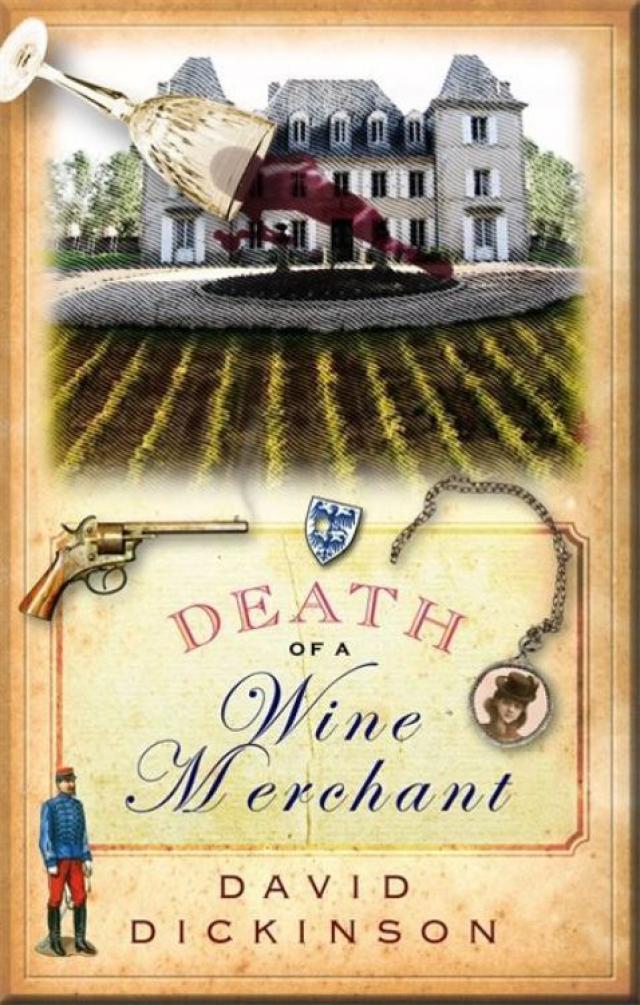
Death of a wine merchant, p.32
Death of a Wine Merchant,
p.32


The barrister from Gray’s Inn carried on. He was on the second piece of evidence from Beaune now where Madame Yvette Planchon told of the stolen kiss, the unexpected arrival of her husband the sergeant, his threat to kill Randolph Colville and his disappearance from the scene.
Powerscourt was staring at the shorthand writers at the table below the judge. They, unlike everybody else in Court Two, had remained impassive as the new evidence was disclosed. Perhaps they had heard it all before. Powerscourt’s mind was racing. Yet another interpretation of events at Brympton Hall had just flashed through his brain. He picked up his pen and wrote a very brief message. He folded it carefully twice and wrote Pugh on the front. As his colleague made his way through the letter that had arrived from Beaune that morning with the astonishing news that the Colvilles in England knew about the other Colville wife in France, he leant forward and slipped it into the hand of Richard Napier, leaning back from his bench. Lady Lucy, sitting beside her husband with Cosmo’s solicitor on her other side, looked at him expectantly. Powerscourt spoke not a word.
Pugh had finished. He placed the three documents on the exhibit table where the gun was still lying as it had throughout the trial.
‘Call Mrs Colville, Mrs Cosmo Colville.’ Napier slipped the note into his hand. Pugh read it while the new witness made her way to the box. He squashed it up and put it in his pocket, then he turned and glanced enigmatically at Powerscourt.
‘Mrs Colville,’ he began, ‘Would you say that you were a close family?’
‘Yes,’ she said, ‘we always have been.’
‘So perhaps you could tell the court, Mrs Colville, when you first became aware that your brother-in-law was a bigamist with a second wife in France?’
She blushed deeply. She seemed to find it difficult to give an answer. She began folding and refolding her hands. Powerscourt thought that had she been Lady Macbeth she would have been washing those hands by now.
‘Come, Mrs Colville,’ said Pugh in his politest tones, ‘I’m sure you can give us an answer.’
‘It must have been fairly close to the wedding,’ she said finally.
‘And did all the Colvilles attend the meeting?’
‘No,’ she was whispering now, ‘the first meeting was just the two brothers, Randolph and Cosmo, and their wives. We told the others in the days that followed. Everybody in the family knew by the time of the wedding.’
‘I wouldn’t want the intimate details of what was said at that first meeting, Mrs Colville, but perhaps you could just give us the broad picture.’ The more intelligent members of the jury realized that intimate details were exactly what Charles Augustus Pugh did want but knew he wouldn’t get if he asked for them directly.
Mrs Colville was now looking very distressed indeed. Only when Powerscourt turned round almost one hundred and eighty degrees did he see part of the reason. Cosmo Colville had hardly moved a muscle during the trial so far. But now he was sitting directly opposite his wife, he, Cosmo, in the dock, she in the witness box. The eye-lines of the court had been constructed for precisely this purpose. Before the arrival of gas lighting a mirrored reflector was placed above the prisoner in the dock to reflect light from the windows on to the faces of the accused. This, Pugh had told Powerscourt years before, allowed the court to examine the facial expressions of the prisoners during testimony. Cosmo was now bent forward in the dock, his hands leaning on the little wooden wall and making gestures to his wife on the other side of Court Two. These gestures seemed to be causing considerable distress. Powerscourt wondered how long it would be before the judge noticed them.
‘Mrs Colville,’ Pugh said in his mildest tones, ‘I can appreciate how distressing this must be for you, but I would remind you that you are under oath in a court of law. Could you please answer my question?’
Out of the corner of his eye Powerscourt saw that the dumb show in the dock was continuing. Cosmo might have chosen not to give evidence but he was trying his hardest to influence the court by other means.
‘I’m sorry,’ said Mrs Colville, ‘everybody was very cross, very angry. People said Randolph had ruined the family name, that Colville Wine would become a laughing stock. The firm might even go out of business.’
The judge had finally caught sight of Cosmo. ‘Prisoner at the bar,’ he said sternly, ‘please stop making signs to your wife. If I see you doing it once more you will be taken below to the holding cells and kept there until the end of this trial. I would remind you that this is a court of law, not some School for Semaphore.’ He turned back to the witness box. ‘Pray continue, Mrs Colville, Mr Pugh.’
‘And what,’ Pugh went on, any note of criticism or reproof removed from his voice, ‘was the reaction of your brother-in-law, Mr Randolph Colville?’
She paused. ‘If anything,’ she said finally, ‘he was the most upset of all of us. He kept saying, over and over and over, that he had destroyed the good name of Colville and ruined the lives of his family.’
‘I see,’ said Pugh, ‘and did that attitude continue when the other members of the family were informed?’
‘If anything, it grew worse,’ Mrs Colville replied, now looking at the jury, now at Pugh. ‘We kept telling him that there was no need for him to attend these terrible meetings. He could have gone for a walk or kept to his room. But he wouldn’t have it. He felt he owed it to all his relations to be there in person to be attacked and humiliated.’
‘Terrible meetings, you said, Mrs Colville?’
‘Well, there was a lot of shouting. One of the uncles said Randolph deserved a horse whipping.’
Powerscourt could see where Pugh was heading. Any minute now, he said to himself, he’s going to mention the S word. Or maybe he’ll try to bring Mrs Colville to say it.
‘And had Randolph’s attitude changed at all by the time of the wedding, Mrs Colville?’
‘I’m afraid not,’ she replied, ‘if anything it got worse.’
Now, Powerscourt thought, surely he must say it now.
‘Mrs Colville, would you agree with me that your brother-in-law Mr Randolph Colville was weighed down by his circumstances?’
‘Yes, I would.’
‘And would you agree with me that he found it hard to see a way out of his predicament?’
‘I don’t think he could see any way out at all.’
‘And over the ten days or so between the bigamy information reaching England and the wedding itself, did his mood improve at all?’
‘No, it didn’t. If anything it got worse.’
‘In view of what we know now, Mrs Colville, what is your view about Mr Randolph Colville’s conduct?’
Mrs Colville paused. She looked up at the dock where her husband was watching carefully. ‘I’m afraid to say, Mr Pugh, I think now as I thought then that it all got too much for the poor man. The shame and the disgrace drove him to suicide.’
Pugh was quick to reply. ‘Suicide, Mrs Colville? Are you sure?’
The word was out now. Suicide in shorthand was entered in a dozen reporter’s notebooks.
‘Yes, I am,’ she said. ‘Watching him through those ten days there was a very strong sense that he thought his options had run out, that he had come to the end of the road. So, yes, I think it is possible, indeed probable, that he committed suicide.’
Powerscourt had been watching Mrs Cosmo Colville intently for the last few minutes. He could have sworn that for a split second after the mention of suicide her face lit up with happiness. Then her surroundings pulled her back to the normal pose of conventional regret. If Randolph had indeed committed suicide, and the jury believed that, then her husband would be a free man, able to leave the gaunt surroundings of Pentonville for the delights of St John’s Wood and Lord’s Cricket Ground.
‘No further questions, my lord,’ said Pugh, consulting his notes and giving the jury time to take in Mrs Colville’s evidence.
‘Please call Mrs Randolph Colville,’ said Pugh. Almost a hundred pairs of eyes followed Hermione Colville on her long journey towards the witness box.
‘Mrs Colville,’ Pugh began, ‘we have heard from your sister-in-law about the mental condition of your late husband in the days before his death. Would you agree with her about his state of mind?’
Mrs Randolph Colville glanced quickly over to Sir Jasper. ‘I would agree,’ she said.
‘And would you agree with her that it is possible he committed suicide?’
‘I would, yes,’ she said.
‘Did he mention it in conversation, that he might take his own life?’
‘I’m afraid there was no conversation in those days. We were not speaking to each other.’
‘And was that,’ said Pugh, taking a small sip of water, ‘because he wasn’t speaking to you or because you weren’t speaking to him?’
‘I’m sorry to say I wasn’t speaking to him. I was so angry. The last words we exchanged were a discussion about who should walk the dogs the evening before that letter arrived.’
‘Perhaps you could tell us, Mrs Colville, about your own state of mind in the period following the arrival of the letter from France?’
She stopped and looked up at the prisoner in the dock.
‘Some of the time,’ she said, ‘I was out of my mind with rage. I was angry with Randolph, so angry that I could scarcely look at him. He’d betrayed us all. I was angry at that French whore. But I knew I had to reorder my life. There was no point in being angry all the time.’
Charles Augustus Pugh took a deep breath. Now or never. Cry havoc and let slip the dogs of war.
‘Mrs Colville,’ he said, ‘I want to put a proposition to you if I may. We have heard from your sister and from yourself this morning about the possibility of suicide, that Randolph Colville took his own life. It certainly seems to fit some of the available evidence. If the jury were to believe it they would have to acquit the defendant. It would be in both your interests, an acquittal. Your sister-in-law would regain her husband. You would regain your brother-in-law. Mr Cosmo Colville would presumably regain his voice as well as his freedom. Is that not the case, Mrs Colville?’
‘I suppose it is, yes.’
Pugh paused and picked up a piece of stiff cardboard from the table of exhibits. ‘But I want to put to you, Mrs Colville, a rather different sequence of events.’
Mrs Colville looked yet again at Cosmo Colville. There was a desperate pleading in her eyes. There was no signal in reply. Everyone had gone completely silent in court. The eyes of judge, jury, pressmen, spectators were fixed on the slim figure in the witness box whose last conversation with her dead husband had been about who should walk the dogs.
‘I put it to you, Mrs Colville, that on the morning of the wedding, you were indeed out of your mind with rage. Your husband had betrayed you. It wasn’t as if he betrayed you with some compliant mistress hidden away in the Home Counties. Randolph had betrayed you with another woman in another country. Not only had he betrayed you, he had actually married this other woman in Beaune. You were left, only half a wife. Is that not so?’
‘If you say so.’
‘Your future and that of your family were on the very edge of ruin. Your children would be known for ever after as the children of the bigamist. So, you went to the room in your house where the guns are kept. I have heard accounts of this room, gentlemen of the jury. There are enough firearms in there to equip a small regiment. You picked out the pistol because you knew how it worked. Is that not the case?’
Mrs Colville did not reply. A look that might have been fear flashed across her face.
Pugh paused and took another sip of his water. Lady Lucy was holding her husband’s hand very tightly, her eyes fixed on Hermione Colville. Richard Napier appeared to be making a sketch of the scales of justice that sat on top of the Old Bailey roof.
‘You kept the pistol in your bag all the way on that journey to Norfolk. You attended the wedding. You took a glass of champagne in the Nashes’ garden, Dutch courage amid the flower beds and the broken fountain.
‘I put it to you, Mrs Colville,’ Pugh’s eyes were locked on to the face of the woman in the witness box, ‘that at some time in the half-hour between the end of the service and the wedding breakfast, you carried out a quick reconnaissance of the first floor of Brympton Hall. I presume that you thought the state bedroom was a good distance away from the room where the food was to be served.’
Pugh held out his diagram of the first floor of Brympton Hall for the jury.
‘Gentlemen,’ he said, ‘here is the Long Gallery, looking out over the gardens. Here is the state bedroom round the corner, where the murder took place. Here and here,’ he pointed to the stairs to the garden at the end of the Long Gallery and the other stairs down from the state bedroom, were the entrances and exits open to those who did not want to come up by the Grand Staircase back here.
‘I put it to you, Mrs Colville, that you managed to speak to your husband to lure him up the staircase into the state bedroom. You pulled the pistol out of your bag. You shot him. You dropped the pistol on the ground and rushed out of the house down the staircase in the state bedroom, along the opposite side of the Hall to where the champagne had been served, and back into the house to join the rest of the guests by the main entrance near the main staircase. Aroused by the shot, Cosmo arrives to see what’s going on. He picks up the gun off the floor and sits down on the chair while he works out what to do. There he is found. There he is arrested while you are preparing to eat your wedding breakfast a couple of rooms away. There, Mrs Colville, that’s how it was, isn’t it?’
She was sobbing now. ‘No, that’s not how it was,’ Hermione Colville managed to say, ‘not the last bit anyway.’
‘Tell us about it,’ said Pugh.
‘Cosmo came in just as I was leaving,’ she said, the tears running down her cheeks. ‘I still had the gun in my hand. Cosmo took it. “Give me that,” he said, “and get back down those stairs as fast as you can.”’
There were shouts of ‘No! No! No!’ from the bar of the court.
For the first time since the trial began Mr Justice Black raised his voice. ‘Mrs Colville! Mrs Colville! Please pay attention! You do not have to answer any further questions that might incriminate yourself in any future proceedings. Do you understand?’
Mrs Randolph Colville nodded sadly. Cosmo looked as though he was trying to climb out of the dock into the main body of the court. The warders manhandled him roughly back into his chair. A great sigh ran through the court. Mrs Randolph Colville had collapsed in a chair, watched over by two sturdy policemen. Lady Lucy was trembling. Detective Chief Inspector Weir was striding across the court for a conference with Sir Jasper. The newspapermen were elbowing their way towards the entrance as fast as they could. Some of them muttered to each other that they hadn’t seen such a sensational case this century. Pugh was sitting down, talking quietly with his junior, other barristers and solicitors whispering their congratulations. Powerscourt felt only pity for this poor woman, driven halfway out of her mind by her husband’s crimes.
Emily Colville nudged her mother gently in the ribs. ‘That’s what I told you on the night of the wedding, Mama,’ she whispered. Emily did not see fit to tell her mother that she had known for years about Randolph’s other wife in France. That, after all, was what Tristram had been blackmailing him about.
Georgina Nash leaned over to whisper back. ‘What did you tell me on the night of the wedding, Emily?’
‘Why, Mama, I told you I had seen Mrs Colville, Mrs Randolph Colville, running down the stairs out of the state bedroom after the shot. Where the murder was.’
Georgina Nash stared at her daughter. Of course. That was what she had tried to remember about that awful day. That was what she had intended to tell Lord Powerscourt only it had slipped out of her mind. And at some point between the wedding and today, she realized, she had forgotten that she had forgotten. She wondered how much work and trouble and expense might have been avoided if her memory hadn’t let her down. The whole affair began with Emily’s wedding. It was ending now with Emily telling her that she had seen the murderer leaving the scene of the crime. Should she tell Lord Powerscourt? There didn’t seem much point now. It was over.
Pugh leant back and whispered to Powerscourt and Lady Lucy: ‘I wonder if some sharp solicitor advised her on how to tell her story. You see, if she goes on with the line of being out of her mind with anger and grief, it could go well for her. Her counsel could argue that she didn’t know what she was doing, that she was suffering from a kind of temporary insanity. I don’t think it would get her off, but they wouldn’t hang her.’
Sir Jasper Bentinck was rising to his feet now. ‘My lord,’ he began, speaking loudly to rise above the noise in court, ‘I have just been having a conference with Detective Chief Inspector Weir of the Norfolk Constabulary. I have to inform your lordship that in the light of recent events the Crown no longer believes in the case against the defendant Mr Colville.’
The judge beckoned Pugh and Sir Jasper over to his position for a brief conversation. Then he banged his gavel very firmly on his desk.
‘Gentlemen of the jury, you have heard what Sir Jasper has just told us, that the Crown have lost faith in their case. That means they do not believe Mr Colville is guilty. But even in these circumstances, the law must have a verdict. Mr Cosmo Colville has been on trial here on the most serious charge a man may face in an English court, that of murder. The Crown no longer believe Mr Colville to be guilty. But he must be seen to be Not Guilty. That is why I am going to send you out now to consider your verdict. Only you can put Mr Colville back into society as an innocent man. I recommend most strongly that you give your verdict in favour of the defence, a verdict of Not Guilty.’
The judge nodded at the foreman, who led the jury out. He stared at the spectators and the remaining newspapermen, as if daring them to speak. Pugh was taking sips of his water, holding a whispered conversation with his junior who sent Powerscourt a note.
‘Can’t stop for drink afterwards. New case.’
‘Markham Square, six o’clock,’ Powerscourt replied. ‘We’ll contact everybody.’