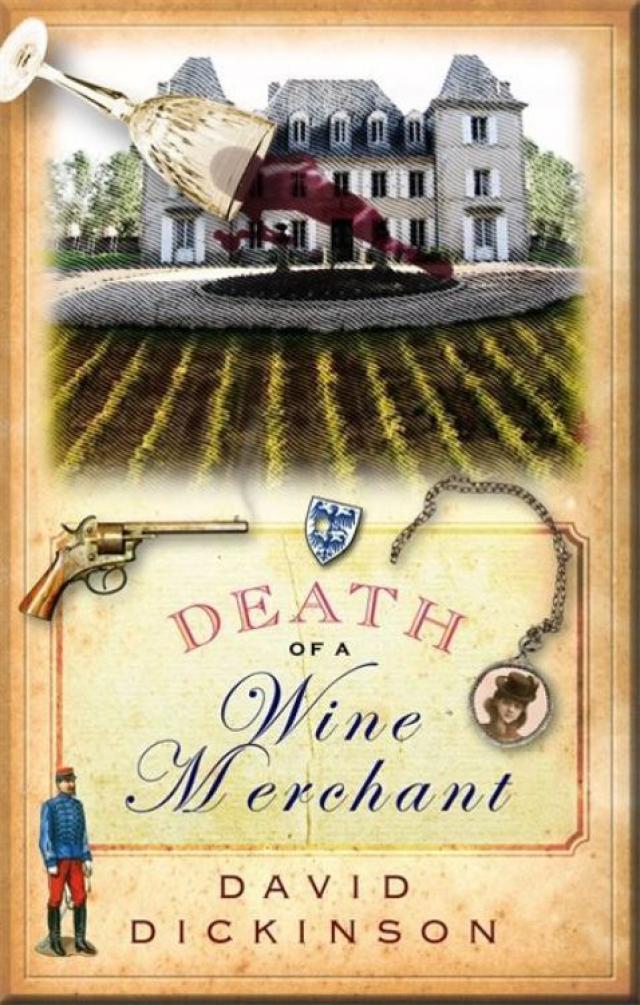
Death of a wine merchant, p.31
Death of a Wine Merchant,
p.31


‘Battalions, gentlemen, battalions,’ said the judge grimly and read the final piece of evidence from Beaune.
‘There is a precedent, my lord, for documents arriving late being admitted as evidence. Regina versus Spick, my lord, 1897. Late financial information from America was accepted by Mr Justice Williams in that case.’ Pugh did not bother to point out that his young assistant had discovered five other cases where the late evidence had not been admitted before tumbling on Spick at a quarter to two in the morning.
The judge muttered to himself as if precedents were not going to hold much weight with him. ‘Mr Pugh,’ Mr Justice Black laid his glasses on a pile of papers on his desk, the one concealing the wine catalogue, ‘what can you tell us about the provenance of these documents?’
‘Well,’ said Pugh, ‘the defence has been fortunate to have at its disposal a private investigator who went to Burgundy, discovered the other wife and tried to give their testimony such legitimacy as he could. You will note that the first two are signed in the presence of a French lawyer and the Mayor of Beaune? And there is the marriage certificate, of course.’
‘Did you say private investigator?’ asked the judge. He made it sound like the lowest forms of rat catcher.
‘I did, my lord, he is a most distinguished man in his field, called Powerscourt.’
‘Powerscourt, did you say, Mr Pugh? Lord Francis Powerscourt?’ asked Sir Jasper.
‘The same, Sir Jasper. He is without, if you would like to question him.’
‘Forgive me, Mr Pugh,’ said the judge, ‘I should like to hear from Sir Jasper about the attitude of the prosecution to these documents. I have to say I regard it as most irregular. There are no witnesses. The proper course would be for me to adjourn the trial for forty-eight hours and send a reliable man over to Burgundy who can confirm that these statements are reliable. Or I could throw them out altogether. Sir Jasper?’
‘My lord, my initial reaction is one of suspicion. These documents could all be forgeries after all. I see that the note from Lord Rosebery vouchsafes the veracity of the translations but not the veracity of the documents themselves. Where are the witnesses, my lord? Why are these two ladies not in court to give their evidence? Why is there nobody for me to cross-examine to establish the truth? That, after all, has always been a fundamental right of counsel in English law going back centuries.’
Richard Napier was making a lightning sketch of Sir Jasper now, Bentinck in Full Flow he had decided to call it.
‘I think we can launch a limited investigation into the truth of the documents right here in this court, my lord.’ Sir Jasper was sounding very efficient now, a man rising to the occasion. ‘I believe we have the wife of the defendant and the wife of the victim in the witness room, both of whom took part in family discussions on these matters. I propose to request Detective Chief Inspector Weir here to ask the two ladies if they believe this new material to be true, and if they object to this evidence coming out in court.
‘I must confess an interest here, my lord. I have not had the privilege of meeting Lord Francis Powerscourt in person. But I know many people who have. Indeed I recall our former Prime Minister Lord Salisbury speaking most highly of his integrity and his abilities in my hearing shortly before he died, Lord Salisbury that is, not Lord Powerscourt. Perhaps, my lord, if we could summon him here he might be able to help me.’
‘By all means,’ said Mr Justice Black in cheerful mode at the memory of his winning contract of six spades redoubled in the penultimate rubber. ‘Bring him in when Sir Jasper has finished his conversation with the Chief Inspector.’
Richard Napier went off to find Powerscourt. Pugh suddenly saw that Powerscourt, although he would not be aware of it, might hold the whole case in his hands. If he could convince Sir Jasper that the documents were genuine, then the prosecution would accept them and the judge would have little option but to agree with that decision. If Sir Jasper was not convinced, then there would be no documents and the case would almost certainly be lost.
Another chair was brought forward opposite the judge. Powerscourt bowed to him and shook hands with Sir Jasper.
‘Good of you to join us, Lord Powerscourt,’ Sir Jasper began. ‘I would like to ask you a few questions about these documents if I may.’
‘By all means,’ Powerscourt replied, turning slightly in his chair to face the prosecution counsel.
‘Could I begin by asking what took you to France in the first place? Did you suspect that Randolph Colville might be running a separate establishment over there?’
‘May I say something about the different ways of operating between barristers and judges and private investigators?’ said Powerscourt. ‘You gentlemen here in these august surroundings are dealing with the full majesty of the law. You need facts. You need evidence. You need to be able to cross-examine witnesses to test the truth of their statements. With me it is very different. I went to Burgundy on a hunch, on instinct. It was, admittedly, a hunch of several different parts. Randolph Colville was ambidextrous, totally so. He could play tennis without ever using a backhand. The Colville man in Burgundy disappeared around the time of the murder. He was often asked to England but never came. When representatives of the firm who knew Randolph Colville went to Beaune, he was always away on business. This man in France was also ambidextrous, able to write his name with both hands at the same time. It seemed to me that they might be one and the same person.’
‘Are you telling us,’ Sir Jasper sounded incredulous, ‘that you were not aware of the bigamy factor until you went there?’
‘I was guessing, Sir Jasper. I took a recent photograph from his English wife’s house with me so that the wife and the other woman could confirm his identity.’
‘Let me ask you two related questions, if I may,’ said Sir Jasper. ‘Was it impossible for the two women to come and give evidence? And are you certain this marriage certificate is genuine?’
‘I tried, believe me, Sir Jasper, to persuade one or both of them to come to London. The wife was too upset. She was, after all, married to a man who was married already. Her children, their children, had lost their father and, possibly, their future. She was going to travel as soon as she could to her mother’s house somewhere in the Auvergne. The other lady could not face the shame of telling a court in another country what she had done in her own. And she was waiting for her husband the sergeant to come back. You mention marriage certificates, Sir Jasper. I have brought the one in the possession of the lawyer Antoine Foucard from Givray who witnessed the statements of the two women. His father had been the lawyer responsible for the wedding. His father had been a guest at the reception. When I showed him the photo of Randolph Colville by the Thames he was in no doubt it was Jean Pierre Drouhin. Madame Drouhin was reluctant to let me take her copy away as she thought she would need it in any arguments with the legal gentlemen about the will. The one I have brought is the one from the lawyer’s office. I am certain it is genuine.’
Detective Chief Inspector Weir had found an empty office to talk to the two Mrs Colvilles. He explained that the defence were trying to bring new evidence to bear concerning the bigamous behaviour of Randolph Colville.
‘When did you first hear of this bigamy business?’ asked Weir.
‘I’ll handle this, Hermione,’ said Isabella Colville. ‘We first heard about ten days before the wedding.’
‘But you didn’t see fit to inform the authorities?’ said Weir sternly.
‘No, we didn’t,’ said Isabella, ‘we didn’t think it was any of their business.’
‘I must ask you this, ladies, did you believe it was true, this information about the other wife in France? That there was another Mrs Colville, as it were?’
‘Of course it was true, it is true.’ Isabella Colville sounded indignant. ‘Randolph didn’t deny it, he never said it wasn’t true. He admitted the whole thing, for heaven’s sake.’
‘Could I ask, Lord Powerscourt, if you were operating through a translator in these discussions in Burgundy?’ said Sir Jasper.
‘No, I was not, Sir Jasper. I am fluent in French and my wife Lady Lucy speaks it perfectly. She is, if I could coin a phrase, linguistically ambidextrous between French and English.’
Sir Jasper glanced at his watch. It was now ten past ten, fifty minutes to go before the court re-assembled.
‘One last question, Lord Powerscourt. This is all most irregular. What can you say to convince me that these statements are genuine, that we are not being hoodwinked by a couple of crafty Frenchwomen out to feather their nests in some way or other?’
‘Gentlemen,’ said Powerscourt addressing the judge and Sir Jasper, ‘in my profession, as in yours, you acquire over the years an acute sense of when people are lying to you. I am absolutely convinced that the two women were telling the truth, that their statements are genuine. If you asked me to go into the witness box behind us and swear under oath that they were true I would gladly do so.’
‘Thank you,’ said Sir Jasper, ‘thank you very much.’
‘I must put one other point to you, ladies.’ Weir was well used to being treated as a fool by now. ‘Do you have any objection to this information coming out in court? About the bigamy, I mean.’
Mrs Isabella Colville paused. She knew there were people who suspected that her husband Cosmo was keeping his silence because of some secret, and if those people knew about her brother-in-law’s bigamy, they might assume that the bigamy was the cause of the silence. Would Cosmo want her to admit the bigamy into court proceedings? Would it bring shame on the Colville name? Suddenly she remembered the look on Charles Augustus Pugh’s face and the tone of his voice the previous Friday when she asked him outside the Old Bailey about her husband’s chances. His words were optimistic. His face and his voice were not.
‘It’s the defence that’s asking for it, isn’t it, Detective Chief Inspector?’ Scandal or no scandal, Isabella Colville wanted her husband back. ‘Well, it’s my husband who’s on trial. If his defence team want it, then I think they should have it. Absolutely. No objections here.’
Sir Jasper and the rest of the lawyers listened gravely to the Detective Chief Inspector’s account of his interview.
‘Gentlemen,’ said the judge, ‘I would welcome a brief summary from both of you of your own position. Mr Pugh?’
‘My lord,’ said Pugh, ‘I have very little to say. I believe Lord Powerscourt put the case for the acceptance of the French evidence very clearly. We believe that the signed documents and the marriage certificate are sufficient proof that the women of Givray are telling the truth. We have just heard that the Colville women here are convinced the bigamy is true – the husband never denied it after all – and they have no objections to the matter coming out in court. Of course the defence would like to see the new evidence included. But that is not my decision, my lord. It is for you and Sir Jasper and the defence is most grateful for the way the matter has been handled. I remain in your debt, my lord, for your willingness to look at this late request. We shall, of course, accept your judgement.’
‘Sir Jasper?’
‘I have to say, my lord, that I am torn. On the one hand we have the lack of witnesses, the fact that there is nobody for me to cross-examine. And yet. And yet.’
Sir Jasper was not a dyed-in-the-wool reactionary like some of his colleagues. As a young man, fresh from Oxford at the elegant buildings of Lincoln’s Inn, he had fallen in love with the law. He had lit metaphorical candles in all the temples of the legal system. Those candles had long since gone out, guttered and blackened as his disillusion grew with the passing years. Exaggeration had a lot to with it. The police, he felt, exaggerated their evidence and left out the bits that did not suit their case. The barristers exaggerated their vanity, locked into an adversarial system that confused the force of advocacy with the reality of their cases and the cause of justice. Judges and juries grew confused, cynical of the evidence and the barristers who presented it. Three years ago Sir Jasper himself had been involved in a miscarriage of justice. He had appeared for the prosecution in a case where a man was hanged, only for it to be discovered three weeks later that he was innocent, by which time it was too late. That case had weighed heavily with him ever since.
‘I must say,’ he went on, ‘that I attach great weight to the testimony of Lord Powerscourt. What particularly impressed me was his willingness to put his career and his considerable reputation on the line by going into the witness box. I also attach weight to the marriage certificate for I believe it to be genuine. And we have just heard from Detective Chief Inspector Weir, my lord, that the two Mrs Colvilles, who learnt of the bigamy some ten days before the wedding, are absolutely certain that it is true. And they have no objection to the bigamy evidence being brought into open court. I believe, my lord, that we always have an obligation to maintain the traditions of the law, for without order there is nothing. But we also have an obligation to be fair, to hear all the arguments and all the evidence even when they may have arrived by singularly unorthodox means.’
Sir Jasper paused. Pugh sat perfectly still, looking at his papers. Powerscourt was looking at Sir Jasper. Pugh’s junior had abandoned his sketching for the moment, staring at the prosecution counsel.
‘On balance,’ Sir Jasper concluded, ‘the prosecution has no objection to the admittance of these documents. I leave the matter, my lord, in your capable hands.’
‘Thank you, gentlemen,’ said Mr Justice Black. ‘It is now twenty-five minutes past ten. I suggest the legal teams take an adjournment. If you, Sir Jasper and Mr Pugh, care to return at ten to eleven I shall inform you of my decision. That should give you a little time to prepare for any new circumstances we may find ourselves in.’
The legal teams shuffled out. The jury and the gentlemen of the press were drifting back into court. Pugh and Powerscourt collected Lady Lucy and filled her in on what had happened in the judge’s rooms. They held an impromptu conference on the pavement outside away from the public and the newspapermen.
‘Do you think he’s going to admit it, Powerscourt?’ said Pugh.
‘Yes, I think he will.’
‘Do we run with the mysterious Frenchman? Or the suicide?’
‘Suicide surely,’ said Lady Lucy. ‘He couldn’t take the shame, poor man.’
‘There’s one thing we haven’t realized,’ said Powerscourt. ‘I’ve only just seen it this minute. Sir Jasper may have seemed rather magnanimous in there, but I wonder if he’s just being cunning.’
‘What do you mean?’ asked Pugh.
‘Well,’ said Powerscourt, ‘think about the new evidence. It shows that there was bigamy and that the Colvilles on this side of the water were aware of it. Indeed they had a massive family row about it.’
‘So?’ said Charles Augustus Pugh.
‘Simply this,’ said Powerscourt. ‘The one thing the prosecution case have never had is a reliable motive for Cosmo murdering his brother. Now they have one. The family are desperately keen to preserve the good name of Colville. They do not want the bigamy to be known abroad. Randolph has disgraced the family. Once he is dead the whole story might never get out. Cosmo shoots his brother to preserve the family honour and is just about to make his escape down one of those back stairs. Then the butler steps in. It’s highly unlikely the police would have arrested Cosmo if he hadn’t been found in that unfortunate position. He’d have got away and come in round the front door with the stragglers. Just bad luck he got caught. Remember the police never heard a whisper about the bigamy.’
‘Christ!’ said Pugh. ‘I’ve got to reappear before the judge. I have to say, I have no idea what to do when the court resumes. Send me a note if inspiration strikes you, Powerscourt.’
23
The judge was back in Court Two at exactly eleven o’clock. There was a hum of expectancy round the room. Word had seeped out about the reason for the adjournment. What, people had been asking themselves for the past hour and a half, was this new evidence? Some thought it must relate to some fraud or other outrage in the Colville wine business. Others believed that it had to do with the defendant, that he had a secret history of violent behaviour which had only just been discovered. Most of all, the spectators and the jurymen agreed, they felt they had a right, as free-born Englishmen and ratepayers, to know what the new evidence was. They prayed that the judge was not going to let them down.
Mr Justice Black called the court to order. He coughed lightly and waited until his court was completely still.
‘Gentlemen of the jury,’ he began, ‘an hour and half ago I adjourned this court while we considered whether or not to admit new evidence from the defence. Unusual though the circumstances are, I have decided, after consultations with Sir Jasper Bentinck and Mr Charles Pugh here, to admit the new material. Mr Pugh, perhaps you could read the evidence out to the court so the shorthand writers can enter it into the record.’
Pugh adjusted his glasses and began to read. In each case he mentioned the date and the names of the witnesses at the top. He spoke with no emotion in his voice at all. His tone was neutral, what his junior, who had heard it before, referred to as Pugh’s railway station announcer’s voice. When he revealed the bigamy there was pandemonium in court. One or two of the newspapermen wrote instant news stories and had their runners take them to their offices at full speed. They might just make the lunchtime editions. The society ladies were beside themselves. ‘I’ve never heard of such a thing!’ ‘Fancy leaving a letter like that in your back pocket! Only a man would do that!’ One word ran through the court like a fire in barn of straw: ‘Bigamy, bigamy, bigamy!’
‘Silence! Silence in court!’ Mr Justice Black looked livid, as if one of his famed finesses at the bridge table had failed to come off. ‘Any more noise and I shall clear the court of spectators and newspapermen alike! Mr Pugh.’