Death of a wine merchant, p.7
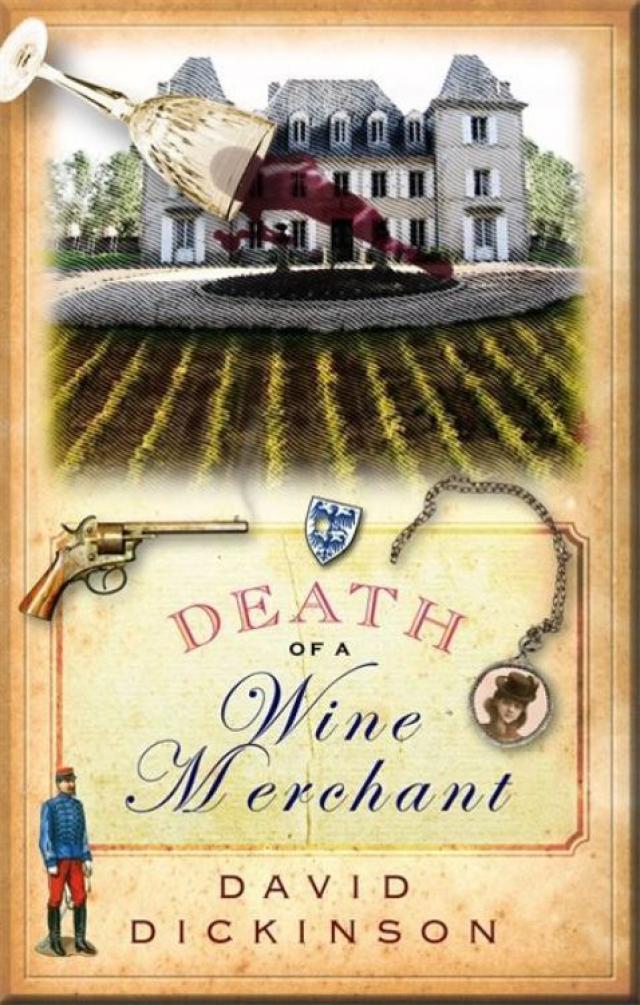
Death of a Wine Merchant,
p.7


Silence reigned in the little room. Powerscourt could hear the guard hopping from foot to foot outside the door. He wondered how much longer he had left.
‘Some of those hanged in Pentonville have killed more than one person,’ Powerscourt tried once more. ‘Let’s take chemist’s assistant Arthur Devereux. He and his wife Beatrice had a little boy and not long after that they had twins. Money was very tight. He wasn’t paid very much, our Arthur, so he decided on drastic measures. He bought a large tin trunk and a bottle of chloroform and morphine, which he persuaded Beatrice to give to the twins and then take herself. He told her it was cough medicine. When they were dead he put them in the trunk and sealed the lid with glue to keep it airtight. He had the trunk sent off to a warehouse in Harrow and moved away with his son to a new address. But he’d reckoned without the mother-in-law. She didn’t believe his story that they’d all gone on holiday. She learnt that a removal company van from Harrow had called at the house. She set off for Harrow where she found the warehouse and the trunk and the three bodies. Devereux was traced to Coventry and tried to persuade the jury at his trial that Beatrice had killed the twins and then committed suicide. He had found them all and panicked, sending them all to the warehouse. He was not believed. His hangman, Henry Pierrepoint, recorded that Devereux stood five feet eleven and weighed eleven stone four. Pierrepoint gave him a drop of six feet six inches.’
Powerscourt wondered if Colville had lost his voice. There was no reply, no response, nothing at all. Cosmo might as well have been a statue. Powerscourt pulled a book out of his pocket and began to read:
‘“He did not wear his scarlet coat,
For blood and wine are red,
And blood and wine were on his hands
When they found him with the dead,
The poor dead woman whom he loved,
And murdered in her bed.”’
‘This is an account of the last days and hours of a man called Charles Thomas Wooldridge, sometime Trooper of the Royal Horse Guards, executed HM Prison, Reading, Berkshire, 7th July 1896.’
Not a muscle moved in Cosmo’s face. Powerscourt read on until he came to the morning of the execution. In the corridor outside a group of prisoners were being escorted to some unknown destination.
‘“At six o’clock we cleaned our cells,
At seven all was still,
But the sough and swing of a mighty wing
The prison seemed to fill,
For the Lord of Death with icy breath
Had entered in to kill.”’
Even the Lord of Death drew no reaction from Cosmo Colville. Powerscourt saw that the prison warder had tiptoed right up to the door and seemed to be listening to the words.
‘“And as one sees most fearful things
In the crystal of a dream,
We saw the greasy hempen rope
Hooked to the blackened beam,
And heard the prayer the hangman’s snare
Strangled into a scream.”’
Still there was no reaction from Cosmo. The man must have a heart like a stone. There was one last passage Powerscourt hoped might draw out some reaction.
‘“The Warders strutted up and down,
And kept their herd of brutes,
Their uniforms were spick and span,
And they wore their Sunday suits,
But we knew the work they had been at,
By the quicklime on their boots.”’
The warder had opened the door a fraction to catch the end of the poem. Powerscourt carried on reading. Far off, deep inside the prison, a man was screaming.
‘“For where a grave had opened wide,
There was no grave at all:
Only a stretch of mud and sand
By the hideous prison-wall,
And a little heap of burning lime,
That the man should have his pall.”’
Powerscourt looked up again into the face of Cosmo Colville. There was nothing there, only a flicker in the eyes that might have been contempt. Cosmo moved his chair back from the table.
‘“For he has a pall, this wretched man,
Such as few men can claim:
Deep down below a prison-yard,
Naked for greater shame, He lies, with
fetters on each foot,
Wrapt in a sheet of flame!”’
Still there was no reaction from Cosmo. Powerscourt could have been reading from the Book of Job for all the impact he was having.
‘“And all the while the burning lime
Eats flesh and bone away,
It eats the brittle bone by night,
And the soft flesh by day,
It eats the flesh and bones by turns,
But it eats the heart alway.”’
‘Do you fancy that, Cosmo?’ Powerscourt asked suddenly. ‘The burning lime? Your soft flesh? Fetters on each foot?’
At last Cosmo Colville spoke for the first and last time between his arrest and his appearance in the Old Bailey. ‘That’s The Ballad of Reading Gaol,’ he said, ‘by Oscar Wilde. I never liked the bugger when he was alive. I like the bugger even less now he’s dead.’ He rose from his chair and opened the door. The last words Powerscourt heard him say were: ‘Can I go back to my cell now, please?’
In his warehouse by the Thames the Alchemist was having a further wine tasting. He slid his special corkscrew down the side of three bottles of red with strange labels. He poured a small amount of liquid into three separate glasses on his table by the window. He tried each one carefully, leaving an interval of a couple of minutes between each tasting. He was humming the Overture from Così Fan Tutte as he worked. The Alchemist had tickets for Mozart’s opera in a couple of days’ time. It had always been one of his favourites. He made notes in his black book. BX LG68 AG15 was the winner of this particular session. Now the Alchemist would have to go to France to supervise the blending of this particular bastard and see that the barrels and the labels were properly French. He would also organize the shipping of the final consignment of phoney claret to its ultimate destination in London. The Alchemist had done this many times before. He still had some more pre-phylloxera wines to create. He hoped he could be back in time for the opera. And, as he contemplated his own cut from this consignment, he thought he might be able to buy a better seat. Maybe he would watch Fiordiligi and Dorabella and their lovers from the luxury of his very own box.
Emily Nash, daughter of Georgina and Willoughby Nash of Brympton Hall, was not a bad person. Certainly in the months leading up to her wedding she had behaved very well. Perhaps it would have been fairer to say she had behaved well most of the time. She may have been too romantic for her own good, Emily. She may have dreamed more often about glittering futures than was good for her. Her imagination may have run on champagne when it would have run better on old-fashioned Indian tea. But her impulses didn’t often win her over completely. Consider the case of her sick grandfather. This elderly gentleman had come to stay in his son’s house and fallen ill. After a couple of days his condition deteriorated and his relatives wondered if he would ever leave Brympton alive. A full-time nurse was hired to help look after him. When she disappeared Emily volunteered to take her place until a replacement could be found. The grandfather’s mind was going. His memory might be sharp in the morning and disappear after lunch. He was losing control of his limbs and his faculties. For a while Emily told herself how brave, how considerate she was being, a junior version of Florence Nightingale in the Fens. Her parents were proud of her when they could drag their attention away from the old man who had come to their house to die. They found little time to praise their daughter who was helping him live through the last days.
The replacement nurse was slow to arrive. Days passed. Emily’s mother helped out when she could but she had other duties to fulfil. Anyway, Georgina Nash reckoned, Emily was doing such a good job she hardly needed any help at all. For some people the mantle of heroine and martyr sits happiest when they are being praised and thanked by all around them. The praise and the thanks seemed to Emily to decrease as time went by. Sometimes her parents didn’t bother to thank her at all. She began to grow resentful, not towards her grandfather but towards her parents. She longed for her nursing days to finish so she could do something dramatic to celebrate her freedom.
The replacement nurse finally arrived. Almost at the same time her friend Tristram called, fresh from his duties as Colville representative in East Anglia. Tristram happened to have brought a number of samples of the firm’s finest with him. Emily longed for her freedom, for a gesture of independence. It came as the sun was setting over the North Sea, lying in a grassy hollow behind the beach, the second bottle of champagne wedged in Tristram’s boot.
Some weeks later she told her mother the results of her gesture of independence. She showed little remorse. If that first nurse hadn’t walked out, and if they hadn’t taken so long to find a replacement, Emily reasoned, then nothing like this would have happened. Georgina Nash thought about the girl’s options. She was deeply shocked but found it hard to be very cross with her daughter. Looking back, they should have taken more trouble to find a replacement nurse for her father-in-law. Secretly she was thrilled at the prospect of a grandchild. It would roll away the years, having a little one in the Hall again, playing hide and seek as the child grew older, Willoughby and the grooms teaching him or her to ride, floating on the lake in a boat in high summer with the dragonflies dancing on the water.
‘I don’t suppose Tristram has offered to marry you,’ Georgina said to her daughter, thinking how very unpleasant it might be to have that young man as an intimate member of her family.
‘He said he wouldn’t,’ said Emily. ‘I mean, I like Tristram well enough, but I’m not sure I’d want to spend the rest of my life with him.’
‘Indeed,’ said her mother firmly. ‘Now, this is what we must do. I am going to put in train a great deal of social organization, dinner parties, dances, balls, everything I can think of. And you, my child, are going to have a whirlwind romance. You have to be bowled over as you have never been bowled over before. Remember always, you need to be at the altar in about six weeks’ time. The young man must have the normal number of arms and legs, that sort of thing. Brains would be an advantage but are not essential. We do not have the time to indulge ourselves with good looks, but don’t turn them down if they come your way. You must do anything, and I mean anything, Emily, to persuade a young man to marry you. And you must do it quickly.’
6
Sir Pericles Freme was clanking as he walked across the Powerscourt hall towards the Powerscourt dining room. Powerscourt himself, speeding down the stairs to meet his guest, thought he sounded rather like the milkman nearing the end of his round. The dining room was on the ground floor, looking out over Markham Square. There was a long Georgian table with elegant candles. The highlight of the room was a full-length portrait of one of Lady Lucy’s ancestors, a general who had served in the American War of Independence. Lady Lucy’s family always maintained that the work was by the hand of Sir Joshua Reynolds and certainly the painting did have something of the swagger and panache of another Reynolds soldier, Colonel Banastre Tarleton, in the National Gallery. Powerscourt had never been sure. Rhys, the Powerscourt butler, was waiting for instructions by the far side of the fireplace.
‘Sir Pericles, how good of you to come,’ said Powerscourt, directing his guest to a chair at the far end of the table. Freme carried out a brief inspection of the general on the wall, nodded as if in posthumous salute, and drew four bottles out of his bag.
‘I changed my modus operandi halfway through this inquiry,’ he began, in the manner of a man telling a friend he has changed his golf swing. ‘That is to say, I decided it might be more illuminating to compare some Colville wines with those of their fellow wine merchants rather than my earlier policy of comparing Colville bottles of today with Colville bottles of earlier years.’
‘Now then,’ Sir Pericles began fiddling about in his bag for a corkscrew, ‘you might think that there is a risk attached to this new policy. How do we know that our other man is a man of probity, that what he calls claret actually is claret? What do you say to that, Powerscourt, eh?’ The old soldier looked sternly at his host.
‘I can only suppose that you are certain that your other claret is the real thing, if you can be certain? Forgive me, Sir Pericles, how many glasses do you think we need? Rhys here can bring them in directly.’
‘Let’s be on the safe side and say a dozen. And could we have some cold water? Now then, this house claret here,’ he pointed to the bottle closest to him, ‘comes from Berry Bros. & Rudd. It is the cheapest blend they sell. I have compared it with the same sort of wine from other reputable and rather expensive merchants and they all taste, more or less, the same.’
There was a loud plop as Sir Pericles opened his two bottles of claret in quick succession. Right on cue, Rhys slipped back into the room with the glasses and the water. Sir Pericles poured a small measure from each bottle into a couple of glasses.
‘Now then,’ he swirled the wine around in his glasses, ‘people talk an awful lot of rot about wine, always have. Imbibo, ergo sum. Shouldn’t be surprised if the bloody Romans hadn’t warbled away in their best Latin about heads and bouquets and such nonsense. Probably picked it up from the Greeks. Dodgy morals, those Greeks, always thought so. But I digress. The thing to do, Powerscourt, is to remember what it tastes like. That’s all. Then have a go at the other chap and see if you think they’re from the same family. That’s all we have to do. For God’s sake don’t talk about fruit.’
Raising his glass to the general on the wall, Sir Pericles took a slug of the Berry Bros. & Rudd glass and swallowed it. Powerscourt was relieved to see he hadn’t spat it out on to the floor. He didn’t think Lucy would have approved. There might not be many domestic implements not present in the Markham Square household, but spittoons, unfortunately on this occasion, were among them. Powerscourt followed suit. The second glass with the Colville wine followed fairly quickly afterwards.
‘Now then, I’m not going to put words into your mouth, Powerscourt, but tell me what you think.’ Sir Pericles began clearing his palate with a glass of water. Powerscourt paused for a moment.
‘Well,’ he said at last, feeling rather nervous, as if his history essay was being marked by the headmaster in person, ‘there’s definitely a difference. The Berry claret is smoother and maybe richer than the other one. The Colville wine tastes a bit rougher, in my opinion. Maybe the grapes were on the wrong side of the hill.’
‘Well done, Powerscourt, I couldn’t have put it better myself. The question we now have to ask ourselves is whether the Colville offering is a claret at all.’ Sir Pericles took another quick glass of water and rummaged again in his bag. ‘Just one more. On the assumption that the Berry claret is the real thing, we can, I think, safely hazard a guess that this other bottle which says it is a claret will also be a claret. Justerini & Brooks, round the corner from Berry’s in St James’s. Let me just pour a couple of glasses of that for us.’
Freme poured two more glasses. Powerscourt suddenly wondered if Johnny Fitzgerald, with his greater experience of quaffing wine in vast quantities, might not have been the better man for this particular job. Sir Pericles and Powerscourt took substantial sips of the latest offering from London’s finest and put their glasses down at virtually the same time.
‘Well?’ said the little man.
‘The same as the Berry one, I should say,’ said Powerscourt, wiping his lips with his handkerchief. ‘I don’t mean it’s exactly the same, but I should say it’s as if they both went to the same school or were taught to sing by the same master.’
‘Capital, we’ll make a connoisseur out of you yet.’ Sir Pericles peered briefly into his bag as if another half-dozen bottles were waiting inside. ‘But you see our difficulty, the general difficulty in the authentication of wines. You and I both think that two of these bottles are claret and the other one probably isn’t. Two other people might take a contrary view. We could pay to have some wine supremos from Bordeaux to give their view on the problem, but they might not agree either. Some of these so-called experts are always reluctant to taste wines blind because they will often get it wrong.’
‘Tell me, Sir Pericles, what do you think the Colville wine actually is? Does it have any claret in there at all?’
‘It’s certainly a blend of something,’ said Sir Pericles, ‘maybe there’s a bit of claret in there somewhere to give it a base. Then there’s probably a whole lot of cheap red from Languedoc and may be a dash of Algerian if it lacks body. The blender will have to change his proportions every year to keep each year’s taste as close as he can to the taste of the year before– even cheap Languedoc isn’t going to be the same in 1908 as it was in 1907. They don’t have a problem with the labels, they put their own on. The stuff is probably cooked up somewhere in the Médoc and shipped from there. It’ll add to the authentic look if the wine has been parcelled up and sent over here by some dodgy shippers or merchants in or near Bordeaux.’
‘Can we prove it? That it’s not proper claret, I mean?’ asked Powerscourt, thinking of Charles Augustus Pugh grilling some unfortunate wine merchant in the Old Bailey.
‘Very difficult. Almost impossible,’ said Sir Pericles, rubbing his hands together cheerfully. ‘For every witness the defence calls to pronounce it a fake, the prosecution will counter with one who says that it is the real thing, maybe the real thing in a bad year, but still the real thing.’