Rambo iii, p.15
Rambo III,
p.15
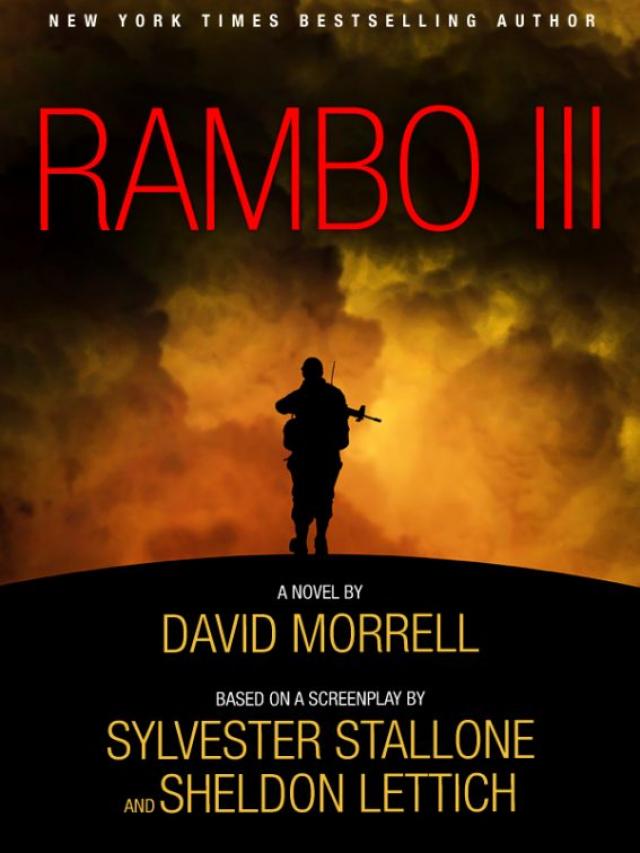


Rambo fired a quick burst from his rifle and hurried Trautman along the parapet.
“Mousa! Andreyev!”
Several bodies lay on the parapet. Rambo rushed with Trautman toward them. Two rebels had been killed by a blast. Mousa rose slowly, dizzily shaking his head. Andreyev tried to stand but fell back. Even in the thick flying sand, flames from the courtyard were bright enough to show the chunk of metal embedded in Andreyev’s chest. A bloodstain spread across the Soviet’s shirt.
“No!” Rambo screamed.
Andreyev fought to sit up. A bullet from the courtyard hit him.
“No!” Rambo pivoted toward the courtyard. “No!” Supporting Trautman, firing one-handed, he strafed the burning area below him. Another charge went off. Another armored personnel carrier exploded. Rambo kept shooting. “No!”
12
Major Azov raised his eyes from the document he typed. His initial intention had been to write a request for reassignment to another command, one as far from the land of the out-of-control as possible. But recalling the acid-bubbled chest of the young boy he’d seen being tortured, Azov had yanked the page from his typewriter and torn it up. He’d hastily inserted another page and furiously begun typing a much different document, one in which he resigned his commission and demanded to be retired from the army. He wanted nothing more to do with war. He wanted to return to the farm country in which he’d been raised, to see things grow instead of people die.
But no matter how much he wanted to flee from the war, the war could not be avoided. It insisted on coming to him. Gunfire startled him. An explosion in the courtyard shattered the window in his second-story room. He shielded his face from flying glass as he fell to the floor. A fireball rose past his window, its glaring brilliance hurting his eyes. A second explosion shook the floor beneath his chest.
He staggered to his feet, heard shots, more explosions, and screams. Before he realized what he was doing, he pulled his pistol from its holster. Jarred by a further explosion, he hurried toward the wall beside his gutted window. The courtyard was in flames. Chunks from devastated jeeps, trucks, and armored personnel carriers lay everywhere. Soldiers fired toward a stairwell in the northeastern corner of the fort, then shifted their aim toward the eastern parapet.
Azov edged toward the window and exposed himself to the minimum, risking furtive glances that lasted no more than a few seconds. The pattern of the fight confused him. It seemed the attack came not from outside the fort, but from within. He didn’t hear the distinctive whistle of mortar shells arcing into the courtyard. Instead the vehicles exploded from underneath, as if charges had been planted under them. Risking another hurried glimpse, he saw figures on the parapet, most of them Afghan civilians, although one man—with blond hair, wearing a uniform—seemed to be a Soviet soldier. The soldier astonished Azov by shooting at the courtyard instead of toward the Afghans.
The concussion from another blast sent Azov reeling backward, but not before he saw an Afghan squirm over the parapet, grip what seemed to be a rope, and slide down, disappearing. Azov recovered from the shock of the nearby explosion and staggered to return to the thick wall beside his window.
Again he glanced out. Another Afghan squirmed over the parapet and slid out of sight. Another followed. Had the soldiers managed to repulse a group of invaders who’d somehow climbed over the walls?
Azov shook his head. That theory didn’t make sense. Invaders would be carrying weapons, but most of the Afghans on the parapet were defenseless. And how to explain the Soviet soldier who fired toward the courtyard?
With force, Azov suddenly did know how to explain every confusing detail he witnessed. The Afghans weren’t invading. They were escaping from the cellblock. The Soviet soldier was helping them.
The sentry box on the northeastern corner of the parapet erupted into flames. The force of the blast knocked three remaining Afghans and the Soviet soldier flat onto the parapet. They attempted to stand, but an explosion farther along the parapet knocked them down again.
The shooting continued. Azov told himself he ought to rush from his room, charge down the stairs, and join the soldiers in the courtyard. It was his responsibility to lead his men. But the furious resignation he’d been typing when the battle began negated his need to obey his training and do his duty.
No! This war isn’t mine!
Two other figures appeared on the parapet. One stumbled. The American prisoner. The man who helped him along the parapet was dressed like an Afghan, but he too seemed American. Despite the density of the wind-driven sand, Azov couldn’t fail to see him. And be impressed. The second American was tall and muscular, magnificent. As his long dark hair blew back in the wind, he crouched beside the three Afghans and the Soviet. One Afghan managed to stand. The Soviet sat up, fell back, sat up again, and jerked his head as if shot in the skull. The American straightened in rage. Holding his rescued compatriot with one arm, he used the other to shoot his automatic weapon toward the courtyard. He shuddered from the recoil, but powerful muscles controlled the arm that held the weapon, scanning the rifle back and forth, strafing soldiers in the courtyard, “No!” the American screamed. “No!” he repeated. “No!” he insisted, outshrieking the wind.
Unaware of what he did, Azov raised his pistol. Surprised at his action, he nonetheless followed through. Responding to discipline and training, he aimed toward the American. From this window, with its clear vantage point toward the American, he had no doubt that he would hit his target. The front and rear sights on his pistol were lined up perfectly, centered on the American’s chest.
From his youth, Azov had been an expert pistol shot. He took pride in having won more championships than any soldier in his regiment. Indeed he held the all-time division record. He felt totally confident in his ability. All he needed to do was gently squeeze the trigger. The colonel would be extremely pleased with him.
Azov slowly lowered his pistol.
Colonel Zaysan can fuck himself.
This isn’t my war! I’m finished with war!
13
The last empty cartridge flipped from Rambo’s rifle and was thrust away by the wind. He set Trautman down, ejected the empty magazine, grabbed a full one taped to the butt of his rifle, and rammed it into the weapon.
Instead of resuming fire, he swung to yell at Mousa, “Get down the rope!”
Mousa aimed a burst from his rifle toward soldiers appearing at the top of the stairwell. As they toppled back, he grabbed the rope, swung over the parapet, and descended.
Rambo fired three quick shots toward more soldiers in the stairwell. He jerked at the rope hand-over-hand in a frenzy, yanked it all the way up, and tied its free end around Trautman’s armpits. As bullets walloped the parapet, he eased Trautman onto the edge of the wall. Bracing his feet, looping the rope around his left shoulder, he grabbed the section of the rope nearest Trautman and swiftly lowered him.
The rope burned sliding across Rambo’s tightly squeezed palms. He didn’t care. Bullets zinged past his head. He didn’t care. All that mattered was Trautman.
Below, outside the fort, an explosion made him wince. No! The rebel prisoners must have lost control. Some of them must have panicked and blown themselves up in the mine field!
“Mousa, tell them no!”
Desperate to set Trautman on the ground, to scurry down, he increased the speed of the rope sliding through his fists.
A bullet nicked his arm. He let the rope slide even faster, felt it go slack, and pivoted to shoot a grenade at the stairwell, to fire a volley at soldiers rushing along the courtyard toward the stairs.
For an instant, he saw a face in a window across from him. An officer lowering a pistol.
Rambo didn’t understand. He slung his M-203 over his shoulder, grabbed the top of the rope, made sure its hook was anchored, and vaulted over the parapet, rappelling with an urgency he’d never before attempted. Stomach swooping, palm burns bleeding, he struck the ground, bent his knees, surged upright, and lunged toward storm-obscured figures in the darkness.
Mousa held Trautman. The remaining Afghans fidgeted, terrified.
“How do we get through the mine field?” Mousa asked. “Without Andreyev—”
Rambo faced the unseen barbed wire, fired his grenade launcher, and saw the blaze with which the barrier disintegrated. He walked forward through smoke and blowing sand, strafing the ground ahead of him. Mines exploded.
Shrapnel flew ahead of him. He grabbed a grenade from a pocket, reloaded his launcher, and fired at the ground he approached. Other mines exploded.
He emptied his rifle’s magazine, reloaded from a full one taped to the opposite side of his rifle butt, strafed the ground again, and continued walking through explosions. More mines exploded. Erupting sand merged with sand blown by the wind and made him feel as if he strode through a heaving sea.
But he kept on, exploded the rest of the barbed-wire barrier, pushed the Afghans so they’d race even harder into the storm, and turned toward Mousa holding Trautman.
“Give him to me.”
“I took Andreyev’s compass from his body,” Mousa said. “Here.”
Rambo hoisted Trautman onto his shoulder. Staring at the illuminated compass, he chose his direction and ran. Trautman’s weight on his shoulder was awkward at the start. But Rambo adjusted his urgent stride, making it smooth, no longer jolting Trautman. He raced harder from the burning fortress. The horses. He needed to get to the horses.
PART EIGHT
THE CAVE
1
The moment the soldier unlocked the cell, Colonel Zaysan shoved ahead of Sergeant Kourov and stumbled out. Except for the pale beam of the soldier’s flashlight, the corridor was dark. Ten minutes ago, after yet another jolting explosion, every light bulb down here had been extinguished. Although he breathed through a handkerchief, Zaysan couldn’t free the sting of tear gas from his nostrils. His eyes were watery, raw, and swollen. His face felt as if he’d been scalded.
His throat and lungs hurt too much for him to question the soldier. But the frenzied battle he’d heard made him grab the soldier’s flashlight and stagger along the corridor as fast as his labored breathing would permit. So many shots and explosions, he thought. The rebels must have attacked in force.
But at once it occurred to him that the man who’d locked the cell had done so before the battle started. Zaysan had caught just a quick glimpse of him through the barred window in the door. The man had worn Afghan clothes, but his fierce startling camouflage-greased face had seemed Caucasian, possibly American. Only after tear gas exploded in the cell and other cells were unlocked along the corridor, prisoners escaping, had the battle begun outside.
Urgent questions insisted. How had the American snuck into the fort? How could a large group of rebels have snuck in with the American and not have been detected?
Followed by Sergeant Kourov and the soldier, Zaysan lurched through rubble at the end of the corridor. His flashlight revealed a dead man as he stumbled up a stairwell. Coughing to clear his lungs of tear gas, he opened the door to the courtyard and faced such unexpectedly dismaying devastation that he almost tottered back. The courtyard was littered with wreckage. Flames gushed from the twisted hulks of trucks, jeeps, and armored personnel carriers. Bodies lay everywhere. Soldiers sprayed fire extinguishers, pulled wounded men from under rubble, scurried to guard the parapets, aimed machine guns toward the fort’s huge solid gate, and searched for other intruders, all the while interfering with each other.
Zaysan lunged through the door and grabbed a lieutenant running past. “Get these men under control.”
Frightened, the lieutenant jerked to attention.
“Those soldiers behind you. Tell them to lower their weapons before they shoot our men on the parapet. Organize a squad to help the doctors. Find the engineers. See to it the generator’s repaired.” The strain on Zaysan’s burned throat made him cough again. He swung toward Sergeant Kourov. “Tell every officer I want a status report as soon as possible.” Zaysan scanned the chaos. “Where’s Major Azov?” Abruptly seeing him near the wreckage of a truck in the middle of the courtyard, Zaysan stalked forward.
Azov struggled to lift a huge chunk of metal from a wounded man.
“How many casualties?” Zaysan demanded.
Azov’s face contorted with effort as he tugged the chunk of metal off the soldier. “Don’t move,” he told the wounded man. “I’ll get a doctor.”
“I asked you a question, Major. How many casualties?”
The wounded man drooled blood. When the soldier quivered and stopped moving. Azov looked disoriented, lost.
“How many casualties, Major Azov?”
Azov’s eyes gained focus. It seemed that only now had he become aware of the colonel’s presence and what was being shouted at him. “Casualties?” He sounded sick. “Twenty men dead.” He shook his head. “At least that I know of. Maybe twice as many wounded.”
Zaysan’s face twitched with shock. “And the rebels? There must have been a small army. How many attacked? How many did we kill?”
“Two Afghans died on the parapet. Another two were killed in the mine field.”
Zaysan gaped. “A force big enough to kill or wound at least forty soldiers, and the enemy loses only four? Impossible!”
“You don’t understand. The Afghans weren’t attacking the fort.”
“What were they doing?”
“Escaping. They were prisoners.”
“We didn’t kill any invader?”
“One. But he wasn’t Afghan.”
“You’re not making sense!”
“One of our soldiers was helping them. A defector. He was killed. Apart from the defector”—Azov gestured toward the confusion of soldiers, wreckage, flames, and bodies around them—“only two men caused all this. An Afghan and an American. The American did most of the damage. I saw him from my window.”
“You saw him?”
“He was standing on the parapet, holding the American prisoner with one hand, strafing the courtyard with the other.”
“Why didn’t you shoot him?”
“Too much was happening. There wasn’t time.”
“You’re the speed-shooting pistol champion of your division, Major. Something’s very wrong here. You’re badly mistaken. A few men didn’t cause this much damage.”
“But—”
“Listen to me! The fort was attacked by at least two hundred rebels. Because of the storm, I prudently ordered more guards to watch the parapets. In spite of my precautions, the rebels managed to reach the fort undetected. Their assault was merciless. But our heroic soldiers rallied, repulsed the attack, and inflicted heavy casualties on the enemy. During their retreat, the rebels carried away their dead and wounded.”
“But that’s not how it happened! It’s not what I saw!”
“You saw almost nothing! A few confused glimpses from your window. Too much was happening—that’s what you told me. There wasn’t time even for you, a speed-shooting pistol champion, to fire at the invaders. That’s how your report will read, or I’ll have you court-martialed for cowardice and dereliction of duty.”
Azov nodded grimly.
“Your fellow officers will submit reports agreeing with yours. You will see to it. A few men couldn’t have caused this much devastation.”
Zaysan didn’t add that, if impossibly a few men had done this much damage, his superiors would demand an explanation. He couldn’t provide one. His career would be ruined. He’d be stuck in this shithole forever, and he did not intend to let that happen. As it was, he’d face accusations enough from his superiors. Only one thing would save him.
“I’ve been too lenient. I’ve relied too much on subordinates. This time, I’ll take charge of the search-and-destroy operation.”
Yes, he thought. Destroy.
“Mobilize the men! I want them ready to attack within the hour!”
“In this storm? You won’t be able to see!”
“The enemy won’t be able to see either! They’ll expect us to stay in the fort! They won’t know we’ve left! I’ll use their tactics against them! I’ll catch them by surprise just as they caught us!”
2
Rambo’s strides became longer, faster. As he ran supporting Trautman’s weight across his shoulder, he worried that he wouldn’t be able to find the hollow in the darkness. He studied the phosphorescent dial of the compass and corrected his direction. Sensing Mousa behind him, he prayed that the men who’d waited in the hollow hadn’t obeyed Mousa’s instructions and left with the horses after an hour elapsed. Although his legs and shoulder ached, although his muscles cramped and blood dripped from his rope-burned palms, he raced harder.
He felt the ground begin to rise. The edge of the valley floor! He’d soon be in the foothills.
But he needed to find the hollow where they’d left the horses. He stopped and waited for Mousa, hoping they weren’t so far apart that they wouldn’t find each other.
A shadow emerged from the storm. It belonged to Mousa,who halted beside him, gasping for breath.
“We know the hollow’s along this slope. But there’s no way to tell if it’s right or left.” Rambo raised his voice to be heard in the wind. “Take the right. Go two thousand paces. If you still haven’t found it, come back this way and join me.”
“But what if you not find hollow either?”
“We head into the mountains on foot.”
“Not get far before soldiers find.”
“They know they can’t see us until the storm ends,” Rambo said.
“Dawn in an hour. Storm easier to see through in daylight.”
“That’ll help us as much as it does the soldiers. Don’t waste time.”