Rambo iii, p.8
Rambo III,
p.8
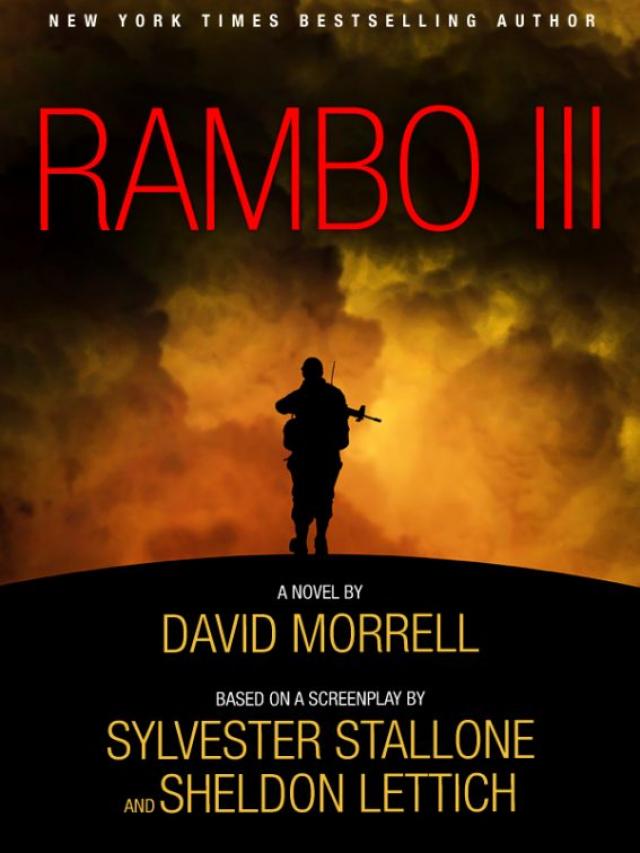


Mousa galloped toward him. “They kill you! Get down!”
But Rambo ignored him, arming the rifle, cramming a tubular grenade into the under-barrel launcher. He squinted toward the village below him as five Afghan men were nearly cut in half by machine-gun fire. On the left side of the village, he saw a young girl rise from cradling a dead woman and run in horror from bullets that kicked up dust, streaking toward her. The girl raced from the ruins of the village, along a path, toward a clump of trees. A gunship followed, diving toward the fleeing girl.
Although the village was a hundred yards below Rambo, the gunships were closer. He steadied his aim by propping his left foot on a rock and resting his left elbow on his bent knee. He peered along the rifle’s barrel, lining up its sights, holding his breath in concentration.
The girl had nearly reached the clump of trees. She glanced back in panic. The gunship sprayed dust-kicking bullets along the path.
Rambo pulled the trigger. The grenade launcher barked. Absorbing its powerful recoil, he didn’t take his eyes off his target.
The projectile pierced the gunship’s nose. Plexiglas shattered. The cockpit exploded a moment before the entire machine split open in a fiery blast. The wreckage hung in the air, then plummeted, chunks of flaming twisted metal cascading over crops. The bulk of the wreckage walloped the ground and exploded again.
Rambo shifted his gaze toward the girl. She sensed where the shot had come from. With a frantic stare toward the ridge on which Rambo stood, she raced again toward the trees.
The slope beneath Rambo heaved from a blast that shocked him off his feet. As he landed hard among rocks, black smoke spewed around him. Another explosion shook the ground. The second gunship had seen its mate destroyed and was roaring toward the ridge. Mousa, who’d galloped toward Rambo and stopped as Rambo fired, wheeled his horse from the smoke and rode to escape yet another explosion that tore a massive hole in the slope just below the ridge.
Mousa’s horse skittered. Mousa fought to control its panic as it sped past the boulders behind which they’d hidden earlier. Abruptly it stumbled, jerked upright, and changed direction. Mousa toppled.
Machine-gun bullets strafed the ridge. Amid thick clouds of dust, Rambo rolled in a frenzy, feeling the ground behind him give way. He felt weightless, then gasped as his back struck a slab of rock. Dazed, he lay at the bottom of a gully, his confusion intensified by a stunning barrage of machine-gun bullets that tore up rock shards along the gully’s rim. Another explosion shuddered the earth. Dust, clouds, and dense black smoke sank over him.
But the second gunship had ceased its barrage. Its whump-whump-whumping roar thundered close as if waiting for the smoke to clear so the crew could study the effectiveness of the attack.
Ears tortured, Rambo reloaded his grenade launcher and squirmed toward the gully’s rim. Smoke and dust were everywhere. The stench of gunpowder stung his nostrils. He stared toward the thunder beyond the smoke and aimed. The smoke thinned. He saw the gunship at the moment its pilot saw him. The gunship was close enough for Rambo to note the pilot’s startled eyes.
Rambo pulled the grenade launcher’s trigger, and this time instead of keeping his gaze on his target, he tumbled protectively back into the gully. The gunship blew apart. Although he couldn’t see the blast, he heard it, felt it. Wreckage streaked over the gully. A twisted rotor blade landed across the gully’s rim. Another explosion and a massive crash followed.
Rambo stood in pain and struggled from the gully. When he’d fired, the gunship had been hovering where the ridge sloped down toward the ruined village. The blast had made it plummet down the slope away from him. When he reached the edge of the ridge, flaming portions of the gunship were still tumbling over rocks toward the stream at the bottom.
He exhaled with angry triumph. His tightly wound muscles suddenly loosened. He trembled with the sickness he always felt after battle, and with an excitement he’d hoped never to feel again, the excitement of having faced death and survived.
Time seemed suspended. At once it began again. He stared toward the smoking rubble of the village. He studied the trees into which the girl had fled. He turned toward where he’d last seen Mousa. During the fight, he’d been only vaguely aware that Mousa had galloped toward him and then away to avoid the second gunship’s attack. He’d heard the horse’s frightened cries.
Now he saw it speeding riderless into the distance. He scanned the terrain in search of Mousa. Past the boulders where they’d hidden earlier, a figure sat up weakly, bending forward, clutching his head.
Rambo spun to find his own horse, to mount it and hurry toward Mousa. But he froze in mid-stride when he saw the animal thirty yards away. It lay on its side. Its intestines protruded from a massive hole in its abdomen. Rambo shot it.
As Mousa tried to stand but fell back onto the ground, Rambo raced toward him.
The Afghan’s usually sallow face was pale.
“Are you hit?” Rambo knelt beside him.
“Dog of a horse. Threw me off.” Mousa clutched his head.
Rambo took off the Afghan’s hat and gingerly inspected the back of his head. He didn’t see blood, but he felt a large lump. “Are you sick to your stomach?”
“No.”
“Look at me. Watch my hand.”
Rambo moved a finger back and forth. Mousa’s eyes followed. “Are you seeing double?”
“No.”
Rambo held up four fingers. “How many?”
“Four.”
“Your thick headgear protected you. You’re lucky it didn’t fall off.”
Mousa started to object.
“Don’t tell me,” Rambo said. “I know what you’re going to say. Allah willed it not to fall off. Everything’s Inshallah.”
Despite his pain, the Afghan smiled.
“Do you think you’ll be all right if I leave you?” Rambo asked. “There might be survivors in the village. I’ve had paramedic training. Maybe I can help them.”
“Go.”
4
In disgust, Rambo searched through the smoldering wreckage of the village. Despite what seemed a hundred lifetimes of combat, he still couldn’t adjust to war’s insanity. Except for a few walls that somehow remained standing, the buildings had been so pulverized it was difficult to imagine that a village had ever been here. Bodies lay everywhere. Some were headless, others limbless. Still others were burned, or blown apart, or eviscerated, or crushed by falling walls. Flies swarmed over wounds and pools of blood. Scavenger birds circled overhead.
He heard a moan and rushed toward a pile of rubble, where he found an old man who’d been shot in the forehead. The old man died as Rambo touched him.
A rock scraped. Rambo swung and saw the top of a tiny head duck below another pile of rubble. He hurried, but when he got there, he was too late to stop a little girl from darting over more rubble and fleeing along the path that led toward the clump of trees outside the village. He assumed this was the same little girl he’d seen from the top of the ridge, and he ran to catch up to her.
“Wait!”
But the little girl raced as if from the devil.
“Stop! I won’t hurt you!”
It was pointless, he knew. She couldn’t understand what he was shouting. But he tried again, hoping she’d sense from his tone what he said.
“Please! Don’t run! I want to help!”
She wouldn’t stop.
As Rambo chased her along the path, he felt a hot breeze rush past his face. He heard a distant rumble, but the sound was not from another black wind or from Soviet gunships. He recognized it from his boyhood on the reservation. Horses. Many horses.
He hesitated. Past the trees, along the foothill of the mountain, dust swirled, quickly approaching. A mass of dark moving figures could be seen inside it. Riders. Afghan horsemen.
From out of the swirling dust, they suddenly appeared, intervening between Rambo and the fleeing girl. Their faces were contorted with rage. They rode in a circle around him, bumping him with their horses, swatting him with whips and ropes.
At once they stopped. The tallest man on the largest horse seemed to be their leader. He glared with hard proud eyes, his bearded face like a photograph in a history book. “Roussi!” he growled.
Rambo didn’t need an interpreter to tell him he was being called a Russian.
“No! I’m American!”
“Roussi!” The leader blurted orders Rambo didn’t understand.
A gun butt slammed the rear of Rambo’s neck. He staggered forward. The circle of horses tightened around him. A rope was thrown around his neck. A horseman grabbed his right arm and looped a rope around his wrist. Another horseman did the same to his left wrist. The riders fastened each rope to a saddle. Rambo’s arms were spread out, painfully taut. The riders pulled in opposite directions.
“No! I’m American! I tried to—!”
The riders kept urging their horses. Rambo felt his arms being pulled from their sockets.
They’ll rip me apart.
With a bellow of pain and fury, he clutched each rope. He tugged back as hard as he could. The horses faltered. He strained to draw his arms back. The riders made a cursing noise and kicked the flanks of their horses.
“I’m here to help!” Rambo screamed. “I’m not a Roussi!”
The Afghan leader spat and gestured forcefully for the riders to gallop away.
Rambo felt the sinews in his arms begin to pop. “No!”
His scream was matched by a shout from someone else, from Mousa who staggered toward the horsemen and mustered strength to yell what sounded like protests.
The horsemen hesitated.
Mousa spoke quickly, urgently, insistently.
The Afghan leader gestured for his men to ease the pressure on the ropes.
“Whatever you’re saying keep saying it,” Rambo told Mousa.
The Afghan leader spoke, and Mousa responded. The Afghan leader gestured toward the wreckage of the helicopters and said something else.
Mousa turned to Rambo. “He not believe you destroy the gunships.”
A small voice made the tribesmen turn their heads. The little girl stood on the path to the trees. Her voice was thin, unsteady from shock. She pointed toward the burning hulks of the gunships and then toward Rambo.
The stony-faced group became silent. They glanced at each other, their skepticism changing to wonderment as the girl continued speaking. With a nod of admiration, the leader gestured again, this time telling the riders to let go of the ropes.
The tension in Rambo’s painfully stretched arms kept them up a moment longer. Slowly they sank to his sides. He freed the ropes and rubbed his raw swollen wrists.
The leader got off his horse and stood face to face with Rambo. The hot wind fluttered the leader’s shirt as he stared so piercingly into Rambo’s eyes that it seemed the leader could read Rambo’s soul. He spoke three words of what sounded like gratitude, put his strong hands on Rambo’s shoulders, and kissed Rambo’s cheeks.
Rambo felt the leader’s stiff beard against his skin and saw what might have been a teardrop in the corner of the leader’s left eye.
The Afghan walked to the little girl, crouched, and embraced her. Sobbing, she held him tightly.
Mousa stood beside Rambo. “His name Khalid. Great warrior. This”—Mousa glanced toward the smoking ruins—“his village.”
“Tell him…” Rambo swallowed. “Tell him I’m sorry.”
“When time is right. The girl’s name Halima. Khalid owe you debt.”
“For shooting down the gunships? What good did it do? I didn’t save the village.”
“You save his daughter’s life.”
Rambo’s chest tightened.
Noises behind him distracted him. The tribesmen had dismounted. Tethering their horses to chunks of rubble, they somberly entered what used to be their village.
“They go now to find the bodies of their loved ones,” Mousa said. “To bury them.”
Following, Rambo heard their stifled moans of grief.
“Where are you going?” Mousa asked.
“To help dig the graves.”
5
They worked as fast as they could. Using chunks of metal they found among the wreckage, Rambo and the tribesmen scraped trenches out of the soil. Because more gunships would be sent to learn why their comrades hadn’t kept in radio contact, there wasn’t time to prepare the bodies for proper burial. And because there weren’t enough tribesmen and horses to transport so many bodies into the foothills where Muslim funeral ceremonies could occur, the Afghans were forced to make do with essentials. Respectfully setting the bodies into the trenches, Rambo and the tribesmen covered them with earth. Green cloths—the color of Islam—were set on the graves. The tribesmen intoned abbreviated prayers for the dead. Although their voices were choked with grief, Mousa explained that their words were joyful.
“Those who die here all martyrs. In paradise now.”
Rambo didn’t repeat his objection to the concept of martyrdom. He thought it, though. Glorify the dead for their sacrifice. Be glad their suffering has ended. But don’t see death as an opportunity. Don’t be eager to die. Make the enemy die.
“Now comes vengeance,” Mousa said.
“That I believe in.”
Khalid signaled the end of the ritual. With mournful eyes, he turned from the grave of his wife, lifted his sobbing daughter, and mounted his horse. The other tribesmen got onto their horses as well. Rambo and Mousa climbed behind two riders and held their waists.
They started into the foothills. The moment they reached the cover of pine trees. Rambo heard the far-off sound of approaching gunships. Just in time, he thought. Another minute, and we’d have been spotted.
6
Trautman jerked as his cell door banged open. His side ached. His back was in agony. His lips were swollen from countless punches, his face a mass of oozing bruises. His eyes hurt the worst. Even when he scrunched them as tightly together as possible, the grid-protected spotlights in the ceiling blazed through his lids and seared his eyes. His retinas felt encrusted with white-hot sand. Sleep. If only I could get some…
Outside the open door, a raspy voice spoke in Russian. “Lieutenant, is he ready to talk?”
An uncertain voice answered, “Colonel, it has been thirty-six hours since he slept. When he starts to doze, we rouse him with this.”
A Klaxon blared so loudly Trautman screamed and grabbed the sides of his head, fearing his eardrums would burst.
The Klaxon blessedly stopped. Bootsteps thumped into the room. Huddled in a corner of his empty cell, Trautman squinted painfully toward the lean ramrod-straight colonel who’d said his name was Zaysan.
Devoid of emotion, the colonel announced, “I wish you to answer questions now.”
Trautman put a hand above his eyes, trying to shield them from the glaring spotlights. Parched, he licked his swollen scab-covered lips.
“You suffer needlessly,” Zaysan said. “A cool drink of water? Answer my questions, and you can drink. Will you confess that your government sent you? Can you tell me where to find the rebel leader Akram Haidar? Why are you here?”
“Why are you here?” Trautman asked.
“Suffer if you wish. I have time.” Zaysan motioned to someone in the corridor. The massive, bare-scalped, cruel-lipped sergeant whose name was Kourov entered.
He grabbed Trautman’s hair and slammed his head against the wall.
The unspeakable began again.
PART FIVE
THE SANCTUARY
1
After the hot bitter wasteland, the cool mountain air smelled sweet, the ground beneath the horses’ hooves soft and loamy. Mounted behind an Afghan rider, Rambo peered ahead past the other horsemen and Khalid toward a trail between boulders. It sloped gently upward to pine trees, whose resin fragrance seemed the greatest pleasure on earth. But within the trees Rambo saw movement and almost called out in warning to the riders until he saw that the running figures were children. They shouted and jumped up and down in eager welcome. Khalid overcame his grief enough to pretend to smile. The children ran beside the horses.
Soon the trees gave way to a clearing rimmed by a semicircular cliff. To the left, a small waterfall formed a pool. Tents filled the clearing, some covered with ragged antiaircraft camouflage netting. Veiled women wearing ankle-length dresses prepared meals over smokeless coals in stone-rimmed pits. Others kneaded bread, mended clothes, and tended to animals. Men sat in groups, drinking tea while cleaning old Enfield rifles. One group watched two teenage boys wrestling. They shouted instructions and encouragement.
As Khalid and his guerrillas rode into the camp, all activity stopped. The villagers crowded around, at first glad to see Khalid and his men, then puzzled by the somber look on their faces, then suspicious about Rambo, the outsider, the infidel.
Dismounting with his daughter, Khalid explained what had happened. A moan of grief swept through the crowd.
Rambo stood in the background.
Mousa approached him.
“Is this their base of operations?” Rambo asked.
“Until Russians find, yes. Khalid decide village too dangerous. He choose this spot and move his people here. But not move all at once. Too many people. Too many things to carry. He leave his wife and daughter at village, not want to show favorites. He come back today to get them.”
Rambo imagined the agony Khalid must be enduring. Khalid’s need to be fair had cost him his wife.
“Soon Russians find this camp,” Mousa said. “Move to another.”
“And another,” Rambo said. “It never ends.”
2
Beyond the tents of the makeshift village, several cave entrances pocked the cliff. Khalid led Rambo and Mousa into a spacious cavern, its shadows deepening as the sun began to set.
The cavern was an infirmary. Sick and wounded lay upon blankets or else on scattered straw or on bloodstained piles of yellowed linen. As at the gun merchant’s shop in Peshawar, Rambo saw crutches and artificial limbs, some carved from wood, others crudely fashioned from metal. On a rock ledge, there were several wooden feet. Kerosene lanterns hung from a rope strung across the cavern’s ceiling and tied to jagged outcrops of stone.