Rambo iii, p.2
Rambo III,
p.2
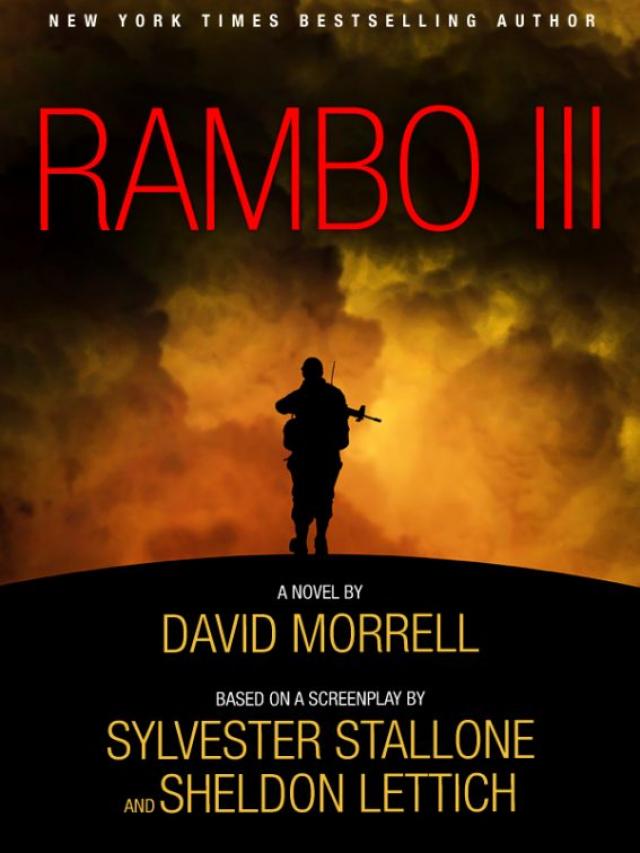


Carolco Pictures had numerous hits: Total Recall, Terminator 2, and Basic Instinct, in addition to the Rambo films. But it also produced films that you might not have heard of: Air America, Mountains of the Moon, and an excellent biography of Charlie Chaplain, starring Robert Downey, Jr., directed by Richard Attenborough. Eventually, the losses exceeded the profits. Carolco’s final picture was Cutthroat Island. A pirate film starring Geena Davis and directed by her then–husband, Renny Harlin, it had a budget of $98 million and box-office returns of only $10 million. In 1995, thirteen years after the theatrical release of First Blood, the studio declared bankruptcy.
In an auction, the rights to make future Rambo films were acquired by Miramax. This amused me. A company known for art films such as The English Patient now owned Rambo. In 1997, I received a phone call from a Miramax producer. After he explained that they were having trouble getting a new Rambo film into development, he asked if I would fly to New York for a meeting to discuss the character. I happily complied. One of the famed Weinstein brothers (I can’t recall whether it was Harvey or Bob) was part of the group I met with, and the reason they were having trouble soon became clear. They misinterpreted the character and thought that Rambo was a mercenary whose gun was for hire. In fact, the opposite is true. As portrayed in the films, Rambo is a reluctant gunfighter who needs a just cause before he would ever agree to go back into action, and he would certainly never do it for a profit motive. In my novel First Blood, his emotions are even more extreme, a combination of anger and hate because of what he discovered about himself.
Miramax asked me to prepare a long document that outlined Rambo’s character. As often happens in the movie world, Miramax’s attention then drifted elsewhere, and around 2005, they sold the film rights to Millennium, the studio that released the fourth film, the title of which, Rambo, can be confusing to people who think that the first film has that title also. Prior to filming, Sylvester Stallone phoned me to say that, in retrospect, he thought that the second and third films glamorized violence and that he planned to return to the character as I imagined Rambo in my novel: angry about his skill for killing, consumed by self-hatred. Throughout much of the fourth film, Rambo keeps washing his hands or else standing in a rainstorm, trying to cleanse himself. In a telling, surprising speech, Rambo at one point says to himself, “Admit it. You didn’t kill for your country. You killed for yourself, and for that, God will never forgive you.”
I’m often asked why I didn’t write a novelization for the fourth film. The answer is that by 2008, when that fourth film was released, the book world had changed drastically. As I explained at the start of this introduction, novelizations became popular because, before DVDs, cable movie channels, and Internet streaming, people who enjoyed popular films such as Star Wars and E.T. didn’t have an easy way to see them after the films ended their theatrical run. To revisit the story, fans needed to read a novelization. But these days, almost every film is readily available for viewing. Because novelizations no longer fill a need, publishers aren’t interested in making them available.
It’s been fun to revisit a book that I wrote so many years ago. While what you’re about to read is based on a screenplay by other writers, I changed, expanded, added to, and interpreted it until the story is very much my own. There are aspects of Rambo here that aren’t dramatized in any of the films. The novelization for Rambo III shows the plot and theme that the film might have had.
AUTHOR’S NOTE
Spoiler alert. If you’re not familiar with my novel First Blood, but you plan to read it, jump ahead to the next section of this book.
Now’s your chance.
Okay. At the end of my novel, Rambo dies. Colonel Trautman kills him with a shotgun. So how on Earth could I resurrect him for the novelizations? I certainly wasn’t going to invent some fake explanation that Trautman hadn’t really killed Rambo, that it had all been an illusion in the dark or else that Rambo had been only superficially wounded.
As I struggled with the inconsistency, I happened to meet my novelist friend, Max Allan Collins, who wrote The Road to Perdition, the Nate Keller series, and several posthumous Mickey Spillane novels.
“David, you look like something’s bothering you.”
After I told Max my problem, he thought a moment and said, “Just acknowledge reality. Put a note at the front that says, ‘In my novel First Blood, Rambo dies. In the films, he lives.’”
Spiritual combat is as brutal as the combat of men; but the vision of justice is the pleasure of God alone.
—Arthur Rimbaud, A Season in Hell
PART ONE
THE ANVIL
1
Life is suffering.
As he meditated upon the first of the Four Truths of Buddha, Rambo gripped the polished bamboo surface of the magnificent ancient bow. He held it low against his left side, closed his eyes, inhaled and exhaled, and attempted to subdue the turmoil in his soul. His muscular torso rippled, his powerful chest and back expanding and contracting. The high-peaked roofs of the Buddhist monastery here in Bangkok, Thailand, disappeared from his mind as they did from his closed eyes. The temple’s ornate golden spires no longer existed, nor did the blaze of sunset reflecting off tile and marble.
But other senses persisted. Wind chimes tinkled. Incense drifted fragrantly up his nostrils. The bow felt terribly solid. Distressed at his inability to shut out every distraction, he opened his eyes and focused his being only on his target.
It was a six-inch square of wood wedged into a thick tight bundle of straw set against a smooth stone wall thirty yards across the courtyard. Rambo stared at the square of wood until it seemed to enlarge and drift toward him, filling his vision. He no longer heard the wind chimes, no longer smelled the incense, no longer felt the bow. The peaks and spires of the monastery, the blazing sunset, the Buddhist monks at their evening prayers, ceased to exist. Only the target existed. And Rambo’s anguished soul.
All life is suffering, the Buddha had taught.
Rambo had learned the lesson well. The complex crisscross of scars on his back and chest, the jagged scar across his right bicep, the scar down his upper left cheekbone, these and so many others—the consequence of bayonets, bullets, knives, barbed wire, flames, and shrapnel—were ample evidence of the Buddha’s truth.
Life is pain.
As he stared at his target, Rambo resuffered Vietnam…the heat, bugs, and leeches of the jungle…the countless firefights…the seemingly endless chaos of screams and explosions, of gunships and tracer bullets, of mortars, mines, and grenades, blood spraying, bodies erupting.
He reendured his capture, his six months of torture, and his agonized escape. But one war was replaced by another.
In America.
That cop! Why wouldn’t he leave me alone? All I wanted was what I’d earned, the freedom to go where I wanted, to do what I wanted, as long as I didn’t bother anybody. Why did he have to push so hard?
But you pushed back even harder, a part of Rambo’s mind told him.
I didn’t have a choice!
At the start you did. You could have done what he wanted. You could have moved on.
Is that why I fought in Nam? To be hassled when I got home? I had rights!
You bet. And you sure taught that cop not to fool with your rights. But the thing is, after you blew his town apart, what rights did you have when they put you in prison? The right to break rocks in a quarry? To feel the walls of your cell closing in on you? If the colonel hadn’t made good on his promise to get you out…
The colonel. Yes. Rambo smiled. The colonel. Trautman, who had trained him, who’d commanded him in Nam, who’d been like a father to him.
The only man Rambo trusted. Because of Trautman’s intervention with the authorities, Rambo had bought back his freedom by agreeing to go back to hell, to return to Vietnam and the prison camp where he’d been tortured, to rescue American soldiers still being held captive. His mission had been successful. Years after the war’s end, he’d finally won it. He’d even been able to defeat another kind of enemy, a representative of the hypocritical system that during the war had sent American soldiers into combat without allowing them the means to win it.
Oh, yes, he’d accomplished his mission.
But at such a cost. Not only to his body. The true damage had been to his spirit, for every time he killed or saw others killed, a part of him had died as well, and God knew he’d suffered many deaths.
One death in particular had nearly destroyed him. Her name—it tormented him to remember—had been Co. A Vietnamese woman in her early thirties, deceptively delicate, exquisitely lovely, she’d been his contact when he’d parachuted back into Nam. She’d helped him rescue the prisoners. She’d even saved his life.
And in the process, she’d taught him what he thought was impossible. To love.
But there hadn’t been time for love. Because Co had been killed.
And Rambo had survived because rage had given him strength. Although dead, she’d once again saved his life.
Grief wracked him with despair. His powerful chest heaved as he stood in the monastery’s courtyard, holding the bow, staring at his target thirty yards away. His meditation had succeeded. The target was all.
With one exception. The leather cord around his neck. The miniature Buddha attached to it.
The medallion had belonged to Co. He’d taken it from her corpse. It pressed like fire against his throat.
2
Suffering is caused by the wish for nonpermanent things. The second truth of Buddha.
Rambo placed a three-foot arrow on his six-foot bow. Obeying the centuries-old ritual by which a Zen archer draws a bow, he stretched his arms straight out before him, keeping them at eye level. His left hand gripped the bow, his right hand the arrow. With equal force from both arms, he slowly pulled his hands in opposite directions, to the left and right, bending the bow, tugging the string, drawing the arrow. Even if he’d used the conventional method of drawing a bow, the one a medicine man had taught him when he was a boy on a Navajo reservation in Arizona, the bow would have been excruciatingly difficult to bend because of the hundred pounds of effort it required. Only someone with Rambo’s extraordinary physique was capable of doing so.
But drawing the bow in the unconventional Zen way made the task more arduous. His arm muscles trembled. Sweat dripped off his forehead.
All living things die, he thought. Everything physical falls apart.
War proved the Buddha’s wisdom. In a world of violence, to seek happiness in a person or object was to doom oneself to disappointment. Because objects exploded, and people got shot.
As Co had been shot.
He exerted his strength to the maximum, straining his arms straight out before him to pull the bow to the left, the arrow to the right. Under normal circumstances, he’d have failed. But the focus of meditation had merged his spirit with his flesh and doubled his capability.
Or perhaps it was the force of his spirit alone. If the Buddha was correct, nothing physical was real, including the bow. Only the spirit was real, bending an imaginary bow.
Shuddering with effort, he parted his arms to the total three-foot length of the arrow. The bow now was curved and, combined with the curve in the string, formed almost a circle. It represented the fullness of being, the totality of God, the wholeness of the One Who was All.
He suspended himself in this agonizing pose. Sweat no longer dripped but poured from his rigid features.
3
Suffering ends when nonlasting things are rejected. The third truth of Buddha.
No object, no person can bring happiness. In a world of violence and pain, of destruction and death, only eternal goals are worth pursuing.
To love Co had doomed him to grieve for her, because if not a year previously, she’d have died hereafter, sometime, eventually, and for every rewarding emotion, an equal and opposite emotion lurked in the future.
But if the Buddha was right…Rambo’s concentration almost failed…if the Buddha was right, there is no future. Only now.
Does that mean that love for someone, even for a second, ought to be grasped and cherished, because that instant lasts forever?
He wanted to scream. His strain in pulling bow and string away from each other had caused the bow to approach his chest. From massive pressure, it trembled before him. With the arrow pointed toward his left, and with his left shoulder in line with the target, all he had to do was turn his head to the left, and his eyes stared down the arrow toward its objective.
4
Seek the eternal. The forever-lasting. God. The fourth truth of Buddha.
But he needed to survive his anguish now!
What do you want?
Peace!
He released the string on the bow. The arrow shot forward with astonishing force. The string thrummed, resonant, vibrant, tuned to the pulse of the universe.
He hadn’t aimed the arrow as much as he’d willed its path. His soul, the bow, the string, and the arrow were caught in a mystical union with the target.
The arrow not only hit but split the target. The sharp whack was overwhelming. As the sections of wood clattered onto the courtyard, their echo ricocheted off walls and slammed against Rambo’s eardrums. His brain seemed pierced. Time lengthened.
Expanded.
Deepened.
Stopped.
The present became forever. Now was eternity.
5
With a heartbeat, time restarted.
Rambo lowered the bow and exhaled slowly, shook his head, flexed his shoulders, and gradually became aware again of his surroundings, of the tiles and marble of the monastery, of the wind chimes and the fragrance of incense. At the opposite end of the courtyard, a huge golden statue of the Buddha reflected the brilliant sunset. The Great Teacher sat with his legs crossed, his hands upon his knees, caught in an attitude of eternal instruction.
Rambo approached it, feeling insignificant compared to the statue’s magnificence. He stopped before it and lowered his head. Although half-Italian (trained to be Catholic) and half-Navajo (encouraged to follow the religion of his tribe), he’d studied the Buddhist religion of a Montagnard guide who’d saved his life and nursed him back to health after an A-team Rambo belonged to had been ambushed in North Vietnam.
The pain isn’t real. It doesn’t exist. Everything except spirit is based on illusion.
In a hellish world, that theory had been attractive. But hell had persisted despite the theory.
What in God’s name do I want? he mentally repeated. His answer was no longer shouted but whispered.
Peace.
He turned from the towering statue of the great golden Buddha and felt transfixed by the stare of a monk across from him. A Thai, the monk had been Rambo’s sponsor when, after his second ordeal in Vietnam, he’d wandered through Bangkok and finally had asked to be allowed to stay in this monastery.
The monk had answered, “My son, forgive me—you’re not one of my countrymen. You can’t understand our ways. What do you claim is your religion?”
“Zen.”
“On what basis?”
“The Buddha…before he became a wise man…was a warrior. I too am a warrior.”
“And?”
“With all my heart, I want to choose wisdom, not war.”
6
Clang!
The bulky hammer struck the slab of red-hot metal. The impact was ear-stunning, high-pitched yet booming. The smoky room reverberated with ringing thunder.
Rambo tightened his right hand on the hammer and struck even harder, tensing his left hand on the tongs he used to press the glowing slab of metal against the ancient anvil.
Clang!
The force of the blow made his body shudder. He slammed the hammer down again.
And again! The anvil rang from the increasing force of his blows. The slab of hot metal gave way beneath his assaults.
It flattened, spread outward, began to assume the shape of a plaque.
The metal was bronze. Days earlier, in another part of this ancient forge, copper and tin had been smelted together, seven parts to one.
A small amount of zinc and manganese had been added. The molten mixture had been poured into forms, where it cooled and hardened into blocks, only to be softened by being reheated and subjected to Rambo’s persistent attacks.
Bronze.
The legendary alloy of antiquity. Strong and resilient. Tough and unbreakable. The substance of swords and shields that outlasted the warriors dependent on them.
Permanent.
As war was permanent.
But so was beauty. The artifacts of antiquity, the bronze medallions and bracelets of humanity’s ancestors, had also survived the ages, had been as everlasting as instruments of war.
They shall beat their swords into plowshares, and their spears into pruninghooks. Nation shall not lift up sword against nation. Neither shall they learn war anymore.
The Bible’s Isaiah had been a dreamer. What nations learned best was how to make war.
But not me! Rambo angrily slammed his hammer against the red-hot slab of bronze. Not anymore!
7
He’d learned his blacksmith’s skill from the same wise man in his mother’s tribe who’d taught him to be an archer.
“Seek discipline and strength,” the old man had said. “Turn thought into motion. Learn to respect a craftsman’s talent, to realize that a task done well seems easy but is terribly difficult. Appearance is deception. That is the lesson of a blacksmith. The objects around you, which look so permanent, are changeable. A horseshoe can be a medallion. A sword can be a plowshare. Only the spirit within the metal remains constant.”