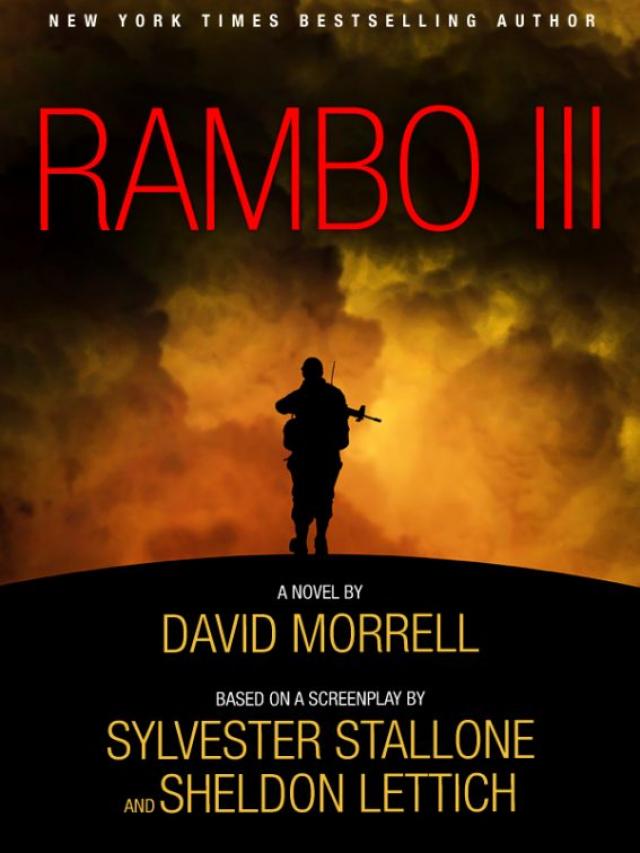
Rambo iii, p.9
Rambo III,
p.9


Khalid led his daughter to a figure kneeling beside an unconscious wounded man. When the figure changed a bandage on the man’s bloody chest and then straightened, Rambo saw a weary sandy-haired woman in her early forties. She wore a dusty khaki shirt and pants. Her features were strong, almost mannish. She lit a cigarette.
With a taut voice, Khalid repeated what he’d told the villagers.
The woman’s eyes narrowed. She responded in a shocked tone and stooped to examine Halima, who looked withdrawn, her eyes fixed on nightmarish memories. A veiled Afghan woman came over to help. Khalid watched with concern as his child’s wounds and bruises were cleansed and treated. He led her toward the side of the cave and tried to subdue his own grief enough to console her.
Cigarette dangling from her mouth, the sandy-haired woman studied Rambo. “American?” Her accent was Dutch.
Rambo nodded.
“Michelle Pillar.” She held out her hand.
“Rambo.” He shook hands with her.
She continued assessing him. “You don’t have a camera. You’re probably not a journalist. You haven’t come to watch the war, take pictures, then leave like the others. Why are you here?”
“I’m looking for someone.”
“Who?” The woman inhaled on her cigarette.
“A friend. Another American. The Soviets captured him.”
“God help him then. Where are they holding him?”
“I hope these people can tell me.”
Khalid spoke suddenly.
“He say you both talk later,” Mousa said.
“Yes, later,” Michelle echoed.
“You come now with him,” Mousa said. “He and villagers say prayers. Then you talk to council.”
3
It was night. Thirty guerrillas sat in a semicircle, their dark eyes reflecting the fire, glaring at Rambo across from them. Khalid sat on the far left. Two chiefs from other tribes had arrived as the council convened. One was a wiry clean-shaven warrior in his late twenties. His name was Rahim, and he seemed to have a reputation equal to Khalid’s. But the other was a bullish angry-looking man in his forties, tall, with a beard that had a silver streak down each side from the ear to the chin. His name was Akram, and he was treated with the respect accorded to a living legend. Akram clearly didn’t like dealing with strangers, especially infidels.
While Akram, Rahim, and Khalid spoke heatedly to each other, Mousa sat behind Rambo and explained. “Akram say you are Russian spy.”
“That doesn’t make sense,” Rambo said. “Would a spy shoot down two of his country’s gunships?”
“Khalid explain that. Akram say Russians not care about human life, not even of fellow Russians. He say Russians do anything to trick and kill us.”
“I also saved Khalid’s daughter. That ought to prove I mean them no harm.”
“Akram say why you not save all village. Khalid say he trust you, owe you. Akram say you KGB. Rahim sit on—how you call it?—fence.”
The three leaders argued while the guerrillas listened.
Mousa explained, “Khalid convince them you not Russian. Not look like Russian, not speak like Russian.”
“Good.”
“But I not think they help.”
The guerrillas turned to Rambo. Mousa spoke rapidly to them, respectfully but emphatically. Rahim interrupted. As he and the other leaders spoke, Mousa translated.
“You claim you are an American. No matter. America is no friend,” Rahim said. “We want help in fighting the war, help from other countries. But this has not happened. We will not help those who do not help us.”
Rambo tried to reply, but Akram stopped him.
“We hear your country help many people. In Afghanistan, no help. We fight for survival. Alone.”
Rambo finally had a chance to speak. “I’m not here because of my government. I came on my own, to find my friend. Besides, America has sent aid. My friend was trying to learn why the supplies my country sent haven’t reached you.”
“Words,” Akram said.
“The weapons I brought aren’t just words.”
Akram sat straighter. “Weapons?”
“Automatic rifles and ammunition,” Rambo said. “And explosives. I brought as many as two packhorses could carry.”
Rahim glanced around. “Where are these packhorses? I don’t see the weapons.”
“The horses died on the way here.”
Akram scoffed. “Words. The rifles are lies.”
“We buried the weapons and marked the spot. They’re a three-hour ride from here,” Rambo said.
“You think you can find this mythical place?” Akram asked.
“No.”
“Of course not. The weapons don’t exist.”
“But I can find them,” Mousa said.
Rahim stroked his clean-shaven chin. “You are sure?”
“If the wind hasn’t buried the marker.”
“If. If you cannot find the weapons, both of you will die,” Akram said.
Khalid had been silent throughout the conversation. At last he spoke. “I trust the American. I believe he did bring weapons. If they cannot be found, it is not his fault. For the life of my daughter, I will not let you kill him.”
“We will wait for tomorrow and see,” Akram said.
“What if the weapons are found?” Rambo asked. “Will you help me find my friend?”
“If the Russians captured your friend, he cannot be saved.”
“I don’t believe that.”
“Many rebels captured. Tortured. Always killed. He cannot be saved.” Akram said.
“I need to try.”
“Then if we do not kill you, the Russians will.”
4
At dawn, after the villagers had finished their prayers, Rambo watched Mousa and three rebels ride from camp leading two unburdened packhorses. One of the rebels belonged to Khalid, the others to Rahim and Akram, who’d wanted witnesses to the search for the weapons.
Look hard, Rambo thought. The colonel’s life depends on you, Mousa. Find those rifles.
He followed the riders down through pine trees, pausing on a bluff, watching them disappear among lower foothills. In the distance, dust clouds skittered across the wasteland.
Turning to his left, he saw a spacious clearing. Ten Afghan warriors played a game in which they each held a lance and took turns charging on horseback toward a three-inch tent peg stuck into the earth.
As Rambo approached the clearing, the Afghans noticed him and galloped faster back and forth, showing off, excitedly trying to spear the peg.
“If they find the rifles, when do you expect them back?”
The voice behind Rambo made him turn. It belonged to Michelle, the sandy-haired Dutch woman he’d met yesterday in the cave infirmary.
“Early afternoon,” Rambo said.
“Don’t blame these people for being suspicious. It’s very hard for them to trust outsiders after what they’ve been through.”
“I just hope—”
“If the weapons were meant to be found, they will be.”
“You’ve been in Afghanistan a long time.”
Michelle raised her eyebrows. “How did you know?”
“‘Meant to be found’? You think like a Muslim,” Rambo said.
“There’s a lot of wisdom in Islamic teachings,” Michelle said. “The concept of destiny helps these people believe there’s a purpose for their suffering.”
Rambo shook his head bitterly. “I can’t accept that. I don’t believe in destiny, and suffering is meaningless.”
“But suffering’s also a fact. It needs to be dealt with.” Michelle pointed toward the infirmary in the cave. “I’m forced to deal with it every day. I couldn’t go on if I didn’t believe their suffering had some meaning.”
“Have you figured out what that meaning is?”
“Not yet.”
“I didn’t think so.”
Rambo glanced back toward the game.
A galloping horseman speared the tent peg, yanking it from the ground. The others cheered.
A few horsemen turned in Rambo’s direction.
The next rider missed the peg and was jeered.
More horsemen turned toward Rambo.
“Don’t be misled by their carefree attitude,” Michelle said. “The war is always on their mind. They play the game with sorrow…and pride…to remind themselves of the way this country used to be.”
One of the players, who’d dropped out of the action, yelled at Rambo.
“What’s he saying?” Rambo asked.
“He wants you to join the game,” Michelle said.
The Afghan waved for Rambo to get on a horse. A larger player shouted and pointed toward the tent peg.
“Don’t watch,” Michelle said. “They’ll make you play.”
Two other players yelled at Rambo.
He shook his head and held up his hands as if to say he didn’t know anything about the game.
The riders shouted gruffly.
“What are they saying now?” Rambo asked.
“Just the usual Afghan insults. Don’t let them bother you.”
“Tell me.”
“They think…”
“What?”
“Nothing.”
“Tell me.”
“They think you’re afraid.”
“We can’t have that.” Rambo stepped into the clearing.
“No!” Michelle said. “They’ve played it since they were children! They make it look easy, but it’s—!”
“I need to make them respect me.”
Rambo reached the players. A grinning Afghan handed him reins. Rambo mounted the horse and gripped a lance he was offered.
The players nudged each other.
Rambo focused on the peg fifty yards away. As when he’d drawn the Zen bow in the monastery, he concentrated so hard that everything around him disappeared. But now instead of a bow, he held a lance. He pressed his heels against the horse’s flanks, and the animal surged forward. Its hooves pounded, its powerful withers rippling beneath him. The tent peg enlarged with astonishing speed.
He clutched the lance and aimed, his arm muscles hardening. The horse ran faster. The peg zoomed closer.
He thrust with the spear.
The spear dug into the ground, jolting him so hard he hung in the air while the horse continued galloping. The next thing he knew, he hit the ground, gasping.
The Afghans laughed.
Rambo slowly came to his feet. Word of the joke had spread. Other Afghans came down from the camp, watching from the trees at the edge of the clearing.
Rambo walked toward the horse from which he’d fallen. He remounted.
“Don’t!” Michelle shouted. “You’ll be killed!”
He ignored her. This time when a grinning warrior offered him a lance, he refused.
The warrior stopped grinning. The players and villagers looked at each other in puzzlement.
Rambo rode back to where he’d started. Again he focused on the peg. Determination sharpened his concentration.
He jabbed his heels against the horse, the command so strong that the animal bolted into sudden full gallop, its speed even greater than before. With massive strides, it bore down on the peg.
The peg enlarged with greater abruptness.
In a blur, Rambo drew his huge knife, let go of the reins, gripped the saddle, leaned down until his head was even with the stirrups, and strained his vision toward the peg that swiftly approached just below him. His long curved swordlike knife flashed with sunlight as he thrust, jabbed the peg, and yanked it from the ground. Holding the gleaming knife up so that everyone could see the peg, he straightened in the saddle and galloped around the clearing.
The Afghans couldn’t restrain their reaction. They yelled, whooped, and laughed in enthusiastic approval.
Again leaning down from the saddle, Rambo jammed the peg back into the ground and returned to the rider whose horse he’d borrowed.
Akram had been watching from the trees. Stern, he stepped forward, the silver streaks in his beard catching the brilliant sunlight. When he spoke, Rambo didn’t understand what he was saying.
Michelle translated, unable to hide her concern. “He says your performance was impressive. He wants to know if you’d like to play a different game.”
“If I need to,” Rambo said. “To make him trust me.”
“No,” Michelle said. “Think of a way to bow out gracefully. He wants to trick you, to make you look foolish.”
“I’ll look foolish if I don’t play.”
“But I’m afraid I know the game he has in mind.”
“Buzkashi,” Akram said.
“Buzkashi?” Rambo frowned.
“The game of the calf,” Michelle explained.
“The game of …?”
“It’s Afghanistan’s national sport. Akram’s an expert. To play with him would be like boxing with a heavyweight champion.”
“I don’t have a choice.”
5
Buzkashi was played on horseback. A beheaded calf was placed in a ditch. The point of the game was to run to the ditch, fight with other players to gain possession of the calf, then throw the carcass over a saddle, jump onto a horse, and ride across a field. At the far end of the field, you needed to pivot your horse around a marker, gallop back across the field, and toss the carcass into the ditch where you began. All the while, other mounted players would fight to pull the carcass from your grasp so that one of them could return the carcass to the ditch.
It was simple.
And brutal.
The entire population of the encampment came down to watch. Since food was scarce, a diseased calf was chosen for beheading. As soon as its blood stopped gushing, it was set in a furrow at one end of the clearing.
With their horses behind them, Rambo, Akram, and ten other tribesmen waited for the game to begin. Akram stood with his feet apart, his chest out, a champion who intended to show he was still the best.
The village executioner was the referee in a game that had virtually no rules, except to do everything to win.
Rambo took off his shirt. His broad muscles rippled. He flexed his powerful arms and shoulders.
The executioner raised his sword and shouted.
The game began.
Akram and the other Afghans charged. Rambo rushed after them. The ditch became a flurry of writhing bodies and clawing hands. A tribesman groaned and doubled over from an elbow to his stomach. Another tribesman grabbed a hind leg on the calf, only to be thrust aside by a rival who lifted the calf and was knocked to the ground. Blood flew from the calf’s severed neck.
The blood sprayed across Rambo’s chest and face. He shouldered between two men, reached for the calf, and felt his legs kicked out from under him.
The man who’d toppled him was Akram. The chieftain shoved and pulled, twisted and yanked his way though the tribesmen. Grabbing the calf, Akram kneed an opponent’s groin and struggled toward his horse. Still sprawled on the ground, Rambo grabbed Akram’s ankle, dropped him, and scurried toward the calf. Someone pounded a foot against Rambo’s back. Someone else ran over his head.
Spitting dirt, Rambo sprang to his feet and raced beside Akram to stop a tribesman from flinging the carcass across his saddle. Akram shoved Rambo, trying to make him lose his balance. Rambo shoved back, then grabbed a tribesman from behind and threw him to the ground. He surged past two others, winced from a fist against his spine, and lunged for the player, who’d managed to sling the calf across his horse.
But Akram reached the player first, pushed him to his knees, and used the player’s back for support as he vaulted onto the horse. Kicking its flanks, he urged the horse forward.
Rambo ran toward the horse and jumped, catching Akram’s shoulder, both men falling to the ground. Akram growled, jabbed Rambo’s ribs, and chased the riderless horse. So did the other tribesmen.
The calf began to slide off. Someone shoved it back on and hurried to mount the horse. He was knocked aside. The man who replaced him was also knocked aside. Akram thrust players right and left, reached the horse, and swung onto it.
Rambo was the first man to reach his own horse. As the villagers shouted Akram’s name, Rambo galloped after him, pursued by the other now-mounted tribesmen. Akram had the calf in front of him. Its stomach drooped across the horse’s neck, its legs dangling on each side.
Rambo caught up to him and grabbed for the calf. Akram swatted his hand away.
Rambo tried again. Akram flailed with his reins, whipping Rambo’s hand, then his face.
Cheeks stinging, Rambo grabbed for Akram instead of the calf. Ignoring the fiery welts on his hand, he jerked Akram’s arm so angrily he almost toppled him. The Afghan managed to steady himself.
But not before Rambo yanked the calf away. He held it just below a hoof. Trying to fling it across his horse, he listed from the sudden weight. Three seconds of awkwardness gave Akram just enough time to flank Rambo and grab an opposite leg on the calf. Galloping side by side, they each tugged at the carcass, its skin bursting, its sinews popping.
We’ll pull it in half! Rambo thought.
Other riders were suddenly around them, jostling Rambo, bumping Akram, trying to make them lose their hold. A horse banged Rambo’s leg. He flinched. His fingers began to slip from the calf. Again a horse banged Rambo’s leg. He groaned, and the calf fell away.
The confusion of riders reached the end of the field. Gripping the calf, Akram urged his horse around the stone marker, kicked the animal’s flanks, and began to gallop back. As Rambo veered around the marker, two horses next to him collided, throwing their riders. He surged ahead.
The calf dangled from Akram’s hand, dragging along the ground. The hide on its stomach was gashed. Rambo sped closer. He avoided a rider who tried to bump him, avoided another rider who tried to get ahead and block his way, and succeeded in blocking someone else.