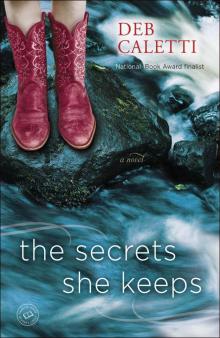
The secrets she keeps, p.12
The Secrets She Keeps,
p.12
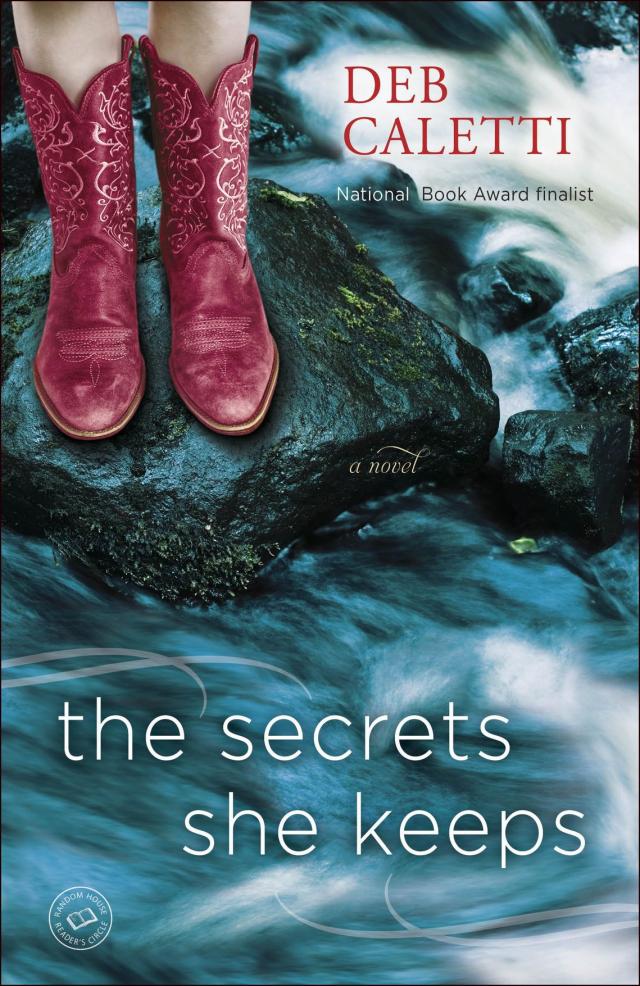


A few hours later they all rise to leave, laughing and knocking into one another as they go. Outside, Jack leans against his truck and lights up a cigarette. His cowboy hat is on the hood, and as he exhales, he tilts his head to the night sky.
Veronica says she’s driving, since Nash isn’t walking straight. Nash’s mother will kill her if she ever finds out, but who cares. Veronica drives too fast, and Nash has her nose out the window because she doesn’t feel well. Her clothes smell like cigarettes.
“If Eddie could see me now!” Ellen says. She won some money at craps and is riding high on her victory. “We’re better off without him! The children don’t need a father like that.”
“I told Stuart the baby was someone else’s,” Lilly says from the backseat.
Even through her nausea, Nash is shocked by the words. Veronica snaps off the radio. Merle Travis abruptly stops singing after I ain’t coming back.
“What?”
“So he’d let me go. So he wouldn’t have anything more to do with us.”
Ellen chatters on about Scotty and the birthday gift Eddie never gave him, but Veronica catches Hadley’s eyes in the rearview mirror. Nash feels abruptly sober. She thinks about the man with the camera and the one in that back booth, who paid his tab just as they were leaving. She watches the beam of the headlights behind them in the side mirror. She thinks about Jack, smoking that cigarette. How he’d better be careful, because jealousy can be lethal. She’s mad at him, the way he acted all night, how he pretended to read Lilly Marcel’s palm, tracing lines with his fingertip. Still, nothing bad had better happen to him. Jack belongs to them, not to Lilly. He thinks he knows so much, but he’s an innocent next to Stuart Marcel.
“Shit!” Veronica screeches, and swerves the car.
Lilly lets out a little scream.
“Dear God, Veronica!” Ellen has her hand to her chest.
It was just a stupid rabbit. Nash wouldn’t have overreacted if she were driving. Jesus! Sometimes, truly, the ladies could get on your nerves, and on one another’s, too.
“If I remember, you don’t even know how to drive, so shut your trap,” Veronica says.
“Be nice, and keep your eyes on the road,” Hadley says, and tosses a bottle cap she must have found deep in the backseat of the Styleline Deluxe. It pings against Veronica’s chignon, which doesn’t feel a thing.
It comes to Nash then. It’s eluded her all night. The gray-haired man with the lumpy nose. He doesn’t work at the bank. He’s a judge at the Washoe County Courthouse. He’s the Honorable Judge Riley, whom Nash stood in front of with the adulterous Mrs. Fletcher.
That night, no one was what or who they seemed. Veronica wasn’t, as Ted slipped his tongue into her mouth, and Hadley wasn’t, when she opened her pocketbook and handed out more bills to lose, and Lilly wasn’t, in her sweet, jeweled hair clip, letting her hand rest, palm up, in Jack’s, and that man at the back table wasn’t, either. He’d gotten in a different car from the one that has been following them ever since they left Broderick’s.
Veronica hits every rut in the road to Tamarosa. Yet they are home safe, Nash thinks. Home. Safe. This is what home should be above all else, though Nash knows how often home is the secret setting for the darkest troubles.
They tumble from the car. A wind rushes through and shakes the curved branches of the desert willow, and there is a brief shower of purple flower blossoms catching moonlight as they fall. The sky is silvery-black with a salt shake of stars, and Nash thinks she hears thunder in the distance, above the chatter and laughter. It is going to rain, she wrongly tells herself, right before she lurches toward the acacia tree and retches up the regrets of the night.
As far as regrets go, she is just getting started.
“I’m just not happy,” Thomas said. “It’s been months since I felt happy. Maybe longer.” His voice sounded far away, as if he was driving somewhere.
It was looking like a mistake to talk to Thomas so regularly when he needed his “time alone.” I had no idea what else to do, though. I felt helpless, as if I were holding someone else’s crying baby in my arms, wishing his mother would hurry back. I watched the landscape out the window of my room; a gust of wind blew through and the desert willow shook in protest. Purple blossoms fluttered past, as if fleeing that old cranky tree at last.
“Should I come home?” In Taj Mahal, I walked around the bed and back again, a metaphorically fitting path. Maybe staying at the ranch was foolish. Only a few days had passed, but perhaps this was the time that a wife was supposed to rush in with marriage-saving gestures—sheet-tearing nights of lust, proclamations of love and loyalty, sickbed attention of grilled cheese sandwiches and soup and shoulder rubs.
I felt an odd lack of alarm. Then again, I had always preferred dread to panic. It was quieter. It had an element of the slow burn that panic lacked, the benefits of stalling and denial. Panic got in there with its fists up. Dread painfully dragged its feet, but at least it bought you time.
“No, don’t. Your aunt needs you. It’s great. I’m taking it easy. Eating what I want. Doing some self-care.”
I couldn’t believe he’d just said that. Did he actually use those words? “Self-care?” I repeated.
Who was this man? Had I been married to a stranger all these years? None of this was like him at all. Thomas was a happy person. He sometimes even whistled. Who whistled? Small things pleased him—a package of powdered-sugar donuts, lumber from the hardware store, a call from Melissa. He deserved my kindness; he was honestly struggling, and I respected the integrity in that, but the man I knew hated a cliché. Self-care? Really? Would he be taking lavender-scented baths next, with those plastic blow-up pillows? Dear God, would he start lighting candles?
“Thanks, Cal. I appreciate your sarcasm.”
“I’m sorry, but where’s my husband? Can we be real here? What do you want, Thomas?”
“I want to know what I want! I feel…empty.”
I hadn’t had a cup of coffee yet. Tex sat by my bed and stared at me, as if he, too, felt empty and might be full again if I could only read those small, pleading eyes. Down the hall, Shaye was talking to Nash as if Nash had gone deaf. I wished I could lay my head on a pillow scented with lavender oil and rest.
“Your mother died! It’s only been six months.”
“Stop saying that. It’s not just her dying.”
But grief, I suspected, was a dangerous creature. A person had no idea how menacing it was. It lurked behind rocks, leaping out to take you down the moment you thought it was safe to come out. It was our evil nemesis our whole life long, the enemy we dreaded and avoided and stood right up against as it blew its withering breath on us. It was wily, too. It could make sneak attacks during innocent tasks like cleaning a closet or turning pages in an address book. Small losses could fell you as sure as large ones; they could gang up, thugs on a dark, empty street, taking your valuables and beating you senseless.
“It’s like we’re buddies,” he said. “A couple of roommates.”
“Is this about sex?”
“It’s about passion. It’s about giving up some idea…”
“Everyone feels this way,” I said. “And do you know why? It’s not a fair story to put on two real people.”
Thomas didn’t reply. There was only the hollow-chamber whooshing of him in a moving car.
“Do you want to leave me?” I asked.
Silence. And then a long exhale. “I found myself looking at a woman at work,” he said.
My stomach sank. I thought, Here we go. “People look, Thomas.”
“I don’t look. I’ve never looked.”
“Who was it?”
“Doesn’t even matter. Someone I can’t even stand. It’s the idea.”
“I want to know.”
“You don’t.” I didn’t, not really.
“I do! Who?”
“Fine. Remember that Laura?”
“The one with the—”
“Right.”
“Tall? Brown hair? Kind of…”
“Yeah, that’s the one.”
“I know who you mean.”
“She’s annoying as hell, to be honest. But, still.”
“It doesn’t mean anything,” I said.
Well, that wasn’t true; it did, and I knew it.
My mother-in-law, June, once told me that marriage takes work. She said it as if she’d thought up this concept herself. She was one of those people who always said obvious, long-accepted truths in a way that implied she was the expert, teaching and enlightening. A person needed to be careful using credit cards. Video games could cause children to be violent. Too much salt could lead to high blood pressure. Who knew.
She cornered me in her kitchen the Thanksgiving before Thomas and I got married. He had sold his Volkswagen Beetle to buy me a ring, and it sparkled on my left hand. I was so proud of it. I actually tried to catch it in beams of sunlight, because I loved the rainbow reflections it made. That ring somehow evened things out with the tight-mouthed woman who was Thomas’s mother and me, I thought, but I was wrong.
The house smelled like turkey cooking: sage and thyme and something buttery. June had grabbed my wrist and looked at me sternly as if I’d already made dire mistakes. And I had, in her eyes. Deciding to keep my surname was a rejection of her and her husband, the deceased Mr. William Bennett. You know, Callie, she said, marriage takes work. With her eyes fixed on mine and her voice as thin and cunning as the silk of a spider, it sounded mean and dark and doomed. It sounded like a prognosis of failure, a pronouncement of her lack of faith in my ability to come through. Instead of Sunday mornings together, and our own children, and a lifetime of each other’s birthday cakes, she made Thomas’s and my future sound like black lung and canned beans, the Sisyphean hauling of boulders and cold cellars lit by a single lightbulb.
But what kind of work should one do, exactly, when a partner is not happy? Or when a partner feels a lack of passion or finds himself looking at a woman at work? Does one try to juggle clowns to make him smile? Ride a unicycle in a negligee? Send him off on a tropical vacation involving fruity drinks and girls in small bikinis? Apply the assumed cure-all couples counseling, even if half of the couple refuses to go? Work implies the application of specific tasks and efforts to get particular results. The problem is, what tasks? Which efforts? This kind of work had no job description or employee manual. You couldn’t fix life. You could come to accept it; you could modify it and shine it up a bit, but you couldn’t change what it was.
I suspected something then, as I held that phone with the silent man on the other end: When it came to us mysterious, complicated, and wayward human beings and our even more mysterious, complicated, and wayward hearts, work was a comforting illusion. It was better than nothing, but sometimes it was a downright lie. It was a life preserver with a tear, or a road sign spun the wrong direction by mean boys. Even if two people were working cheerfully beside each other, sharing the same goal, picking up litter on the freeway of life, keeping it beautiful, there was no telling when one might decide to hop into the back of a stranger’s pickup. As much as we might wish otherwise, a person had his own thoughts on the matters of life and love and acted of his own accord. Thomas would, Nash would, and so would I. Think of the time and energy we’d save if we got this through our thick heads: All of the work and cajoling and manipulating and being good and being kind and being hideous that every one of us partakes in in order to control someone else—well, it is no match for the simple will all humans were given on the day sperm met egg. Will was our surest road to ruin, and to glory.
—
I wasn’t sure if I still knew the way to the lake. I hoped so, otherwise I could get lost out there, and it would be embarrassing when they had to search for me with small planes and infrared lights. I’d have to apply the knowledge I gained when Melissa was (too briefly, it now turned out) in the Girl Scouts. She never liked that uniform, and, brave girl—a girl much bolder and braver than I ever was—she refused to wear it.
I passed the cabins. Old Avalon and Shangri-La and the Ritz and another that no longer had a sign hanging above the door—they had held up well over the years, but they were eerie in their vacancy. When you looked at the spiderwebs everywhere and the windows crusted with dirt, you felt the ghosts of people who must be dead by now. Any kind of animal might have made a home inside there. Bats, even, with their vampire faces and webbed, leathery wings; prehistoric mammals from your worst nightmares.
Across from the cabins was a creepy outhouse—it had a shower stall and a metal sink. I remembered us running in for a quick pee when we were kids, hurrying out as fast as we could, sure we were going to be murdered by a maniac hiding under that rusty showerhead. I remembered Amy and Melissa, too, years later, holding hands and squealing whenever they dashed by.
Past the outhouse, down the gravel path—which I could barely see beneath the weeds—was another cabin, a larger one, made of logs, with a porch and a tilting chimney. The dude wrangler used to live out there, if I had that right. A woodpile leaned against one wall. I wouldn’t reach for a stick of that wood without a medic nearby—it had been there so long, the spiders would have evolved to fist-sized brutes. A metal pail sat on the porch, and a frayed rope hung on a rusted hook. A cabin like that, land like this: It would seem like some kind of Western cliché to us Seattleites, who lived amid vegetarian restaurants and yoga studios, yet here it was.
The path wound through open acres, headed up. Hugo would have loved that walk. A thicket of eucalyptus snagged my memory, and I went that way. I’d told Nash I was taking a nature hike, and she’d looked at me the same way people supposedly looked at the first joggers of the 1970s. In Seattle, if you didn’t hike or bike at least once a month, they took away your citizenship and made you live in the suburbs, where people actually used their cars. But here, there were no nature hikes. There was just nature, the plain-faced fact of it. You walked in it to get places.
I felt a little out of breath from altitude, or from my sorry physical condition. My imagination got carried away with me as I tromped across the yellow grass and the rocks of that hill. I tried not to think about snakes and lizards and poisonous things, and so of course I thought about snakes and lizards and poisonous things. I swatted my ankles at every innocent brush of a tall weed. It was one of the reasons you wore boots out here and not the silly sandals I had chosen.
I hiked on. I remembered the rise that came just before you saw Washoe Lake spread out below. But obviously I didn’t remember it very well, or maybe that kind of majesty is required to fade and then hit you anew every time, because, when I reached the ridge, the vista shocked me. “Wow,” I said out loud, to no one or to the One who might be out there. It felt like something offered, something that required an expression of appreciation, at least—the enormous, rugged expanse carved by ice flows and rivers, the valley of yellow with splays of purple flowers, the deep blue-green of Washoe Lake, and, beyond that, miles and miles and miles of land and land and land. I was a silly, insignificant human with my squabbles with Thomas, with my menial, mortal issues. This vista was reason enough to spend your life out here, as Nash had. Even alone, and with more to handle than was good for you, if you could just stand on that ridge every now and then and witness how large the sky was, it would be worth it.
I breathed it all in. There, I could understand how people used the word Maker, a word that sounded preposterous in everyday life. People in Seattle would smirk with superiority at a word like that, but it made sense then. I saw the hand of the One True Great Artist, and let the capital letters fly; I don’t care. That’s how I felt.
And from there, too, I could see where the semitrucks had gathered. I could see a tiny huddle of men and a tiny pile of something metal. I saw a row of trailers.
I moved on, traveled toward them. From the ridge, the collection of equipment and crew had looked like the slightest muddle on the landscape, but when I arrived, I saw how wrong that first impression was. There was a dusty energy around me, a sense of something large happening. There were hay bales and men unloading things and dropping them with loud clatters, and there was the slam of doors and orders called out and the smell of heat and bodies and horseshit.
I saw him before he saw me. I recognized that tan suede hat, and the shoulders in that heather-blue T-shirt, and something about the way the muscles in his back moved as he rode his horse. The horse was shiny, shiny black with white socks, and it had thick, meaty muscles in its hindquarters. Kit’s thighs gripped the horse as he rode down the sections of metal fence going up.
He waved. I felt immediately self-conscious. I had no business being there. A woman in stiff jeans stepped around me as if I was in her way. Seven or eight people were in sight—on horseback, on foot, men in plaid shirts wearing sunglasses under cowboy hats. God, it was hot out there, and I was wearing those sandals, and my own T-shirt seemed too bright and wrongly cheery.
Kit Covey rode my way on his horse, and I didn’t know a thing about either of them, and they both terrified me. Even the sound of those hooves clopping on the ground was foreign. This had all seemed like a better idea back at the ranch, just after I had that jolt of caffeine. The why not of it was fading fast. You had to be careful with coffee. A few sips, and you could feel like the world was yours.
“You came!” Kit said. “You walked?”
“It’s not that far,” I said.
“Far enough, in this heat. Come on.” He swung off that horse and was on the ground next to me. It was something out of the movies—he was. He was another cliché that wasn’t a cliché at all here. In Seattle, we had tech guys and hipster baristas with nose rings, and we thought that life like that—the one going on right here right now, with men in cowboy hats, men with silver belt buckles, men with horses and guns—had been gone for years. But Kit Covey—his face and neck were shiny with sweat, and, dear God, if I didn’t imagine him in bed. I’m sorry, but that firm grip, those forearms—anyone would have. What was it about a cowboy? I didn’t know; I just saw it there in front of me. He was a lost thing, the antithesis of men you see in city elevators, carrying their cardboard latte cups and their paper bags with a scone inside.