

The case of the irate wi.., p.1
The Case of the Irate Witness and Other Stories,
p.1
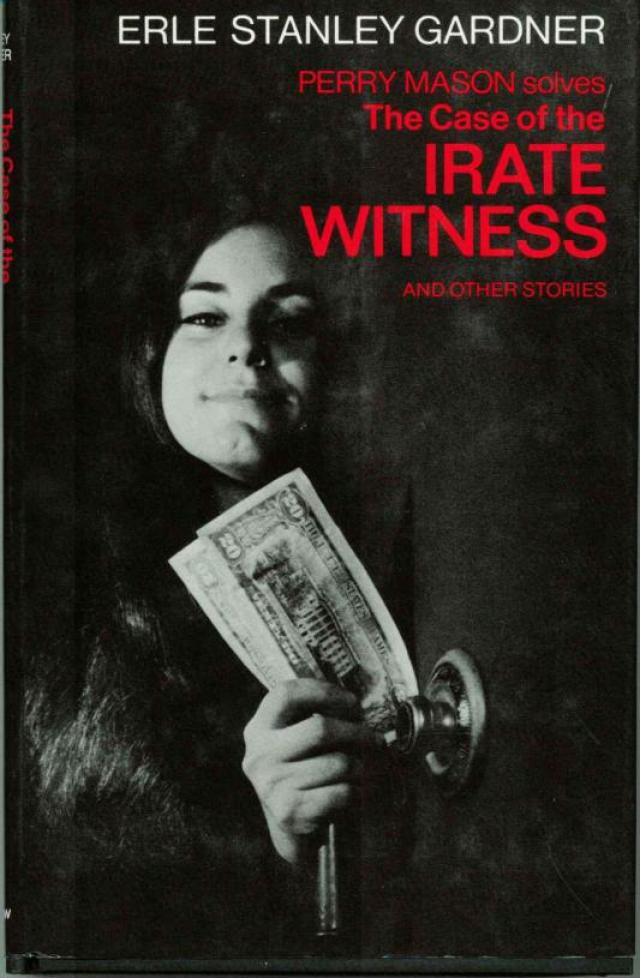


The Case of the
Irate Witness
by
Erle Stanley Gardner
Copyright © 1972 by Jean Bethel Gardner
Electronic Book: Copyright © 2012 by The Erle Stanley Gardner Literary Trust
All rights reserved.
Contents
Copyright
THE CASE OF THE IRATE WITNESS
THE JEWELED BUTTERFLY
SOMETHING LIKE A PELICAN
A MAN IS MISSING
About the Author
The Case of the Irate Witness
The early-morning shadows cast by the mountains still lay heavily on the town’s main street as the big siren on the roof of the Jebson Commercial Company began to scream shrilly.
The danger of fire was always present, and at the sound, men at breakfast rose and pushed their chairs back from the table, others who were shaving barely paused to wipe lather from their faces, and those who had been sleeping grabbed the first available garments. All of them ran to places where they could look for the first telltale wisps of smoke.
There was no smoke.
The big siren was still screaming urgently as the men formed into streaming lines, like ants whose hill has been attacked. The lines all moved toward the Jebson Commercial Company.
There the men were told that the doors of the big vault had been found wide open. A jagged hole had been cut into one door with an acetylene torch.
This was the fifteenth of the month. The big, twice-a-month payroll, which had been brought up from the Ivanhoe National Bank the day before, had been the prize. The men looked at one another silently.
Frank Bernal, manager of the company’s mine, the man who ruled Jebson City with an iron hand, arrived and took charge. The responsibility was his, and what he found was alarming.
Tom Munson, the night watchman, was lying on the floor in a back room, snoring in drunken slumber. The burglar alarm, which had been installed within the last six months, had been bypassed by means of an electrical device. This device was so ingenious that it was apparent that, if the work were that of a gang, at least one of the burglars was an expert electrician.
Ralph Nesbitt, the company accountant, was significantly silent. When Frank Bernal had been appointed manager a year earlier, Nesbitt had pointed out that the big vault was obsolete.
Bernal, determined to prove himself in his new job, had avoided the expense of tearing out the old vault and installing a new one by investing in an up-to-date burglar alarm and putting a special night watchman on duty.
Now the safe had been looted of $100,000 and Frank Bernal had to make a report to the main office in Chicago, with the disquieting knowledge that Ralph Nesbitt’s memo stating the antiquated vault was a pushover was at this moment reposing in the company files.
Some distance out of Jebson City, Perry Mason, the famous trial lawyer, was driving fast along a mountain road. He had had plans for a weekend fishing trip for some time, but a jury which had waited until midnight before reaching its verdict had delayed Mason’s departure and it was now eight-thirty in the morning.
His fishing clothes, rod, wading boots, and creel were all in the trunk. He was wearing the suit in which he had stepped from the courtroom, and having driven all night, he was eager for the cool, piny mountains.
A blazing red light, shining directly at him as he rounded a turn in the canyon road, dazzled his road-weary eyes. A sign, STOP—POLICE, had been placed in the middle of the road. Two men, a grim-faced man with a 30-30 rifle in his hands and a silver badge on his shirt and a uniformed motorcycle officer, stood beside the sign.
Mason stopped his car.
The man with the badge, a deputy sheriff, said, “We’d better take a look at your driving license. There’s been a big robbery at Jebson City.”
“That so?” Mason said. “I went through Jebson City an hour ago and everything seemed quiet.”
“Where you been since then?”
“I stopped at a little service station and restaurant for breakfast.”
“Let’s take a look at your driving license.”
Mason handed it to him.
The man started to return it, then looked at it again. “Say,” he said, “you’re Perry Mason, the big criminal lawyer!”
“Not a criminal lawyer,” Mason said patiently, “a trial lawyer. I sometimes defend men who are accused of crime.”
“What are you doing up in this country?”
“Going fishing.”
The deputy looked at him suspiciously. “Why aren’t you wearing your fishing clothes?”
“Because,” Mason said, and smiled, “I’m not fishing.”
“You said you were going fishing.”
“I also intend,” Mason said, “to go to bed tonight. According to you, I should be wearing my pajamas.”
The deputy frowned. The traffic officer laughed and waved Mason on.
The deputy nodded at the departing car. “Looks like a live clue to me,” he said, “but I can’t find it in that conversation.”
“There isn’t any,” the traffic officer said.
The deputy remained dubious, and later on, when a news-hungry reporter from the local paper asked the deputy if he knew of anything that would make a good story, the deputy said that he did.
And that was why Della Street, Perry Mason’s confidential secretary, was surprised to read stories in the metropolitan papers stating that Perry Mason, the noted trial lawyer, was rumored to have been retained to represent the person or persons who had looted the vault of the Jebson Commercial Company. All this had been arranged, it would seem, before Mason’s “client” had even been apprehended.
When Perry Mason called his office by long distance the next afternoon, Della said, “I thought you were going to the mountains for a vacation.”
“That’s right. Why?”
“The papers claim you’re representing whoever robbed the Jebson Commercial Company.”
“First I’ve heard of it,” Mason said. “I went through Jebson City before they discovered the robbery, stopped for breakfast a little farther on, and then got caught in a roadblock. In the eyes of some officious deputy, that seems to have made me an accessory after the fact.”
“Well,” Della Street said, “they’ve caught a man by the name of Harvey L. Corbin and apparently have quite a case against him. They’re hinting at mysterious evidence which won’t be disclosed until the time of trial.”
“Was he the one who committed the crime?” Mason asked.
“The police think so. He has a criminal record. When his employers at Jebson City found out about it, they told him to leave town. That was the evening before the robbery.”
“Just like that, eh?” Mason asked.
“Well, you see, Jebson City is a one-industry town, and the company owns all the houses. They’re leased to the employees. I understand Corbin’s wife and daughter were told they could stay on until Corbin got located in a new place, but Corbin was told to leave town at once. You aren’t interested, are you?”
“Not in the least,” Mason said, “except that when I drive back, I’ll be going through Jebson City, and I’ll probably stop to pick up the local gossip.”
“Don’t do it,” she warned. “This man Corbin has all the earmarks of being an underdog, and you know how you feel about underdogs.”
A quality in her voice made Perry suspicious. “You haven’t been approached, have you, Della?”
“Well,” she said, “in a way. Mrs. Corbin read in the papers that you were going to represent her husband, and she was overjoyed. It seems that she thinks her husband’s implication in this is a raw deal. She hadn’t known anything about his criminal record, but she loves him and is going to stand by him.”
“You’ve talked with her?” Mason asked.
“Several times. I tried to break it to her gently. I told her it was probably nothing but a newspaper story. You see, Chief, they have Corbin dead to rights. They took some money from his wife as evidence. It was part of the loot.”
“And she has nothing?”
“Nothing. Corbin left her forty dollars, and they took it all as evidence.”
“I’ll drive all night,” he said. “Tell her I’ll be back tomorrow.”
“I was afraid of that,” Della Street said. “Why did you have to call up? Why couldn’t you have stayed up there fishing? Why did you have to get your name in the papers?”
Mason laughed and hung up.
Paul Drake, of the Drake Detective Agency, came in and sat in the big chair in Mason’s office and said, “You have a bear by the tail, Perry.”
“What’s the matter, Paul? Didn’t your detective work in Jebson City pan out?”
“It panned out all right, but the stuff in the pan isn’t what you want, Perry,” Drake explained.
“How come?”
“Your client’s guilty.”
“Go on,” Mason said.
“The money he gave his wife was some of what was stolen from the vault.”
“How do they know it was the stolen money?” Mason asked.
Drake pulled a notebook from his pocket. “Here’s the whole picture. The plant manager runs Jebson City. There isn’t any private property. The Jebson company controls everything.”
“Not a single small business?”
Drake shook his head. “Not unless you want to consider garbage collecting as small busin
ess. An old coot by the name of George Addey lives five miles down the canyon; he has a hog ranch and collects the garbage. He’s supposed to have the first nickel he ever earned. Buries his money in cans. There’s no bank nearer than Ivanhoe City.”
“What about the burglary? The men who did it must have moved in acetylene tanks and—”
“They took them right out of the company store,” Drake said. And then he went on: “Munson, the watchman, likes to take a pull out of a flask of whiskey along about midnight. He says it keeps him awake. Of course, he’s not supposed to do it, and no one was supposed to know about the whiskey, but someone did know about it. They doped the whiskey with a barbiturate. The watchman took his usual swig, went to sleep, and stayed asleep.”
“What’s the evidence against Corbin?” Mason asked.
“Corbin had a previous burglary record. It’s a policy of the company not to hire anyone with a criminal record. Corbin lied about his past and got a job. Frank Bernal, the manager, found out about it, sent for Corbin about eight o’clock the night the burglary took place, and ordered him out of town. Bernal agreed to let Corbin’s wife and child stay on in the house until Corbin could get located in another city. Corbin pulled out in the morning and gave his wife this money. It was part of the money from the burglary.”
“How do they know?” Mason asked.
“Now there’s something I don’t know,” Drake said. “This fellow Bernal is pretty smart, and the story is that he can prove Corbin’s money was from the vault.”
Drake paused, then continued: “As I told you, the nearest bank is at Ivanhoe City, and the mine pays off in cash twice a month. Ralph Nesbitt, the cashier, wanted to install a new vault. Bernal refused to okay the expense. So the company has ordered both Bernal and Nesbitt back to its main office at Chicago to report. The rumor is that they may fire Bernal as manager and give Nesbitt the job. A couple of the directors don’t like Bernal, and this thing has given them their chance. They dug out a report Nesbitt had made showing the vault was a pushover. Bernal didn’t act on that report.” He sighed and then asked, “When’s the trial, Perry?”
“The preliminary hearing is set for Friday morning. I’ll see then what they’ve got against Corbin.”
“They’re laying for you up there,” Paul Drake warned. “Better watch out, Perry. That district attorney has something up his sleeve, some sort of surprise that’s going to knock you for a loop.”
In spite of his long experience as a prosecutor, Vernon Flasher, the district attorney of Ivanhoe County, showed a certain nervousness at being called upon to oppose Perry Mason. There was, however, a secret assurance underneath that nervousness.
Judge Haswell, realizing that the eyes of the community were upon him, adhered to legal technicalities to the point of being pompous both in rulings and mannerisms.
But what irritated Perry Mason was the attitude of the spectators. He sensed that they did not regard him as an attorney trying to safeguard the interests of a client, but as a legal magician with a cloven hoof. The looting of the vault had shocked the community, and there was a tight-lipped determination that no legal tricks were going to do Mason any good this time.
Vernon Flasher didn’t try to save his surprise evidence for a whirlwind finish. He used it right at the start of the case.
Frank Bernal, called as a witness, described the location of the vault, identified photographs, and then leaned back as the district attorney said abruptly, “You had reason to believe this vault was obsolete?”
“Yes, sir.”
“It had been pointed out to you by one of your fellow employees, Mr. Ralph Nesbitt?”
“Yes, sir.”
“And what did you do about it?”
“Are you,” Mason asked in some surprise, “trying to cross-examine your own witness?”
“Just let him answer the question, and you’ll see,” Flasher replied grimly.
“Go right ahead and answer,” Mason said to the witness.
Bernal assumed a more comfortable position. “I did three things,” he said, “to safeguard the payrolls and to avoid the expense of tearing out the old vault and installing a new vault in its place.”
“What were those three things?”
“I employed a special night watchman, I installed the best burglar alarm money could buy, and I made arrangements with the Ivanhoe National Bank, where we have our payrolls made up, to list the number of each twenty-dollar bill which was a part of each payroll.”
Mason suddenly sat up straight.
Flasher gave him a glance of gloating triumph. “Do you wish the court to understand, Mr. Bernal,” he said smugly, “that you have the numbers of the bills in the payroll which was made up for delivery on the fifteenth?”
“Yes, sir. Not all the bills, you understand. That would have taken too much time. But I have the numbers of all he twenty-dollar bills.”
“And who recorded those numbers?” the prosecutor asked.
“The bank.”
“And do you have that list of numbers with you?”
“I do. Yes, sir.” Bernal produced a list. “I felt,” he said, glancing coldly at Nesbitt, “that these precautions would be cheaper than a new vault.”
“I move the list be introduced in evidence,” Flasher said.
“Just a moment,” Mason objected. “I have a couple of questions. You say this list is not in your handwriting, Mr. Bernal?”
“Yes, sir.”
“Whose handwriting is it, do you know?” Mason asked.
“The assistant cashier of the Ivanhoe National Bank.”
“Oh, all right,” Flasher said. “We’ll do it the hard way, if we have to. Stand down, Mr. Bernal, and I’ll call the assistant cashier.”
Harry Reedy, assistant cashier of the Ivanhoe Bank, had the mechanical assurance of an adding machine. He identified the list of numbers as being in his handwriting. He stated that he had listed the numbers of the twenty-dollar bills and put that list in an envelope which had been sealed and sent up with the money for the payroll.
“Cross-examine,” Flasher said.
Mason studied the list. “These numbers are all in your handwriting?” he asked Reedy.
“Yes, sir.”
“Did you yourself compare the numbers you wrote down with the numbers on the twenty-dollar bills?”
“No, sir. I didn’t personally do that. Two assistants did that. One checked the numbers as they were read off, one as I wrote them down.”
“The payrolls are for approximately a hundred thousand dollars, twice each month?”
“That’s right. And ever since Mr. Bernal took charge, we have taken this means to identify payrolls. No attempt is made to list the bills in numerical order. The serial numbers are simply read off and written down. Unless a robbery occurs, there is no need to do anything further. In the event of a robbery, we can reclassify the numbers and list the bills in numerical order.”
“These numbers are in your handwriting—every number?”
“Yes, sir. More than that, you will notice that at the bottom of each page I have signed my initials.”
“That’s all,” Mason said.
“I now offer once more to introduce this list in evidence,” Flasher said.
“So ordered,” Judge Haswell ruled.
“My next witness is Charles J. Oswald, the sheriff,” the district attorney announced.
The sheriff, a long, lanky man with a quiet manner, took the stand. “You’re acquainted with Harvey L. Corbin, the defendant in this case?” the district attorney asked.
“I am.”
“Are you acquainted with his wife?”
“Yes, sir.”
“Now, on the morning of the fifteenth of this month, the morning of the robbery at the Jebson Commercial Company, did you have any conversation with Mrs. Corbin?”
“I did. Yes, sir.”
“Did you ask her about her husband’s activities the night before?”
“Just a moment,” Mason said. “I object to this on the ground that any conversation the sheriff had with Mrs. Corbin is not admissible against the defendant, Corbin; furthermore, that in this state a wife cannot testify against her husband. Therefore, any statement she might make would be an indirect violation of that rule. Furthermore, I object on the ground that the question calls for hearsay.”
Judge Haswell looked ponderously thoughtful, then said, “It seems to me Mr. Mason is correct.”















