The case of the lucky le.., p.1
The Case of the Lucky Legs,
p.1
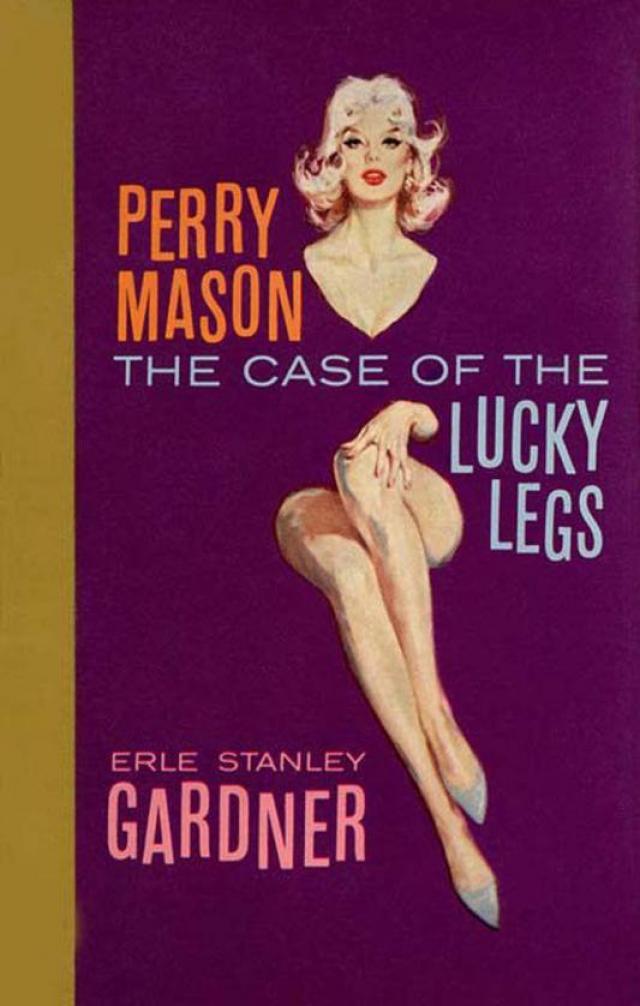


The Case of the
Lucky Legs
by
Erle Stanley Gardner
Copyright © 1934 by Erle Stanley Gardner. Renewed 1961
Electronic Book: Copyright © 2012 by The Erle Stanley Gardner Literary Trust
All rights reserved.
A Note from Erle Stanley Gardner
Perry Mason shares the prerogative of all good fictional characters. They never grow old. Yet the lawyer’s cases began years ago in what now seems almost a different world. The Case of the Lucky Legs deals with Perry Mason at a time in his career when there were three powerful “slick paper” magazines, The Saturday Evening Post, Collier’s and Liberty. Only The Saturday Evening Post has survived. It occurred in a period when much of the best food was in speakeasies, when sliding-panel doors were standard equipment. Moreover, in these earlier cases Perry Mason had the great advantage of complete freedom of action.
Those of you who read Perry Mason’s adventure of The Case of the Lucky Legs will, I think, agree that fame has disadvantages; that a young, relatively unknown fighting criminal lawyer can get into a series of most attractive escapades with skeleton keys and an impulsive disregard for the finer points of legal ethics. Nowadays when the celebrated Perry Mason dashes past a cornerstone of legal ethics without bothering to touch base, bar associations shiver with apprehension. In these earlier days when only a few people knew of the daring, resourceful Perry Mason, a bunch of skeleton keys in his pocket was standard equipment. After all, who dared to keep a locked door between a Perry Mason reader and the mystery on the other side? Certainly not the author!
So to those who wish to encounter Perry Mason in one of his earlier adventures, who have a nostalgic longing for the days of the speakeasy and individual initiative, I trust this reprinting of The Case of the Lucky Legs will give you your money’s worth of excitement and entertainment.
E. S. G.
Contents
Copyright
A Note from Erle Stanley Gardner
Cast of Characters
Chapter 1
Chapter 2
Chapter 3
Chapter 4
Chapter 5
Chapter 6
Chapter 7
Chapter 8
Chapter 9
Chapter 10
Chapter 11
Chapter 12
Chapter 13
Chapter 14
Chapter 15
Chapter 16
Chapter 17
Chapter 18
Chapter 19
About the Author
CAST OF CHARACTERS
PERRY MASON—Who wants to be the first to guess what happened and usually is
DELLA STREET—His devoted secretary, whose soft heart for the underdog is equalled only by her concern for Perry Mason’s safety
MR. J. R. BRADBURY—A very substantial citizen, former President of the Cloverdale National Bank, and a fighter who refused to be underestimated
EVA LAMONT—Who signed the telegram that precipitated the hunt
MARJORIE CLUNE—Tricked, robbed, and betrayed by her not-so-lucky legs
FRANK PATTON—Motion picture promoter with a beguiling proposition
DR. ROBERT DORAY—Rising young dentist who ran afoul of the law in the big city
MAMIE—The blonde at the cigar counter
PAUL DRAKE—Owner of the Drake Detective Agency who knows how to turn question marks into exclamation points
THELMA BELL—Another girl whose legs were lovely but not lucky
DETECTIVES RIKER AND JOHNSON—Who thought they had finally caught up with Perry Mason
Chapter 1
Della Street held open the door of Perry Mason’s private office.
“Mr. J. R. Bradbury,” she said.
The man who pushed past her, into the room, was around forty-two years of age, with quick gray eyes that surveyed Perry Mason with ready friendship.
“How do you do, Mr. Mason?” he said, extending his hand.
Perry Mason arose from his swivel chair to take the hand. Della Street stood for a moment in the door, watching the two men.
Perry Mason was taller than Bradbury. He was, perhaps, heavier, but his heaviness was the result of big bones and heavy muscles, rather than the heaviness of fat. There was in his motions, as he arose from the chair and shook hands, a suggestion of finality. The man seemed as substantial as a granite rock, and there was something of the appearance of rugged granite in his face, which was entirely without expression as he said:
“I’m pleased to meet you, Mr. Bradbury. Have a chair.”
Della Street caught Perry Mason’s eye.
“Is there anything you want?” she asked.
The lawyer shook his head. Then, as Della Street closed the door, turned to his visitor.
“You told my secretary that you had sent me a telegram,” he said, “but our files fail to disclose any telegram by a man named Bradbury.”
Bradbury laughed and crossed one well-tailored leg over the other. He seemed very much at ease.
“That,” he said, “is easily explained. I filed the telegram from an office where my name was known. I didn’t want to use my name, so I signed the telegram Eva Lamont.”
Perry Mason’s face showed quick interest.
“Then,” he said, “you are the one who sent the photograph by air mail. The photograph of the young woman.”
Bradbury nodded and fished a cigar from his waistcoat pocket.
“All right if I smoke?” he asked.
Perry Mason nodded an answer. He picked up the telephone on his desk, and when he heard Della Street’s voice, said, “Bring me that photograph that came yesterday, also the telegram that was signed ‘Eva Lamont.’ ”
He hung up the telephone, and, as Bradbury clipped the end from his cigar, Perry Mason took a cigarette from a humidor on his desk. Bradbury scraped a match along the sole of his shoe and jumped from his chair to hold a light to Mason’s cigarette, then, still standing, he applied the flame to the end of his cigar and was just dropping the match into the ashtray on the desk when Della Street opened the door from the outer office and laid a legal jacket on Perry Mason’s desk.
“Anything else?” she asked.
The lawyer shook his head.
Della Street’s eyes turned appraisingly to the well-tailored figure of the man who stood puffing on his cigar. Then she turned and left the room.
As the door clicked shut, Perry Mason turned back the jacket and picked up a photograph which had been printed on glossy paper. It was the photograph of a young woman, showing her shoulders, hips, arms and legs. The photograph did not show the young woman’s face, but there could be no doubt of her youth from the willowy shape of her body, the graceful contours of her hands, and the sweep of leg which was displayed in the picture.
The woman’s hands held her skirts very high, showing a pair of slim legs. Underneath the picture was a typewritten caption which had been pasted to the photograph and which read “THE GIRL WITH THE LUCKY LEGS.”
Clipped to the photograph was a telegram which read:
“SENDING YOU SPECIAL DELIVERY AIR MAIL PHOTOGRAPH OF UTMOST IMPORTANCE IN CASE I AM ABOUT TO PRESENT KEEP PHOTOGRAPH AND AWAIT ME IN YOUR OFFICE WITHOUT FAIL
(Signed) EVA LAMONT”
Bradbury crossed to the desk, stared down at the photograph.
“The girl who posed for that photograph,” he said, “was tricked, robbed and betrayed.”
Perry Mason looked not at the photograph but at Bradbury’s face, his eyes holding that steady, watchful scrutiny which seeks to uncover truth beneath a veneer of stage setting. It was the scrutiny of an attorney who has handled clients of all types, and who has learned to calmly and unhurriedly brush aside layers of falsehood in order to get at the real facts.
“Who is she?” Mason asked.
“Her name,” said Bradbury, “is Marjorie Clune.”
“You say she was tricked, robbed and betrayed?”
“Yes.”
“And who is the person who is responsible for that?”
“Frank Patton,” said Bradbury.
Perry Mason waved his hand toward the big leather chair which faced his desk.
“If,” he said, “you’ll sit down and tell me about it from the beginning, we can probably make faster progress.”
“There’s one thing I want understood,” Bradbury said, sitting down, “and that is that whatever I tell you is going to be in confidence.”
“Certainly,” said Mason.
“My name is J. R. Bradbury. I live in Cloverdale. I was a heavy stockholder in the Cloverdale National Bank and was its president for many years. I am forty-two years of age. Recently I retired, to devote my time exclusively to private investments. I am a substantial citizen of Cloverdale and can furnish you with any number of first-class references.”
Bradbury’s voice held the close-clipped articulation of a man who is dictating. The lawyer watched him with eyes that seemed to penetrate the man’s mind as X-rays penetrate human tissue.
“Marjorie Clune,” went on Bradbury, “is a young woman of character and beauty. She is an orphan. She was employed as a stenographer in my bank. She would probably have agreed to marry me within another month. Frank Patton came to town. He was a promoter. He claimed to be representing a motion picture company that was searching for a young woman of personality and beauty, who could stand being advertised as ‘THE GIRL WITH THE LUCKY LEGS.’ They were going to
insure her legs for two million dollars; release publicity about the most beautiful legs in the world.”
“Did Patton say he had authority to act for such a motion picture company?” Mason asked.
Bradbury smiled wearily, as though he were telling something that he had repeated on many occasions.
“He had a contract with a motion picture producing company with offices here in the city. The contract was signed in blank by the picture company. Patton was empowered to select the other party to the agreement. Ostensibly, it was an agreement by which the actress was to be employed for forty weeks out of the year, at a salary of three thousand dollars a week. It contained, however, a joker by which the company could terminate the contract if it decided not to go ahead with the picture in which it contemplated starring the actress.”
“How did Patton make his money out of it?” Mason asked.
“Through the Chamber of Commerce. He sold them on the idea of the advertising that would result to Cloverdale if the young woman was selected there. He sold scrip to the merchants; the merchants passed it out to customers. The scrip entitled the holder to share in the profits of the picture.”
“Wait a minute,” Perry Mason said, “let’s get that straight. The scrip holders became partners in the production?”
“Not in the production,” Bradbury said, “but in the earnings from the production. There’s a vast distinction. We didn’t realize it at the time. The actress was to sign a contract with Patton to act as her manager on a percentage of her earnings. The earnings were to include a share in the picture. Patton assigned that share of the earnings to the scrip holders.”
“And the scrip holders,” asked the lawyer, “were to assist in the selection of the actress?”
“Now,” Bradbury said, “you’ve got the idea in a nutshell. The scrip was sold to the merchants; the merchants gave it out with purchases. The holders of the scrip cast ballots to determine who should be the actress selected. There were half a dozen candidates. They appeared in bathing suits, posed in the stores, modeled stockings in the windows, appeared in the local picture shows, allowed their legs to be photographed and the photographs placed in store windows. It stimulated business. Naturally, it exploited the young women. Patton made a bunch of money out of it.”
“Then what happened?” asked Perry Mason.
“Marjorie Clune was selected as the most beautiful of the contestants, or candidates, if you want to call them that. Patton gave her a big send-off. There was a banquet. The secretary of the Chamber of Commerce presented her with the contract. It was signed with a fountain pen which was placed in a glass case and returned to the Chamber of Commerce to be kept in the city hall. Cloverdale was to be put on the map. It was to be the home of the biggest motion picture actress in the industry; the most beautiful girl in America. Patton had engaged a drawing-room on the night train. Margy was escorted to the drawing-room by more than fifteen hundred cheering citizens. The drawing-room was banked with flowers. There was a brass band. The train pulled out.”
Bradbury paused for a moment, then said dramatically, “That was the last anyone ever heard of Marjorie.”
“You think she was abducted or something?” Mason asked.
“No; she was swindled and her pride wouldn’t let her return. She had left Cloverdale to take her place among the big motion picture stars. She didn’t have courage enough to return and admit she had been the victim of a legal fraud.”
“Why do you say a legal fraud?” Perry Mason asked.
“Because it’s air-tight. There were no false representations made that the district attorney of Cloverdale is willing to act on. He wrote the motion picture company; they stated that they were in search of such an actress; that they had empowered Patton, in whose judgment they had the greatest confidence, to discover such an actress; that Marjorie Clune had appeared at their studios; they had employed her for two days while they started to film the picture, and then had decided to scrap it, due, in part, to the fact that Miss Clune did not screen well.”
“The contract was limited to one picture?” asked Perry Mason.
“To three pictures, but they were all of them predicated on the satisfactory completion of the first.”
“And the title of the first was specifically set forth so that there was nothing to prevent the motion picture company from abandoning production on that play, changing the name and employing another star for the same picture?” Perry Mason asked.
“Now,” Bradbury said, “you’ve got the sketch.”
“What do you want me to do?” Mason inquired.
“I want to put Frank Patton behind the bars,” said Bradbury. “I think he’s had some very shrewd legal advice; I want to get some that’s just as shrewd. I want to find him. I want to find Marjorie Clune. I want to force him to make restitution to Marjorie Clune, and, incidentally, I want to make him confess to a fraudulent intent.”
“Why?” Perry Mason asked.
“Because then,” Bradbury said, “the district attorney here will proceed against the picture company, and the district attorney in Cloverdale will proceed against Patton; but they claim they have to prove his intent beyond a reasonable doubt. It’s a mixed-up case. If he claims good faith, they can’t convict him. They want some sort of an admission from him.”
“Why don’t they get it then?” Mason asked.
“The district attorney in Cloverdale,” Bradbury said, “for some reason simply won’t have anything to do with the matter. The district attorney here says that he isn’t going to wash Cloverdale’s dirty linen; that if I want to work up a case against Patton, he’ll take some action, but he won’t waste county time and money trying to pull chestnuts out of the fire for Cloverdale; that it was Cloverdale money that was taken, and the representations were all made in Cloverdale.”
“What else do you want me to do?” asked Perry Mason.
“I want you,” Bradbury said, “to see that I don’t get put in jail for blackmail.”
“You mean when we find Patton?”
Bradbury nodded and pulled a wallet from his pocket.
“I am prepared to pay,” he said, “a retainer of one thousand dollars.”
Perry Mason turned to Bradbury.
“You’ll need a good detective,” he said. “Paul Drake, head of the Drake Detective Bureau, is a very good friend of mine. I’ll give you a card to him.”
He picked up his desk telephone.
“Della,” he said to his secretary, “make a receipt to J. R. Bradbury for one thousand dollars. Get Paul Drake on the line, and then get me Maude Elton, the district attorney’s secretary, on the line.”
Chapter 2
Maude Elton, the general secretary at the district attorney’s office, was reputed to know more about the inside history of criminal matters than any one in the court house. Her complexion was slightly sallow; her features were hardly the kind to get motion picture producers raving over screen tests, but her face showed a quick vitality, an alert watchfulness which made her seem as restless as a canary hopping about in bright-eyed scrutiny of a stranger who has approached too close to its cage.
“Hello, Mr. Mason,” she said.
Perry Mason grinned at her.
“After seeing some of these dumb-bells,” he said, “who can’t think of anything except getting their powder on smoothly, it’s refreshing to look into a pair of eyes like yours.”
“I presume,” she told him, “that means you’re going to try to pump some information out of me that you can’t get from any one in the office.”
“This is once,” he told her, “that your environment has betrayed you.”
“Why my environment?”
“Because you always see the seamy side of life. You deal with crooks and with persons who have ulterior motives. My errand today is merely that of a peaceful citizen, a taxpayer if you wish, who comes to the office of a public servant, seeking legitimate information.”
She twisted her head slightly to one side as she stared at him.
“I believe you’re right, at that,” she said.
“I am,” he told her.
“You’re not kidding?”
“No. On the square.”
“Well, I’ve seen lots of things in my time, but I never expected to see this. What is it you want?”