

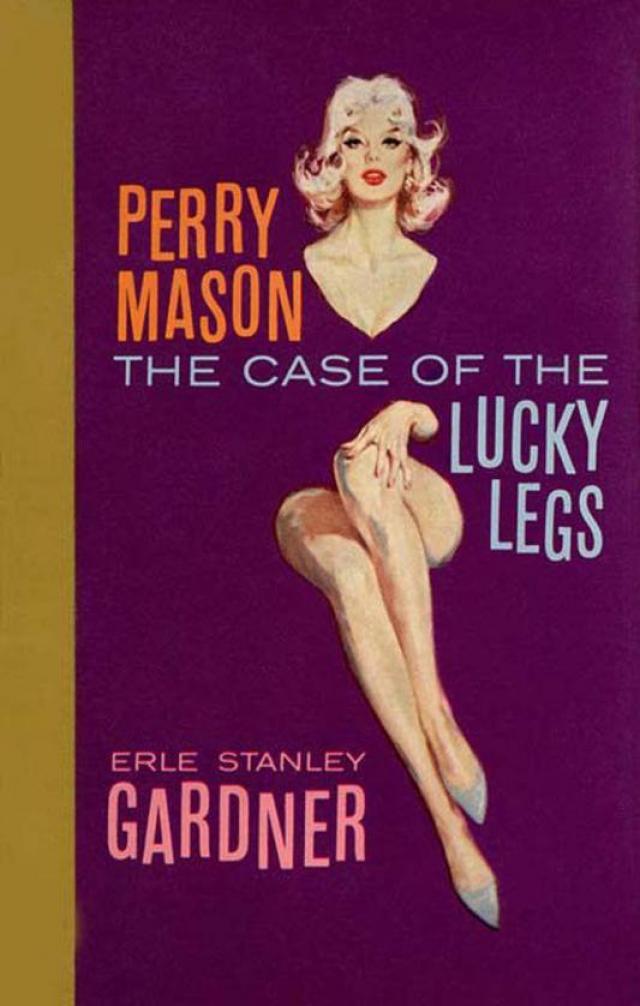
The case of the lucky le.., p.8
The Case of the Lucky Legs,
p.8


“But Margy is all right?” asked Bradbury. “You can promise that you’re going to keep her in the clear?”
“I can’t promise anything,” Perry Mason said. “I’ve done the best I could, and I got to her before the police did.”
“Tell me about Frank Patton,” said Bradbury. “How did it happen?”
“I don’t know how it happened,” said Mason. “I found out where he lived and went out there.”
“How did you find that out?” Bradbury asked.
“Through the detective you employed.”
“When did you find it out?”
“This evening.”
“Then you knew where he was living when you started out of your office tonight?”
“Yes.”
“Why didn’t you take me along?”
“Because I didn’t want you along. I wanted to try and get some sort of a confession or an admission out of Patton. I knew that you’d lose your temper and start making a lot of accusations that wouldn’t get anywhere. I wanted to talk to him and lay a trap or two for him and see if he wouldn’t walk into one of the traps. Then I was going to get rough with him; after I had softened him up some, I was going to get you and my secretary to come out. My secretary would have taken down the conversation in shorthand.”
Bradbury nodded.
“That sounds all right,” he said. “I was a little bit hurt at first.”
“There’s nothing to get hurt over,” Mason said. “I’m handling this case for the best interests of all concerned. You’ve got to have confidence in me, that’s all.”
“Go ahead,” Bradbury said, “tell me what happened.”
“Well, I got out there,” Mason went on, “and pounded on the door of the apartment. There was no answer. I dropped down and took a peek through the keyhole. There was a light on in the apartment. I looked through the keyhole and saw a table with a hat, a cane and some gloves on it. I feel certain they belonged to Patton. They looked the part, they fitted in with the description of Patton that we had.
“I pounded on the panel again, and went to work on the buzzer. I stopped in between times to listen, but couldn’t hear a thing. I was just ready to go away when I noticed a cop standing at the corner of the corridor, he’d evidently been watching me for a little while, I don’t know just how long.
“Right away, I figured that perhaps something was wrong and I’d walked into it, but there was nothing I could do then except put a bold front on it, so I walked right on toward the cop, he stopped me and wanted to know what I’d been doing, trying to get in the apartment, I told him that I was looking for Frank Patton. That I understood he lived in the apartment there and that I thought he’d be home. I told the cop who I was and gave him my business card.
“There was a woman with the cop; she said she lived in the apartment across the way. I think she’s on the up and up. She looked as though she’d tumbled out of bed and dressed in a hurry. She said she’d gone to bed and hadn’t been feeling well. That some woman was raising hell in the next apartment and having hysterics about lots of things, among which she was mentioning the words ‘lucky legs.’ I told you that part on the phone.”
“Then what happened?” asked Bradbury.
“Then,” said Perry Mason, “the cop went into the woman’s apartment and they held a pow-wow. The cop finally managed to get the room opened. He found that Patton had been stabbed with a big bread knife, one of those triangular-bladed affairs that are big and long. I got in touch right away with you because I wanted to find out what you wanted me to do about Margy.”
“How did you know Margy was mixed up in it?” Bradbury inquired.
“I saw her—that’s what I called you about,” Mason told him. “She was coming out of the apartment house just as I went in, and she looked so guilty that she caught my attention. It wasn’t guilt as much as it was panic. There was fear in her eyes. She had on that white coat with the white hat, and the red button on the hat, but you’re not supposed to know anything about that. It’s in confidence. Keep it to yourself.”
“Of course I’ll keep it to myself,” Bradbury said, “but why didn’t you speak to her?”
“I didn’t know her,” said Perry Mason. “I didn’t have any idea who she was until afterwards. She looked panic-stricken when she went by me and when I checked up what this woman told the cop about the girl having hysterics over her legs, I figured that it must have been Margy who was in the bathroom.”
“What would she be doing in the bathroom?” Bradbury asked.
“You can search me,” Mason said. “It looks as though the party had got a little rough. Patton had a bathrobe half on, but his outer clothes were off. There’s a chance he tried to pull something and Marjorie had barricaded herself in the bathroom. That’s the way I figure it.”
“Then Patton followed her into the bathroom and she stabbed him?” asked Bradbury.
“No,” Mason said, “the body wasn’t in the bathroom. The body was in a bedroom on the other side of the bathroom. There’s a chance that the girl was in the bathroom and Patton managed to get the door open. They might have had a struggle of some sort, and then she stabbed him in self-defense. There’s another chance that while she was in the bathroom with the door locked, some one else entered the apartment and stabbed Patton.”
“Was the door locked?” asked Bradbury.
“Sure,” Mason said, “the door was locked. Didn’t I tell you that the cop had to go hunt up a janitor or something to get the door open.”
“Then,” said Bradbury, “if the door was locked, how could any one have walked into the apartment while Margy was in the bathroom?”
“That’s easy,” Mason said. “Whoever did it, could have locked the door behind him when he went out.”
Bradbury nodded again.
“How about the detective, Paul Drake,” he said. “Was he around there?”
“Paul Drake was to have followed me out,” Perry Mason said. “I told him to give me a five-minute start. I went down to meet Drake at Ninth and Olive and that took a little while. We figured out our plan of campaign and Drake was to leave Ninth and Olive five minutes after I did. Drake was driving his car. I went in a taxicab. Drake would probably make better time than I did; I haven’t had a chance to talk with him. The way I figure it is, that just about the time he started toward the building, he saw the woman and the uniformed policeman going into the building. He figured right away that something was wrong, so he played foxy and jumped in the background until he found out what it was. At any rate that’s the way I figure it; I haven’t had a chance to talk with him.”
The curtains clicked back and the waiter brought in their orders. Bradbury poured himself a stiff jolt of whiskey from the flask, dropped ice into the glass, poured in ginger ale, stirred it with a spoon, and drank half of the glass in three big gulps.
Perry Mason critically inspected the wine bottle, moved the neck of the bottle under his nostrils, poured out a glass of the red wine, broke off a piece of the French bread, took a mouthful of the hot bread and sipped the wine.
“Was there anything else?” asked the waiter.
“That’s all for the present,” Bradbury said. “We’ll ring when we want the check. In the meantime, will you see that we’re not disturbed?”
The waiter nodded.
“I’ve said about all I have to say,” Perry Mason said.
Bradbury nodded.
“I want to do some talking,” he said.
Perry Mason shot him a quick glance.
“You do?” he asked.
Bradbury nodded.
“Go ahead,” said Mason.
The waiter stepped out and the curtains fell back into position.
“In the first place,” said Bradbury slowly, “I want you to understand one thing, Mason. That is, that I’m going to stand back of Marjorie Clune in this thing, no matter what happens.”
“Why, sure,” said Mason, tearing off another piece of the French bread with his fingers. “That’s the impression I’ve had all along.”
“Furthermore,” said Bradbury, “I am going to see that Marjorie Clune gets out of this, no matter who gets hurt.”
“Yeah,” said Perry Mason, “you haven’t told me anything new yet.”
Bradbury leaned forward and stared intently at Perry Mason.
“Understand me, Counselor,” he said, “I don’t want any misunderstandings about this. I am going to see that Marjorie Clune gets out of this, no matter who gets hurt.”
There was a beating, steady insistence about his tone, and Perry Mason held the wine-glass halfway to his lips. His eyes suddenly snapped to focus upon Bradbury with a new light in them.
“Huh?” he said.
“Marjorie Clune,” said Bradbury, “comes first. I love her more than I love life itself. I would do anything for her. I don’t know the particulars as yet, you don’t know them yourself, but I want it definitely understood that Marjorie Clune is not going to be placed in any danger. I am going to fight for her against the whole world. I don’t care who I have to fight against.”
“Go on,” Perry Mason said, still holding the glass of wine halfway to his lips.
“I was wondering,” said Bradbury, “just how long you had been knocking at the door before the officer got there.”
“A minute or two,” said Perry Mason. “Why?”
“Do you remember exactly what time it was when the officer arrived?”
“No,” Mason said, “I didn’t look at my watch.”
“That,” said Bradbury, “is something that can be ascertained, of course.”
“Of course,” Mason said, and set down his wine-glass. “Go ahead, Bradbury, I’m listening.”
“I was wondering just what time the murder was committed, with reference to the time that you got to the apartment?” Bradbury went on. “The time element may be important there.”
“It may be,” agreed Perry Mason.
“It seems funny to me,” Bradbury said, “that if Margy had been in the bathroom and some one had killed Frank Patton, that the door would have been locked.”
“Why?” asked Perry Mason.
“In the first place,” said Bradbury, “it is utterly impossible for me to believe that Marjorie Clune had a key to Frank Pattern’s apartment. That is simply out of the question.”
“Go ahead,” Mason told him, “I’m listening.”
“In the event,” said Bradbury, “Marjorie Clune was barricaded in the bathroom, and Frank Patton broke in through the door, and there was a struggle and Marjorie killed him in self-defense, she would have been the last one to go through the door.”
“Yes,” said Mason, “what of it?”
“In that event, the door wouldn’t have been locked. Since Marjorie Clune didn’t have a key to it, and since the dead man could hardly have locked the door.
“On the other hand,” went on Bradbury, his eyes boring into those of Perry Mason with steady insistence, “if Marjorie Clune had been in the bathroom, and Patton had been trying to get in the bathroom, but hadn’t been able to do so, and some other person had walked through the door into the apartment and killed Patton, and then walked out as you suggest, locking the door behind him, how could Marjorie have got out of the apartment?”
Perry Mason kept watching Bradbury in silent speculation.
“The only other possible solution,” said Bradbury, “would be that Marjorie Clune ran out of the bathroom while the two men were struggling. That is, while Frank Patton was struggling with the intruder who had entered through the door of the apartment. In that event, Marjorie Clune would have seen this murderer, and would undoubtedly either have recognized him if she had known him, or been able to give something in the line of a description of him if she hadn’t known him.”
“And then?” asked Perry Mason.
“Then,” said Bradbury, “the murderer would have stabbed Patton and run from the apartment. In that event, he would probably have seen Marjorie Clune, either when she emerged from the bathroom, or while she was in the corridor, or in the elevator.”
“You,” said Perry Mason, “are a pretty good detective yourself, Bradbury. You’ve reasoned the thing out quite clearly.”
“I simply wanted to impress upon you,” said Bradbury slowly, “that just because I came from a smaller city is no reason that I can’t stand up and fight when the occasion arises. I don’t want you to underestimate me, Counselor.”
Perry Mason’s eyes were filled with interest and with the glint of a dawning respect.
“Hell, no, Bradbury,” he said, “I’m not going to underestimate you.”
“Thank you, Counselor,” said Bradbury and picked up his highball glass. He finished draining the highball.
Perry Mason watched him attentively for a few moments, and then raised his wine-glass, sipped, and refilled the glass from the bottle.
“Are you finished talking?” he asked.
“No,” said Bradbury, “there’s one other point I wanted to make. That is, that I am satisfied Marjorie Clune must have-seen the murderer, that in the event she didn’t make an outcry or an alarm, it was because the murderer was known to her, and she desired to protect him.”
“You’re referring to Dr. Doray?” asked Perry Mason.
“Exactly,” said Bradbury with a tone of cold finality in his voice.
“Look here,” Mason said, “I may be able to set you right on one thing, Bradbury. I saw Marjorie Clune when she came out from the apartment house. I stood and watched her until she had walked a little over a half a block and then I turned and went into the apartment house. I took the elevator. After I left the elevator, I went down the corridor directly to Frank Patton’s apartment. I didn’t notice any one else coming from the apartment where Patton lived. I stayed at the door until after the officer arrived there. The officer wouldn’t have let any one leave the apartment without his knowledge until he had made the search. Therefore, it is reasonable to assume that the apartment was empty when I arrived there. There is, of course, the possibility that a murderer might have gone down the stairs while I was coming up in the elevator. That is only a possibility. I had met Dr. Doray. If I had seen him there in the apartment house, I would have recognized him.”
“How about the windows?” asked Bradbury. “Were there windows?”
“Yes, there’s a window that opens on a fire escape,” Mason said slowly.
“There you are,” Bradbury triumphantly pointed out.
“But,” said Perry Mason, “if Dr. Doray had been in the room, if Marjorie Clune had run from the bathroom and out of the door, why would Dr. Doray have locked the door of the apartment and then gone through the window and down the fire escape?”
“That,” said Bradbury, “is one of the things we are going to determine.”
“Yes,” Mason agreed, “there are a lot of things we will have to determine when we’ve got more facts, Bradbury. You understand that it’s a physical impossibility for a man to reconstruct the scene of a crime, unless he knows all of the facts.”
“I understand that all right,” Bradbury said, “but the point I’m getting at is that the facts as we know them don’t seem to check up with certain things that must have happened.”
“That,” Mason said, “is something for us to figure on when we come into court and start analyzing the case of the prosecution.”
“I would prefer,” Bradbury said, “to figure on them right now.”
“Then,” Perry Mason said, “you think that Bob Doray is the one who is guilty of the murder?”
“To be frank with you, I do. I have told you all along that the man was a dangerous man. I feel certain that he is the one who is implicated in the murder, and I feel equally certain that Marjorie Clune will try to shield him, if it is possible for her to do so.”
“Do you think she loves him?”
“I am not certain as to that. I think she is fascinated by him. It may be that she thinks she is in love with him. You understand, Counselor, there’s a distinction.”
Perry Mason regarded the hard glittering eyes of J. R. Bradbury with a new-found respect.
“I understand,” he said.
“Furthermore,” Bradbury said, “in the event Marjorie Clune tries to sacrifice herself, in order to give Dr. Doray a break, I propose to see that she doesn’t do it. Have I made myself plain on that point?”
“More than plain,” Perry Mason said.
Bradbury tilted the flask over his glass and poured in another generous shot of rye, which he diluted with ginger ale from the bottle.
“No matter what happens,” he said, “Marjorie must not be allowed to sacrifice herself for Dr. Doray.”
“Then you want me to try and show that Dr. Doray did the crime?” asked Perry Mason.
“On the contrary,” said Bradbury slowly. “I want to impress this upon you, Counselor, that in the event it turns out that I am right, and Dr. Doray is either implicated in this or it should appear that he is the one who actually committed the murder, I think I shall instruct you to represent Dr. Doray.”
Perry Mason sat bolt upright in his chair.
“What?” he asked.
Bradbury nodded slowly.
“I shall ask you,” he said, “to represent Dr. Doray.”
“If I’m representing him,” Perry Mason said, “I’m going to do my best to get him off.”
“That would be understood,” Bradbury told him.
Perry Mason ceased eating, and his fingers made drumming motions on the edge of the tablecloth as he stared across at Bradbury.
“No,” he said slowly, “I don’t think that I’ll underestimate you, J. R. Bradbury—that is, never again.”
Bradbury smiled. “And now, Counselor,” he said, “that we understand one another perfectly, we can proceed to forget business and eat and drink.”
“You can,” Mason told him, grinning, “but I’ve got to get in touch with my office, and I have an idea there’ll be some detectives prowling around the office.”
“What will they want?” Bradbury inquired.
“Oh, they’ll know that I was out at the apartment, and they’ll want to find out what I went there for, and all about it.”















