

The case of the substitu.., p.11
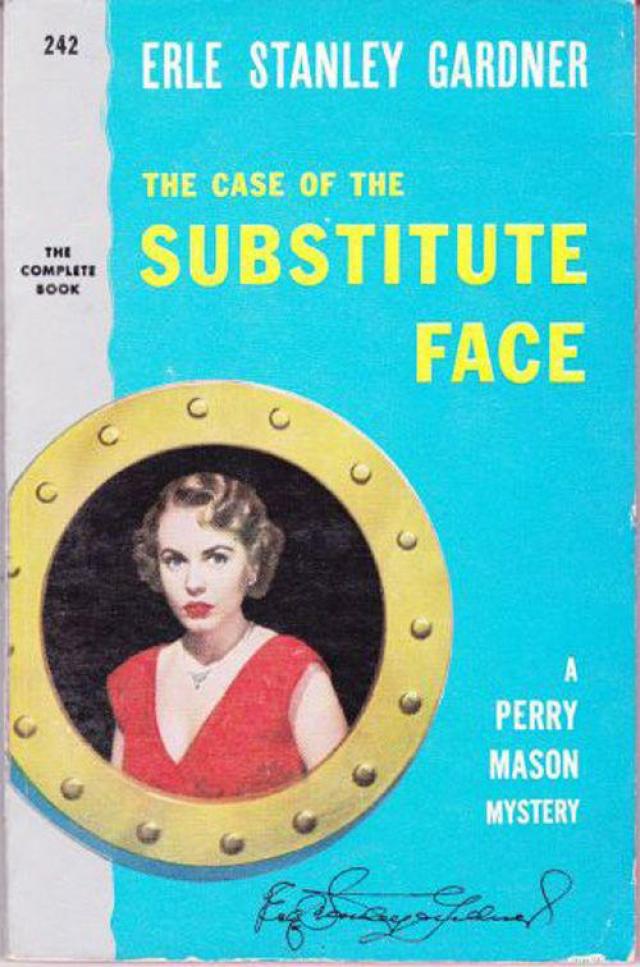
The Case of the Substitute Face,
p.11


“Then Moar did win the money in a lottery?” Hungerford asked.
“I don’t know,” Mason said. “I’m afraid not.”
“Where did he get it?”
“That remains to be seen. Of course, we don’t know that the money which was found in a money belt under the mattress of Moar’s bed belonged to him. It may have belonged to Mrs. Moar.”
“What does she say about it?” Hungerford asked.
“She doesn’t say,” Mason said drily.
For a moment Hungerford was silent.
Mason said, in a kindly tone, “I want you to know these things, Hungerford, before you burn any bridges.”
“My bridges are burnt, as far as that’s concerned,” Hungerford told him simply. “There’s only one person in the world who can make me happy and that’s Belle. I want her.”
Mason said, “One other thing you don’t want to overlook is that at present her mother is accused of murder. Circumstantial evidence against her looks rather black.”
“Her mother didn’t do it,” Hungerford said. “Belle’s mother simply couldn’t have done anything like that.”
“Well, opinions differ in those matters. The San Francisco district attorney seems to think otherwise.”
Hungerford said, “That reminds me, Mr. Mason, I’ve uncovered something I want to tell you about. In fact, a couple of things.”
“Go ahead.”
Della Street opened the door, smiled at Hungerford and said, “Mr. Scudder, the deputy district attorney in San Francisco, is on the line.”
Mason picked up the phone on the law library table and said, “Put him on here, Della.”
Della closed the door and Hungerford said, “The message which Mr. Newberry—I mean Mr. Moar—received just before he left the table was sent by a Miss Evelyn Whiting, a nurse who was accompanying a man with a broken neck.”
Mason heard a click on the line and a man’s voice saying, “Yes. … Hello. This is Mr. Scudder.”
“Mason talking, Mr. Scudder,” Mason said. “I want a preliminary hearing in that Newberry case.”
“You can have it any time,” Scudder told him. “However, I deem it only fair to advise you, Mr. Mason, of what you may not know at this time. The San Francisco papers are carrying a story to the effect that Mr. Moar had embezzled twenty-five thousand dollars from the Products Refining Company. The money in the money belt which was recovered by the captain was undoubtedly a part of that embezzled money which Mrs. Moar had removed from Moar’s body before pushing him overboard. It, therefore, can’t even be used by Mrs. Moar to defray any legal expenses.”
“That doesn’t change my position in the least,” Mason said. “I want an immediate hearing, and you’re holding Belle Newberry. I want her released.”
“I’m afraid,” Scudder said, “that will be impossible.”
“All right,” Mason told him, “I’m getting out an application for a writ of habeas corpus and flying to San Francisco with it tonight. Either put a charge against her or release her.”
He snapped the receiver back into position, looked up at Hungerford and said, “How do you know?”
“About Miss Whiting?”
“Yes.”
“One of the room stewards saw Miss Whiting slip a note on the glass-covered shelf in front of the purser’s window. He feels certain it was the same note that was delivered to Moar.”
Mason frowned thoughtfully. “How was she dressed?” he asked. “Did the room steward say anything about that?”
“No,” Hungerford said, “he didn’t. He merely mentioned he saw her putting the envelope there. His name is Frank Bevins. I don’t think he’s said anything to the officers. In fact, I gathered from what he told me, he didn’t want to have any contact with the officers. I think the man may be wanted himself. He told me he had some information he’d give me for fifty dollars.”
“You paid him the fifty?” Mason asked.
Hungerford nodded. “You see,” he said, “the stewards knew that I’d been with Belle quite a bit.”
“And this man didn’t want to be a witness?”
“I think,” Hungerford said, “he was going to take the fifty dollars and skip out. He told me that he’d taken the job as room steward so that he could lie low for a while.”
“Then it’s just a tip,” Mason said, “nothing I could use as evidence.”
“That’s right.”
“Know anything else?” Mason asked.
“I understand the Fell girl is telling a different story now from what she did at first. She claims now she actually saw Mrs. Newberry shoot her husband and push him over the rail.”
Mason said, “The thing grows with repetition, doesn’t it?”
“It seems to.”
Mason picked up the telephone and pushed the button which connected him with Della Street. “Della,” he said, “tell Paul Drake to telephone his correspondents in Honolulu and have them find out everything they can about Evelyn Whiting, the nurse who came over on the ship with us. Have him send an operative to see Ida Johnson, Aileen Fell’s cabin-mate, and get a written statement from her. The Johnson girl’s friendly. And tell Paul to get a photograph of Aileen Fell in a dinner dress.”
“Just a minute,” Della Street said.
Mason held the phone and could hear her transmit the message to Drake, then she said into the telephone, “Drake says he can get a prompt report from Honolulu but he doesn’t know how he’s going to get a photograph of Aileen Fell in a dinner dress. He says the district attorney will have a couple of detectives guarding her and—”
“Get some politician to throw a party for the detectives,” Mason interrupted. “Tell them it’s formal and the dicks will show up in their tuxedos, then Drake’s photographer can pose as a newspaper photographer and take a flashlight. No detective ever overlooked an opportunity to have his picture taken in a tuxedo. … My God, do I have to tell Drake how to run his detective agency?”
Della Street laughed and said, “Paul was just telling me his parents had made a mistake. He should have been quintuplets.”
“You’d think he was from his expense accounts,” Mason said. He hung up the receiver, reached across the table and shook hands with Hungerford. “Thanks a lot, Roy,” he said. “If it becomes necessary to call on you for a financial contribution, I’ll let you know. I don’t think it will be. Would you like to fly up to San Francisco with us right after dinner?”
“No, thank you,” Hungerford said. “I have my own plane. But I’ll see you up there.”
Mason escorted Hungerford to the door, stepped into the outer offices, shook hands with the office force, chatted for a few minutes about China and Bali, then piloted Jackson into the law library.
Jackson blinked studious eyes from behind tortoise shell glasses and said, “You’re going to have a tough time with Rooney, Mr. Mason. I feel that I should warn you.”
Mason grinned, “You don’t seem to like him, Jackson.”
Jackson said, “He’s an arrogant, dictatorial, obstinate nincompoop.”
“You really should take up profanity, Jackson. It’s a lot more satisfying,” Mason told him.
“You insinuated I wasn’t fighting,” Jackson went on in a hurt voice. “I want you to know I did everything humanly possible. I left no stone unturned, Mr. Mason. I told Mr. Rooney in no uncertain terms exactly what I wanted, and when he refused to accede to my request I openly accused him of betraying the best interests of the corporation.”
Mason opened a drawer, took out a bottle of whiskey and two glasses. “Jackson,” he said, “when you start fighting, never try to hit the other man where he’s expecting the punch. And when you once start a fight, never give up until the other man’s licked. If you can’t do it by hook, do it by crook. By the way, I don’t suppose you happen to know a Marjory Trenton?”
“No, sir.”
Mason filled the whiskey glasses. “That’s where you made your mistake, Jackson.”
Chapter 10
Tuesday morning dawned with overcast skies and a cold, drizzling rain. Mason, a temporary office established in his hotel suite, finished dictating the application for a writ of habeas corpus and said to Della, “All right, Della, transcribe those records. We’ll get these writs issued and served.”
The telephone rang. Della picked up the receiver, smiled up at Mason and said, “Mr. Charles Whitmore Dail is in the lobby.”
“Tell him to come on up,” Mason said.
Drake, who had been in communication with his San Francisco branch office on another telephone, came in through a connecting door and said, “I have a report on Evelyn Whiting, Perry. She’s a registered nurse. She’s been married and divorced, resumed her maiden name, and has her own private opinion on husbands, taken by and large, as a class and as individuals.”
“Like that, eh?” Mason asked, grinning.
“Exactly,” Drake said.
“She didn’t impress me as being a man-hater,” Mason told him.
“I didn’t say she was a man-hater,” Drake said. “I said she was a husband-hater.”
“So what?” Mason asked.
“So when Moar fell for her like a ton of bricks and wanted her to marry him, she said nothing doing, they’d be friends and that was all.”
“Wasn’t she a bit high-powered for a chap of Moar’s type?” Mason asked.
“I don’t know,” Drake said. “You saw Moar, I didn’t. But I gathered that Moar rated about one date a week and she was trotting out to night clubs in between times. In other words, her intentions weren’t honorable or serious. Moar’s were.”
“Where did you get the dope?” Mason asked.
“She has a sister here in San Francisco, a Marian Whiting, who lives in the Wavecrest Apartments.”
“Your men talked with the sister?”
“Yes.”
“What else did they find out?”
“That’s all that’s shown in the report,” Drake said.
“Was the sister suspicious or close-mouthed?”
“Apparently not,” Drake told him. “She was excited because Mrs. Moar had been accused of murder, and she wondered what Evelyn would say to that.”
Mason stared at Drake and said, “What’s that, Paul?”
Drake raised his eyebrows. “She was wondering what her sister would say when she heard about it.”
Mason said, “Wait a minute, Paul, that doesn’t make sense. Her sister’s here in San Francisco?”
“Well. … Oh, I see,” Drake said, frowning into his notebook. “You may have something there, Perry. Want me to have my men make a further investigation? They can go see the sister and—”
“No,” Mason interrupted. “I want to think it over. It’s either unimportant, or it’s important as the devil; I don’t know which. If it’s important, we won’t trust anyone else with it. We’ll handle it ourselves.
“Now here’s something else that bothers me: Just before the ship left Honolulu, someone picked the lock on Moar’s suitcase, took out a picture of Belle Newberry and substituted a picture of Winnie Joyce.”
“What was the idea?” Drake asked.
“The idea of the substitution,” Mason said, “was evidently to keep the theft of Belle Newberry’s picture from being discovered. Apparently there’s rather a startling resemblance between Belle and the picture actress. The picture which was substituted was just about the same pose and lighting.”
“How come?” Drake asked.
“Belle got a fanmailed photo of Winnie Joyce and then had one of her own taken in just the same pose and with the same lighting effect. Someone got hold of a Winnie Joyce publicity photograph and made the switch.”
“You don’t think Winnie Joyce is mixed up in it, do you?” Drake asked. “There’s big money invested in her. If her name ever came into the investigation they’d …”
“No, I don’t think so,” Mason said.
“You could raise hell with the Prosecution by letting Winnie Joyce’s studio get a hint that you were going to drag her name in, and …”
“No,” Mason interrupted. “I don’t play ball that way, Paul. From what I’ve seen of Winnie Joyce on the screen, she’s a nice kid. There’s a startling resemblance, though. Not only does Belle Newberry resemble her in face and figure, but in actions and temperament. They have high-powered personalities, if you know what I mean.”
“And you think this substituted picture had something to do with the murder?” Drake asked.
“I don’t know, Paul. So far, I’ve been acting on the assumption that Celinda Dail, who apparently has matrimonial designs on Roy Hungerford, stole the picture and sent it by air mail to Rooney for an investigation. But I’m not so certain that’s correct. Rooney admitted he’d made an investigation for Celinda, but didn’t say anything about the picture. He intimated Belle had let drop some remark which had given Celinda a clue she’d gratuated from U.S.C. I’d like to find out something about that picture. Have your men cover the Royal Hawaiian Hotel over in Honolulu and see if they can uncover anything. Perhaps some of the employees may have seen someone hanging around Moar’s room— Remember, though, Paul, he was registered under the name of Newberry.”
Drake said, “Okay, Perry, on my way,” and dashed through the door into his room.
Someone knocked on the door of the sitting room. Mason said, “That’s Dail. Let him in, Della.”
Della Street opened the door and said, “Come in, Mr. Dail.”
Charles Whitmore Dail seemed far from comfortable. “Good morning, Mr. Mason,” he said. “Good morning, Miss Street. I seem to have placed myself in rather an unenviable position.”
“Sit down,” Mason invited.
“Thank you,” Dail said. He glanced around him at the room with its dictating machines, protable typewriters, and law books.
“Field headquarters,” Mason explained.
“You move around rather rapidly,” Dail observed.
“I don’t let any grass grow under my feet when I’m working on a murder case,” Mason admitted.
“I’ll say you don’t,” Dail said. “I suppose you know what I want to see you about, Mr. Mason. I must confess you stole a march on me.”
“In what way?” Mason asked.
Dail laughed nervously. “You move too fast for me, Mr. Mason. I can’t keep up with you.”
“Did you,” Mason asked, “intend to keep up with me?”
“Well,” Dail said, “I think you’ll agree that I had every reason to think Carl Moar was guilty of embezzlement.”
Mason lit a cigarette. “I don’t see that you had any reason to think so.”
“Surely,” Dail said, “when a man has been in your employ, suddenly leaves without a word of explanation, and there’s a shortage of twenty-five-thousand dollars, it’s at least a reasonable inference he’s guilty of embezzlement.”
“That’s the weakest sort of circumstantial evidence,” Mason retorted. “It might justify you in auditing the books. It certainly wouldn’t justify you in making a bareface accusation.”
“Well,” Dail blurted, “consider the other circumstances. Here we were on a boat on the high seas. You’re aboard the ship. Moar’s aboard the ship, traveling under an assumed name. You come to me and offer to return twenty thousand dollars—”
“I beg your pardon,” Mason interrupted. “I didn’t make any offer. I said I was asking questions. I wanted that specifically understood.”
“Well, it amounts to the same thing,” Dail insisted.
Mason said, “Speaking as a lawyer, I beg to differ with you. But you’re doing the talking.”
“I didn’t come here to argue,” Dail said. “I appreciate I’m in an embarrassing predicament if Mrs. Moar cares to take advantage of it.”
“She does,” Mason told him conversationally.
“You mean she’s going to sue me?”
“Exactly.”
“Well,” Dail said, “if you want to get technical about it, Mason, I didn’t accuse her of anything, I accused her husband, who is now dead.”
“You said, however, that the money which was found in her possession was money which had been embezzled from the Products Refining Company. It now appears that your relative was responsible for that embezzlement. Moar was innocent.”
“Then why the devil did Moar leave in the way he did?” Dail asked.
Mason shrugged his shoulders.
“You’re not making this particularly easy for me,” Dail said.
“Did you expect that I would?” Mason inquired.
“I thought that you’d be reasonable.”
“I always try to be reasonable.”
“Look here,” Dail blurted, “I don’t want to have it publicly known that Rooney embezzled that money. Under the peculiar circumstances, it would hurt my prestige with the stockholders of the company. I have, therefore, arranged to cover the shortage.”
“I’m glad to hear it,” Mason said.
“The financial structure of the Products Refining Company is such that … Well, it’s rather complicated.”
“I understand.”
“If Mrs. Newberry filed any action against me, and alleged in her complaint that there actually had been a embezzlement by the auditor … Well, Mason, I want to settle.”
“On what basis?” Mason asked.
Dail said, “I don’t think there’s been any great damage done to Mrs. Moar’s case, but if I should assume the responsibility of underwriting your fees, that should be more than a fair settlement.”
Mason smiled. “My fees come high.”
“I was afraid they would,” Dail admitted.
“How high are you prepared to go?” Mason asked.
“Shall we say five thousand dollars?” Dail asked.
“I’ll take the matter up with my client,” Mason said.
“Can you give me a prompt answer?”
Mason said, “I feel quite certain my client’s answer will be that she wouldn’t consider a cent less than ten thousand dollars.”
“As your fees?” Dail asked, raising his eyebrows.
Mason said, “Oh, say five thousand dollars for my fees, and five thousand to give her funds with which to cover additional expenses.”















