The case of the substitu.., p.5
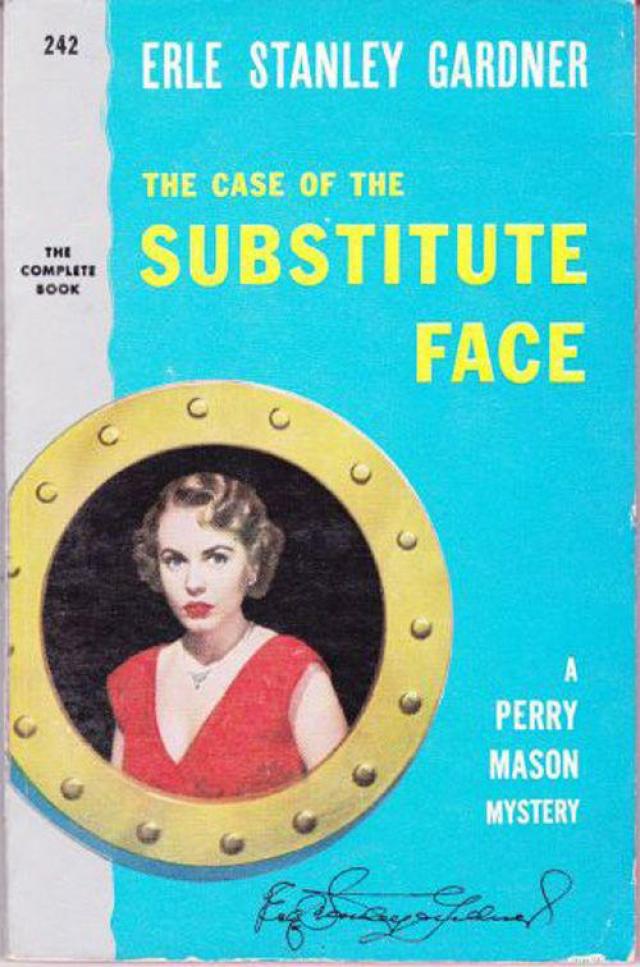
The Case of the Substitute Face,
p.5


The eyes which she turned up to him were laughing through tears. “No,” she said, “you do it. This is my last night of happiness. I’m leaving it up to you, Perry Mason, to do the dirty work.”
She turned and walked rapidly down the swaying corridor, steadying herself from time to time with an outstretched hand, Mason stood watching her with sympathetic eyes.
Chapter 5
There were many vacant chairs at the captain’s dinner. Sheeted rain lashed against the portholes. Those passengers who made merry with colored paper cups, balloons and pasteboard horns lacked spontaneity. Their merriment seemed merely a forced attempt to comply with maritime conventions. Waiters felt their way, a few steps at a time, half-filled dishes carried in deep serving trays.
Mason, dining with Della Street, looked across to where Carl Newberry and his wife and daughter were entertaining Roy Hungerford.
“Isn’t it about time you were getting something definite from them?” Della Street asked.
“Yes,” Mason said, “I’ve warned Mrs. Newberry I must know where I stand before ten o’clock tonight. She told me to be in her cabin at nine-thirty and she’d have the money for me. Then I can go to Dail and make my proposition.”
“Moar—or I guess I should remember to call him Newberry—doesn’t seem particularly concerned,” Della Street said.
“No,” Mason admitted. “He seems to be having a good time. It’s fortunate for him that Evelyn Whiting has all of her meals in the stateroom with her patient.”
“Chief,” she said, “I have an idea Newberry’s reached an understanding with that woman.”
“What makes you think so?”
“I saw him coming out of her stateroom yesterday afternoon, and he was smiling.”
“You’re certain it was Newberry?”
She nodded.
“Perhaps,” Mason said, “that’s why he’s acting so carefree now. I’ve been wondering how he was going to manage it when the passengers went through customs and quarantine tomorrow. He’s almost certain to meet her face to face.”
“I think he’s figured that all out. After all, all he needed to do was to go to her, make some explanation and ask her to keep quiet.”
“The only trouble with that,” Mason pointed out, “is that she might indulge in gossip with some shipboard acquaintance and let the cat out of the bag. If Celinda Dail had any idea Evelyn Whiting knew anything about Belle’s father, she’d certainly move heaven and earth to find out what it was.”
Della Street said, “Belle, poor kid, realizes she could never fit into Roy’s life.”
“Don’t you think he’ll try to keep in touch with her just the same?” Mason asked.
“He won’t have the chance, Chief. She’s going to tell him she’ll meet him at the Santa Anita Race Track next Tuesday. She told him her folks have a box there. She’ll never see him after she gets off the boat.”
Mason said, “If she’s in love with him I don’t see …”
“I understand exactly how she feels,” Della Street interrupted. “Taking things in her stride, mingling with him on terms of equality, she’s been able to interest him. But the minute he realizes she’s not in his set, the minute his friends start patronizing her, he’ll begin to lose interest in her. She and the Dail girl have been running neck and neck. Give Celinda Dail the handicap of being able to patronize Belle, and Belle will be entirely out of the running.”
“I’m not so certain,” Mason said.
“Well, I am,” Della Street told him. “That Dail girl is clever. She won’t rub it in. Instead, she’ll try and drag Belle out to all sorts of affairs where Belle will be among strangers but everyone else will know each other with that intimacy which comes of years of rubbing elbows and taking each other for granted. Belle will be completely out of place.”
“Well,” Mason said, “I think Belle should tell her mother exactly what she plans to do.”
“Why?”
“Because,” he said, “if Belle’s going to step out of Roy’s life, there’s no reason why I should go to a lot of trouble trying to fix things up with the Products Refining Company.”
“Oh, yes, there is,” Della told him. “It would be the greatest tragedy of Belle’s life if detectives should meet her father at the gangplank tomorrow and snap handcuffs on his wrists. And particularly if he had embezzled money from a company operated by Celinda Dail’s father. Chief, you must stop that, no matter what happens. Can’t you see? She wants Roy to remember her as a woman of mystery, not pity her. And she could never bear to have Celinda Dail gloating in triumph over her.”
“Well,” Mason said, “I’ll meet Mrs. Newberry at nine-thirty. She’ll have a definite answer by that time. I’m going to take a turn on deck. How’d you like to go out and get a lungful of storm?”
“No,” she told him, “I’m going over and join the Newberrys for a minute. I promised Belle I would. It’s eight-thirty-five now. I’ll hunt you up around nine o’clock. That’ll give us time for a liqueur and then you can meet Mrs. Newberry at nine-thirty.”
Mason nodded, crossed over to pull back her chair, gave her arm a squeeze and said, “I’ll be over on the lee side, probably on the promenade deck.”
Mason went to his stateroom, put on a top coat, wound a light silk scarf around his collar, and went on deck.
Doors on the weather side were locked. On the lee deck, rain lashed down in torrents, spurting up into little geysers, where the big drops hit the planking. Electric lights, burning in glass-enclosed cages, shed reddish rays which reflected upward from the wet deck, and were swallowed in the enveloping maw of wind-swept darkness. The roar of troubled waters furnished a steady, ominous undertone of sound.
Mason found the promenade deck a little too exposed, so went to the deck below. He walked slowly, skirting a pile of deck chairs which had been folded back and lashed securely. Water soaked up through the thin soles of his dress shoes. Spray from the beating rain moistened his face and beaded his hair. He squared his shoulders, inhaled the driving freshness of the ocean gale, listened to the roar of the waves, the shrieking of the wind—and was content.
The ship’s bells clanged twice—nine o’clock. The wind whipped the sound and dispersed it, just as it snatched the smoke from the stacks of the steamer, tore it into black ribbons, and dissolved them into the night. On the port beam, a lighthouse winked intermittently.
The ship, rolling heavily, swung far over to port, paused, then, instead of righting itself, rolled still farther, until Mason, clinging to a stanchion for support, could look down the slanting deck to the dark, tossing waves.
He heard a faint scream, then an explosive sound. He stood still, listening. The scream was repeated. It seemed to come from two decks above him.
As the ship slowly righted, Mason ran to the rail, leaned over, and tried to peer upward. The rain flooded his eyes, beat down upon his coat, trickled in rivulets along his neck and down the angle of his jaw. He could see nothing.
The ship sluggishly swung over to starboard. The waves, as though concentrating in a surprise attack, crashed against her quivering hull. Mason heard the faint jangling of a bell somewhere, then the whistle blew five short, quick blasts. The ship heeled far over and was filled with thumping jars, as though it had been an automobile running on a flat tire.
Mason realized one screw had been reversed, while the other was going full speed ahead, swinging the ship in a quick turn.
Feet pounded along the boat deck. Mason saw a circular life buoy whirl out into the darkness. It struck the water, and almost immediately the inky darkness was dispelled by a bright flare of light which drifted back and to one side as the ship turned.
The big seas now struck on the beam. The ship rolled in the troughs. Mason held to a stanchion, then fought his way back to the door, which suddenly burst open. A uniformed officer shouted, “Get back inside!”
“What’s the matter?” Mason asked.
“Man overboard!” the officer yelled, and ran forward, clinging to a hand rail to keep from slipping on the wet, slanting deck.
Mason stamped water from his soggy shoes, ran to the stairway and started down it.
He made straight for Mrs. Newberry’s stateroom. The ship had turned enough to catch the huge seas on her bow, making the craft pitch and plunge.
Mason pounded on the door of the stateroom. There was no answer. He tried the knob. The door was locked. He banged with his fist, then, when there was no response, kicked with the toe of his shoe.
After a moment, he heard Mrs. Newberry’s voice. “Who is it?”
“Mason,” he said.
“Just a minute,” she told him. “I’ll let you in.”
Mason rattled the doorknob. “Open the door now,” he ordered.
She unlocked and opened the door, said, “Oh, well, come in if it’s that important.”
She was clad in stockings and peach-colored underwear. As Mason closed and locked the door, she slipped a dress over her head. “What is it?” she asked.
“Where’s your husband?”
She wiggled the dress down from her shoulders, smoothed it across her hips, frowned at the lawyer, and said, “He had to see a man. He promised he’d be back in five minutes. What’s the matter with your watch? It’s not nine-thirty yet.”
“How long since you’ve seen him?”
“Five minutes ago. Our party broke up when my husband received a note. He said he had to see a man on some business.”
“And what did you do?”
“Came to my stateroom. I slipped my gown off, because I’d spilled some wine on it. Carl and I are going to have a showdown. He’ll be back any minute— What’s all the commotion about? The ship’s jumping around so I can hardly stand up. We haven’t run into anything have we? Look, there’s a light over there on the water! And look at the searchlights!”
Mason nodded, watched her while she hooked up her dress, and said, “I’m particularly interested in finding out about where your husband went and what he did.”
“Look here, Mr. Mason,” she said, facing him, “I’ve been married twice. I’m not exactly a prude. But I’m not accustomed to having men burst into my room while I’m dressing. I let you in because your voice indicated you wanted to talk with me on a matter of the greatest importance. Now, if you’ll please explain …”
Mason said, “I heard the sound of a shot. An officer tells me there’s a man overboard. Does that mean anything to you?”
For a moment she stared at him with wide, frightened eyes, then she crossed to the drawer of a dresser, jerked it open and stood looking down at the empty interior.
“What is it?” Mason asked.
“Carl’s gun,” she said. “It’s gone.”
“Now let’s get this straight,” Mason said. “You and Carl were going to have a showdown?”
“Yes.”
“Did you tell him what you wanted to talk with him about?”
“I told him that I wasn’t going to stand for a lot of vague generalities any longer; that I wanted to know exactly where he obtained that money, and that I wanted him to turn it over to me.”
“What did he say?”
“He said we’d talk it over later.”
“He wouldn’t discuss it then?”
“No. You see, just as we were finishing dinner, a bellboy handed him a note. Carl said he had to see a man on some business. That broke up our little dinner party. Carl and I came to the stateroom. I told him I was going to have things out with him, that for Belle’s sake I wanted that money. He said he’d be back within five minutes, but he simply had to see someone on a matter of the greatest importance.”
“There was a gun in that drawer?”
“Yes.”
“When did you see it last?”
“This afternoon.”
“It was Carl’s gun?”
“Yes.”
“How long has he had it?”
“About two months. When he started carrying large sums of money with him, he thought he needed a gun for protection.”
Mason said, “I happen to know that your husband has been in touch with Evelyn Whiting, the nurse. I think he’s tried to reach some agreement with her so she wouldn’t disclose his real identity. I don’t know what she told him. It’s a fine situation for blackmail—if she’s that type. Do you suppose he could have gone to meet her—and taken a gun with him?”
“I don’t know.”
Her hand clutched his arm. “Mr. Mason,” she said, “I want you to promise me that you’ll stand by me, will you? Please, for Belle’s sake.”
Mason hesitated a moment, then said, “Okay, I’ll see you through. Now, let me ask you some more questions before Carl gets here. Just how much have you told him?”
“I told him that Mr. Dail, the president of the Products Refining Company, was aboard. It seems that wasn’t any news to him. I told him Mr. Dail was willing to make some concessions if Carl made restitution. He told me I was absolutely crazy. He said that if I ever approached Dail with any proposition like that, he’d kill me. He said he hadn’t taken a cent from the Products Refining Company. So then I told him that Celinda Dail was looking for an opportunity to expose Belle … and that made him furious.”
“What else?” Mason asked.
“That’s all,” she said. “That’s all I had time to tell him.”
“Was that after he received this note, or before?”
Afterwards. We had left the others and entered the stateroom. I talked to him for just a minute or two. Then I stepped into the closet to get out another dress and I heard him slam the door.”
“And he told you he had to see a man?”
“Yes. He said he’d be back in five minutes and have it out with me.”
Mason said, “I think we’d better go on deck and find out what’s happened. You’re certain Carl took the gun?”
“Yes. I heard him slam the drawer in the dresser. I didn’t realize what it meant at the time. If … if somebody’s overboard, can they find him—her?”
“It’s a pretty slim gamble,” Mason told her. “There’s a heavy sea running. They might swing the ship broadside to the wind and launch boats in the lee, but I don’t think they’ll do it until they have something definite to go on. They’ll play searchlights on the water, throw flares overboard, and keep a sharp lookout. They certainly won’t risk men’s lives in an open boat unless there’s some indication the person’s still alive—and don’t forget that a shot was fired.”
“Do you suppose it could be Mr. Dail?” she asked. “Oh, Heavens! Carl wouldn’t have done that!”
“There’s no use speculating,” Mason told her. “Let’s get on deck. I want to find Carl.”
“And you’ll stand by me?” she asked.
“I’ll stand by you for Belle’s sake. But I’m not going to represent your husband.”
She nodded. “Come on, let’s go.”
As they were opening the door, Mrs. Newberry suddenly gave a gasp of dismay.
Mason turned to her. “What is it?” he asked.
“I just thought of something,” she said, in a voice which was hardly above a whisper.
“Go ahead,” Mason told her, “talk fast. What is it?”
“Carl,” she said. “Carl knew we were having a showdown. He knew he couldn’t keep up the pretense any longer, and he knew that Belle’s happiness depended … Oh, Mr. Mason, you don’t suppose he went up on deck and … and …”
“Committed suicide?” Mason asked.
She nodded.
“What do you think?” Mason asked.
“I don’t know,” she said. “I’m afraid … That would leave Belle in the clear, wouldn’t it?”
“What do you mean?”
“They couldn’t do anything about that embezzlement, could they?”
“They can’t arrest a dead man, if that’s what you mean.”
“Well, that’s what I meant.”
“If Carl left any money, they could go after that.”
“How about the insurance? Could they touch it?”
“How much insurance?”
“Fifty thousand.”
“In whose favor?”
“Mine.”
“Taken out when?”
“Two months ago.”
Mason said, “Look here, Mrs. Newberry, if it should appear your husband had embezzled money, would you want to make reimbursement to the company out of the insurance?”
“No, not unless I had to.”
“I asked the question,” Mason said drily, “to get your viewpoint. The policy doubtless contains a clause making it void if suicide takes place within one year from the date of the policy.”
There was dismay in her eyes. “You’re sure?”
“Yes.”
“Come on, Mr. Mason, let’s go up on deck. Please stay with me.”
Mason opened the stateroom door. They started down the corridor and were nearing the stairs when Della Street swung around the corner and almost ran into them. A cloak over her shoulders dripped rivulets of water. Beneath the edge of a beret, tendrils of hair were plastered to the sides of her head.
“I’ve been looking all over for you, Chief,” she said.
“I was up on deck,” he told her, “but a man fell overboard and I came …”
“I know,” she interrupted. “Good Lord, I was frightened! You said you’d be up on the promenade deck, and I couldn’t find you. I suppose you dashed down to Mrs. Newberry?”
“Yes,” he said.
She raised her eyes to his significantly. “I wanted to see you first, Chief.”
An officer came running along the corridor. “Will the passengers kindly go to their cabins at once,” he called out, “and stay there until you’re summoned. A man’s overboard. We’re doing everything that can be done. Passengers will simply be in the way. The purser is making a roll call, to find out who’s missing.”
Mason took Mrs. Newberry’s arm and turned her back toward the cabin. “After all,” he said, “that’s probably the best thing to do.”
“But I can’t stand this suspense,” she told him. “I can’t simply wait in the cabin.”
Mason lowered his voice and said, “You don’t want Belle to be known as the daughter of an embezzler, do you?”