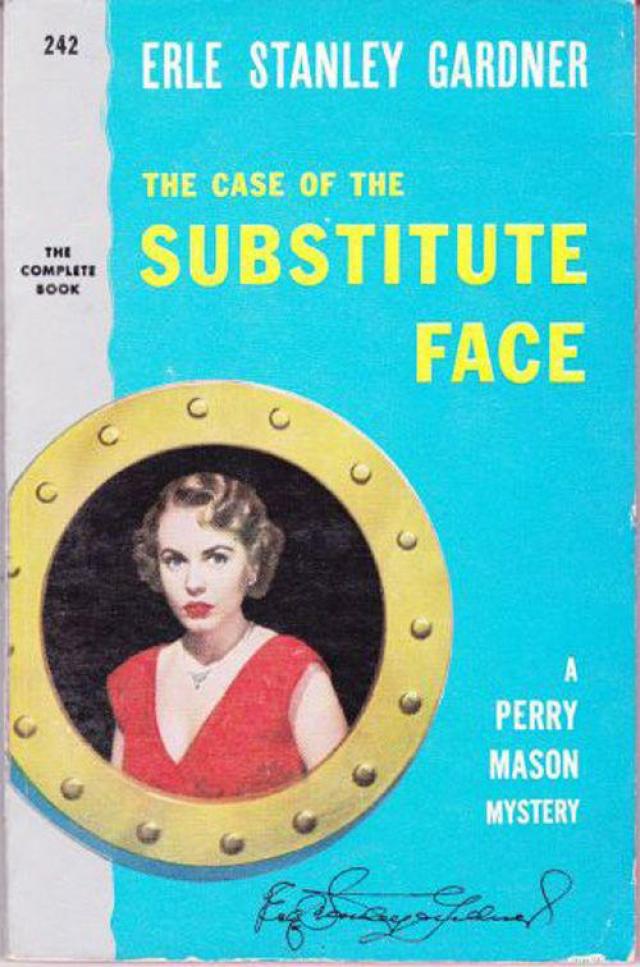
The case of the substitu.., p.22
The Case of the Substitute Face,
p.22


Della Street drove to a neighborhood picture show, and parked the car. The three of them entered the lighted foyer. Mason bought tickets. Drake said, “Well, at least I can have a few minutes’ relaxation. … Oh, Lord, Perry, I’ve seen this picture before and didn’t like it.”
Della Street parked her rented car near the hotel. Mason took Della Street’s arm, started across the pavement with her, heard Drake say, “Oh-oh!” and felt a hand grip his shoulder. He whirled around, to confront a tall man who loomed to enormous proportions in a heavy black overcoat. Thick-lensed spectacles distorted the man’s pale green eyes.
“Where you been?” he asked.
Mason turned back toward the entrance of the hotel, the hand of the big man still on his shoulder.
“Who wants to know?” he asked.
“The D.A. does.”
Mason said, “Tell him I’ve been to a picture show.”
A chunky figure materialized from the doorway, to stand at Paul Drake’s arm.
“Inspector Bodfish,” the big man introduced.
Mason unexpectedly reached across in front of Della Street, grabbed Bodfish’s right hand, pumped it up and down, and turned to the big man. “What’s your name?”
“Borge.”
“Nice name,” Mason said, shaking hands.
“We could get along without your wise cracks,” Borge told him.
“So many people can,” Mason complained. “The trouble is that I can’t. Where do we talk?”
“The D.A.’s waiting for you.”
Mason said, “Do you know, I think it would be a swell idea to let him wait.”
Borge said, “I don’t.”
“Is this a pinch?” Drake demanded.
“You’re damn right it’s a pinch,” Bodfish told him.
“On what grounds, may I ask?” Mason inquired.
“On suspicion of murder.”
Mason raised his eyebrows.
“Accessory after the fact, I believe,” Inspector Bodfish announced.
“Kidnaping,” Borge added.
“That all?” Mason asked.
“That’s all so far. Perhaps we can add resisting an officer by the time we have you booked.”
“Got a warrant?” Mason inquired, lighting a cigarette.
“We don’t need one.”
“All right,” Mason said to Della Street, “you go up to the room and wait, Della. Paul can keep you company. I won’t be …”
“They’re coming right along,” Inspector Bodfish said.
“What grounds?”
“The same grounds.”
“All three of us?”
“All three of you.”
Mason yawned, “Let’s get it over with.”
Borge called a taxi. They drove silently, Mason, Della Street and Paul Drake in the back seat, Inspector Bodfish and Borge seated on the folded backs of the jump seats, facing the trio. The cab turned into Stockton Boulevard, ran several blocks, and stopped.
“The D.A. live here?” Mason inquired.
“You know damn well who lives here,” Borge remarked.
Mason said to Bodfish, “I’d like to have your unbiased opinion, Inspector. Do you think it’s necessary for an officer to ape this hard-boiled style in order to be efficient?”
“Shut up,” Bodfish ordered.
Mason nodded to Drake. “He does,” he told the detective.
Borge led the way up a flight of stairs, across a porch, rang a bell, received a buzzing signal, pushed the door open, and said, “Upstairs, you three.”
They climbed the stairs, with no word. Mason pushed past Della Street, so that he was the first up. Scudder, who had been standing by a window, walked across to meet Mason, and said, “Perhaps you can tell us what happened here.”
“Oh, did something happen here?”
“You know it did.”
“When?”
“When you were here.”
“And when was that?” Mason asked.
“Not very long ago.”
Mason looked at the powder which had been dusted over various objects, and said to Paul Drake and Della Street, “Don’t touch anything. Paul, stick your hands in your pockets and keep them there. They’ve been frisking the place for fingerprints. It looks like a frame-up.”
Scudder’s face flushed. “You’re not in Los Angeles now,” he said. “You can’t pull that stuff and get away with it.”
Mason shrugged his shoulders.
“A man by the name of Roger P. Cartman was here,” Scudder said. “You have him concealed somewhere. I want him.”
Mason said, “You’re crazy.”
“You were here earlier this evening. You and a man named Eves decided to hide him so he wouldn’t have to testify.”
“Have you,” Mason inquired solicitously, “looked under the bed?”
“Take his fingerprints,” Scudder ordered.
“This,” Mason remonstrated, “is a damned outrage!”
Borge slipped out of his overcoat, draped it across the back of a chair, wiped perspiration from his forehead with a handkerchief. Inspector Bodfish moved in on the other side.
“Is this the way you do things in San Francisco?” Mason demanded.
Scudder said nothing.
Borge grabbed Mason’s right wrist. Mason jerked back. Borge twisted Mason’s arm under his own, pivoted his body so that Mason was pulled up against the big man’s hip.
“Wrestler, eh?” Mason inquired.
Borge, saying nothing, twisted Mason’s arm so that the fingers were spread out. Bodfish put ink on Mason’s fingers and took a series of impressions. “Hold out your other hand,” Bodfish ordered. Mason held it out.
Silently, Inspector Bodfish took the fingerprints from the other two.
“Now then,” Scudder said, “we want to know when you last saw Mr. Cartman.”
Mason said hotly, “You started this party, now go ahead and run it. Tell your big bruiser to try and make me talk—or do you use a rubber hose in this jurisdiction?”
“You mean you’re not going to answer questions?” Scudder demanded.
“I mean I’m not even going to give you a pleasant look,” Mason said.
“Perhaps you’ll tell us something,” Scudder said, facing Della Street. “You’re mixed up in this thing deep enough already. Loyalty is an excellent thing in its place, but you’re carrying it too far …”
“Don’t answer a single question, Della,” Mason ordered.
“You remember a man by the name of Cartman who sailed on the ship from Honolulu with you?”
“Don’t answer, Della,” Mason warned her.
Della Street clamped her lips together.
“You’re not answering?”
She shook her head.
Scudder swung to Drake. “You,” he said, “are on a spot. In some ways, I don’t blame you—Mason’s a client of yours. He gives you all of his business. You naturally want to protect him. But you have a living to make. They revoke the licenses of detectives who …”
“You can save it, Scudder,” Mason said grimly. “Drake isn’t going to talk. If you’d gone at this thing in a decent manner, we’d have been glad to answer questions. As it is, you can go jump in the lake.”
Scudder regarded Mason with sullen hostility. “Mason,” he said, “you’re all finished. You have a reputation for pulling fast stuff and getting away with it. This time you can’t do it. Other times, district attorneys have been willing to let things drop when you blew their cases up. This time I’m going through to a finish. I have all the evidence I need, and I’m going to get more.”
Mason lit a cigarette, and said tauntingly, “I thought you were a better lawyer than that, Scudder. You can’t make a case against me.”
“What do you mean?” Scudder demanded.
Mason said, “I’m a practicing lawyer. District attorneys don’t like me, but I have a good reputation with the public. How the hell are you going to get a jury to convict me on the testimony of an ex-convict?”
Scudder’s face was a mask. “You’re kidding yourself,” he said.
Mason went on, “Furthermore, a man can’t be convicted on the uncorroborated testimony of an accomplice. Turn that over in your mind and see where it leaves you—if you want to get technical.”
Scudder’s eyes narrowed as he regarded Mason in thoughtful appraisal. “So your accomplice was an ex-convict,” he charged.
Mason, instantly wary, said, “Now, wait a minute. Let’s not have any misunderstandings about this. I haven’t admitted having an accomplice. I’ve merely quoted some law.”
Scudder said, “Let him go, boys.”
Inspector Bodfish said, “You mean book him on an open charge or …”
“I mean let him go. Let him walk out of here,” Scudder ordered. “Turn all three of them loose.”
Mason’s bow was sardonic.
“Do I,” he asked, “get my fingerprints back?”
Scudder said grimly, “Try and get them.”
Borge wiped his forehead, blinked through the thick-lensed glasses, and said, “We aren’t done with this guy.”
Scudder said, “Shut up, Borge. That’s all, Mason. Get out.”
Mason led the way down the long flight of stairs to the street.
En route to the hotel, Mason turned to Drake and said with a grin, “Well, Paul, that wasn’t so bad as you thought it would be, was it?”
“Your grammar’s all shot to hell,” Drake said mournfully. “You mean to say, ‘Well, Paul, this isn’t as bad as you think it will be, is it?’ ”
Mason said, “I think we’re in the clear now, Paul.”
“You mean the district attorney’s going to quit?” Della Street asked.
“Lord, no!” Mason told her. “He’s just starting. That was the idea back of all this, to get the district attorney started.”
“Well,” Drake said, “you’ve got him started now.”
Charles Whitmore Dail was waiting for Mason at his hotel. “May I see you for a few moments, Counselor?” he asked.
“You can if you have that ten thousand dollars,” Mason told him, grinning.
“I have it,” Dail said, “and there’s another matter I wish to take up with you.”
“Come on up,” Mason invited.
When they were seated in the lawyer’s room, Dail looked significantly at Della Street and said, “In addition to this settlement I am making with Mrs. Moar, Mason, I had another matter I wanted to discuss with you.”
“All right,” Mason said, “go ahead and discuss it. I have no secrete from Della. Let’s get this ten thousand dollars out of the way first.”
“You have an agreement prepared?” Dail asked.
Mason nodded, and passed over a typewritten paper which contained Mrs. Moar’s signature. Dail studied it a moment, then folded it, slipped it in his pocket, opened a wallet, took out ten one-thousand-dollar bills and passed them over to Mason.
“Go ahead,” Mason told him.
“It’s about my daughter, Celinda.”
“What about her?”
“She has been subpoenaed as a witness in this case. It’s rather a minor matter. She happened to see Mrs. Newberry running down the stairs from the upper deck. Mrs. Newberry was carrying a chamois-skin money belt in her hand, and her gown was soaking wet.”
“How long was this after the whistle sounded its five blasts?” Mason asked.
“Celinda doesn’t remember clearly,” Dail said.
“What did you want to see me about?” Mason asked. “If the district attorney has subpoenaed Celinda, she should talk with him, not me.”
“I wanted to discuss Celinda’s temperament with you,” Dail said. “The child is rather nervous. She’s never been in court before and she’s read in the newspapers something of your vigorous cross-examination of Aileen Fell. I thought that perhaps we might reach some arrangement, Mr. Mason, by which Celinda wouldn’t be subjected to such a grilling cross-examination.”
Mason said, “What agreement did you have in mind?”
“Well,” Dail said, “of course the matter is rather delicate and I wouldn’t want you to misunderstand what I have in mind, but as I understand it, five thousand dollars of the money I have just paid goes toward your fees, five thousand goes to Mrs. Moar. Now, it seems to me that the very clever and adroit representation you are giving Mrs. Moar should entitle you to a larger fee. And, because she was a fellow passenger on the ship, I might be willing to interest myself somewhat in her behalf.”
“You mean to the extent of adding to my fees?” Mason asked.
“Yes,” Dail said.
Mason’s mouth twisted in a fighting grin. “I think I understand you perfectly, Dail,” he said, “and it happens I’m very glad your daughter is going to be a witness.”
“Why?” Dail said. “I thought the fact that she had seen Mrs. Moar carrying that money belt might … well, might be damaging.”
Mason said, “Never mind that. When Celinda gets on the stand, I’m entitled to show, by way of cross-examination, her bias toward the parties.
“I happen to know that Celinda found out from Belle that she’d graduated from the University of Southern California; that she sent a wireless to Rooney asking him to look up a Belle Newberry who had graduated from the University of Southern California. With that to go on, it didn’t take Rooney long to find out that her stepfather was Carl Moar. Celinda wanted to humiliate Belle Newberry. She thought the best way to do it would be to have detectives waiting at the gangplank to take Moar into custody. I have reason to believe she had made all the arrangements. Now then, on cross-examination I am entitled to show all of that in order to show bias on the part of the witness.”
“But,” Dail said, “I don’t see what that’s going to gain you. After all, it’s rather petty, it certainly doesn’t affect Mrs. Moar—”
“No,” Mason said, “but it affects Belle. When Roy Hungerford learns that Celinda was on that ship posing as a friend of Belle Newberry, asking her to attend week-end parties after the ship had docked, and all the time planning to humiliate her at the gangplank by showing that her stepfather was an embezzler, Hungerford will have a very accurate appraisal of just what your daughter considers fair play.”
“Oh, I say,” Dail protested, his face flushing, “isn’t that hitting below the belt?”
Mason said, “Dail, when I’m fighting for a client, I hit where it’s, going to hurt the most. You might tell Celinda what to expect in the line of cross-examination.”
“I’d like very much to avoid this,” Dail said.
Mason got to his feet and crossed to the door. “I feel quite certain that you would,” he said. “In fact, Mr. Dail, thinking back on it, I have a very clear recollection of the charming urbanity with which you signified your willingness to discuss a monetary settlement with Moar. Knowing the plans which you had in the back of your mind, I can only call your attention to the old proverb about chickens coming home to roost.”
Dail tried to make his exit dignified. He turned on the threshold and said, “You can’t get away with it, Mason. You’ll find that I draw some water around here. Good night!”
He slammed the door.
Mason grinned across at Della Street.
“You shouldn’t have done that, Chief.”
“Why not?”
“Celinda will get in touch with Roy Hungerford and bring things to a head tonight. She’s clever, and she wants him. She’s a shrewd campaigner.”
“That,” Mason said, “is exactly what I figured she’d do. Now, I happen to know that of all the things Roy Hungerford detests, a woman who tries to force things is his pet abomination. Designing females have been trying to give him the rush act ever since he was old enough to wear long pants. If he’s hesitating between Celinda, who’s in his set, and Belle, who’s not, Celinda will wreck all of her chances trying to rush things—and the beautiful part of it is that it will be all her doing.”
Della Street said, “Well, I hope she cooks her goose to a cinder!”
Mason opened the door to Paul Drake’s room and said, “Paul, I have something else for you.”
“What is it?” Drake asked.
“You said that Morgan Eves was acquitted of murder about two months ago in Los Angeles?”
“Yes.”
“And,” Mason went on, “Baldwin Van Densie defended him?”
“Yes.”
“Well,” Mason said, “Moar was on a jury in Los Angeles about two months ago. It was a murder case. Van Densie was defending. Moar took a dislike to Van Densie, claimed he was putting up a sell-out defense. The D. A. had a pushover with the other jurors, but Moar went to the bat in the jury room and whipped them into line. You might have your Los Angeles office look up the records and see if Moar was on Morgan Eves’ jury.”
The detective twisted his forehead into a frown. “Gosh, Perry, if that was the case, then Eves would be bound to Moar by a debt of gratitude, and if Evelyn Whiting had been going with Moar for some time, she must have … Why, dammit, Perry, as soon as she found out Moar was on the jury, trying the man she loved, she’d have brought all sorts of pressure to bear to get an acquittal.”
Mason grinned and said, “You’re doing fine, Paul. Go ahead and put through that call. And in the meantime, I’m on my way to the morgue where I will loudly proclaim that the body is not that of Carl Moar.”
“You mean to say they’ve identified the wrong body?” Drake asked.
“I mean to say,” Mason replied, “that I am going to give an interview to the press in which I will positively deny that the body is that of Carl Moar.”
“There’ll be newspaper reporters there?” Della Street asked.
“There will be before I get through talking,” Mason said grimly.
Drake, reaching for the telephone, said, “Gosh, Perry, if you’d only stayed in Bali!”
Chapter 18
Donaldson P. Scudder entered the courtroom with the air of a crusader, armed in the cause of righteousness and intent on routing the forces of evil. He failed to speak to Perry Mason. Judge Romley took the bench. The bailiff intoned the usual formula for opening court.