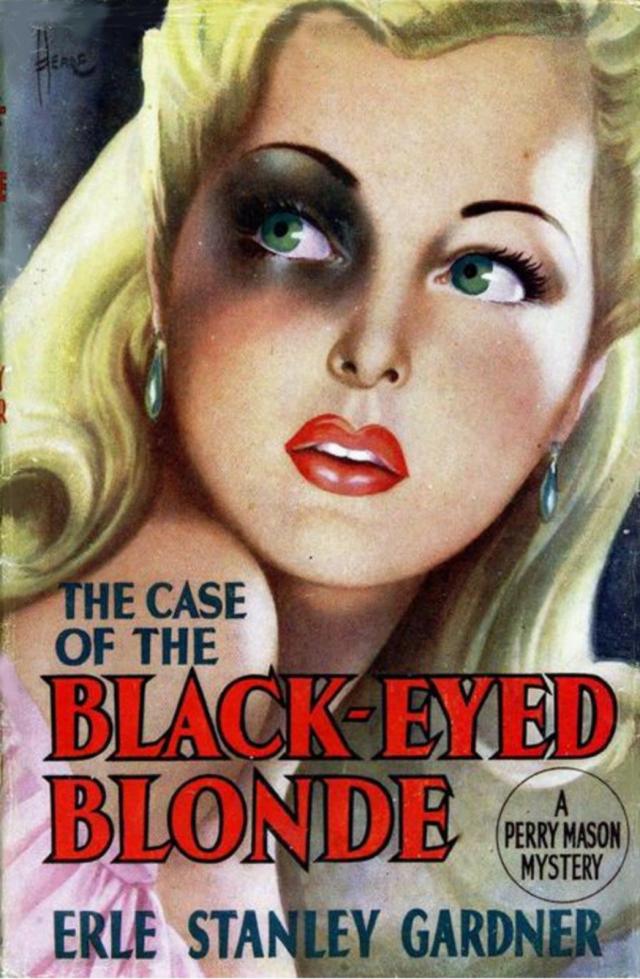
The case of the black ey.., p.12
The Case of the Black-Eyed Blonde,
p.12


“Therefore,” Judge Winters went on, “if it should appear that sometime prior to the time it began to rain the cistern had been emptied, and the water from that cistern drained down into that low place in the back yard where the body was found, it might have some bearing upon the circumstantial evidence as to the time at which the murder was committed.”
“Well, it’s not proper cross-examination anyway.”
“On that score, I think I will be forced to sustain the objection,” Judge Winters ruled. “I think that as it now stands, this is a matter of defense to be brought out by the defendant.”
“Very well,” Mason said smiling, “perhaps I can get at it another way. I believe you stated on your direct examination, Mrs. Bartsler, that you left the house about six o’clock?”
“Very shortly after six.”
“And didn’t return until well after midnight?”
“That’s right. At that time I was taken back by the officers¯thanks to someone who disabled my car so it wouldn’t run, and gave the officers information as to where I could be found.”
“Didn’t you want to see the officers?” Mason asked. “You surely weren’t avoiding them.”
“I would have preferred to have gone home under my own power.”
“But you didn’t go to your house, and weren’t anywhere near your house between six o’clock in the evening and sometime well after midnight?”
“That’s right.”
“You weren’t near the front of the house?”
“No.”
“When was the last time you were near the front of the house?”
“When I left, shortly after six.”
“When was the last time you were at the back of the house?”
“I don’t know, some time that afternoon.”
“Had you been near the drain at the cistern that afternoon?”
“Same objection,” Drumm said. “It’s still not proper cross- examination.”
Mason said, “If the Court please, the witness has been interrogated on direct examination as to when she left the house, and I certainly have a right to challenge that statement by a searching cross-examination dividing the premises into their component parts.”
Judge Winters smiled. “The objection is overruled.”
“When was the last time you were at the drain to the cistern?” Mason asked.
*At the drain?”
“Yes.”
“By that you mean the faucet at the bottom of the cistern that drains out the water?”
“Yes.”
“I haven’t been there for days. That is, I haven’t touched it, if that’s what you mean.”
“And the child, Robert, concerning whom you have testified, is the natural child of you and your deceased husband, Robert Bartsler, a posthumous child born some four months after your husband’s purported death?”
“Yes.”
“Had you ever advised Jason Bartsler that he was a grandfather ?”
“Objected to as incompetent, irrelevant, and not proper cross- examination,” Drumm said.
“Sustained,” Judge Winters ruled. “Since the question quite evidently relates to some conversation that would necessarily have been held almost three years ago.”
“No, Your Honor,” Mason said, “the question is whether she ever advised her husband’s father of the birth of the son.”
Judge Winters’ face showed surprise. “Surely, Counselor, you don’t contend … Oh well, the objection is overruled.”
Helen Bartsler said in a clear, calm voice, “No, I never told him. He is a selfish, domineering, heartless parent. He’ had no love for his son, no love for me, and never recognized me as one of the family. I considered the birth of my son none of his business.”
Judge Winters leaned forward, asked incredulously, “You mean the man never knew he had a grandson?”
“I never told him he had one,” Helen said coldly.
Judge Winters shook his head. “Proceed,” he said to Mason, but his eyes remained on the witness.
“And after your son was kidnapped, did you get in touch with Jason Bartsler?” Mason asked.
“No.”
“And you had no information leading you to believe that Mildred Danville was going to be at your house at San Felipe Boulevard that evening?”
“No. I understood she was coming to the residence of Ella Brockton at twenty-three twelve Olive Crest Drive.”
“Thank you,” Mason said. “That is all.”
Judge Winters leaned forward. “The Court has a few questions. Mrs. Bartsler, do I understand that because you felt Mr. Jason Bartsler had never received you into the family, you undertook to revenge yourself by concealing from him the birth of your son?”
“No, Your Honor, I didn’t conceal it. I simply never told him about it. The child’s birth certificate was duly and regularly recorded.”
“But you never told him about it?”
“No.”
“In order to revenge yourself for the treatment he had extended to you?”
“No. I did it for the best interests of my son. His grandfather is a cruel man. He prides himself upon being cynical. He is cynical, sneeringly so. He has no knowledge of the finer emotions. He is always looking for an ulterior motive. I didn’t want Robert’s boy to judge his father by any such standards. I didn’t want him to know his grandfather—for the boy’s own good.”
“And that was your only reason?”
“Yes, Your Honor.”
Judge Winters sighed. “Very well,” he said in a voice that showed he was far from convinced. “The prosecution will call its next witness.”
Drumm began to fill in time with routine witnesses, a ballistic expert who testified to firing test bullets from the revolver which had been introduced into evidence, comparing them in a comparison microscope with the fatal bullet which had been recovered from the brain of Mildred Danville. They were, he announced, identical. The fatal bullet had been fired from this revolver.
A fingerprint expert took the stand, testified to examining the revolver for fingerprints, showed enlarged photographs of fingerprints which had been found upon the weapon. “Fingerprints,” he announced, “which were all made by one person.” He then introduced photographs of the fingerprints of the defendant, and at long and tedious length, pointed out points of similarity. “There were,” he explained, “no fewer than seven clear fingerprints found upon the gun, each of which had so many points of similarity with those of the defendant that it was possible to state beyond any peradventure of doubt that those fingerprints had been made by the defendant. And as to certain smudged prints on the gun, while they could not be positively identified, there were enough points of similarity to indicate the strong probability that they also were those of the defendant, that there was no evidence whatever that would indicate they were made by any other person. In other words, that all of the fingerprints on the gun that could be identified had been made by the defendant, and those that could not be identified gave no indication of having been made by any other person.”
It was plain that Judge Winters was very much impressed by this line of testimony, and he carefully followed the tedious testimony through the long afternoon, checking the different fingerprints, and making his own comparison as to points of similarity.
At four-thirty, court adjourned until the next morning.
Mason, walking back to his office with Della Street, said, “Well, that’s the way it is, Della. We know good and well that Helen Bartsler is lying. She must have opened the drain on that rain water cistern. There’s no way of proving her a liar, particularly in view of the fact that the police flashlight photographs don’t show the background clearly enough to show whether that faucet is open, and water draining out or not. I might have trapped her into admitting she opened that faucet if Judge Winters hadn’t gone ahead and pointed out what I was getting at and the purpose of the question. That tipped her off and she’d never have admitted turning on the drain faucet after that.”
“Do you think she’s guilty of the murder?” Della Street asked.
“It’s hard to tell. We know she’s lying. She’s lying about the telephone conversation with Mildred Danville, lying about knowing that Mildred was coming out there for a ten o’clock appointment, probably lying about the time she left the house. And she is quite probably lying about the drain faucet on the rain water cistern in order to bolster up her other lies.”
“Why do people lie like that?” Della Street demanded indignantly.
“To save their own skins,” Mason said. “They do it many, many, many times in murder cases. You take Helen Bartsler, for instance. She may not have had anything to do with the murder of Mildred Danville; but she knew that Mildred Danville was to be out there at ten o’clock. Sometime around ten o’clock she went back to her house and found Mildred lying face down in the mud, and decided she had better get out of there and build herself an alibi. And there was something about that conversation which she and Mildred had over the telephone when the ten o’clock appointment was made that she wanted to keep out of the evidence. Therefore, she went out to her friend, Ella Brockton, and they fixed up an alibi. There’s just a chance we can break that alibi by trapping Ella Brockton. But it’s one chance in a hundred.
“Then there’s another angle. How did Lieutenant Tragg know a body was out there? It probably was an anonymous telephone call—but who placed it? And why? And what is the reason Mildred Danville became so attached to Helen’s son ?
“What we’ve got to do is to find out what happened, and why it happened, and the only way we can do that is by detective work and logical reasoning. Otherwise, we’re just groping around in the dark, asking questions that have no particular purpose back of them, going up and down blind alleys.”
“I see what you mean,” Della Street said, “but how are we going to find out what did happen?”
“In the first place,” Mason said, “we’ve got to find out why Mildred Danville parked her car so long at that particular place. We’ve also got to find out why Diana’s account of how she sustained the black eye had such an effect on Mildred. Why do you suppose a black eye should have caused so much excitement?”
Della said, “It must have been because he was in Diana’s room, searching. That must have been the significant part … . Something in there caused a lot of excitement.”
“But what?”
“Search me.”
“What are you going to do.?”
“Tonight, we’ll try to get possession of that diary.”
“Chief, that’s dynamite!”
“I know it is, Della, but it’s got to be done. I know now how a doctor feels when he’s sitting by the bedside of a patient he’s powerless to save. After all, Della, a lawyer is sort of a doctor of justice. Hang it! If I could only reconstruct some of the things that happened the afternoon of the twenty-sixth I should be able to find some flaw in the prosecution’s case—or else convince myself my client is guilty.”
“Chief, can’t you do something with Helen Bartsler’s alibi? If Helen Bartsler knew Mildred was dead … Well, why did she go to the apartment?”
Mason said, “It must have been to try and see Diana, but she could have … Wait a minute!” Mason said frowning. There’s one thing she could have done.”
“What?”
“Dropped that letter to Diana into the mailbox.”
“Of course!” Della exclaimed. “Perhaps that’s the only reason she went there at all. But why?”
“She wanted Diana to get the letter. But where did Helen get it, and how did she get it? Had Mildred given it to her … ? Now wait a minute. That letter must have been written along in the afternoon before Mildred had talked with Diana on the telephone—and yet Helen must have put that letter in the mailbox at Diana’s apartment. Now why was it so important that the letter should be found in Diana’s mailbox?
“Hang it! That’s the disadvantage of groping around in the dark. We’ve simply got to get the case worked out between now and tomorrow morning. We’ve got to know what’s back of all of these various moves. We’ve got to reconstruct what was done. Come on, Della, let’s go start Paul Drake working.”
Chapter 15
PAUL DRAKE looked up from notes on which he was working as Mason and Della Street entered the office.
“Hello, Perry. How’s the case coming?”
“It isn’t coming. It’s going.”
“Well, I’ve got some miscellaneous information for you.”
“Shoot.”
“Mrs. Jerry Krason, a neighbor of Ella Brockton, lives out on Olive Crest Drive at twenty-three-o-nine. That’s right across the street from Ella Brockton’s house. She’s a nosey old gal with a tongue that’s hinged in the middle of her mouth and clacks like one of the old-fashioned police rattles, but she’s smart and observing, and hard to rattle.”
“What,” Mason asked, “does she know?”
“Apparently quite a bit, Perry. She’s been taking an interest in what’s been going on across the street ever since the child left. She says that on the night of the twenty-sixth, the house was dark, and she knows there wasn’t anyone home up until about nine o’clock. At about nine o’clock when it was raining cats and dogs, Ella Brockton came home in a taxicab; that she was there alone until about eleven-fifty. Helen Bartsler drove up and parked the car and went inside, and that almost immediately another car parked down the street a ways and a man came up and raised the hood of Mrs. Bartsler’s car.”
“Your operative?” Mason asked.
“Uh huh, taking out the distributor head so he could go and telephone for instructions.”
Mason grinned, “Well, that’s a break.”
“It’s going to be next to impossible to use it in court though.”
“Why?”
“There’s a regular feud between Mrs. Krason and Ella Brockton. Mrs. Brockton had the Krasons arrested for trespass, and went to the authorities to make a complaint that she was a cat poisoner. There’s some circumstantial evidence pointing to Mrs. Krason, I guess. It’s a regular neighborhood feud. Another thing, Perry, I’d hate like the devil to have it come out in court that one of my men had tampered with an automobile in order to get a chance to telephone in a report. Of course under the circumstances that was the only thing he could have done—the only way he could have let us know. He intended to take the distributor head, go telephone us, and then in case the woman was still in there when he got back, he could replace the part and that would be all there’d be to it. If she was trying to get the car started, he could come along as a good neighbor who happened to be parked near by, start tinkering with the automobile and slip the commutator into place while he was pretending to inspect the wiring.”
Mason said, “Anyway, it gives me a break. So far the breaks have been going all the other way. That gun has Diana’s fingerprints all over it. What gets me, is that I can’t figure the thing out. I can’t tell what happened. Why should the fact that Carl Fretch was in Diana Regis’ room and hit her in the eye, cause such terrific commotion?”
“You must be barking up the wrong tree on that,” Drake said.
“I can’t be, Paul. When Diana first told Mildred about her adventures, it was just a nice little gossip party. Then Mildred had a chance to think things over for four or five minutes—and evidently became all excited, made this ten o’clock appointment and called Diana back. Carl Fretch and the black eye he gave Diana must have some hidden significance. What else is new, Paul? Did you get the name of the garbage collector?”
“The one who has the garbage contract is a woman,” Drake said “and a darn smart woman at that. She … ”
“I don’t want her,” Mason interrupted. “Not if she’s smart. Who’s the garbage collector?”
“The one who actually does the collecting in that district is a chap by the name of Nick Modena. He has greedy eyes.”
“He’s my man,” Mason said. “Where do I locate him?”
“Go on down to your office and I’ll have him located for you within half an hour. He’s out on the job somewhere.”
“Okay. What else is new?”
“I’ve got a little blonde number who has made a contact with Carl Fretch.”
“Any date?”
“Not yet. Give the boy time.”
“He doesn’t need time.”
“This operative is good,” Drake said.
“Can she take care of herself?”
Drake grinned. “Any place, any time, anywhere.”
“Strong?”
“She weighs about a hundred and twenty,” Drake said, “and she can look so demure that you’d think she’s right fresh off the pantry shelf, but she knows all of the answers and most of the angles.”
“Suppose the party gets rough?”
Drake said, “For a while she was a boxing female champion—so called. Used to put on an exhibition bout with a male sparring partner. And she’s good. She wants to know how much she has to take in case there’s a date.”
“Well,” Mason said judicially, “she isn’t hired just to go out and act coy. On the other hand, I don’t want to put her in a position where she has to take too much. She’s going out to get information. Tell her to get what information she can, but—oh, tell her to use her own judgment.”
“She’s pretty good,” Drake said. “I’ve had her on some other cases. She’ll put up with a lot if she’s getting information, and she can usually get it.”
“Okay. I want to know something about Carl Fretch. I want to know what the police said to him, and what he said to the police, and what was said to Jason afterward. It’s all fresh in the boy’s mind, and he should talk.”
“He should,” Drake said, “He’s a funny one.”
“Anything else?” Mason asked.
“Helen Bartsler seems to have fixed things up with Grandpa. She and Jason got together right after court adjourned. They’re still talking.”
“Oh, oh,” Mason observed. “That might mean something. Who made the break, do you know?”
“Jason broke the ice. She was distant at first, then he said something and she warmed up a bit.”