

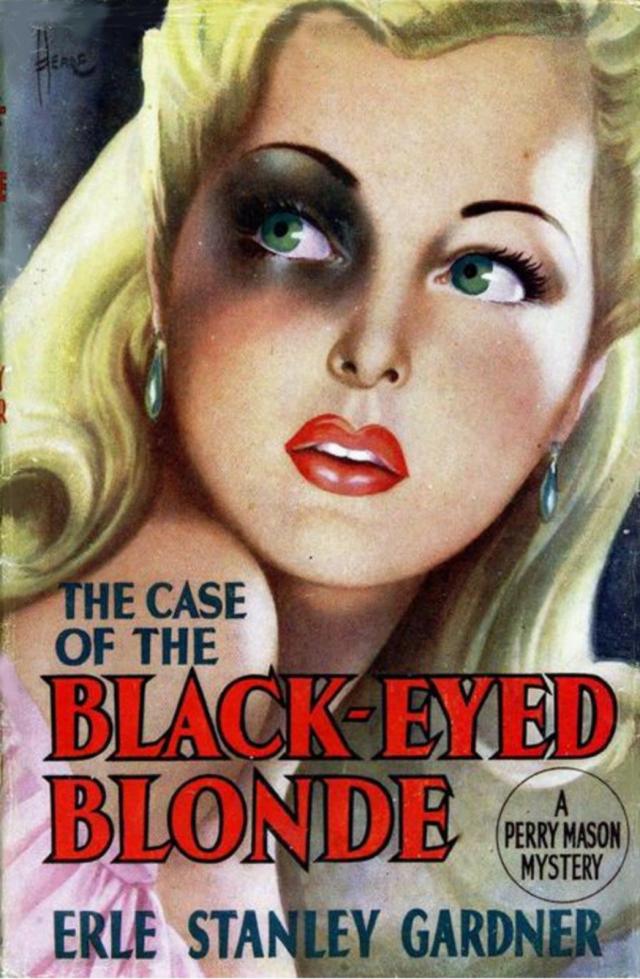
The case of the black ey.., p.9
The Case of the Black-Eyed Blonde,
p.9


“Did he see this chap come down the fire escape?” Mason asked.
“No, he didn’t. The fire escape was on the alley and where my man was parked, you couldn’t see that. The law came there right after this bird went in and the relief operative started his car, signaled you with three blasts, and then got the hell out of there, so then this bird took over. Holcomb got rough with him trying to pump him. The guy acted dumb, said it was a routine tailing job, that he was to pick up a blonde with a black eye when she came out and he hadn’t paid much attention to people going in. He’s smart—a hell of a lot smarter than Holcomb, so he made it stick.”
“What did you do with Holcomb?”
“Well, after he crabbed around that we weren’t co-operating with the police, I woke up enough to get sore and put on a counter-offensive. That got rid of him—and I think scared him a little.”
“Then what, Paul?”
“Well, as soon as I learned it was Jason Bartsler’s car, I went up to the office and got hold of the reports which had come in from the operatives who were covering the Bartsler residence. Seems that a man who apparently was Carl Fretch, Jason Bartsler’s stepson, went out in a car and came home in the small hours of the morning in a taxicab.”
“Pass that information on to Sergeant Holcomb?”
“I did not,” Drake said. “Holcomb doesn’t even know that we were watching the Bartsler residence. He did spot my operative down in front of Diana Regis’ apartment house so I had to kick through on that. The other stuff I kept mum about.”
“Anything else happen out at Bartsler’s?”
“I take it, from what Sergeant Holcomb let slip, that you had rather a hard night, Perry.”
“What about the diary that’s missing?” Drake asked.
“It’s missing.”
“It just occurs to me,” Drake warned, “that the police are going to get really tough about that.”
“Let them get tough.”
“I have an idea there’s something in the diary about Diana Regis’ past life—something that will give them a good angle for an investigation.”
Mason said, “Phooey! They have an idea that they’ll find something prejudicial to Diana they can feed to the newspapers. They couldn’t get any of that stuff admitted in evidence and they know it, but they can dish it out to the newspapers and let the newspaper reporters smear it all over the papers. Then when the girl comes up for trial, the jurors will remember all about what they read in the papers. It’s an old police trick by which they get stuff before the jury they couldn’t possibly put in as evidence in the regular way.”
“I’m just telling you,” Drake said, “that Holcomb is really worked up about this thing, feels that this diary slipped through his fingers by some hocus-pocus, and he’s really going to town on it. If you have that or know where it is, my own suggestion is that you’d better run for cover.”
“The hell with Sergeant Holcomb,” Mason said. “If there’s anything shady in the past life of my client, it certainly doesn’t have anything to do with this murder case.”
“How do you know it doesn’t?”
“Because it couldn’t.”
“It might furnish a motive.”
“Don’t be silly,” Mason said. “Suppose there was a diary kept by Mildred. And Mildred and Diana were old friends, and they’d been sharing an apartment. Why should Diana suddenly want to kill her because of something Mildred knew?”
“Why should she want to kill her anyway?” Drake asked.
“She didn’t.”
“The police think she did.”
“Bunk! … . Paul, according to a letter which Mildred wrote Diana and which was probably the last thing she ever wrote, Mildred had taken Diana’s purse because a cop had pinched her for some minor violation and asked to check up on her driving license. She didn’t have one, so pulled the old gag that she’d left it in her apartment, and the cop decided to go up to her apartment and check with her. Now I want to find that cop.”
“Any idea what time the thing happened?”
“Probably sometime around the first part of the afternoon.”
“Yesterday?”
“That’s right.”
“You don’t know where?”
“It was evidently some place within a block or two of the apartment because Mildred evidently told the cop she’d just run down to do a little quick shopping and had forgotten to take her purse with her. The cop went back to the apartment with her and she naturally had to pick up Diana’s purse and take it along because that’s where Diana’s driving license was, and Mildred was passing herself off, for the time, as Diana.”
“I’ll see what I can find out,” Drake said, dubiously.
“And I want a complete check-up on the arrivals and departures at the Bartsler residence.”
“Driving a car?” Mason asked.
“His own.”
“First and last, seems to have been a lot of activity.”
“There was.”
“Do you know what time it started to rain last night, Paul?”
“Officially it started raining at seven forty-seven. That rain figures in the police theory of the murder, you know, Perry. The position of the body and the clues on the ground show that death took place sometime after the rain had started.”
“Oh, sometime around an hour to an hour and a half. They’re fixing the time of death, I understand, as between eight and nine.”
“Just how much of a case have they got against Diana?” Mason asked.
“It’s pretty early to tell much about it. I get most of my information as to police activities through a friend on the newspaper who gets his stuff from the cops. I can tell you this much, Perry, the case they have against her is pretty strong. There’s mud on Diana’s shoes, and an analysis of that mud shows it’s exactly the same soil as that in which the body was found. There are footprints near the body and those footprints were still sufficiently well preserved when the police found the body so they can pretty well pin them on Diana. All of that stuff doesn’t make too strong a case, but they’re working on the thing and may uncover some more evidence. The police theory is that Mildred Danville started to run from Diana when she realized Diana was trying to kill her; that Diana opened her purse, pulled out a gun and shot; that she dropped her purse when she fired; that after she had killed Mildred she went down to the body, bent over it and took something from the body—something that the killing was over, and the police would like to claim it was that diary— so you can see that letter you found becomes pretty important.”
“You know what was in that letter?” Mason asked.
“Sure, it’ll be in the newspapers tonight, a complete facsimile of it.”
“It’s evidence,” Drake said. “They’re holding it as such.”
“Of course,” Drake went on, “if they should claim that letter is a forgery they’ve got a lot of stuff to back them up—the fact that the letter was found in your possession rather than in the mailbox, and that you’re acting as her attorney and all that stuff.”
“I know,” Mason said, “but once we can prove that Mildred picked up Diana’s purse it’s up to the police to prove that she gave it back. You get busy and see if you can find that cop who made the pinch.”
“If you find him,” Mason warned, “get a statement out of him. Sew his testimony up before Holcomb tampers with his evidence.”
“Think Holcomb would do it?”
“You’re damn right I do. Holcomb would do anything to get a conviction in this case. He’s mixed up in it too deep himself.”
“I think so.”
“It’s a little difficult with things happening the way they are. They may spot my men.”
“If they do, they’ll think it’s the police,” Mason said. “Stay with it. Also keep a check on the place where Mildred and Diana had their apartment. I want to know what goes on there.”
“So would I.”
Mason said, “Now that Holcomb’s mixed up in the case he’ll move Heaven and earth to get hold of that diary. He’d like to smear Diana’s reputation all over the newspapers. And watch the way they’ll see that the newspapers have a chance to play up the fact that she has a black eye.”
“Why?”
“Oh, you just don’t associate a black eye with a woman of respectability,” Mason said. “And there’s a big section of the reading public that will think that a girl who has a black eye is fully capable of murder. The thing I can’t figure out is why Diana’s black eye got Mildred so excited. It must be because Carl Fretch had gone through Diana’s purse. Now if Mildred had borrowed this purse on some prior occasion, we can begin to see some reason for Mildred’s excitement. But suppose there’s some other reason. Suppose it was something other than Carl … .”
The telephone rang, the unlisted telephone to which no more than half a dozen persons in the city had the number.
Mason himself picked up the receiver, said, “Yes. Hello. What is it?”
Paul Drake’s dry laconic voice came over the wire. “Looks like you lose, Perry.”
“What?”
“The police have found the murder weapon.”
“Where?”
“Diana Regis’ apartment shoved down in the bottom of the dirty clothes hamper.”
Mason said angrily, “Then it was planted there. That’s what Carl Fretch was doing when … .”
“Take it easy, Perry, take it easy,” Drake said. “You haven’t heard all of it yet.”
“Give me all of it then.”
“It’s got Diana’s fingerprints all over it. And those are the only fingerprints on the gun.”
“That all?” Mason asked.
“Isn’t that enough?”
“Too damn much,” Mason said, and dropped the receiver back into place.
Chapter 11
“What,” Mason asked, “is there in your past life that you want to conceal?”
“Why, nothing.”
“You’re certain about that?”
“Yes.”
“You’re divorced?”
“Yes.”
“You get the divorce or did he?”
“I did, cruelty.”
“Hang it,” Mason said irritably, “you try holding out on me all the time. Can’t you realize you’re just cutting your own throat when you hold out information on your lawyer?”
“I guess,” she admitted somewhat ruefully, “I should have told you about the gun.”
“Mr. Mason, please don’t.”
“Mr. Mason, I’ve always told you the truth, only—well, about the gun, I didn’t because I thought it was Mildred’s, and that perhaps she’d been intending to do something, well, desperate.”
“How do you know it was Mildred’s?”
“I’ve seen her with it.”
“When?”
“The last two or three weeks. She’s … . I know she carried a gun.”
“Why?”
“I don’t know.”
“When did you discover this gun?”
“Last night.”
“When?”
“Right after I left Miss Street’s apartment the first time. I decided I’d go down to my apartment and see if there was anything there—any further message from Mildred. I took a taxi.”
“What time did you get there?”
“I don’t know.”
“How soon after you left Miss Street’s apartment?”
“Not over fifteen minutes.”
“Was it raining?”
“Yes, it had just started to rain, perhaps twenty minutes earlier.”
“Then where was the gun?”
“Lying on top of the dresser.”
“What did you do?”
“I naturally wondered what it was doing there. I picked it up and looked at it and then put it in the dresser drawer and then thought that perhaps … well, I didn’t know … I didn’t want to have it found right on top so I went over to the dirty clothes hamper and put it in there.”
“Why?”
“I don’t know. I just was worried about Mildred. I thought she might have got into some sort of trouble. She told me she was going to try something rather desperate.”
“Then what?”
“Then I started back to Della Street’s apartment, but it was raining and—well, I was worried about Mildred, wondering if she’d got into some sort of trouble, so I took a taxi and went right out to San Felipe Boulevard.”
“How long did that take you?”
“It was quite a long ride from my apartment. It must have taken twenty-five minutes or half an hour.”
“Do you know what time you got there?”
“It must have been around half past eight or quarter to nine.”
“And what did you do?”
“Just what I told you, Mr. Mason. I looked around for a while, went over to my car and waited, then I got out and walked around back, and then I found Mildred’s body and then I got in my automobile and drove back to try and find Miss Street, and she was gone and … . Well, that’s just the way it happened.”
Mason said, “Now listen, Diana, let’s be fair about this thing. When Mildred’s body was found it was lying face down in the mud. There were tracks where her fingers had dragged through the mud. Now your story simply can’t be true, because if that gun was actually used as the murder weapon the killing must have taken place after it started to rain.”
“I can’t help it. I’m telling you the truth, Mr. Mason.”
“How much did you tell the police?”
“Good Heavens!” Mason said angrily. “Can’t you play fair with me? How much did you tell the police?”
“I told you to keep your mouth shut.”
“I know you did, but they—well, it was all right until they found that gun, and then they were so nasty and sneering and triumphant, and—and my fingerprints were on the gun and they started to bully me. Well, I told them the truth.”
“But,” Mason said angrily, “it can’t be the truth, Mildred wasn’t killed until after it started to rain.”
“Look here,” Mason charged, “you’re trying to protect someone. You found that gun some time after you’d discovered the body, not before. You hid it and … ”
“No, Mr. Mason, honestly. I swear.”
“How,” Mason demanded, “could that gun have been used in committing the murder if the murder was committed after it started to rain, and … wait a minute!”
“I’m telling you the truth, Mr. Mason.”
Mason said, “She says she found the gun before she went out to San Felipe Boulevard. That means that she found the gun very shortly after it began to rain.”
“But the murder couldn’t have been committed then,” Della Street said. “The marks of the hand dragging through the mud show that it had already started to rain when the murder took place.”
“Then she’s lying,” Della Street said bitterly.
“No,” Mason said, “there’s one chance, one slender theory that may give us a fighting chance. The girl may be telling the truth.”
“I don’t see how.”
“I wouldn’t know, why? What’s that got to do with it?”
“Well?” she asked.
“And yesterday when it was apparent that it was going to start raining the natural thing to have done would have been to open the drain faucet in the cistern and let the old water drain out. And that water would naturally run down into the low part of the backyard where the body was discovered so that the murder could have been committed before the rain started, and there still would have been mud there that would have left the tracks of the clutching fingers——”
“Chief!” Della Street exclaimed. “I remember now. You said the faucet was open when we were out there!”
“Could I be a witness?”
“Did you notice the water running out through the faucet?”
“There you are,” Mason said.
“But how about you? Couldn’t you be a witness?”
“Not while I was also a lawyer for the defendant—and even if I were a witness, would the jury believe me? No, Della, we’ve got to rely upon the police photographs. They should show that there is a stream of water coming down from the faucet on the cistern.”
“Did you tell Diana?” she asked.
“Why? It would give the girl some hope, something to cling to, something … ”
“And the police would find out she was clinging to something, work her over until they found out what it was, and we’d be licked before we started. No, Della, the only hope we have of using that theory is to bring it as a stunning surprise to the prosecution, let them build up their entire case on the theory that the murder was committed an hour or so after the rain started, and then spring this on them to show that it could have been committed before. That’s the only way we can ever account for the time element on the finding of that gun.”
Delia Street gripped his arm. “Gosh, Chief! I’m so excited! If it will only work!”
Mason started the car, said grimly, “It’s darn near got to work. There was some sort of bond between Diana and Mildred that made Diana intensely, fanatically loyal to her friend. She saw Mildred’s gun and hid it—and didn’t tell me. She found Mildred’s body—and told no one but tried to get me to go out with her. She’s playing a deep game.”
“Find out what the trouble was in her past life?” Delia asked.
“No.”
“Why?”
“Because I was afraid to have her tell me about it. Once she told me, it would be easier for her to start talking the second time and tell the police all about it. I gave her a brush-off for holding out on me, and then left. She’ll grit her teeth now and hold out on the cops until doomsday—or let’s hope so.”
Chapter 12
THE preliminary hearing in the case of The People versus Diana Regis found the prosecution wearing that complacent smirk which indicates an airtight case. After suffering several ignominious defeat at the hands of Perry Mason, it was a triumphant moment when Claude Drumm, the chief trial deputy, had at last a case so bulletproof that it would try itself, a case that simply couldn’t be upset no matter which way the cat jumped.















