

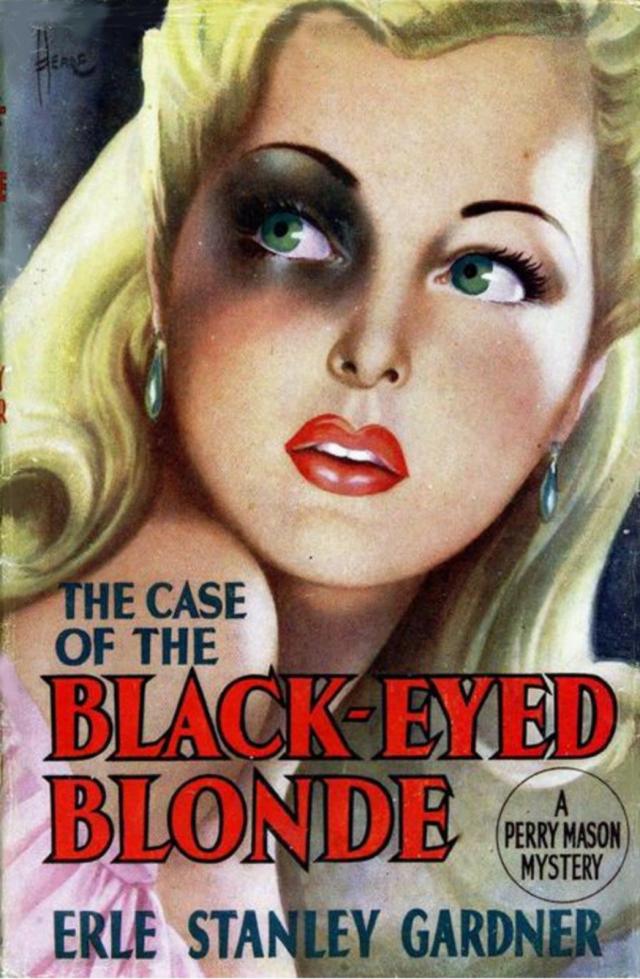
The case of the black ey.., p.17
The Case of the Black-Eyed Blonde,
p.17


“By taking him to dinner, I suppose,” Mason said.
Drake chuckled. “That’s what I thought,” he said. “I’ve invited him to join us for dinner.”
“You and your stomach,” Mason groaned. “What’s the address?”
“Staying with a sister name of Ruffin, eleven ninety-one Kill- man Boulevard. And now if you’ll excuse me, Perry, I think Mr. Thurston is hungry, and I wouldn’t want to let him out of my sight. I’m ordering nice thick, juicy tenderloin steaks with French fried potatoes, cocktails, head of lettuce salad, mince pie a la mode—and on the expense account. Oh boy! How’s your chocolate bar setting?”
There was a click at the other end of the line.
Mason hung up the telephone, said to Bartsler, “Well, 7 think this woman either had your grandchild, or knows who did—that is, if you really have a grandchild. I wanted to find out what was back of her visit, and that’s the only reason I called on you.”
“We’ll find out, all right,” Bartsler said.
“And what was Carl Fretch doing in Diana’s apartment?” Mason asked.
“Says he wasn’t there,” Bartsler said. “He still sticks with the story that he was out with a girl. They parked the car and got out. Someone stole the car. He finally kicked through with the name of the wren he was with. Police checked up. She confirmed his story—so there you are.”
Mason said, “I’ll be going. If you find out Carl talked to this Mrs. Kennard, I’d appreciate it if you’d let me know.”
“I will,” Bartsler promised, “but when I locate the woman I’m not going to tell you where she is until after I’ve talked with her. It’s each man for himself on that end of it.”
“I understand,” Mason said. “And now we’ll say good night. We have quite a bit of work to do.”
Jason Bartsler escorted them to the door. “I think we’re on the homestretch now,” he said as he closed the door.
Out in the car, Della said, “Not a word about patching up his differences with Helen.”
Mason nodded, his manner preoccupied.
“Was that Paul who telephoned?”
“Uh huh.”
“Had he located Mrs. Kennard?”
“Thinks he had.”
“We going out there now?”
Mason spun the car into a tight turn at the corner. “Going out there right now,” he said.
Della Street sighed. “Hand me one of those chocolate bars, will you, Chief?”
Chapter 19
MASON swung his car into Killman Boulevard. Della Street kept track of the numbers. “This is the nine hundred block … the ten hundred block … the eleven hundred block … that must be it, the light stucco house over there on the left.”
Mason shot the car in to the curb, switched off lights and the ignition. The night was cold and clear, and the stars blazing down in steady splendor seemed to be drawing the earth closer to them.
Mason walked up the steps with Della Street, rang the bell.
Steps sounded behind the closed door. Mason, listening intently, heard the altering tempo of those steps, a heavy step and then a light one, a heavy then a light, a heavy then a light.
Della Street’s fingers touched his hand. “Gosh, Chief,” she whispered, “it’s someone who limps.”
The door opened.
A somewhat heavy-set woman with graying hair, keen determined eyes from which radiated a network of fine lines that gave to her face a somewhat benevolent expression, smiled at them.
“Mrs. Ruffin?” Mason asked.
“No,” she said, “I’m sorry. Mrs. Ruffin is out.”
Mason let his face show disappointment. “That’s too bad,” he said. “I wanted to see her about a matter of business—about some property she’s going to inherit.”
“Property?” the woman asked, fairly pricking up her ears.
Mason nodded. “A relative who … well, perhaps I’d better wait until Mrs. Ruffin … ”
“I’m Mrs. Ruffin’s sister, Mrs. J. C. Kennard. Perhaps if she’s going to inherit property, I’m going to inherit some, too.”
“Oh, are you Mrs. Kennard?” Mason asked, taking a notebook from his pocket and turning the pages. “Why I had you listed as living on Lobland Avenue.”
“Come in, come in,” the woman beamed at them. “I am visiting my sister for a few days. She hasn’t been well, and—well, you know, nothing that confines her to the house, but just nervousness, and I thought I’d run over and do the housekeeping for a while.”
“I see,” Mason said, permitting Mrs. Kennard to escort Della Street and him into the comfortable although somewhat cheaply furnished living room.
“Do sit down,” Mrs. Kennard urged, “and tell me about it. I wonder if it was Uncle Douglas. We always thought he might have some property.”
Mason smiled. “Well, simply in order to follow the routine procedure in such matters, Mrs. Kennard, let me ask you some questions before I answer any—not that I have the slightest doubt as to your identity, but then you know there’s a certain procedure we have to follow in these things.”
Mrs. Kennard folded her hands on her lap, beamed at him. “Go right ahead, young man, go right ahead.”
Mason said, “You’re a widow, Mrs. Kennard?”
“That’s right. Mr. Kennard died in nineteen hundred and thirty-four.”
“You’ve never remarried?”
“No.”
“And your sister?”
“Mrs. Ruffin is divorced.”
Mason frowned. “That’s bad.”
“Why?”
“Because so many times divorce decrees are obscurely drawn. Property settlements aren’t carefully worked out, you know, opportunities for lawyers to come in and claim that the property hadn’t been all divided.”
“But wouldn’t any property that she received by an inheritance be her separate property, and something her husband couldn’t touch in any event?”
“That’s right as a general proposition,” Mason said, “but we have an instinctive dread of running into divorce cases, although it isn’t so bad when the property is coming to the wife, and it’s the husband who’s divorced. When it’s the other way around, there are quite frequently a lot of complications. You haven’t any children, Mrs. Kennard?”
“No.”
“And your sister?”
“She has a boy.”
“Over twenty-one, or under?”
“Oh, he’s over. My sister’s older than I am, and her boy’s—well, let me see, Ralph must be past thirty now. He’s married and has one child.”
“Your sister has some occupation?”
“Well, not right at present. She did work in a candy company up until two months ago.”
“And you?”
She smiled. “I’m a working woman.”
“May I ask what occupation?”
“Well, for the last few months I’ve been keeping a nursery. You know, so many people are working now, and don’t have any place to leave their children, and it’s almost impossible to get competent domestic help. Well, I’ve built up rather a good business.”
“That’s recent?”
“Oh, yes.”
“Very interesting,” Mason said. “How did you get your clientele, Mrs. Kennard?”
She laughed and said, “I just put a want ad in the paper, and you’d be surprised how many women brought their children to me. Of course, they made an investigation first, then came and talked with me. But I didn’t have any trouble at all getting business.”
“That’s quite interesting, indeed. And among the clients was there one named Mildred Danville who was murdered a few nights ago?”
Mrs. Kennard had been smiling, the genial, affable smile of one who wishes to make a very good impression, and is anxious to co-operate in giving information. When that question hit her with the impact of a blow, she tried to hold her face so that it wouldn’t change expression. But the result was a ghastly travesty.
“And,” Mason went on, “she left with you a child whose name was Robert Bartsler, and because she didn’t give you exactly the most convincing story, you became rather concerned and looked in the telephone directory to find if you could locate someone by the name of Bartsler. You found a Mr. Jason Bartsler, and you rang his telephone. Now suppose you tell us what happened after that, Mrs. Kennard.”
Mrs. Kennard blinked her eyes, her tongue moistened her lips, but she said nothing.
Mason’s smile was affable. “Really, Mrs. Kennard, I think it will be much better if you tell the truth, and put your cards right on the table. After all, you know, a murder has been committed, and your connection with it puts you in a very, very serious position.”
Mrs. Kennard said, “You’re crazy!”
“Suppose,” Mason went on, “you tell us where the child is, Mrs. Kennard.”
“I don’t know.”
“Will you deny that a child named Robert Bartsler was left with you?”
“I don’t know the names of all of my children.”
“When you left and closed up your day nursery very suddenly, you said that you had been exposed to smallpox.”
“I think I have been exposed to smallpox.”
“Yet you told us that you came here to take care of your sister.”
“Well, I did. I could do both, couldn’t I?”
“Did you take any child with you when you left the nursery?”
“No, of course not.”
“So you have no child here at all?”
“Certainly not!”
Mason glanced at Della Street, then let his eyes rove around the room. He noticed a huge dictionary on the top of a small table. He glanced at the dictionary, then at Della, then at the dictionary, then back at Della.
She followed the direction of his eyes, frowned, then suddenly smiled and nodded, almost imperceptibly.
Mason turned back to Mrs. Kennard. “Did you discuss anything with Mr. Jason Bartsler other than the possible sale of a mine?”
“No, of course not.”
“How did you happen to go to him?”
“A friend told me about him.”
“Who is the friend?”
“A man who had done some work for me and who knew something about mines.”
“A man you have known for some time?”
“Yes.”
Della Street moved unobtrusively over to the table by the dictionary.
“Oh, what a splendid dictionary,” she said.
Mrs. Kennard turned to look at her with eyes that were still dazed and punch groggy.
Della Street started to pick up the dictionary. “Is this the seventh edition?” she asked.
She picked up the dictionary, held it some eighteen inches above the table, then suddenly let it slip from her fingers.
“I’ve dropped it!” she exclaimed, and screamed.
The thud of the heavy book on the floor, and Della Street’s scream mingled into a sudden volume of noise, following which the silence seemed suddenly tense as everyone waited for some other sound to follow.
“Oh,” Della Street said, “I’m so sorry,” and then remained silent.
The thin, reedy wail of a child in an adjoining bedroom merged into a lusty yell.
Mason said, “Come on, Della,” and started in the direction of the noise.
Mrs. Kennard got up out of her chair, started walking toward the front door.
Mason and Della Street groped their way through a strange house, moving through dark rooms, groping for light switches, guided by the child’s crying.
They found the boy in a back bedroom lying in a crib.
Mason switched on lights.
Della Street said, “Oh, you poor thing!” and moved over to the crib. She leaned over and picked the child up.
Instantly the child stopped crying.
Della Street smiled at him, wiped the tears from his eyes. “Hello, honey,” she said. “What’s your name?”
“Robert Bartsler and I’m ’most three and I won’t never, never see my daddy anymore,” the boy said all in one sing-song as though reciting something he had carefully learned by rote. Then he began to cry again.
“What,” Della asked, “do I do with him?”
“Start dressing him,” Mason said. “Bundle him up in clothes and get him ready to move.”
Mason rushed back to the front of the house. “Mrs. Kennard,” he called. “Oh, Mrs. Kennard!”
There was no answer.
“Mrs. Kennard,” Mason shouted, raising his voice.
He moved through the front room, felt a draft of cold air.
“Mrs. Kennard,” he shouted again, and went out into the front corridor.
The front door was standing wide open. Mason’s car which he had left parked at the curb was gone.
Chapter 20
MASON’S fingers spun the dial of the telephone to the division marked “Operator.”
“Hello, hello, Operator!” Mason said. “Hello, this is an emergency. Get me the Police Department! Put through the call at once … . Hello, hello, Police Headquarters? Let me talk with Lieutenant Tragg.”
“He isn’t in,” the voice” at the other end of the line said.
“Who’s on duty in Homicide?”
“Sergeant Holcomb.”
“Put Sergeant Holcomb on the line. This is Perry Mason. This is an emergency!”
A moment later Holcomb’s voice said, “Yeah, what is it?”
“This is Perry Mason, Sergeant Holcomb. I want to get a police car on the job immediately.”
“Oh, you do, do you?”
“Listen, get this straight. I’ve found out the reason Mildred Danville was murdered, and I think I know who murdered her. Now in order to keep another murder from being committed, it’s going to be necessary to rush a police car to the house of Jason Bartsler at once. Put enough men in the place to see that nothing happens until I get there.”
“Well, ain’t you smart!” Holcomb said. “And I suppose after we lead with our chins on this, you’ll have some newspaper reporters out there and spill your story to them and make it look as though the Police Department placed a lot of credence in it. Nothing doing, Mason. You paddle your own canoe. As far as this department is concerned, we know who killed Mildred Danville and why.”
“Look here, Holcomb,” Mason said patiently, “I can’t outline my theory to you over the telephone, but I’m telling you just as sure as you’re sitting there, that if you don’t get men out to Jason Bartsler’s place, a murder is going to be committed.”
“Okay,” Holcomb said, “if it is, we’ll remember that you seemed to have been mixed up in it, and you can explain to the grand jury how you knew so much about it and why you’re not an accessory. Why don’t you go there yourself, if you’re in such a hurry?”
“Someone’s stolen my car,” Mason said.
“Well, now ain’t that too bad! Ha, ha, ha! Good-by, Mason.”
Mason slammed up the telephone as he heard the click at the other end of the line. He hesitated a moment, then looked around for a telephone book, couldn’t find one, dialed Information and said, “Give me the number of Jason Bartsler’s residence, please. It’s highly important.”
“Just a moment—how do you spell the last name?”
“B-a-r-t-s-l-e-r, and please rush it.”
“Just a moment.”
It was some fifteen seconds later that a voice said, “His number is Westgate 9643.”
Mason said, “Thank you,” and was dialing the number with frantically hurrying fingers.
A few moments later a voice asked, “What number are you calling, please?”
“Westgate nine six four three.”
“Just a moment.”
Again there was a delay, then the voice said, “That line seems to be out of order. I am reporting it. Will you call a little later, please?”
Mason’s forefinger slammed down the pronged cradle in which the receiver rested, clearing the line for another call, called a taxi company. “This is an emergency,” he said. “Can you send a taxicab out to eleven ninety-one Killman Boulevard immediately?”
“I’m sorry, we have no cabs available for calls in that district.”
“This is an emergency. This is a matter of life and death, and … ”
“We hear that so often,” the girl said in a bored voice. “If the matter has such urgency, you had better call the police, or an ambulance. I think I can have a cab out for you in thirty minutes, if that will do.”
“It won’t do,” Mason said savagely.
“Very well. Good-by.”
Mason dialed the number of Drake’s Detective Agency and when he had Drake’s night operative on the line, said, “This is Perry Mason. Where’s Paul?”
“He telephoned in that he was eating dinner. He has someone … ”
Oh, Lord!” Mason groaned. “Any idea where he is?”
“Yes. He left a phone number where I could reach him if there was anything of any particular importance.”
Mason said, “Get a call through to him. Tell him to burn the road up getting out to eleven ninety-one Killman Boulevard, I’ll be waiting for him. Wait a minute. Is there anyone there in the office who can get out here quicker than that?”
“No, Mr. Mason, I don’t think there is. I think Mr. Drake——”
“All right, get Paul. Now listen. Anita Dorset is with him, and they’re entertaining a man by the name of Thurston at dinner. Tell Paul to have Anita stay with Thurston, and for him to jump in the car and get out here, and to step on it.”
“Very well, Mr. Mason.”
Mason hung up the telephone, started pacing the floor.
Della Street entered the room carrying the baby in her arms. “Look, Chief, isn’t he cute?”
Mason nodded perfunctory acknowledgment, said, “All ready to travel?”
“Yes. I’ve bundled him up all nice and warm.”
Mason said, “We’ve got to get out of here, and there’s no way of getting out. Mrs. Kennard stole my automobile and probably went for reinforcements. I can’t get any action out of the police, and the taxi companies won’t send a cab out here. Everyone has pulled that life-and-death stuff on them until they’re tired of it … . Okay, I’ll tell you what I’ll do, Della. I’ll do it the hard way if I can’t do it the easy way.”















