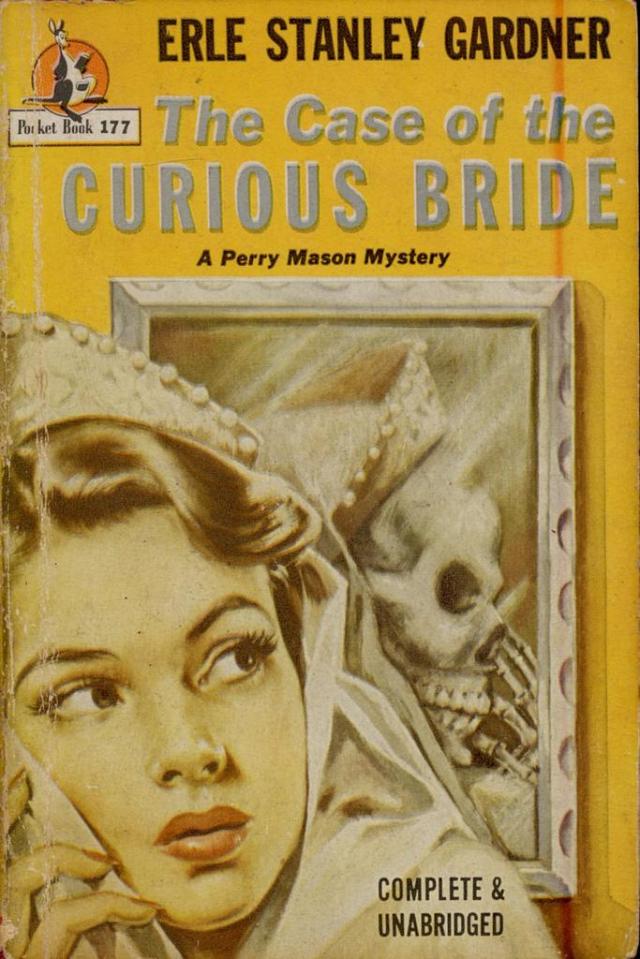
The case of the curious.., p.13
The Case of the Curious Bride,
p.13


Earlier in the day Perry Mason, working through a real estate agent, had rented the entire building. Three of the apartments had been vacant for several months. The fourth had been rented by the week, furnished, by Gregory Moxley. The march of progress had doomed the old frame building to eventual destruction. Tenants demanded more modern apartments. The owners of the building had been only too glad to accept the rental offer made by the lawyer’s representative, without inquiring too minutely as to the purpose for which the building was to be used, or the identity of the tenant.
Mason took from his pocket the four keys which had been delivered to him. Shielding the beam of a flashlight under his coat, he selected one of the keys, inserted it quietly in the lock and paused once more to listen. A car turned off the main boulevard and whined past the street intersection. Mason waited until it had reached the next corner before turning the key. The lock clicked, the door swung open and Perry Mason stepped into the darkness, pausing to close and lock the door behind him. He groped his way up the stairs upon cautious feet that kept crowding the side of the stair treads, lest they should make unnecessary noise.
The apartment that had been occupied by the murdered man covered the entire south side of the upper floor. Street lights, sending beams through the windows, furnished sufficient illumination to disclose the outlines of the furniture.
What had, at one period of the history of the house, been a front bedroom was now remodeled into a living room. Back of it, a room had been fitted as a dining room, and back of the dining room was a kitchen and a corridor. The corridor led to a bedroom in the back of the kitchen. A bathroom opened from the bedroom. Perry Mason moved quietly through the room, checking the articles of furniture against the copies of the police photographs which he carried in his hand and which he illuminated with his small flashlight. He moved to the window which looked out toward the Bellaire Apartments. That window was now closed and locked. Perry Mason made no effort to raise it. He stood by the window, staring at the dark apartment directly opposite, an apartment which was, he knew, occupied by Benjamin Crandall and wife.
Perry Mason moved back across the room, out into the corridor and entered the kitchen. Over a gas stove he found what he was looking for.
The lawyer tip-toed to the window, carefully pulled down the curtain, making certain that it was fixed in an even position at the bottom, so that no light would trickle through. He snapped on his flashlight, took from his pocket a screw-driver and a pair of pliers, a roll of adhesive tape and some wire. He picked up a chair, carried it across to a point of vantage, stood on the chair, and let the circle of illumination from his flashlight rest upon the electric bell which had been screwed into the wall. Working with painstaking caution, Perry Mason unfastened the screws, disconnected the wires, removed the bell from the wall. When he had it in his hand, he carefully studied it, then stepped down from the chair. Using the beam of the flashlight to guide him, he walked to the head of the stairs. Here he had placed a package which had been under his arm when he entered the apartment.
He untied a heavy cord, opened the package and disclosed four buzzers, similar in appearance in every way to the bell which he had taken from the wall above the gas stove. The only difference was that the one he had removed was a bell which rang by agitating a clapper between two hollow hemispheres of metal; while the others were buzzers which gave forth an explosive buzzing sound when the current went through the coils.
Mason carried one of the buzzers back to the kitchen, climbed on the chair, screwed the buzzer into position and saw that the wires were connected. Then he replaced the chair and raised the curtain. He paused to listen, picked up his package and tip-toed down the stairs. He waited for several seconds before he unlocked the door and slipped out into the cool night air.
Hearing no sound, he locked the door behind him, took another key from his pocket and opened the door of the lower apartment. This apartment exuded a smell of musty closeness—a smell that assailed the nostrils with a message of untenanted neglect. Perry Mason found the call bell in the kitchen, and replaced it with a buzzer. Then he raised the curtain and slipped silently into the night.
He next opened the door which led to the upper apartment, opposite the one in which Moxley had been killed. Working swiftly and silently, he again disconnected the call bell and installed one of the buzzers. He was on the point of leaving the apartment when the beam of his flashlight picked up the stub of a burnt match in the corridor. The match was one of those waxed paper affairs which had been torn from a pocket package. Mason slid the beam of his flashlight along the boards of the corridor, soon picked up another match stub, and then another. He followed those stubs to the back porch, where the light fuse boxes for the apartment were kept. Here was also a place for the delivery of groceries and garbage.
Mason noticed that a similar porch-like platform projected from the apartment on the south which Moxley had occupied. An agile man could easily slip across the intervening space, climb a railing and find himself in the back of Moxley’s apartment, with access through corridor and kitchen to the bedroom where Moxley was murdered.
Mason stepped across to the adjoining porch. Here he found one more match, and then, over in the corner where it apparently had been discarded, the empty container from which the matches had been torn. It was of waxed pasteboard with a flap which folded over the matches. On the back of this folder was printed a cut of a five story building, below which appeared the printed words “Compliments of the Palace Hotel, the best in Centerville.”
Perry Mason wrapped the bit of pasteboard in a handkerchief, slipped it in his pocket. He retraced his steps, left the upper apartment and made a brief visit to the remaining lower apartment. When he left the house, there was not a single electric doorbell in the building. Each one of the four apartments was equipped with buzzers.
Mason wrapped the bells carefully in the heavy, brown paper, tied up the package into a compact bundle, listened to make sure no one was about, and then stepped out from the shadows of the foyer to the sidewalk.
Chapter 12
Perry Mason flung back his shoulders and inhaled the fresh air of the morning. He consulted a small memorandum book, looked at the street numbers, paused as his eyes caught a sign on the glass window of a small storeroom. The sign read, “OTIS ELECTRIC COMPANY.” Mason pushed open the door, heard a bell ringing in the back of the store. He stood in a narrow space between counters that were loaded down with electric light globes, brackets, switches, and wires. Overhead, the ceiling was clustered with various chandeliers and indirect lighting fixtures.
A door from the rear opened. A young woman smiled ingratiatingly. “I want to see Sidney Otis,” said Perry Mason.
“You got something to sell?” she asked, the smile fading from her face.
“Tell him,” Mason said, “that Perry Mason, the lawyer, wants to see him.”
There was the sound of commotion from the back room, the noise of something being dropped to the floor. Quick steps pounded the floor. A burly figure in overalls pushed the young woman to one side and stood staring at Perry Mason, a wide grin twisting his lips away from tobacco-stained teeth. Sidney Otis weighed well over two hundred. His weight was evenly distributed. He radiated a genial booming honesty. His arms were bare to the elbow, and smeared with grease. His overalls had, very apparently, never seen the interior of a wash tub, but there was wholehearted cordiality in his welcome. “Perry Mason!” he said. “This is an honor! I didn’t think you’d remember me.”
Mason laughed. “I always remember people who sit on my juries, Otis,” he said. “How are you?” He extended his hand.
The big man hesitated for a moment, then wiped his paw up and down on the leg of his overalls, and folded his fingers about Mason’s hand. “Tickled to death, Counselor,” he said, suddenly self-conscious.
“There’s something you can do for me,” Mason told him.
“Tell me what it is and I’ll do it.” Perry Mason glanced significantly at the young woman.
The big electrician jerked his head toward the rear. “Beat it, Bertie,” he said. “I’ve got some business to talk over with Mr. Mason.”
“Aw gee, dad, I never get to …”
“You heard me,” Otis boomed, his big voice filling the shop, but his face twisted in a grin. “Beat it.”
The girl pouted, moved toward the rear of the store on reluctant feet. When the spiteful bang of the door announced that she had moved out of earshot, Otis turned an inquiring face to the lawyer.
“Where are you living now, Otis?”
The man lowered his eyes apologetically. “I used to keep an apartment upstairs,” he said, “but sledding has been tough lately. I’ve got a room where I keep the missus and the little girl, the other one stays down here with me and helps run the shop. I’ve got a bed in the back that I sleep on, and …”
“I have taken a lease on an apartment for six months,” Perry Mason said, “and it happens that I can’t live in the apartment. I’d like to have you move in.”
“In an apartment!” said Otis, the grin fading from his face. “Oh, shucks, Counselor, I couldn’t afford anything like that….”
“The rent,” Perry Mason said, “is all paid for six months. It’s rather a nice apartment.”
Otis frowned. “How come?” he asked.
“It is,” said Perry Mason, “the apartment where a man was murdered. You probably read about it in the paper. It’s Apartment B of the Colemont Apartments at 316 Norwalk Avenue. A man by the name of Carey was murdered there. That was his real name. He was going under the name of Moxley at the time of the murder.”
“Yeah, I read about it,” Otis said. “They got some woman for it, didn’t they? The wife of a wealthy guy from Chicago.”
Mason nodded. There was a moment of silence and then the lawyer went on in a low voice, “Of course, Otis, your family wouldn’t need to know that a murder had been committed there. They might recognize the place, or some of the neighbors might tell them, but by that time they’d be moved in. It’s a very comfortable little apartment. It would be a nice place for the folks. It’s on the south side of the house and catches the sunshine.”
“Gee, that’d be swell,” Otis said, “but why do that for me, Counselor?”
“Because,” Perry Mason said, “I want you to do something for me.”
“What is it?”
“When you move into the apartment,” Perry Mason said impressively, “and I’d like to have you move in today, I want you to take off the doorbell that’s in the apartment and put on one of your own.”
The electrician frowned and said, “Take off the doorbell?”
“It may be a bell, or it may be a buzzer,” Mason said. “Whichever one it is, I want you to take it off and put on another one. The doorbell that you put on must be one that you’ve taken from stock. I want it to have your price mark on it, and I want you to have at least two witnesses who see you take off the one that’s there now and put the new one on. Those two witnesses can be two members of your family if you want, but I want to be certain they see you do it, and I don’t want any one to know why you’re doing it. You can make some objection to the bell or buzzer that’s there now. Say that you don’t like the sound of it, or something of that sort.”
“You don’t want me to put on a buzzer?” asked Otis, puzzled. “If there’s a buzzer on there now, do you want me to put on a buzzer?”
“No. Put on a doorbell, and put on one that you’ve taken from stock. Be sure it’s a bell and not a buzzer.”
The electrician nodded.
“One more thing,” Mason said, “the bell or buzzer that’s on there now must be kept, and when you take it off, you can put some mark of identification on it so you’ll know it if you see it again. For instance, you can let your screw-driver slip and make a long scratch across the enamel, something that will look like an accident, and yet will furnish means of identification. Do you understand?”
Otis nodded. “I think I do,” he said. “Tell me, is it on the up and up?”
“Absolutely. I’ve paid the rent to the landlord for six months in advance. If any one should ask you how you happened to rent that apartment, you can say that you wanted an apartment where you could put your family, a place where there was some sunlight; that you didn’t want to pay a high rental; that as soon as you saw in the paper that a murder had been committed in this apartment, you knew that it could be rented cheap.
“Here’s the key to the apartment and here’s fifty dollars which will cover the expenses of moving in. It’s furnished, but there’s room for anything you’ve got.”
The big electrician made a brushing motion with his hand, pushing back the folded fifty dollar bill.
Mason insisted. “It’s a matter of business all around, Otis,” he said. “You’re doing me a favor and it gives me a chance to do you a favor.”
Otis was undecided for a moment; suddenly his forehead puckered to a frown. “Wasn’t there something in that case,” he said, “about people next door hearing a doorbell ring when the murder was being committed?”
Perry Mason stared steadily at him. “Yes,” he said.
Otis grinned, reached out and took the fifty dollars. “Thanks, Counselor,” he said, “we’ll move in today.”
Chapter 13
Paul Drake was seated in Perry Mason’s outer office chatting with Della Street when Mason pushed open the door, removed his hat and grinned greeting. The detective elevated a bony forefinger toward the morning paper which was folded under the lawyer’s arm. “Have you read it?” he asked.
Mason shook his head. “I usually buy it from the boy at the corner,” he said, “and read it before I start the daily grind. Why? Is there anything important in it?”
The detective nodded lugubriously. Della Street’s face was serious. Perry Mason looked from one to the other.
“Go ahead,” he said, “spill it.”
“The district attorney,” Drake said, “has evidently got a regular professional publicity man on the job.”
“Why?”
“Because every morning he keeps releasing something dramatic against your client.”
Mason said tonelessly, “He’ll run out of facts one of these mornings. What is it this time?”
“He’s going to exhume the body of the man who was buried under the name of Gregory Lorton. He intimated he expects to find poison. He keeps harping back to the fact that Rhoda Montaine was a nurse; that she put Ipral in her husband’s chocolate when she wanted him to sleep soundly; that if she wanted him to sleep just a little more soundly, it would have been an easy matter for her to have put in a deadly poison.”
The lines of Mason’s face became harsh. “They’re afraid they won’t be able to use the testimony of the husband in court, so they’re spreading this Ipral business all over the newspapers.
“There’s no question they’re using a deliberate campaign of adverse newspaper publicity. They’re trying to slap me in the face with the front page of a newspaper every morning.”
“Anything you can do about it?” asked Paul Drake.
Mason narrowed his lips and said, “A lot I can do about it. If he wants to give that girl a fair trial, that’s one thing. If he wants to try the case in the newspapers and try to prejudice the public against her, that’s another thing.”
“Watch your step, chief,” Della Street warned; “the district attorney may be trying to get you to do something desperate.”
Perry Mason’s slow grin held grim portent. “I’ve fought the devil with fire before this, and haven’t had my fingers burnt.”
“You’ve had your hair singed a couple of times,” Drake pointed out. “When you start pulling fast ones, you can take more chances than any one I ever knew.”
A twinkle came to the lawyer’s eyes. “Well,” he said, “I’ll promise you both something.”
“What is it?”
“You haven’t seen anything yet.”
“You mean you’re going to pull a fast one in this case?” Della Street asked, her eyes dark with concern.
“So fast,” Mason said, “that it’s going to whiz over the home plate before any one knows whether it’s a strike or a ball.”
“What good’s it going to do if the umpire can’t call it?” Drake inquired, the droll humor of his face more emphasized then ever.
“Perhaps,” said Perry Mason softly, “it’s not anything that I want called by the umpire. I may be aiming at the man who’s doing the batting. … Come on in, Paul.”
The two men seated themselves in Mason’s private office. Drake pulled a notebook from his pocket.
“Got something, Paul?”
“I think so.”
“What is it?”
“You told me to check back on Moxley and find out everything he’d been doing, as nearly as I could.”
“Yes.”
“It wasn’t easy. Moxley did time. He got out of jail broke. He needed money pretty badly. He was a lone wolf, so it’s pretty hard to tell all that he did, but I’ve got a line on something that he did, that is, I think he did it.”
“Go ahead,” the lawyer said.
“We found out Moxley put through a long distance call to Centerville. We also discovered his trunk had a label from the Palace Hotel in Centerville. We checked the records of the Palace Hotel and couldn’t find where Moxley had ever been registered there. However, there’s one peculiar thing about his record. He’d keep changing his last name, but he’d nearly always keep his first name as Gregory. He probably did that so when people called him by his first name, he didn’t have to watch his step to remember an alias. Anyhow, we went back over the records of the Palace Hotel, and found that a Gregory Freeman had been registered there for something over two months. So we took a look through the marriage licenses and found out that a man named Gregory Freeman had married a girl by the name of Doris Pender.
“We looked up the Pender woman and found that she’d been employed as a stenographer and bookkeeper in a creamery, there at Centerville. She was a steady, industrious worker and had saved up a little money that she’d put in stocks and bonds. Then she got married, gave up her job and moved away with her husband. Apparently, she didn’t have any relatives there in Centerville, although the people at the creamery thought she had a brother some place in the northern part of the state.”