The case of the curious.., p.15
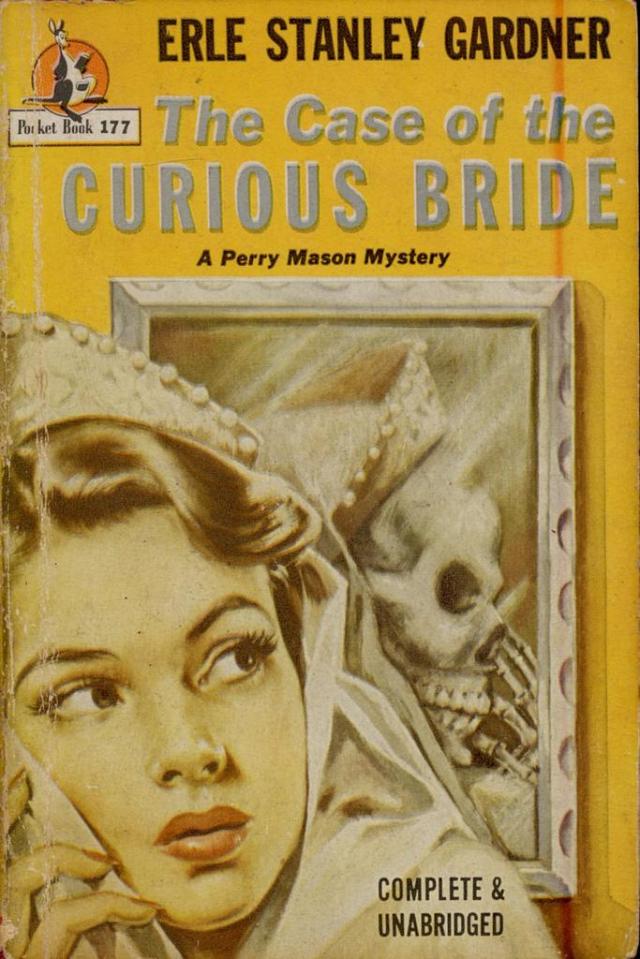
The Case of the Curious Bride,
p.15


The men piled out of the elevator, strode across the lobby and were careful not to even glance in the direction of the car, where Danny Spear sat slumped behind the wheel. They turned to the right, crossed the street, so that they would be in full view of the apartment house, and signaled a cruising cab.
Chapter 15
Back in his office, Perry Mason paced the floor, his thumbs thrust in the arm-holes of his vest. Della Street, seated at the corner of the big desk, the sliding leaf pulled out to hold her notebook, took down the words which Perry Mason flung over his shoulder as he paced up and down the room.
“… wherefore, plaintiff prays that the bonds of matrimony existing between her, the said Rhoda Montaine, and the defendant, the said Carl W. Montaine, be dissolved by an order of this court; that the said plaintiff do have and recover of and from the said defendant, and that the said defendant pay to the said plaintiff by way of alimony, and as a fair and equitable division of the property rights of the said parties herein, the sum of fifty thousand dollars, twenty thousand of which to be paid in cash, the remaining thirty thousand to be paid in monthly installments of five hundred dollars each, until the whole of the same is paid, such deferred payments to bear interest at the rate of seven percent per annum; that the said plaintiff prays for such other and further relief as to this court may seem meet and equitable. …”
“That’s all, Della. Put a blank on there for the signature of the attorney for the plaintiff and an affidavit of verification for Rhoda Montaine to sign.”
Della Street finished making pothooks across the page of the notebook, raised her eyes to Perry Mason and asked, “Is she really going to file this suit for divorce, chief?”
“She is when I get done with her.”
“That puts you in a position of fighting the annulment action, yet filing an action for divorce?” Della Street asked.
“Yes. If they got the annulment there wouldn’t be any alimony. That’s one of the things that C. Phillip Montaine is figuring. He wants to save his pocketbook. The district attorney wants Carl to testify in the murder trial.”
“And if you can beat the annulment action, he can’t testify?”
“That’s right.”
“Will he be able to testify if he gets a divorce, chief?”
“No. If they can annul the marriage Carl can give his testimony. In the eyes of the law a void marriage is no marriage at all. If there was a valid marriage, even if it was subsequently dissolved by divorce, he can’t testify against his wife without her consent.”
“But,” Della objected, “you can’t keep them from getting an annulment. The law plainly says that a subsequent marriage contracted by any person during the life of a former spouse is void from the beginning.”
“I’m glad it does,” Mason answered, grinning.
“But, when Rhoda married Carl Montaine, her former husband was still living.”
Mason resumed his savage pacing of the office. “I can lick them on that with my eyes shut,” he said. “It’s the other things that are worrying me. … Stick around, Della, and give me a chance to think. I want to think out loud. I may have something for you to write out. Is some one watching the telephone board?”
“Yes.”
“I’m expecting an important call,” Mason said, “from Danny Spear. I think we’re going to find the persons who were putting the screws on Moxley for the money.”
“Do you want to find them, chief?”
“I don’t want the district attorney to subpoena them,” he said. “I want to get them out of the country.”
“Won’t that be dangerous, compounding a felony, or something of that sort?”
He grinned at her, and the grin, in itself, was an eloquent answer. After a moment, he said softly, “And are you telling me?”
She looked worried and made aimless designs on the pages of her notebook. At length she glanced up at him, followed his pacing with anxious eyes and said, “Don’t you think it would have been better if you’d relied on self-defense?”
He whirled on her savagely. “Sure, it would,” he said. “We could have worked up a case of self-defense that would have stuck. We might not have secured an acquittal, but it’s a cinch the prosecution could never have secured a conviction. But she walked into the D. A.’s trap. She can’t claim self-defense now. She’s placed herself in front of the door, ringing the doorbell, when the murder was committed.”
Della Street pursed her lips and asked thoughtfully, “You mean she didn’t tell the police the truth?”
“Of course, she didn’t tell them the truth. They gave her a nicely baited hook, and she grabbed at it, hook, line and sinker. She doesn’t know that she’s hooked yet, because it hasn’t suited the district attorney to jerk the line and set the hook.”
“But why didn’t she tell them the truth, chief?”
“Because she couldn’t. It’s one of those cases where the truth sounds more unreasonable than any lie you can think up. That happens sometimes in a criminal case. When a person is guilty, a clever attorney makes up a story for him to tell the jury. Therefore, the defendant’s story usually sounds pretty convincing. When a defendant is innocent, the facts don’t sound nearly so plausible as they do when they’re fabricated. When a person makes up a story, the first thing he tries to bear in mind is to make up a story that’s plausible. When he relates events just as they happened, the story doesn’t sound as plausible.”
“I can’t exactly see that,” Della Street objected.
“You’ve heard the old adage,” he asked, “that truth is stranger than fiction?” She nodded.
“This is simply a concrete example of that same principle. There are millions of facts that may fall from the wheel of chance in any possible combination. Ninety-nine times out of a hundred those combinations of facts are plausible and convincing, but once out of a hundred the actual truth challenges credulity. When a defendant is caught in that kind of a trap, it’s one of the worst cases a lawyer can get hold of.”
“What are you going to do?” she asked.
“Under the circumstances,” he said, “I’m going to try to make the stories of the prosecuting witnesses sound improbable. What’s more, I’m going to try and prove an alibi.”
“But you can’t prove an alibi,” she said. “You, yourself, have just admitted that the witnesses for the prosecution will prove that Rhoda Montaine was out keeping an appointment with Gregory Moxley.”
He nodded and chuckled. “Why the chuckle?” she asked.
“I’ve thrown some bread out on the water,” he said. “I’m waiting to see what comes back.”
There was a knock at the door. One of the typists who watched the switchboard when Della Street was in Perry Mason’s private office said in a thin, frightened voice, “A man named Danny Spear just rang up. He said that he was one of Paul Drake’s detectives, and that he couldn’t wait for me to get you on the line. He said for you to come to forty-six twenty Maple Avenue just as fast as you could get there, that he’d be waiting for you in front of the entrance. He said that he’d already tried to get Paul Drake, but that Drake wasn’t in his office, and that you should come at once.”
Perry Mason jerked open the door of the coat closet, pulled out his hat, jammed it down on his head. “Did he sound as though he was in trouble?” he asked.
The girl nodded her head.
“Type out the divorce complaint, Della,” Perry Mason said as he shot through the door. He sprinted down the corridor, caught an elevator, flagged a cab at the entrance to the office building, and said, “Forty-six twenty Maple Avenue, and keep a heavy foot on the throttle.”
Danny Spear was standing at the curb as the cab pulled in to the sidewalk. “There you are, boss,” said the cab driver. “It’s the dump over there on the right—the Greenwood Hotel.”
Mason fumbled in his pocket for change. “I’ll say it’s a dump,” he said.
The cab driver grinned. “Want me to wait?”
Mason shook his head, waited until the cab had rounded the comer before he turned to Danny Spear.
Danny was a dejected and bedraggled looking individual. The collar of his shirt had been ripped open, and was now held in place with a safety pin. His necktie had been torn. His left eye was discolored, and his lower lip was puffed out and red. “What happened, Danny?” asked Perry Mason.
“I walked into something,” Danny Spear said.
Mason surveyed the battered countenance, nodded, waited for further information. Spear pulled the hat lower on his forehead, depressed the brim so that it shaded his bad eye, tilted his head forward and turned toward the Greenwood Hotel. “Let’s go in,” he said. “Barge right past the bench warmers in the lobby. I know the way.”
They pushed their way through the swinging doors. Half a dozen men were sprawled about the narrow lobby of the third-rate hotel. They stared curiously. Danny Spear led the way past the long row of chairs and thick-bellied, brass cuspidors, to a narrow, dark stairway. Over on the left was an elevator shaft screened with heavy iron wire. The cage seemed hardly as large as the average telephone booth. “We can make time using the stairs,” Danny Spear called back over his shoulder.
They reached the corridor on the second floor, and Spear led the way to a door which he flung open. The room was dark and smelly. There was a white enameled bed with a thin, lumpy mattress, a bedspread with several holes in it. A pair of socks, one of them with a large hole in the toe, had been thrown over the iron rail of the bed. A shaving brush with dried lather on it was standing on the bureau. A wrinkled necktie hung to the side of the mirror. A piece of brown paper, large enough to wrap a bundle of laundry in, lay on the floor. A laundry ticket was beside it. Half a dozen rusted safety razor blades were on the top of the scarred bureau. To the left of the bureau was a half open door which led to a closet. Chips of wood lay all over the floor. The lower part of the door had been whittled away and broken out. Danny Spear closed the door to the corridor, swept his arm about the room in an inclusive gesture. “Well,” he said, “I stepped on my tonsil.”
“What happened?” asked Perry Mason.
“You and Paul crossed over to the other corner and took the taxicab after you came out of the Balboa Apartments. I guess the jane was watching you from a window, because you hadn’t any more than rounded the comer before she came out in a rush and ran over to the curb, looking for a cab to flag. It took her three or four minutes to get a cab, and she was almost wringing her hands with impatience.
“A yellow finally pulled in to the curb for her. Evidently she never figured on being followed. She didn’t even bother to look out of the rear window as the cab pulled away. I started the crate and jogged along behind, nice and easy, not taking any chances on losing her. She came to this place and paid off the cab. She was wide open.
“When she started to go in the hotel, however, she seemed to get a little bit suspicious. It didn’t look so much as though she suspected she’d been followed, as though she was doing something she shouldn’t. She looked up and down the street, hesitated and then ducked into the hotel.
“I was afraid to crowd her too closely, and by the time I hit the lobby, she’d gone on up. The elevator was at the second floor. I figured she’d left it there. There were just the usual bunch of barflies hanging around the lobby, so I took the stairs to the second floor, went over there in the shadows by the fire escape and sat tight, watching the corridor. I guess it was ten minutes later that she opened the door of his room, stood in the corridor for a minute, pulling the old business of looking up and down, and then started for the stairs. She didn’t take the elevator.
“I marked the room, let her get a good start, and then went on down after her. She didn’t take a cab this time, and I had a little trouble picking her up. She’d rounded the corner before I found her. She was walking down to the car-line. She took a surface car that would take her to within a block of the Balboa Apartments at seven twenty-one West Ordway. So I figured it was a safe bet she was just economizing on cab fare and that I could come back and spot the bird she’d been talking with. That was where I pulled the prize bonehead play of the day.”
“Why?” asked Mason. “Did he recognize you?”
“Naw, he didn’t recognize me. I was sitting on top of the heap, if I hadn’t tried to get too smart.”
“Well, go on,” Mason prompted impatiently. “Let’s have it.”
“Well, I came back to the hotel, climbed the stairs and knocked on the door of the room. A big guy came to the door. He was in his shirt sleeves. There was a suitcase on the bed that he’d been packing. It was one of those cheap, big-bellied suitcases that the country merchandise stores feature, and it was pretty well sun-bleached, as though it had been in a show window on display or had been left out in the sun somewhere. The guy was about thirty years old, with heavy-muscled shoulders, as though he’d been pitching hay all of his life. Somehow, though, I didn’t figure him so much for a ranch hand, as for a garage mechanic. Maybe it was just a hunch, but there was grime worked into his hands, and something about the way he kept his sleeves rolled up that spelled garage to me.
“He looked pretty hostile and just a little bit scared, so I smirked at him and said, ‘When your partner comes in, tell him that I’ve got some stuff that’s way ahead of this blended caramel water the drug stores are passing out; and the price is right.’ He wanted to know what I was talking about, and I pulled the old stall about being a bootlegger who had been selling the place and I’d sold a guy who had the room two or three weeks ago, a fellow who told me he was going to be there permanently, so I figured this guy was a roommate.”
“Did he fall for it?” asked Perry Mason.
“I think he was falling for it, all right,” Spear said, “but all the time I was sizing him up, and I saw that he had the same peculiar eyes, the same long, cat-fish mouth that the woman had I’d trailed over there. I’d got a good look at her when she paid off the cab driver. There couldn’t be any mistaking that long upper lip and those eyes.”
“You figure this guy was her brother?” Mason asked.
“Sure he was her brother, and I figured I was going to pull a fast one. I remember that her name had been Pender and that she came from Centerville. I could see that this bird wasn’t going to do anything except listen to me sing my song and then slam the door in my face. I figured that if I could pull a good line on him, he’d take me into his confidence and loosen up. It was just one of those hunches that go across like a million dollars when they go across, and get you patted on the back as being a smart guy; and when they don’t go across, they look like hell and get you fired. I didn’t have time to think it over. I just played the hunch. I let my face light up with recognition and said, ‘Why, say, don’t you come from Centerville?’
“He looked at me sort of strange and gulped a couple of times and said, ‘Who are you?’, and I got a grin all over my face and said, ‘Now I place you. Hell’s bells, your name’s Pender!’, and with that I stuck out my hand.”
“What did he do?”
“There,” said Danny Spear, “is where he fooled me. There’s where he slipped one over on me.”
“Go ahead,” Mason said.
“I played him for a hick,” Spear remarked ruefully, “and what a dumb boob I was! I was watching him like a hawk to see how he’d take it. For a moment, he was flabbergasted as though I’d knocked him off of the Christmas tree, and then all of a sudden his face lit up into a smile, and he started pumping my hand up and down, and said, ‘Sure, buddy, I remember you now. Come in.’
“Well, he kept hold of my right hand with his right hand and pulled me in the door. He was grinning like Santa Claus on Christmas Eve. He kicked the door shut with his left foot, pumped my hand up and down two or three times, said, ‘How are all the folks back home?’ and crossed his left over to my eye with a sock that damn near put me out. He let got of my right hand then, and smacked me one in the kisser that smashed me back up against the closet door. I bounced back just in time to connect with one in the solar plexus that took all the joy out of life. I remember something coming up and smacking me in the face, and realized it was the dirty carpet.”
“What did he do?” asked Perry Mason.
“Tore a pillowslip into pieces, stuck some rags down my mouth, tied my hands and feet, opened the closet door and stuffed me inside.”
“Were you out?”
“Not clean out, but groggy. Don’t make any mistake, whether I’d been out or not, there was no percentage in fighting that boy. He handled his fists just like the girl in your office handles the keys on the switchboard. Why, say, he juggled me around in the air like a Jap juggler tossing billiard balls.”
“Go on,” Mason said.
“After I was in the closet, he put on an act,” Danny Spear went on ruefully, “and I’m damned whether I know if it was an act or not. Of course, when I saw what I was up against, I played ‘possum and went limp as though I was out for keeps. I figured I might be able to twist my wrists a little and get some slack on the tie, so I pulled a dead flop. He tossed me in the closet as though I’d been a sack of grain he was putting in the barn. He closed the door and twisted the bolt—and, brother, let me tell you there’s a strong bolt. It freezes that door into a wall as solid as a rock.”
“What was the act he put on?” Mason asked curiously.
“Well, he went ahead with the packing up, and, believe me, he was in a hurry. He slammed open drawers and banged things into the suitcase and ran back and forth between the bed and the bureau like a rooster on a hot stove. About every two minutes he’d stop and call Garvanza three-nine-four-aught-one. He’d hold the phone for a minute or two and there wouldn’t be any answer.”
“That’s the number of the Balboa Apartments,” Mason said.
Danny Spear said, “I know it. He kept calling that number and asking for Miss Freeman.”
“There was an answer then?”
“Yeah. Somebody answered at the other end all right, and he’d asked for Miss Freeman and wait awhile and then hang up. The closet door was pretty thin. I could hear every move he made and every word he said.